The single most expensive component in any electric vehicle is its high-voltage traction battery. Depending on the model, the battery pack represents 30–40% of the vehicle's total manufacturing cost and determines everything from driving range to charging speed to long-term resale value. Yet most EV shoppers evaluate batteries by a single number — total kWh — while ignoring the chemistry inside the cells.
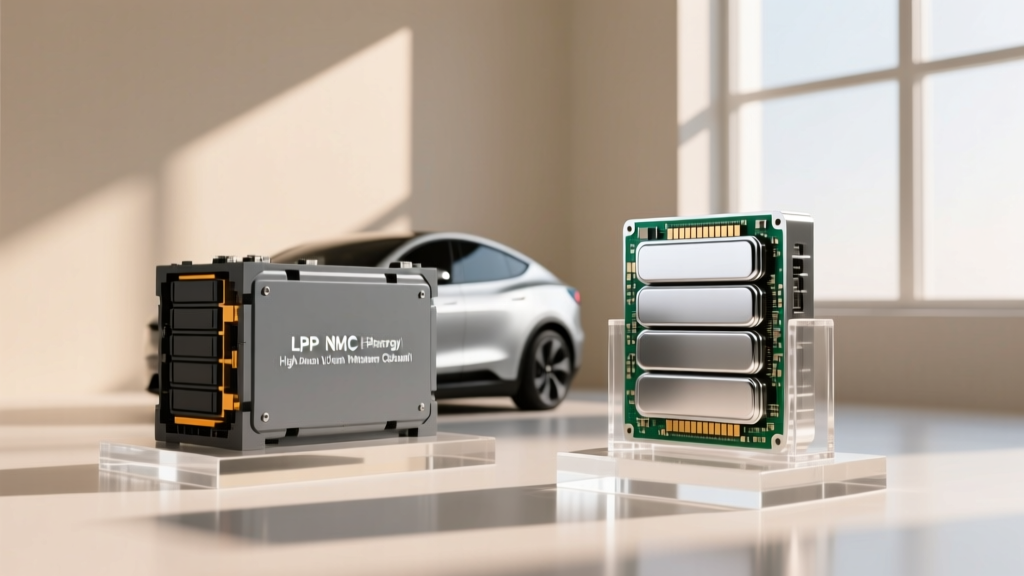
As of 2026, two dominant lithium-ion chemistries power the vast majority of EVs sold in the United States: LFP (lithium iron phosphate, also written LiFePO₄) and NMC/NCA (nickel manganese cobalt / nickel cobalt aluminum). Each has distinct trade-offs in energy density, cycle life, cold-weather performance, and cost. Choosing the right one for your driving pattern is one of the most consequential decisions in an EV purchase.
This guide breaks down the data behind each chemistry, examines real-world degradation curves, explains what battery warranties actually cover, and looks at the emerging technologies — solid-state and silicon-anode cells — that will reshape the landscape later this decade.
LFP vs NMC/NCA: The Chemistry Comparison That Matters
Before diving into degradation and cost, you need to understand what makes these two chemistries fundamentally different. Both are lithium-ion, but the cathode material — the positive electrode where lithium ions are stored during discharge — defines their behavior.
NMC (Nickel Manganese Cobalt) and its close cousin NCA (Nickel Cobalt Aluminum) prioritize energy density. They pack more kWh into a smaller, lighter volume, which translates directly to longer EPA-rated range per kilogram of battery weight. Tesla, Hyundai, BMW, Rivian, and most legacy automakers have historically relied on NMC or NCA packs for their long-range and performance trims.
LFP (Lithium Iron Phosphate) sacrifices some energy density for durability and cost. LFP cells contain no nickel or cobalt — two expensive, supply-chain-sensitive metals — making them cheaper to produce. They also tolerate deeper daily cycling and higher charge states with less degradation, which is why manufacturers like Tesla (Model 3/Y Standard Range), BYD, and Ford (select trims) recommend charging LFP packs to 100% regularly.
| Attribute | LFP (Lithium Iron Phosphate) | NMC / NCA (Nickel-based) |
|---|---|---|
| Energy density (cell-level) | 160–200 Wh/kg | 220–300 Wh/kg |
| Typical cycle life | 3,000–6,000+ cycles | 1,000–2,500 cycles |
| Calendar life expectancy | 15–20+ years | 10–15 years |
| Cold-weather performance | Moderate (slower charging below 32°F) | Better (more tolerant of sub-freezing temps) |
| Cost per kWh (cell-level, 2026) | ~$70–$90 | ~$100–$130 |
| Daily charge recommendation | Up to 100% SoC | 80% SoC for daily; 100% for trips |
| Thermal stability | Excellent (higher runaway threshold) | Good (requires more active cooling) |
| Critical mineral dependence | Iron, phosphate — abundant | Nickel, cobalt — supply-constrained |
| Common in these 2026 models | Tesla Model 3 RWD, BYD Seal, Ford Mustang Mach-E Select (LFP option) | Tesla Model Y LR, Hyundai Ioniq 5/6, BMW iX, Rivian R1T/R1S |
The bottom line: NMC/NCA is the better choice if you need maximum range from a single charge and frequently drive in cold climates. LFP is the better choice if you want a battery that will likely outlast the vehicle, plan to keep your EV for 10+ years, and mostly charge at home where you can top to 100% without guilt.
How Long Do EV Batteries Actually Last?
The short answer: far longer than most buyers assume. Data from fleet operators, telematics companies, and automaker warranty claims consistently show that modern EV batteries lose roughly 10–15% of their original capacity over 150,000–200,000 miles under normal use. That means a vehicle with a 300-mile EPA range when new would still deliver approximately 255–270 miles at 200,000 miles — still very usable.
Real-world degradation data points from major sources:
- Tesla 2025 Impact Report: Model 3/Y vehicles show approximately 12% average capacity loss at 150,000 miles, with the curve flattening significantly after the initial 20,000-mile break-in period.
- Geotab fleet data (2024 study of 10,000+ EVs): Average annual degradation across all chemistries was 1.8% per year, with LFP-equipped vehicles averaging 1.2% per year vs. 2.1% for NMC/NCA.
- Recurrent Auto battery reports: Chevrolet Bolt EV owners (NMC, 60–65 kWh packs) showed median 8% loss at 100,000 miles. Nissan Leaf (passive air-cooled NMC) showed higher loss at ~14% over the same distance — underscoring how thermal management matters as much as chemistry.
Two distinct mechanisms drive battery degradation:
Cycle degradation occurs each time you charge and discharge the battery. A "cycle" is one full 0–100% equivalent — two 50% discharges count as one cycle. LFP chemistries handle far more cycles before hitting 80% capacity retention, which is why they're preferred for applications where the battery is cycled daily.
Calendar degradation happens regardless of use, driven by chemical reactions inside the cell that slowly reduce the amount of active lithium. Higher average State of Charge (SoC), higher ambient temperatures, and time all accelerate calendar aging. This is why storing an NMC battery at 100% SoC in a hot garage for weeks is one of the worst things you can do for its longevity.
What Does the EV Battery Warranty Actually Cover?
Federal law mandates a minimum battery warranty of 8 years / 100,000 miles for all EVs sold in the United States. Several states that follow California's CARB standards (including New York, Massachusetts, and Washington) extend this to 10 years / 150,000 miles. Most automakers meet or exceed the federal floor, and some go further.
The critical detail is the capacity retention threshold: the warranty guarantees the battery will retain at least a specified percentage of its original usable capacity. That threshold is typically 70%, though some manufacturers set it at 65% or 75%.
| Manufacturer | Warranty Duration | Capacity Threshold | Chemistry |
|---|---|---|---|
| Tesla (Model 3/Y RWD — LFP) | 8 yr / 120,000 mi | 70% | LFP |
| Tesla (Model Y LR/AWD — NMC) | 8 yr / 120,000 mi | 70% | NMC |
| Hyundai / Kia (Ioniq 5/6, EV6) | 10 yr / 100,000 mi | 70% | NMC |
| Ford (Mach-E, F-150 Lightning) | 8 yr / 100,000 mi | 70% | NMC / LFP (trim-dependent) |
| BMW (i4, iX, i7) | 8 yr / 100,000 mi | 70% | NMC |
| Rivian (R1T, R1S) | 8 yr / 175,000 mi | 70% | NMC |
| BYD (Seal, Atto 3 — US availability limited) | 8 yr / 100,000 mi | 70% | LFP (Blade) |
What triggers a warranty claim? If your battery's State of Health (SoH) drops below the threshold within the warranty period, the manufacturer must repair or replace the pack — or individual modules, if the pack design allows it — at no cost to you. In practice, most claims involve module-level replacement rather than a full pack swap, which is faster and less costly for the automaker.
Warranties typically do not cover damage from collisions, flooding, improper charging equipment, or modifications to the high-voltage system. Read your owner's manual's warranty section carefully.
How Much Does an EV Battery Replacement Cost?
This is the question that generates the most anxiety — and the most misinformation. Let's ground it in data.
As of 2026, a full battery pack replacement (parts and labor) at a dealership or authorized service center typically costs between $8,000 and $22,000, depending on pack size and vehicle. However, the critical context is that most EV batteries never need replacement during the vehicle's normal lifespan. The data from warranty providers and fleet operators shows that fewer than 2–3% of EV batteries require out-of-warranty replacement, and the vast majority of those that do are covered under the 8–10 year warranty.
| Vehicle | Battery Capacity | Chemistry | Estimated Replacement Cost |
|---|---|---|---|
| Tesla Model 3 RWD | ~60 kWh | LFP | $8,000–$12,000 |
| Tesla Model Y Long Range | ~75–82 kWh | NMC | $12,000–$16,000 |
| Hyundai Ioniq 5 | 77.4 kWh | NMC | $11,000–$15,000 |
| Ford F-150 Lightning (Extended Range) | ~131 kWh | NMC | $18,000–$22,000 |
| Chevrolet Equinox EV | ~85 kWh | NMC | $10,000–$14,000 |
| BMW iX xDrive50 | ~105 kWh (usable) | NMC | $16,000–$20,000 |
Two trends are working in owners' favor. First, cell-level pricing has dropped from over $200/kWh in 2018 to roughly $80–$130/kWh in 2026 (source: BloombergNEF battery price surveys), so replacement packs are becoming cheaper over time, not more expensive. Second, the growing availability of module-level repairs — where only the degraded or failed modules within a pack are replaced — can reduce costs to $2,000–$5,000 for vehicles with modular pack designs.
Independent EV repair shops are also emerging as a lower-cost alternative to dealer service for out-of-warranty battery work, though availability varies by region.
Factors That Accelerate (or Preserve) Battery Life
Battery longevity is not purely a function of chemistry and time — your habits matter significantly. Here are the factors that research and fleet data consistently identify as most impactful:
Maximize Battery Health — Owner Checklist
- Avoid sustained 100% SoC (NMC/NCA only): For nickel-based chemistries, set your daily charge limit to 80%. Reserve 100% for road trips. LFP owners can charge to 100% daily — in fact, periodic 100% charges help the battery management system (BMS) recalibrate.
- Minimize DC fast charging frequency: Occasional DC fast charging is fine. But daily use of 150+ kW DC fast chargers accelerates degradation by generating sustained high temperatures inside the cells. A Recurrent study found that vehicles fast-charging more than 3 times per week showed ~0.5% additional annual loss compared to those primarily using Level 2.
- Precondition before fast charging: Most modern EVs precondition the battery when you navigate to a DC fast charger, warming or cooling it to the optimal temperature window (roughly 85–105°F). If your EV doesn't auto-precondition, do a few minutes of moderate driving before arriving at the charger.
- Avoid extreme SoC in extreme heat: Parking an NMC vehicle at 100% SoC in 100°F+ ambient heat for days is the single worst combination for calendar degradation. If storing the vehicle, aim for 50–60% SoC in a shaded or climate-controlled space.
- Use Level 2 home charging as your primary method: A 7–11 kW Level 2 charger adds roughly 25–44 miles of range per hour and generates far less heat than DC fast charging. For daily driving needs of 30–50 miles, overnight Level 2 charging is ideal.
- Don't baby the battery too much: Modern BMS systems are sophisticated. They maintain buffer zones (typically 5–10% at the top and bottom of the pack that you can't access) to protect against over-charge and deep-discharge damage. Drive your EV normally — the engineering is robust.
How to Check Your EV Battery's State of Health
State of Health (SoH) is expressed as a percentage: 100% SoH means the battery holds its original rated capacity; 90% means it holds 90% of the original. Monitoring SoH lets you track degradation over time and anticipate any warranty claims.
Built-in vehicle tools: Several 2026 models now include a battery health indicator in the infotainment system. Hyundai/Kia EVs display an SoH percentage in the EV settings menu. Tesla provides a rated-range figure that effectively serves as a proxy — comparing your current rated range at 100% to the original EPA figure gives a reasonable SoH estimate. Some BMW iX and i4 models show SoH directly in the iDrive system.
OBD-II diagnostic apps: For vehicles without a built-in SoH readout, an OBD-II dongle paired with apps like EV Health, Leaf Spy (Nissan Leaf), or TeslaFi can read the battery management system's internal SoH estimate. These tools access the same data the dealer sees, typically within ±1–2% accuracy.
Third-party battery reports: Services like Recurrent and AVILOO offer battery health certificates based on real driving data, which are increasingly used in the used-EV market to validate remaining capacity. If you're buying a used EV, requesting a battery health report is as important as checking a CarFax.
Emerging Battery Technologies: Solid-State and Silicon Anode
If you follow EV news, you've seen headlines about solid-state batteries promising 500+ mile ranges and 10-minute charging. Here's a realistic, hype-free assessment of where these technologies stand in 2026:
Solid-state batteries replace the liquid electrolyte in current lithium-ion cells with a solid material (ceramic, sulfide, or polymer). The theoretical benefits are significant: higher energy density (potentially 400–500 Wh/kg at the cell level), faster charging without lithium plating risk, and improved safety due to the non-flammable electrolyte.
However, manufacturing scale remains the barrier. Toyota has announced solid-state battery production for a limited-run vehicle expected around 2027–2028, and Samsung SDI is targeting mass production by 2027. These timelines have slipped before. Realistic expectation: solid-state packs will appear in low-volume, premium vehicles first, with mainstream availability not expected before 2029–2031.
Silicon-anode technology is closer to reality. Companies like Sila Nanotechnologies and Group14 are replacing the graphite anode with silicon-dominant composites, increasing energy density by 20–40% without requiring entirely new manufacturing infrastructure. Mercedes-Benz has partnered with Sila for the upcoming G-Class electric, and several 2026–2027 model-year EVs are expected to incorporate partial silicon-anode cells. This is an incremental but meaningful improvement, not a revolution.
Sodium-ion batteries are also entering the conversation for lower-cost, shorter-range EVs. CATL has begun shipping sodium-ion packs in Chinese-market vehicles, with energy densities around 140–160 Wh/kg — lower than LFP, but using abundant, inexpensive materials. US-market availability is likely 2027+ and would initially target fleet and budget segments.
For buyers shopping today: don't wait for solid-state. Current LFP and NMC chemistries are mature, well-warrantied, and backed by extensive real-world data. The next chemistry revolution will take years to reach mainstream price points.
Which Battery Chemistry Should You Choose?
There is no universally "best" battery chemistry — the right answer depends on your ownership plan and driving pattern. Use this decision framework:
Choose LFP if:
- You plan to keep the vehicle 8+ years and want maximum cycle life
- You charge primarily at home and can top to 100% regularly
- You live in a mild climate (rarely below 20°F for extended periods)
- You want lower upfront cost and less concern about daily charging habits
- Your daily driving needs fit within the slightly lower range that LFP's energy density provides
Choose NMC/NCA if:
- You need maximum EPA-rated range (300+ miles) for frequent road trips
- You regularly drive in cold climates where NMC's better low-temperature performance matters
- You need the fastest DC fast-charging speeds (NMC generally sustains higher charge rates)
- You're buying a larger vehicle (truck, large SUV) where pack weight and volume are critical
- You're comfortable following an 80% daily charge limit for optimal longevity
Frequently Asked Questions
How long do EV batteries last in years and miles?
Based on fleet data and warranty claims, most modern EV batteries retain 85–90% of their original capacity at 150,000 miles and 80–85% at 200,000 miles. In years, that translates to a functional lifespan of 15–20 years for most owners. LFP chemistries typically outlast NMC/NCA by a significant margin in cycle life, though both are engineered to outlive the vehicle's expected service life.
How much does an EV battery cost to replace?
Full pack replacements range from approximately $8,000 for a ~60 kWh LFP pack (e.g., Tesla Model 3 RWD) to $22,000 for a ~131 kWh NMC pack (e.g., Ford F-150 Lightning Extended Range). However, fewer than 3% of EV batteries require out-of-warranty replacement, and most are covered under the federally mandated 8-year/100,000-mile warranty. Module-level repairs can reduce costs to $2,000–$5,000 when applicable.
What does the EV battery warranty cover?
The warranty guarantees that the battery will retain at least 70% (in most cases) of its original usable capacity for 8 years or 100,000 miles, whichever comes first. In CARB states, the minimum extends to 10 years / 150,000 miles. If the battery falls below the threshold, the manufacturer repairs or replaces it at no cost. Warranties do not cover collision damage, flooding, or unauthorized modifications.
How do I check my EV battery's State of Health?
Many 2026 EVs display SoH directly in the vehicle's infotainment system. For those that don't, an OBD-II dongle paired with apps like TeslaFi, Leaf Spy, or EV Health can read the BMS-reported SoH. Third-party services like Recurrent and AVILOO also generate battery health certificates based on driving data, which are valuable when buying or selling a used EV.
Is LFP better than NMC, or vice versa?
Neither is universally better. LFP offers longer cycle life (3,000–6,000+ cycles vs. 1,000–2,500), lower cost (~$70–$90/kWh vs. ~$100–$130/kWh), and the convenience of daily 100% charging. NMC offers higher energy density (220–300 Wh/kg vs. 160–200 Wh/kg), better cold-weather performance, and faster sustained DC charging speeds. Choose LFP for longevity and value; choose NMC for maximum range and cold-climate capability.
Does frequent DC fast charging damage my battery?
Occasional DC fast charging is not harmful. However, data from Recurrent shows that vehicles relying on DC fast charging more than 3 times per week exhibit slightly higher degradation rates — roughly 0.5% additional annual loss — due to sustained high cell temperatures. For daily charging, a home Level 2 charger (7–11 kW) is gentler on the battery and more convenient.
Will solid-state batteries make current EVs obsolete?
Not in the near term. Solid-state batteries are expected to reach limited production in premium vehicles around 2027–2028, with mainstream availability not before 2029–2031. Current LFP and NMC chemistries are mature, reliable, and backed by extensive warranty coverage. Waiting for solid-state means delaying an EV purchase by at least 3–5 years for technology that will initially carry a significant price premium.
Understanding battery chemistry is one of the highest-leverage things you can do as an EV buyer. The choice between LFP and NMC/NCA affects your daily charging routine, your long-term ownership costs, and how the vehicle will perform in the climate where you live. Use the data above — not marketing claims — to make your decision.