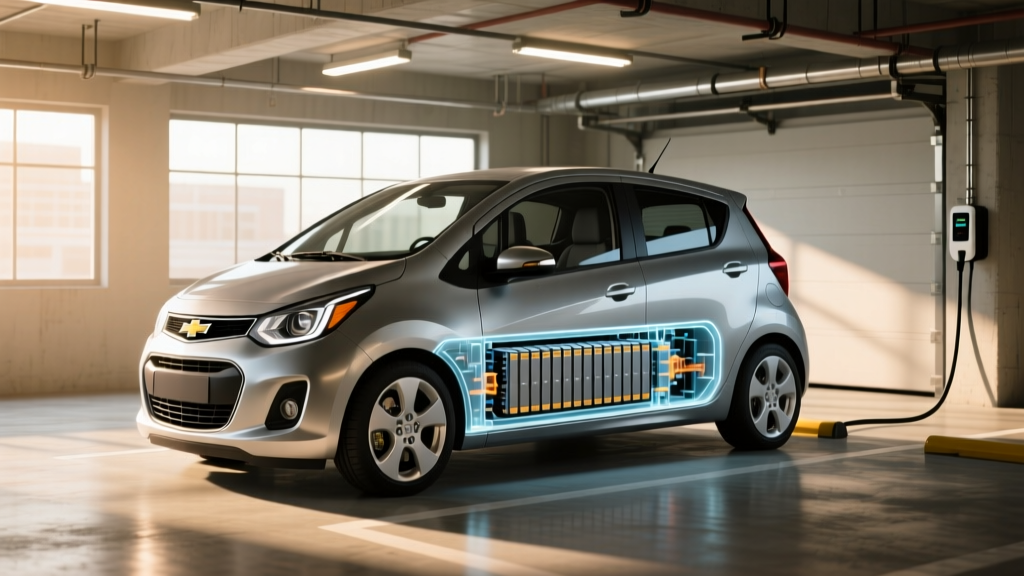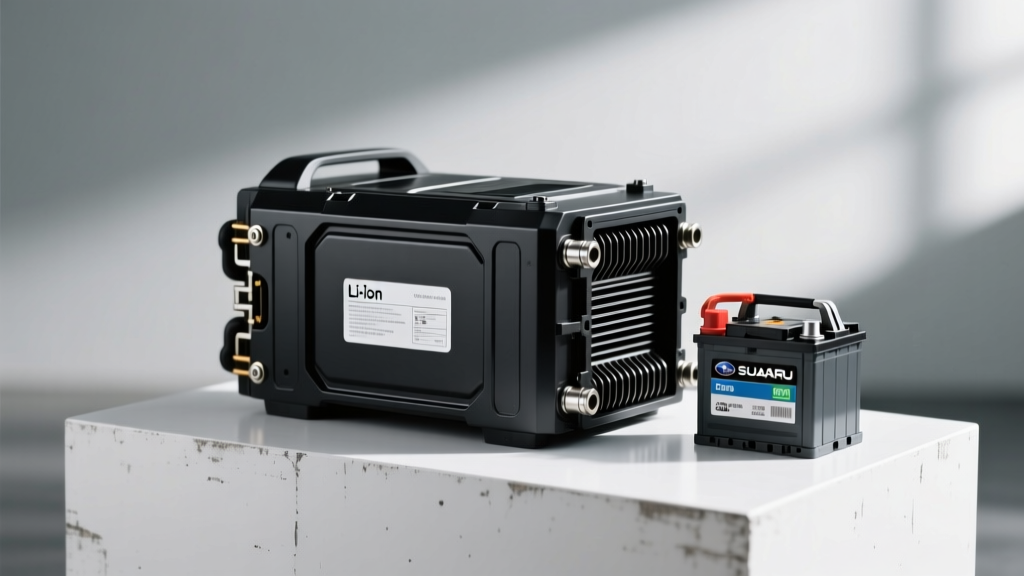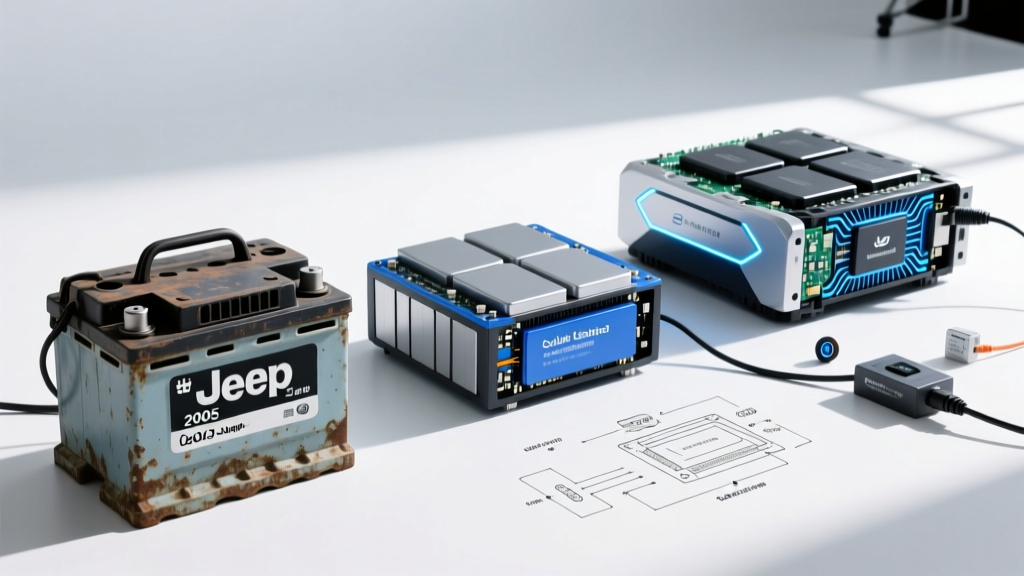
If you've ever replaced the 12V battery in a 2005 Jeep Cherokee, you know the drill: a Group 34 or 75 lead-acid unit, roughly 700 cold-cranking amps, around $130–$180 at an auto parts store, and a lifespan of 3–5 years before it struggles on a cold morning. That battery's only job is to crank a 4.0L inline-six and run the radio when the engine is off. Modern electric vehicles carry a fundamentally different energy storage system: a high-voltage traction battery measured in kilowatt-hours (kWh) — the unit of energy capacity, not to be confused with kilowatts (kW), which measure power delivery or charging rate.
This guide bridges that gap. Whether you're coming from a legacy vehicle like the 2005 Jeep Cherokee (Liberty in some markets) or shopping your first BEV, understanding EV battery chemistry, degradation, warranties, and replacement economics is essential before you sign a purchase agreement.
LFP vs NMC: Which Chemistry Should You Choose?
Two lithium-ion chemistries dominate the 2026 EV market: LFP (lithium iron phosphate) and NMC (nickel manganese cobalt), with NCA (nickel cobalt aluminum) appearing in some Tesla and Panasonic cells. The chemistry inside your pack determines energy density, cycle life, thermal stability, and cost.
| Attribute | LFP (LiFePO₄) | NMC / NCA |
|---|---|---|
| Energy Density | ~160–180 Wh/kg (lower) | ~220–300 Wh/kg (higher) |
| Cycle Life | 3,000–5,000+ cycles | 1,000–2,500 cycles |
| Cold Performance | Reduced; slower charge below 32°F | Better low-temp performance |
| Thermal Stability | Excellent; higher runaway threshold | Good; requires active thermal management |
| Cost per kWh | Lower (~$80–100/kWh at pack level) | Higher (~$110–140/kWh at pack level) |
| Typical Use | Standard-range models (Tesla Model 3 RWD, base Ford Mustang Mach-E) | Long-range and performance trims |
| SoC Recommendation | Can charge to 100% daily | Best kept 20–80% for daily use |
The trade-off is straightforward: LFP offers longer cycle life, lower cost, and the ability to charge to 100% without accelerated degradation, but at the expense of range per pound. NMC packs more energy into a smaller, lighter package — critical for long-range models — but is more sensitive to sustained high SoC and extreme heat. According to IEA's Global EV Outlook, LFP market share surpassed 40% globally by 2025, driven by cost-sensitive segments and Chinese OEM adoption.
How Long Do EV Batteries Actually Last?
The short answer: most EV traction batteries outlast the vehicle they're installed in. Data from fleet operators and long-term owners consistently shows that modern lithium-ion packs retain 85–92% of their original capacity after 100,000 miles and 5–7 years of typical use.
Real-World Degradation Data Points:
- Tesla Model 3/Y (NMC, 2019–2023): ~88–91% capacity retained at 100,000 miles, per Tesla's 2024 Impact Report and aggregated fleet data.
- Nissan Leaf (early air-cooled packs, 2011–2017): ~75–82% retained at 100,000 miles — a cautionary tale about thermal management.
- Chevrolet Bolt EV/EUV (NMC, liquid-cooled): ~90–93% retained at 80,000 miles based on owner forums and Recurrent Auto data.
- LFP-equipped Tesla Model 3 RWD (2022+): ~93–96% retained at 60,000 miles; LFP's slower degradation curve is well-documented.
Degradation is not linear. Most packs experience a steeper drop in the first 10,000–20,000 miles (2–4% loss as the solid-electrolyte interphase layer stabilizes), then settle into a slow, nearly flat decline of roughly 1–2% per year thereafter. By comparison, the 12V lead-acid battery in that 2005 Jeep Cherokee was functionally dead within 4–5 years — the EV traction battery is engineered for a 15–20 year service life under normal conditions.
Battery Warranty: What's Covered and for How Long?
Federal law mandates a minimum 8-year / 100,000-mile warranty on EV battery packs for emissions-related compliance, and most manufacturers meet or exceed this baseline. The warranty typically guarantees that the battery will retain a specified percentage of its original capacity — most commonly 70% — over the warranty period.
| Manufacturer | Warranty Period | Capacity Threshold | Notes |
|---|---|---|---|
| Tesla (Model 3/Y) | 8 yr / 120,000 mi (LR/AWD); 8 yr / 100,000 mi (RWD) | 70% | Includes module-level replacement |
| Hyundai / Kia (EVs) | 10 yr / 100,000 mi | 70% | Among the longest coverage in the industry |
| Ford (Mustang Mach-E, F-150 Lightning) | 8 yr / 100,000 mi | 70% | Covers battery and HV components |
| GM (Ultium-based EVs) | 8 yr / 100,000 mi | 70% | Modular pack design aids partial replacement |
| Rivian | 8 yr / 175,000 mi | 70% | Higher mileage cap reflects truck use case |
The warranty covers defects and abnormal degradation — meaning if your pack falls below the threshold under normal use, the manufacturer will repair or replace it (often at the module level, not the full pack). It does not cover damage from accidents, flooding, or unauthorized modifications. For full terms, always check the manufacturer's warranty booklet and the EPA's EV technology overview for context on federal requirements.
How Much Does an EV Battery Replacement Cost?
This is the question that generates the most anxiety — and the most misinformation. Here are the real numbers for 2026:
| Vehicle / Pack Size | Full Pack Cost (Parts + Labor) | Module-Level Repair | Typical Replacement Timeline |
|---|---|---|---|
| Tesla Model 3 RWD (~57 kWh LFP) | $8,000–$12,000 | $2,500–$4,500 | Rarely needed before 200,000+ mi |
| Tesla Model Y LR (~81 kWh NMC) | $12,000–$16,000 | $3,500–$6,000 | Rarely needed before 200,000+ mi |
| Ford F-150 Lightning Ext. Range (~131 kWh) | $18,000–$25,000 | $4,000–$8,000 | Rarely needed before 150,000+ mi |
| Hyundai Ioniq 5 (~77 kWh NMC) | $10,000–$15,000 | $3,000–$5,500 | Rarely needed before 200,000+ mi |
| Chevrolet Bolt EV (~65 kWh NMC) | $9,000–$14,000 (post-recall) | $3,000–$5,000 | Post-recall packs show improved longevity |
Context matters enormously here. A full pack replacement at $15,000 sounds alarming until you consider that (a) it's almost never needed within the warranty period, (b) module-level repairs are increasingly common and far cheaper, and (c) pack costs have fallen roughly 90% since 2010 on a per-kWh basis. For perspective, a complete engine and transmission replacement on a used 2005 Jeep Cherokee could easily run $4,000–$7,000 — and unlike an EV battery, the ICE powertrain has hundreds of moving parts that wear mechanically.
The IRS §30D clean vehicle credit can offset up to $7,500 on qualifying new EVs, which meaningfully reduces the upfront cost gap that battery replacement fears often inflate in buyers' minds. Eligibility depends on MSRP caps ($55,000 for sedans, $80,000 for SUVs/trucks), buyer income limits ($150K single / $300K joint), and battery component/critical mineral sourcing rules — always verify current-year rules with a tax professional.
Factors That Accelerate (or Preserve) Battery Life
Your habits directly influence how quickly your pack degrades. Here's what the data shows:
Practices That Maximize Battery Longevity:
- Daily SoC limits: Charge NMC packs to 80% for daily use; reserve 100% for road trips. LFP packs can be charged to 100% regularly — Tesla recommends this for LFP calibration.
- Minimize DC fast charging: Occasional Supercharger/EA stops are fine, but daily 150+ kW fast charging adds thermal stress. A study by Recurrent Auto found that vehicles fast-charging 3+ times per week showed ~1–2% additional degradation over 3 years vs. primarily Level 2 charging.
- Thermal management: Park in shade or a garage when possible. Sustained battery temps above 95°F accelerate calendar degradation. Preconditioning your battery before fast charging (most EVs do this automatically when a charger is navigated to) reduces thermal shock.
- Avoid deep discharge: Don't regularly drain below 10–15%. Lithium-ion cells experience more stress at the extremes of their SoC window.
- Storage: If leaving the vehicle for weeks, store at ~50% SoC in a cool environment. Never store at 100% or near 0%.
Cold weather reduces range (typically 20–30% loss at 20°F due to increased internal resistance and cabin heating demand), but it does not permanently damage the battery. The thermal management system protects the cells. The real degradation risk is sustained high heat, not cold.
How to Check Your Battery's State of Health (SoH)
State of Health (SoH) is the percentage of your battery's original usable capacity that remains. A new pack starts at 100% SoH; at 70% SoH, you'd see noticeably reduced range.
Built-in tools: Some EVs display SoH directly. The Nissan Leaf's "battery health bars" (visible on the dash) are a well-known example. Tesla owners can access detailed battery data through the service menu or third-party apps like Tessie or Stats.
OBD-II scanners and apps: Devices like the OBDLink MX+ paired with apps such as EV Dash or Car Scanner can read the battery management system (BMS) and report estimated SoH, cell voltage variance, and pack temperature.
Dealer diagnostics: Most manufacturers can run a full pack health report during service visits. Hyundai, for example, provides a detailed SoH printout on request.
Range tracking: The simplest method — track your real-world range over time at a consistent SoC. If your 80% charge used to yield 220 miles and now yields 200, you're seeing roughly 9% degradation. Keep in mind that temperature, tire pressure, and driving style all affect range independently of SoH.
Emerging Battery Tech: What's Next and When?
Several next-generation technologies are in development, but timelines matter — none of these are available in production vehicles as of 2026:
- Solid-state batteries: Replace the liquid electrolyte with a solid material, promising higher energy density (potentially 400+ Wh/kg) and improved safety. Toyota has announced a solid-state EV targeting 2027–2028, but production volumes will be extremely limited initially. QuantumScape and Samsung SDI are also advancing prototypes. Realistic mass-market availability: 2029–2032.
- Silicon-dominant anodes: Replacing graphite anodes with silicon can boost energy density by 20–40%. Sila Nanotechnologies and Group14 are supplying early production cells. Expect limited adoption in premium models by 2027–2028.
- Sodium-ion batteries: Lower cost and no lithium dependency, but significantly lower energy density (~120–150 Wh/kg). CATL has begun production for Chinese-market city EVs. US availability: uncertain, likely 2028+ for budget segments.
These technologies are promising but remain forward-looking. For buyers shopping today, current-generation LFP and NMC packs offer proven, data-backed longevity that already exceeds most ownership horizons.
Frequently Asked Questions
How long do EV batteries last in years and miles?
Most modern EV batteries are engineered for 15–20 years and 200,000+ miles of service before reaching the 70% capacity threshold that triggers a warranty claim. Fleet data from Tesla, Rivian, and Chevrolet Bolt owners supports this timeline, with many packs retaining 85–90%+ capacity at 100,000 miles.
How much does an EV battery cost to replace?
Full pack replacements range from $8,000 to $25,000 depending on pack size and vehicle, but full replacements are rare. Module-level repairs typically cost $2,500–$8,000. Most owners never need either within the 8-year/100,000-mile warranty window.
What does the battery warranty cover?
EV battery warranties typically cover defects and capacity loss below 70% of original capacity over 8 years / 100,000 miles (or longer for brands like Hyundai/Kia at 10 years and Rivian at 175,000 miles). They do not cover accident damage, misuse, or unauthorized modifications.
How do I check and maximize my battery's health?
Monitor SoH through your vehicle's built-in display, OBD-II diagnostic apps, or dealer service reports. Maximize longevity by keeping NMC packs between 20–80% SoC for daily use, minimizing frequent DC fast charging, avoiding deep discharges, preconditioning before fast charges, and storing at ~50% SoC if the vehicle will sit unused.
LFP vs NMC — which is better and why?
Neither is universally better. LFP is ideal if you prioritize longevity, lower cost, and the convenience of daily 100% charging, and you can accept slightly less range. NMC is the better choice if you need maximum range in a lighter, more compact pack and you're willing to manage SoC between 20–80% for daily driving. For most commuters with home charging, LFP's practical benefits outweigh its density disadvantage.
Is the 12V battery in an EV the same as the traction battery?
No. Like the 12V lead-acid battery in a 2005 Jeep Cherokee, EVs still carry a small 12V auxiliary battery (increasingly lithium-iron-phosphate in newer models) to power lights, infotainment, and control electronics. The high-voltage traction battery (400V or 800V, measured in kWh) is an entirely separate system that powers the drive motors. The 12V battery may need replacement every 4–6 years and costs $100–$300 — a routine maintenance item, not a catastrophic expense.
Whether you're transitioning from a 2005 Jeep Cherokee or upgrading from an earlier EV, today's battery technology offers proven durability backed by real-world data, robust warranties, and declining replacement costs. The chemistry inside your pack matters — choose LFP for longevity and simplicity, NMC for range — and your charging habits matter too. But the fear of a $20,000 battery swap at 80,000 miles? That's a myth the data simply doesn't support.