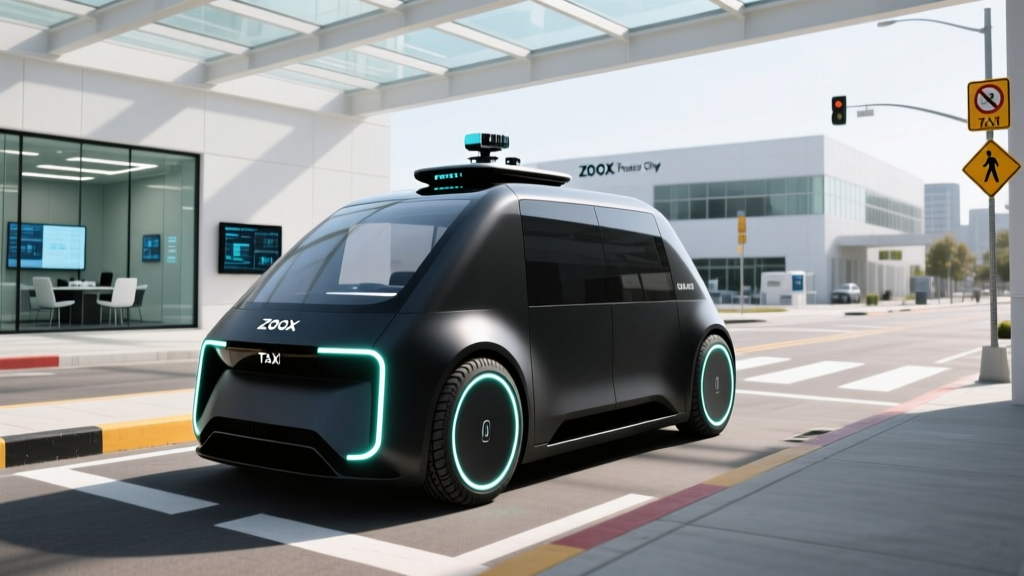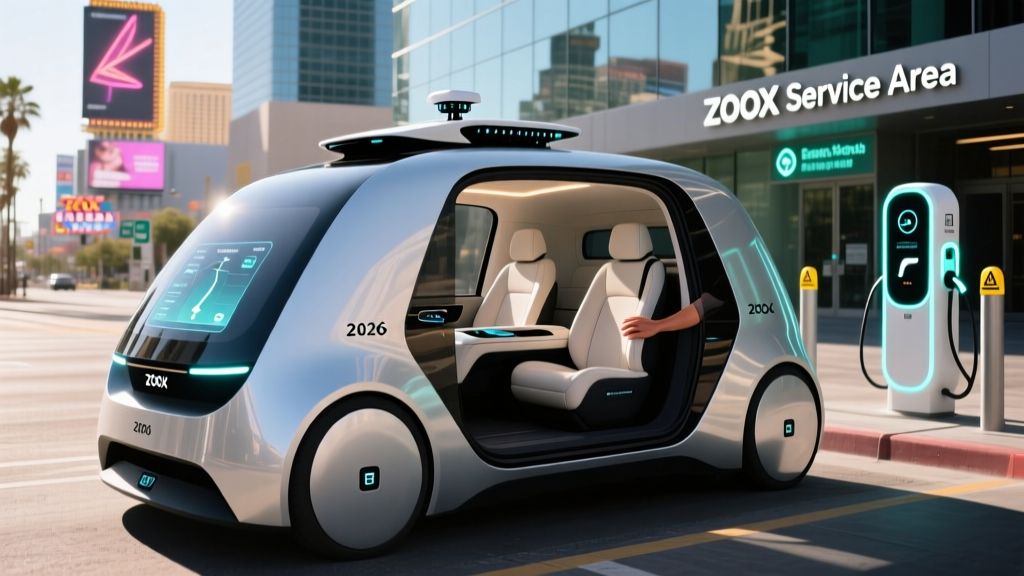
If you've spent any time near the Las Vegas Strip in 2026, you've likely spotted them — compact, symmetrical, steering-wheel-free vehicles glowing with Zoox branding. The Amazon-owned autonomous vehicle company has made Las Vegas its longest-running public testing ground, and the service has evolved significantly since its earliest driverless rides. But what does riding a Zoox taxi in Las Vegas actually look like today, and how does it stack up against Uber, Lyft, and Waymo?
This guide breaks down the real operational footprint, pricing structure, safety record, and technology behind Zoox's purpose-built robotaxi — with the exact numbers and honest limitations you won't find in a press release.
Is the Zoox Taxi Truly Self-Driving? SAE Level Explained
The Zoox vehicle operating in Las Vegas is a SAE Level 4 autonomous system. This is a critical distinction that separates it from consumer driver-assist features like Tesla's FSD (Supervised) or GM's Super Cruise, which are Level 2 systems requiring constant driver engagement.
| Level | Classification | Who Drives? | Example |
|---|---|---|---|
| Level 2 | Driver Assistance | Human (always) | Tesla Autopilot, BlueCruise |
| Level 3 | Conditional Automation | System (human on standby) | Mercedes Drive Pilot (limited) |
| Level 4 | High Automation | System (no human needed) | Zoox, Waymo |
| Level 5 | Full Automation | System (all conditions) | Does not yet exist commercially |
Level 4 means the Zoox vehicle handles all driving tasks within its approved operational design domain (ODD) — specific geofenced areas under defined conditions — with zero human intervention. There is no steering wheel, no pedals, and no driver's seat.
Where Can You Ride a Zoox Taxi in Las Vegas Right Now?
Zoox's Las Vegas operations have expanded incrementally since the company began driverless testing on public roads in 2022. As of early 2026, the service operates within a defined geofence that covers key corridors, though it does not blanket the entire metro area.
| Zone | Coverage Area | Status |
|---|---|---|
| Las Vegas Strip Corridor | Sahara Ave to Mandalay Bay, including major hotel-casino frontages | Operational |
| Downtown / Fremont | Select routes connecting Strip to Fremont Street Experience area | Operational (limited hours) |
| Convention Center District | Las Vegas Convention Center and surrounding hotels | Operational |
| Harry Reid Airport (LAS) | Airport pickup/dropoff | Not yet available |
| Suburbs (Summerlin, Henderson) | Residential areas | Not available |
Service hours typically run from late morning through late evening. Zoox does not currently operate 24/7 in Las Vegas, and availability can be limited during peak convention periods when demand outpaces fleet capacity. To request a ride, users download the Zoox app (available on iOS and Android), create an account, and request a pickup within the geofenced zone. Wait times vary from 3–12 minutes depending on fleet density and time of day.
Zoox vs. Uber and Lyft: Pricing Breakdown
One of the most common questions from prospective riders: how much does a Zoox taxi cost compared to traditional rideshare? Zoox has historically offered promotional and competitive pricing to build ridership, but the economics are shifting as the service matures.
| Metric | Zoox | UberX | Lyft Standard |
|---|---|---|---|
| Base fare | ~$2.50 | ~$2.80 | ~$2.60 |
| Per-mile rate | ~$1.35 | ~$1.55 | ~$1.45 |
| Per-minute rate | ~$0.28 | ~$0.35 | ~$0.32 |
| Typical Strip ride (3 mi) | $8–$12 | $11–$18 | $10–$16 |
| Surge pricing | Less aggressive (fleet-limited) | Frequent during events | Frequent during events |
Zoox rides tend to come in 15–30% cheaper than comparable UberX or Lyft trips within its service zone. The trade-off is availability: you can't summon a Zoox at 3 AM to a suburban hotel, and surge events during CES or major fights can still push prices up. Zoox has also offered loyalty credits and first-ride promotions to attract new users. No tipping is expected or required — there's no driver.
The Zoox Vehicle: Tech Stack and Sensor Suite
Zoox's purpose-built robotaxi is unlike anything else on the road. It's a fully electric, bidirectional vehicle — meaning it can drive equally well in either direction, eliminating the need to turn around in tight urban spaces. Here's what powers it:
Vehicle Specifications
- Powertrain: Fully electric BEV, dual-motor AWD
- Battery: ~75 kWh usable capacity (estimated, NMC chemistry)
- Top speed: 75 mph (electronically limited)
- Seating: 4 passengers, face-to-face configuration
- Steering: None — no wheel, no pedals, no manual controls
- Dimensions: Significantly shorter than a standard sedan, enabling tight urban maneuvering
Sensor Architecture
Zoox uses a redundant, multi-modal sensor stack — not a camera-only approach like Tesla's vision-based FSD. The system includes:
- LiDAR: Multiple solid-state and spinning LiDAR units providing 360° 3D point-cloud mapping out to ~150+ meters
- Cameras: High-resolution camera array covering all directions for object classification, traffic signal recognition, and lane detection
- Radar: Forward and corner radar for velocity detection and adverse-weather redundancy
- Ultrasonic sensors: Near-field obstacle detection for low-speed maneuvers and docking
This sensor redundancy means the system can cross-validate detections — if a camera is blinded by sun glare, LiDAR and radar still perceive the environment. This is a fundamentally different architecture from Level 2 camera-only systems.
Safety Record: What the Data Actually Shows
Safety is the single most scrutinized aspect of robotaxi operations, and rightly so. Zoox, like all autonomous vehicle operators in California and Nevada, is required to report disengagement data and collision reports to regulators.
- Miles driven autonomously (all markets): Millions of driverless miles accumulated across Las Vegas and San Francisco Bay Area operations since public launch
- Disengagement rate: Zoox has reported progressive improvement in miles between required human interventions, though exact per-mile figures vary by reporting period and operational domain complexity
- Collision reports: Like all AV operators, Zoox files reports with the NHTSA Standing General Order for any incident. Most reported incidents in the AV industry involve low-speed contact where the robotaxi was rear-ended or sideswiped by a human driver — not the AV initiating contact
- No fatal collisions: As of this writing, no Zoox vehicle has been involved in a fatal collision during autonomous operation
For the most current safety data, refer to NHTSA's Standing General Order crash reporting database and the California DMV's annual disengagement reports (for Bay Area operations).
It's worth contextualizing these numbers. Human drivers in the U.S. experience approximately 1.35 fatalities per 100 million vehicle miles traveled, according to NHTSA data. Robotaxi operators aim to demonstrably beat that figure, but the total miles driven by AVs remain a fraction of human-driven miles, making direct statistical equivalence difficult. The honest answer: the data is trending positively, but the sample size is still growing.
Regulatory Landscape: Who Approves Zoox Operations?
Robotaxi operations in the United States exist in a patchwork of state and local regulatory frameworks. Zoox's ability to operate in Las Vegas specifically depends on several layers of approval:
- Nevada DMV / Nevada Office of Autonomous Vehicles: Nevada was one of the first states to create a legal framework for autonomous vehicle testing and deployment. Zoox holds the necessary state permits for driverless testing and limited commercial operation.
- NHTSA (Federal): At the federal level, Zoox received a notable exemption from the National Highway Traffic Safety Administration allowing its purpose-built vehicle to operate without traditional manual controls (steering wheel, pedals, mirrors). This exemption was critical — Federal Motor Vehicle Safety Standards (FMVSS) historically required these controls.
- Local jurisdiction (Clark County / City of Las Vegas): Local authorities coordinate on geofencing boundaries, pickup/dropoff zones, and traffic integration.
This regulatory structure means Zoox cannot simply expand to any city at will. Each new market requires state-level approval, potential FMVSS exemptions, and local coordination. This is why the robotaxi footprint nationally remains concentrated in a handful of cities — Las Vegas, San Francisco, and a few others — rather than being ubiquitous.
Current Limitations: What Zoox Cannot Do
Transparency about limitations is essential for any prospective rider. The Zoox robotaxi is impressive, but it is not a universal replacement for human-driven transportation.
Operational Limitations
- Geofencing: The vehicle will not operate outside its approved zone. If your destination falls outside the boundary, the ride cannot be completed.
- Weather constraints: Heavy rain, dust storms (common in Las Vegas monsoon season), or severely reduced visibility can cause the system to pull over safely and end the trip. LiDAR and camera performance degrade in extreme particulate conditions.
- Construction zones: While the system can handle some temporary lane shifts, major unmapped construction can trigger conservative behavior — slow speeds, rerouting, or trip termination.
- No highway operation: The Zoox vehicle is designed for urban speeds. It does not operate on freeways or interstates at this time.
- Limited cargo: The vehicle is optimized for passengers, not luggage or large items. Airport runs with multiple suitcases are impractical even if the airport were in the service zone.
- Accessibility: Zoox has stated commitment to ADA compliance, but the current vehicle's ramp and interior configuration may not accommodate all wheelchair types. Confirm accessibility features in the app before booking.
- No stops: Unlike Uber, you can't ask the vehicle to stop at a drive-through or wait while you run into a store. It's point A to point B.
The Zoox Riding Experience: What to Expect
Stepping into a Zoox vehicle for the first time is genuinely disorienting if you're accustomed to traditional cars. The cabin faces inward — two passengers on each side, facing each other. There's no driver's compartment, no steering wheel, no dashboard in the conventional sense. A central screen provides trip progress, route visualization, and climate controls.
The ride itself is smooth but conservative. Zoox vehicles do not accelerate aggressively or weave through traffic. They follow speed limits precisely, maintain generous following distances, and execute lane changes deliberately. For passengers used to aggressive rideshare drivers, the experience feels almost cautious — which, from a safety standpoint, is the point.
For Las Vegas visitors, the novelty factor is real. Riding in a vehicle with no driver on the Strip at night, surrounded by neon, is an experience that draws repeat riders and social media documentation. But the practical utility is also there: for hotel-to-hotel hops, convention center runs, or getting from a casino to a restaurant within the geofence, Zoox is a legitimate transportation option, not just a tech demo.
Frequently Asked Questions
How do I request a Zoox taxi ride in Las Vegas?
Download the Zoox app from the App Store or Google Play, create an account, and request a ride within the active service zone. The app shows your nearest available vehicle and estimated wait time. Pickup points are typically at designated curb locations near major hotels and attractions.
Is the Zoox taxi free to ride?
No. While Zoox previously offered free promotional rides during early testing phases, the service now charges fares comparable to or slightly below Uber/Lyft rates. Expect $8–$15 for most trips within the Strip corridor. Promotional credits are occasionally available for new users.
How many passengers can the Zoox vehicle carry?
The Zoox vehicle seats up to four passengers in a face-to-face configuration. There is no option for larger groups — you'd need to book a standard rideshare for parties of five or more.
What happens if the Zoox vehicle encounters a problem mid-trip?
The vehicle is monitored remotely by Zoox's fleet operations team. If the system encounters a scenario it cannot resolve autonomously, it will execute a minimal-risk maneuver — typically pulling to the side of the road and stopping safely. A remote operator can then provide guidance or dispatch roadside assistance.
Can I ride a Zoox taxi in other cities besides Las Vegas?
Zoox has also been developing operations in the San Francisco Bay Area (its headquarters region). Expansion to additional cities is planned but subject to regulatory approval in each jurisdiction. Check the Zoox app for current availability — announced expansion cities should not be confused with live service.
Is Zoox owned by Amazon?
Yes. Amazon acquired Zoox in 2020 for approximately $1.3 billion. Zoox operates as an independent subsidiary. Amazon's interest spans both robotaxi passenger service and potential last-mile delivery applications, though the Las Vegas service is currently passenger-focused.
How does Zoox compare to Waymo in Las Vegas?
Waymo (Alphabet/Google's AV division) operates its own robotaxi service primarily in Phoenix, San Francisco, Los Angeles, and select other markets. Waymo uses modified Jaguar I-PACE and Zeekr vehicles with LiDAR-based stacks, while Zoox uses its custom-built bidirectional vehicle. Both are Level 4 systems. As of early 2026, Waymo's operational footprint is larger in terms of total cities and miles served, but Zoox's purpose-built vehicle offers a distinct rider experience. Service availability in Las Vegas specifically: Zoox is the more established operator on the Strip.
This article reflects publicly available information as of early 2026. Robotaxi service areas, pricing, and regulatory status change frequently. Verify current availability and fares in the Zoox app before planning trips. For the latest federal safety data, consult NHTSA. For state-level permits and disengagement reports, consult the Nevada DMV and California DMV autonomous vehicle program pages.