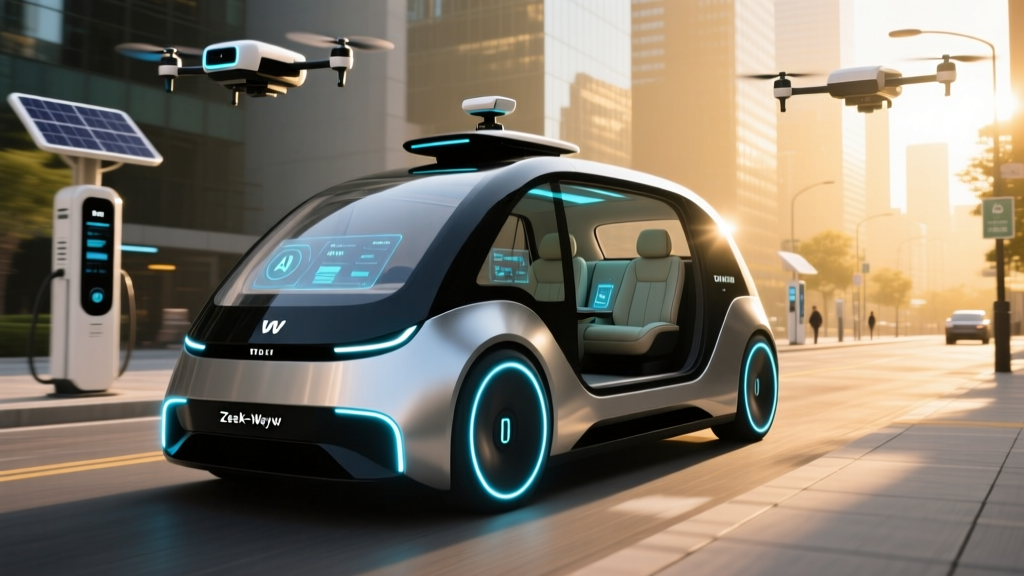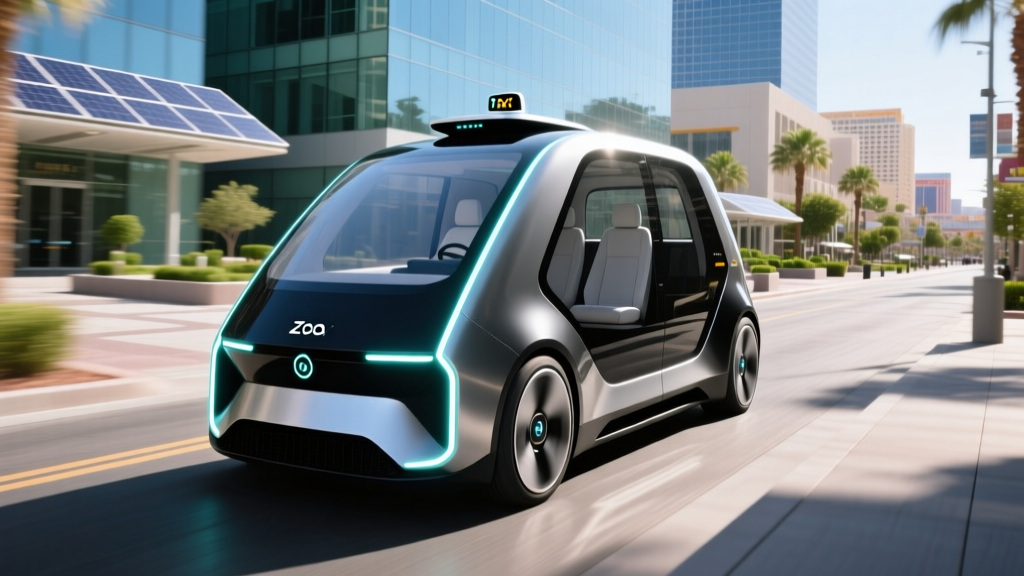
If you've spent any time near the Las Vegas Strip in the past year, you may have spotted a compact, symmetrical vehicle with no visible steering wheel gliding through traffic. That's the Zoox robotaxi — Amazon's autonomous vehicle subsidiary — operating commercially on Nevada roads. Unlike the driver-assist systems you find in consumer EVs, the Zoox vehicle has no driver's seat, no pedals, and no steering column. It is a purpose-built, Level 4 autonomous vehicle designed from the ground up to carry passengers without a human behind the wheel.
This guide covers everything a visitor or resident needs to know about hailing a Zoox self-driving car in Las Vegas in 2026: where it operates, how to get a ride, what it costs, the technology under the skin, and — critically — what it still cannot do.
Where Can You Ride a Zoox Robotaxi in Las Vegas?
Zoox launched its first commercial robotaxi service in Las Vegas in mid-2024, initially covering a limited corridor. As of early 2026, the service area has expanded but remains geofenced to specific zones. You can request a ride within a defined footprint that includes:
- The Las Vegas Strip corridor — covering major resort properties from roughly Mandalay Bay in the south to the Wynn/Encore complex in the north
- Downtown Las Vegas — including the Fremont Street Entertainment District and surrounding blocks
- Select connector routes between the Strip and downtown, primarily along Las Vegas Boulevard and Paradise Road
| City | Status | Service Area | Hours | Access |
|---|---|---|---|---|
| Las Vegas, NV | Commercial (live) | Strip corridor + Downtown (~15 sq mi geofence) | Approx. 10 AM – 11 PM daily | Zoox app (waitlist/invite) |
| Foster City, CA | Commercial (limited) | San Mateo County select zones | Varies | Zoox app (waitlist/invite) |
| San Francisco, CA | Testing / limited commercial | Select neighborhoods | Varies | Zoox app (invite) |
| Seattle, WA | Testing (no public rides) | N/A | N/A | N/A |
| Atlanta, GA | Testing (no public rides) | N/A | N/A | N/A |
Key caveat: Zoox does not yet operate on the I-15 freeway, at Harry Reid International Airport, or in suburban Henderson or Summerlin. If your trip starts or ends outside the geofence, the app will not allow you to book it. The geofence expands incrementally as Zoox validates new road segments, but announced future zones should not be confused with live service.
How to Use the Zoox App and What a Ride Costs
Riding in a Zoox robotaxi in Las Vegas currently requires downloading the Zoox app (available on iOS and Android) and joining a waitlist. As of early 2026, Zoox has been opening access in waves, prioritizing Las Vegas locals, hospitality workers, and frequent Strip visitors. Once approved, you can request a ride much like Uber or Lyft: enter your pickup and drop-off within the geofence, confirm, and walk to the designated pickup spot.
The Zoox vehicle is a compact, carriage-style pod seating up to four passengers on two bench seats facing each other. There is no driver, no steering wheel, and no front trunk — just a climate-controlled cabin with large windows, ambient lighting, and a screen showing your route.
| Service | Typical Fare (2-mile Strip trip) | Surge Pricing | Tipping | Notes |
|---|---|---|---|---|
| Zoox | Currently free (promotional period) | None | Not applicable | Free rides during early commercial rollout; pricing TBD |
| UberX | $10 – $18 | Yes (can exceed $30) | Expected ($2–$5) | Variable by demand |
| Lyft Standard | $9 – $16 | Yes | Expected ($2–$5) | Variable by demand |
| Waymo One (where available) | $10 – $20 | Limited surge | Optional in-app | Comparable to UberX |
The pricing reality: Zoox is currently offering free rides as part of its commercial launch strategy — a deliberate move to build ridership data, refine operations, and normalize the experience before introducing fares. Amazon has not published a long-term pricing model. Industry analysts expect Zoox to eventually charge fares competitive with UberX/Lyft, potentially undercutting them by 15–25% given the absence of a human driver's take-home pay. For now, if you can get off the waitlist, you're riding for free.
Is This Truly Self-Driving? Understanding SAE Level 4
This is where the distinction between consumer EV driver-assist and a robotaxi becomes critical. Tesla's Full Self-Driving (Supervised), GM's Super Cruise, and Ford's BlueCruise are all SAE Level 2 systems — meaning the human driver must remain attentive, keep hands on or near the wheel, and is legally responsible for the vehicle at all times.
The Zoox vehicle operates at SAE Level 4 within its geofenced service area. At Level 4, the vehicle handles all driving tasks — steering, braking, acceleration, lane changes, intersection navigation — without any human intervention or supervision. There is no expectation that a passenger will take over. If the system encounters a scenario it cannot handle, it is designed to pull over safely and contact a remote operations team rather than hand control to a rider.
| SAE Level | Name | Who Drives? | Example |
|---|---|---|---|
| Level 0 | No Automation | Human does everything | Basic car with no assist features |
| Level 1 | Driver Assistance | Human drives; system assists one function | Adaptive cruise control OR lane-keeping |
| Level 2 | Partial Automation | Human drives; system assists steering AND speed | Tesla Autopilot, FSD (Supervised), Super Cruise, BlueCruise |
| Level 3 | Conditional Automation | System drives in specific conditions; human must be ready to take over | Mercedes Drive Pilot (limited markets, low-speed highway) |
| Level 4 | High Automation | System drives fully within a defined operational domain; no human needed | Waymo One, Zoox robotaxi (within geofence) |
| Level 5 | Full Automation | System drives everywhere, all conditions, no human needed | Does not exist commercially as of 2026 |
The Zoox vehicle's Level 4 designation applies only within its approved geofence in approved conditions. Take it outside that zone, or subject it to conditions it isn't validated for, and the system will not operate. This is not a limitation unique to Zoox — Waymo's robotaxis in Phoenix and San Francisco operate under the same Level 4/geofenced model.
The Technology Stack: Lidar, Cameras, and Purpose-Built Design
Unlike Tesla's camera-centric approach to autonomy, Zoox uses a multi-sensor fusion stack that combines several complementary technologies:
Zoox Sensor and Compute Architecture
- Lidar (Light Detection and Ranging): Multiple lidar units provide a real-time 3D point cloud of the vehicle's surroundings, accurate to centimeter-level resolution at ranges exceeding 150 meters. Lidar works independently of ambient light, giving the system reliable spatial awareness at night and in shadowed urban canyons.
- Cameras: A suite of high-resolution cameras covers 360 degrees, handling traffic-light state detection, sign reading, lane-marking identification, and object classification (pedestrian vs. cyclist vs. vehicle).
- Radar: Forward and corner radar units detect object velocity and range, performing well in rain and fog where lidar and cameras can degrade.
- Ultrasonic sensors: Short-range sensors handle close-proximity detection during low-speed maneuvers and pickup/drop-off.
- Redundant compute: Dual independent computing platforms can each independently bring the vehicle to a safe stop if the other fails.
- HD maps + geofencing: The vehicle operates on pre-mapped routes with centimeter-accurate HD maps. The geofence defines the precise operational boundary.
The vehicle itself is purpose-built for autonomy, not a retrofitted production car. Key design differences from a standard EV include:
- Four-wheel steering: All four wheels can turn, enabling a turning radius of under 28 feet and the ability to crab-diagonally into tight pickup spots — useful on crowded Strip-side roads.
- Bidirectional driving: The vehicle is symmetrical and can drive equally well in either direction, simplifying three-point turns and dead-end navigation.
- 75 mph top speed: While it rarely approaches this in urban Las Vegas, the capability exists for future freeway-capable iterations.
- Battery electric powertrain: The Zoox vehicle runs on an undisclosed-capacity lithium-ion battery pack, charged at depot locations between shifts. Exact kWh figures have not been publicly disclosed, but the vehicle is designed for all-day urban operation with opportunity charging.
Safety Record: What the Data Shows
Safety is the most scrutinized aspect of any robotaxi service. Zoox, like all autonomous vehicle operators in Nevada and California, is required to report disengagement data, collision reports, and operational metrics to regulators.
Zoox Safety Data Snapshot (through late 2025)
- Testing and operational miles: Zoox has logged millions of autonomous miles across its test and commercial fleets in multiple cities, though the company does not publish a single cumulative public figure the way Waymo does (Waymo has reported over 20 million autonomous miles as of 2025).
- Disengagement rate: In California DMV disengagement reports, Zoox has historically reported higher disengagement rates (interventions per 1,000 miles) than Waymo, though these figures have improved year-over-year as the software matures. Disengagement rates are self-reported and methodology varies between companies, so direct comparison should be treated cautiously.
- Collision reports: As of early 2026, Zoox has reported a small number of minor incidents to the NHTSA Standing General Order database, primarily low-speed contacts with stationary objects or other vehicles in complex urban environments. No serious passenger or pedestrian injuries have been publicly attributed to Zoox robotaxi operations in Las Vegas.
- Remote assistance: Zoox employs a remote-operations team that can be consulted when the vehicle encounters an ambiguous scenario (e.g., a construction zone with conflicting signage). The remote operator does not "joystick" the vehicle in real time but can approve a proposed path or direct the vehicle to pull over.
For context, NHTSA data consistently shows that approximately 94% of conventional motor vehicle crashes involve human error — distracted driving, impairment, fatigue, or misjudgment. Robotaxis eliminate those specific failure modes but introduce new edge-case risks around sensor limitations and novel traffic scenarios. The overall safety picture for robotaxis is still being written, and the sample size of Level 4 commercial operations remains small compared to the billions of human-driven miles logged annually.
Regulatory Landscape: Who Approves Zoox Operations?
Zoox's Las Vegas operations are governed by a layered regulatory framework:
- Nevada DMV and NDOT: Nevada was one of the first states to pass autonomous vehicle legislation (2011, updated subsequently). The Nevada DMV issues autonomous vehicle testing and deployment permits. Operators must carry minimum insurance, submit safety reports, and demonstrate operational capability before carrying paying passengers.
- NHTSA (federal): The National Highway Traffic Safety Administration sets vehicle safety standards. Because the Zoox vehicle has no steering wheel or mirrors, Zoox received a specific exemption from certain Federal Motor Vehicle Safety Standards (FMVSS) that assume a human driver — a process that took years of petition and review.
- Local jurisdictions: Clark County and the City of Las Vegas coordinate on road-use permits, pickup/drop-off zones, and first-responder protocols for interacting with driverless vehicles.
This multi-jurisdictional approval process is why robotaxi expansion is slow and city-by-city. Each new metro area requires its own permitting, mapping, validation, and first-responder training — there is no single "federal license" to operate a robotaxi nationwide.
Current Limitations: What Zoox Cannot Do (Yet)
For all its technological sophistication, the Zoox robotaxi in Las Vegas operates within meaningful constraints that riders should understand before planning their transportation around it:
- Geofence boundaries: The vehicle will not travel outside its mapped and approved zone. Suburban destinations, the airport, and freeway trips are not available.
- Weather limitations: While Las Vegas is relatively dry, heavy monsoon rain or rare dust storms can degrade lidar and camera performance. Zoox may suspend or limit service during severe weather events.
- Construction zones: Rapidly changing road configurations — lane closures, temporary barriers, detour signage — remain a challenge for all robotaxis. The vehicle may reroute or pull over and wait for remote assistance in complex construction areas.
- No highway driving: The current Las Vegas deployment operates on surface streets only. Merging onto I-15 or US-95 is not supported.
- Limited hours: Service is not 24/7. Late-night rides after approximately 11 PM are not available, which limits usefulness for post-show or post-club transportation.
- Waitlist access: Not everyone can simply download the app and ride. The waitlist can take days to weeks to clear, and availability is prioritized.
- Accessibility: While the Zoox vehicle is designed with ADA considerations, real-world wheelchair accessibility at every pickup point on uneven urban sidewalks remains an ongoing area of validation.
- Edge cases with human behavior: Jaywalkers, aggressive drivers, hand-signal-directed traffic (e.g., a parking attendant waving cars through), and other unpredictable human behaviors can cause the vehicle to stop and wait rather than proceed cautiously as a human driver would.
Zoox vs. Waymo vs. Uber: How Does It Compare?
If you're visiting Las Vegas and weighing your transportation options, here's how Zoox stacks up against alternatives:
| Factor | Zoox | Waymo One | Uber / Lyft |
|---|---|---|---|
| Autonomy Level | SAE Level 4 (no driver) | SAE Level 4 (no driver) | Human driver (Level 0) |
| Las Vegas Availability | Strip + Downtown geofence | Not available in Las Vegas (Phoenix, SF, LA) | Citywide, 24/7 |
| Current Fare | Free (promotional) | N/A in Vegas | $9–$18 typical |
| Wait Time | 5–15 min (limited fleet) | N/A | 3–10 min typical |
| Airport Service | No | No (in markets where available) | Yes |
| Highway Trips | No | Limited | Yes |
| Vehicle Type | Purpose-built pod (4 seats) | Jaguar I-PACE (modified SUV) | Varies (personal vehicles) |
The honest assessment: Zoox is a compelling experience and a genuine technology demonstration, but it is not yet a practical replacement for Uber or Lyft for most Las Vegas visitors. Its limited geofence, restricted hours, waitlist access, and small fleet mean you should treat it as a novel transportation option to try if available — not as your primary way to get around.
Frequently Asked Questions
Can anyone ride the Zoox self-driving car in Las Vegas right now?
Not yet on a walk-up basis. You need to download the Zoox app, join the waitlist, and receive an invitation. Approval timelines vary — some users report being approved within days, others have waited weeks. Las Vegas residents and hospitality workers have reportedly been prioritized.
Is the Zoox robotaxi really driverless, or is there a hidden human operator?
It is genuinely driverless. There is no human in the vehicle — no driver's seat, no steering wheel, no pedals. A remote operations team monitors the fleet and can be consulted for complex scenarios, but they do not remotely "drive" the vehicle in real time. The vehicle's onboard AI handles all driving decisions within the geofence.
How much does a Zoox ride cost compared to Uber?
As of early 2026, Zoox rides in Las Vegas are free during the promotional launch period. A comparable UberX trip on the Strip costs $10–$18 plus tip. Zoox has not announced long-term pricing, but industry expectations suggest fares will be competitive with or slightly below traditional rideshare once monetization begins.
What happens if the Zoox vehicle encounters a situation it can't handle?
The vehicle is programmed to pull over safely and contact Zoox's remote operations center. A remote specialist can assess the situation and either approve a path for the vehicle to continue or dispatch roadside assistance. The vehicle will not hand control to a passenger because there are no passenger-operable driving controls.
Is it safe to ride in a driverless Zoox vehicle?
Zoox has reported a small number of minor incidents to NHTSA through the Standing General Order, with no publicly reported serious injuries in Las Vegas operations. The vehicle uses redundant sensors (lidar, radar, cameras) and dual compute systems for safety. However, the total operational mileage is still small compared to human-driven vehicles, and the long-term safety record is still being established. You can review NHTSA's ADS crash reporting database for the latest incident data.
Does Zoox operate at Harry Reid International Airport?
No. The airport is outside the current geofence, and airport pickup/drop-off requires separate permitting that has not been completed as of 2026. You will need Uber, Lyft, taxi, or shuttle service for airport transfers.
What is the Zoox vehicle's range and battery capacity?
Zoox has not publicly disclosed the exact kWh capacity of its battery pack. The vehicle is designed for all-day urban operation with opportunity charging at depot locations between shifts. Given its compact size and urban speeds (typically under 45 mph), energy consumption is modest compared to a full-size electric SUV. The vehicle is charged at Zoox's Las Vegas depot, not at public charging stations.
The Zoox self-driving car in Las Vegas represents one of the few places in the world where you can hail a truly driverless, purpose-built robotaxi in 2026. It's not yet a replacement for your Uber to the airport, and the geofence is tight, but as a real-world deployment of Level 4 autonomy carrying actual passengers on public roads, it is a milestone worth experiencing — especially while the rides are free.