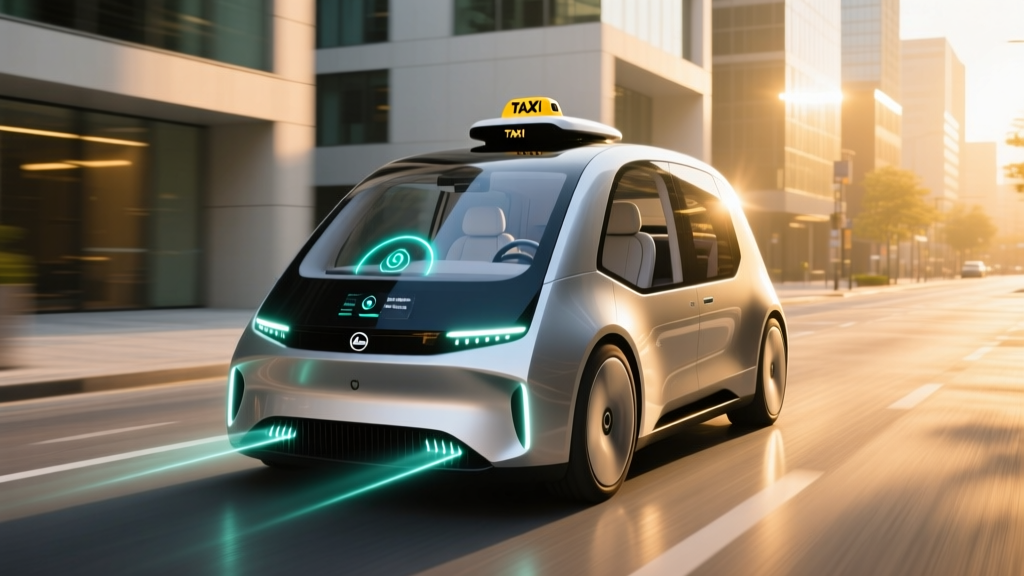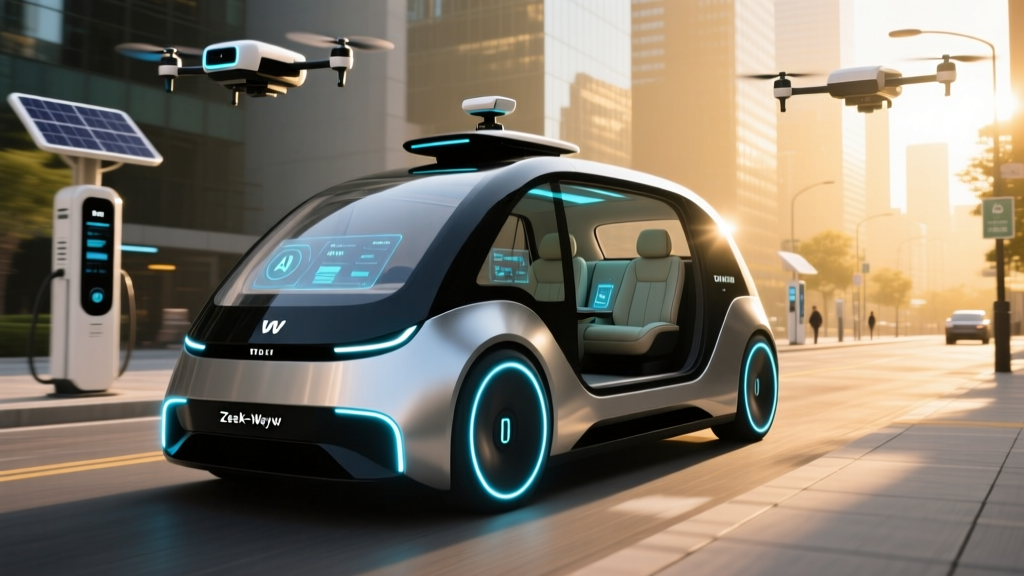
The Zeekr-Waymo robotaxi is the purpose-built autonomous vehicle born from a 2021 partnership between Alphabet's Waymo and Geely's premium EV brand, Zeekr. Unlike Waymo's current fleet of retrofitted Jaguar I-PACE SUVs, this ground-up robotaxi — officially known as the Zeekr M-Vision — was engineered from day one to operate without a steering wheel or pedals. After years of development delays, production timelines have shifted multiple times, and the vehicle is now targeting a phased commercial launch. Here's what buyers, riders, and industry watchers need to know about where the Zeekr-Waymo robotaxi stands in 2026.
What Is the Zeekr M-Vision Robotaxi?
The Zeekr M-Vision (also referred to internally as the Zeekr RT) is a compact, box-shaped electric vehicle designed exclusively for autonomous ride-hailing. It rides on Geely's SEA-M (Sustainable Experience Architecture Mobility) platform — a dedicated skateboard chassis with integrated battery, motors, and compute hardware. The vehicle features a sliding-door entry, a flat floor, and a lounge-style interior with forward-facing and rear-facing seats arranged around a central console. There is no driver's seat, no steering wheel, and no traditional dashboard.
Key hardware specifications announced by Zeekr and Waymo include:
| Attribute | Specification |
|---|---|
| Platform | Geely SEA-M skateboard |
| Battery capacity | ~100 kWh (usable, NMC chemistry) |
| EPA range (estimated) | ~250–300 miles (final EPA rating pending) |
| DC fast charge rate | Up to 200 kW peak; 10–80% in ~30 min (estimated) |
| Drive configuration | Rear-wheel drive, single motor |
| Top speed | ~75 mph (software-limited for urban use) |
| Doors | Power sliding doors, B-pillarless entry |
| Seating | Up to 3 passengers (lounge configuration) |
| Autonomy hardware | Waymo 6th-gen Driver (lidar, cameras, radar) |
| Steering wheel / pedals | None |
The Zeekr M-Vision is designed for SAE Level 4 autonomy — meaning it can handle all driving tasks within its defined operational design domain (ODD) without any human intervention or fallback. This is fundamentally different from Level 2 systems like Tesla Autopilot or GM Super Cruise, which require continuous driver supervision. A Level 4 robotaxi has no expectation that a passenger will take over; if the system encounters a scenario it cannot handle, it executes a safe stop rather than handing control to a human.
Waymo's 6th-Generation Autonomous Driving Stack
The Zeekr M-Vision will ship with Waymo's 6th-generation "Waymo Driver" hardware suite, the same system that began deployment on Jaguar I-PACE vehicles in late 2024 and into 2025. This represents a significant upgrade over the 5th-gen hardware used in Waymo's early commercial fleet in Phoenix and San Francisco.
The sensor suite includes:
- Lidar: Multiple high-resolution lidar units providing 360-degree 3D point-cloud mapping, effective at ranges exceeding 200 meters. Lidar operates independently of ambient light, giving the system reliable perception at night and in glare conditions where cameras struggle.
- Cameras: A surround-view array of high-dynamic-range cameras for traffic-light detection, sign reading, lane marking identification, and object classification. Waymo has moved to higher-resolution sensors in the 6th-gen system compared to its predecessors.
- Radar: Imaging radar units for velocity detection of moving objects, redundancy in heavy rain, and long-range detection of vehicles and pedestrians.
- Compute: Custom Waymo-designed compute platform (details proprietary) with redundant processing paths for safety-critical decision-making.
This multi-sensor approach is a deliberate contrast to Tesla's camera-only FSD architecture. Waymo's lidar-first philosophy provides hardware-level redundancy: if one sensor modality degrades (e.g., cameras blinded by direct sun), lidar and radar continue to provide spatial awareness. The trade-off is higher per-vehicle hardware cost, which Waymo has worked to reduce with each generation — the 6th-gen system is reportedly significantly cheaper than the estimated $100,000+ sensor cost of early 4th-gen prototypes.
Where Can You Ride a Zeekr-Waymo Robotaxi?
As of early 2026, the Zeekr M-Vision has not yet entered commercial passenger service. Waymo's current live robotaxi operations use the Jaguar I-PACE equipped with 5th- and 6th-generation hardware. The Zeekr vehicle is expected to join and eventually replace portions of that fleet, but Waymo has not announced a firm date for the M-Vision's first paid rider.
Waymo's current operational robotaxi service areas (using Jaguar I-PACE vehicles) include:
| City | Service Area Coverage | Status |
|---|---|---|
| Phoenix, AZ (metro) | Chandler, Tempe, Mesa, Scottsdale — ~225 sq mi | Live, fully driverless since 2020 |
| San Francisco, CA | Most of SF proper, expanding south — ~85+ sq mi | Live, fully driverless since 2023 |
| Los Angeles, CA | Selected zones in LA proper, Santa Monica, West Hollywood | Live, phased rollout 2024–2025 |
| Austin, TX | Central Austin, select corridors | Live, expanding 2025–2026 |
When the Zeekr M-Vision does enter service, Phoenix and San Francisco are the most likely initial deployment cities based on Waymo's existing HD mapping infrastructure and regulatory relationships. Waymo has also signaled interest in expanding to additional US metros, though each new city requires separate regulatory approval, mapping, and validation testing.
Internationally, Waymo and Zeekr have discussed potential deployment in China — Zeekr's home market — but no regulatory framework or timeline for Chinese robotaxi operations using Waymo's software stack has been confirmed. China's autonomous vehicle regulations are managed at the municipal level, with cities like Beijing, Shanghai, and Shenzhen running their own pilot programs (dominated by Baidu Apollo, Pony.ai, and WeRide).
Pricing: How Will Zeekr-Waymo Rides Compare to Uber?
Waymo's current pricing for its Waymo One service in Phoenix and San Francisco is designed to be competitive with Uber and Lyft — typically within 10–20% of comparable rideshare fares, and sometimes cheaper during surge-pricing events when human-driver supply is constrained.
| Route | Waymo One (current) | UberX (typical) | Lyft (typical) |
|---|---|---|---|
| Airport to downtown Phoenix (~10 mi) | $22–$30 | $20–$28 | $18–$26 |
| SF Mission to SFO (~14 mi) | $32–$42 | $28–$38 | $26–$36 |
| Short urban hop (~3 mi) | $10–$15 | $9–$14 | $8–$13 |
The Zeekr M-Vision's lower per-vehicle manufacturing cost (no steering column, no driver controls, simplified interior) is expected to improve Waymo's unit economics over time. However, Waymo has not confirmed whether the Zeekr vehicle will be offered at a discount versus current I-PACE rides. The long-term thesis is that removing the human driver — who typically captures 50–70% of a rideshare fare — allows robotaxi operators to undercut traditional rideshare while maintaining margins, once fleet scale and utilization rates are sufficient.
For riders, the booking process is identical to current Waymo One: open the Waymo app, enter a destination within the geofenced service area, confirm pickup, and a driverless vehicle arrives. No human interaction is required.
Safety Record: What the Data Shows
Waymo's driverless fleet has accumulated over 30 million fully autonomous miles on public roads as of late 2025, with the majority in Phoenix and San Francisco. The company publishes periodic safety data and has submitted reports to the National Highway Traffic Safety Administration (NHTSA) as required for autonomous vehicle operators.
• Total driverless miles: 30+ million
• Contact rate: Waymo's published research (peer-reviewed, 2023–2024) indicates a police-reportable crash rate approximately 57% lower than human benchmarks in comparable urban environments, and 85% lower for severe-injury crashes.
• Notable incidents: A small number of minor contact events have been reported, predominantly low-speed sideswipes and stationary-object contacts. In late 2023, a Waymo vehicle in San Francisco was involved in a collision with a cyclist who entered the vehicle's path from behind a large truck; the incident prompted software updates to improve occluded-pedestrian prediction.
• Recalls: Waymo has issued voluntary software recalls (filed with NHTSA) to address specific edge-case behaviors, consistent with how OTA updates are handled across the AV industry.
It is important to contextualize these numbers. Waymo operates in geofenced, HD-mapped urban areas with speed limits generally under 45 mph. The comparison benchmarks from the Insurance Institute for Highway Safety (IIHS) and NHTSA for human drivers include all road types, weather conditions, and impairment scenarios. Direct statistical parity requires careful apples-to-apples analysis that researchers continue to debate.
The Zeekr M-Vision, when deployed, will inherit this accumulated software maturity but will need to validate its specific vehicle dynamics (different wheelbase, weight distribution, sensor placement) through additional testing miles before carrying passengers.
Regulatory Landscape: Who Approves Robotaxi Operations?
Autonomous vehicle deployment in the United States is governed by a patchwork of state and local regulations — there is no comprehensive federal framework for Level 4 robotaxi operations as of 2026. The key regulatory bodies include:
- California Public Utilities Commission (CPUC): Issues permits for driverless commercial passenger service in California. Waymo holds a valid CPUC permit for San Francisco and Los Angeles operations.
- Arizona Department of Transportation: Arizona has maintained one of the most permissive AV regulatory environments since 2015, requiring minimal permitting for testing and commercial deployment.
- Texas (Austin): The Texas Department of Transportation and City of Austin oversee AV operations; Texas law allows driverless vehicles with registration and insurance requirements.
- NHTSA (federal): Sets vehicle safety standards (FMVSS) and requires crash/incident reporting. The Zeekr M-Vision's lack of a steering wheel requires an exemption from FMVSS standards that mandate manual controls — Waymo and Zeekr must petition NHTSA for this exemption, a process that has historically taken 12–24 months.
The FMVSS exemption requirement is the single largest regulatory hurdle for the Zeekr M-Vision specifically. Vehicles without steering wheels and pedals do not comply with current Federal Motor Vehicle Safety Standards as written. NHTSA has granted limited exemptions to other manufacturers (notably GM's Cruise Origin, though Cruise subsequently paused that program), and the Zeekr M-Vision will likely need a similar petition. This process adds timeline uncertainty regardless of the vehicle's technical readiness.
Current Limitations: What the Zeekr-Waymo Robotaxi Cannot Do
Level 4 autonomy is powerful within its operational design domain — but that domain has hard boundaries. The Zeekr M-Vision, like all current Level 4 robotaxis, will face these constraints:
- Geofencing: The vehicle can only operate within pre-mapped zones. Stray outside the geofence — whether due to a detour, road closure, or passenger request — and the vehicle cannot proceed autonomously.
- Weather limitations: Heavy rain, snow, fog, and ice degrade lidar and camera performance. Waymo's Phoenix operations rarely face these conditions, but expansion to cities with harsh winters (Chicago, Boston) requires additional validation. The Zeekr M-Vision's initial deployment will likely be restricted to fair-weather, warm-climate cities.
- Construction zones: Rapidly changing lane configurations, temporary barriers, and flaggers present edge cases that require frequent map updates and cautious software behavior. Expect slower, more conservative driving through active construction.
- No highway deployment (initially): Waymo's current operations focus on surface streets under 45 mph. Freeway-speed autonomous driving (65+ mph) requires different sensor range, decision latency, and regulatory approval. The Zeekr M-Vision's ~75 mph speed limiter reflects its urban focus.
- Emergency vehicle interaction: While Waymo's software detects and yields to emergency vehicles, complex multi-vehicle emergency scenes (accidents blocking lanes, police directing traffic) can cause the robotaxi to stop and wait rather than navigate through.
- Passenger accessibility: The M-Vision's lounge seating and sliding doors are designed for able-bodied riders. Wheelchair-accessible configurations have not been confirmed, which is a gap versus ADA-compliant human-driven rideshare options.
Zeekr M-Vision vs. Competing Robotaxi Platforms
| Attribute | Zeekr M-Vision (Waymo) | Jaguar I-PACE (Waymo current) | Zoox Gen 3 |
|---|---|---|---|
| Designed as robotaxi | Yes (ground-up) | No (retrofitted) | Yes (ground-up) |
| Steering wheel | None | Yes (unused) | None |
| SAE Level | Level 4 | Level 4 | Level 4 |
| Sensor approach | Lidar + camera + radar | Lidar + camera + radar | Lidar + camera + radar |
| Service status (2026) | Pre-launch / testing | Live in 4+ cities | Limited launch, Las Vegas & SF |
| Passenger capacity | 3 | 3–4 | 4 |
| Operator | Waymo | Waymo | Zoox (Amazon) |
The Zeekr M-Vision's primary advantage over the I-PACE is cost efficiency: a purpose-built vehicle eliminates the expense of a driver's cockpit, manual controls, and retail-oriented interior materials that a robotaxi never uses. Against the Amazon-owned Zoox, the M-Vision benefits from Waymo's substantially larger real-world driving dataset and more mature commercial operations.
Frequently Asked Questions
Where can I ride a Zeekr-Waymo robotaxi right now?
You cannot ride the Zeekr M-Vision yet — it has not entered commercial service. Waymo's current robotaxi fleet in Phoenix, San Francisco, Los Angeles, and Austin uses the Jaguar I-PACE. The Zeekr vehicle is expected to begin phased deployment once NHTSA exemptions and final validation testing are complete.
Is the Zeekr-Waymo robotaxi truly self-driving?
Yes — it is designed for SAE Level 4 autonomy, meaning no human driver is present or needed within its geofenced operating area. This is categorically different from Level 2 systems like Tesla FSD (Supervised), GM Super Cruise, or Ford BlueCruise, all of which require the driver to remain alert and ready to take over. The Zeekr M-Vision has no steering wheel or pedals; there is nothing for a passenger to take over even in an emergency. The system is designed to bring the vehicle to a safe stop if it encounters an unresolvable scenario.
How much will a ride in the Zeekr robotaxi cost?
Waymo has not announced specific pricing for M-Vision rides. Current Waymo One fares are competitive with Uber and Lyft — typically $10–$15 for short urban trips and $22–$42 for airport runs, depending on city and distance. The lower vehicle cost of the Zeekr platform could allow Waymo to reduce prices over time, but this depends on fleet utilization and operating costs.
What happens if the Zeekr robotaxi encounters a situation it can't handle?
Waymo's Level 4 system is designed to execute a "minimal risk condition" — typically pulling to the curb and stopping safely — rather than handing control to a passenger. Waymo also maintains a remote assistance team that can provide high-level guidance (e.g., confirming it's safe to proceed past an unusual obstacle), though remote operators do not directly steer or accelerate the vehicle in real time.
When will the Zeekr-Waymo robotaxi be available?
Waymo and Zeekr have not confirmed a firm commercial launch date. The vehicle has been in testing since 2024, with production planned at Zeekr's facilities in China. Timeline uncertainty stems from NHTSA's FMVSS exemption process, final validation mileage requirements, and Waymo's fleet-integration testing. Industry analysts expect initial limited deployment no earlier than late 2026 or 2027, with meaningful fleet scale likely in 2028 or beyond.