If you have searched for zoox route las vegas and come up short on specifics, you are not alone. Amazon-backed Zoox operates one of the most distinctive robotaxi fleets in the United States — a purpose-built, carriage-style vehicle with no steering wheel, no pedals, and no driver — but its Las Vegas footprint is smaller and more carefully managed than many riders assume. This guide breaks down exactly where Zoox runs in Las Vegas as of early 2026, what the ride experience costs, how the safety record stacks up against human drivers and competing robotaxis, and the hard limitations you will hit if you try to use the service outside its geofence.
Where Zoox Actually Operates in Las Vegas Right Now
Zoox launched its commercial robotaxi service in Las Vegas in mid-2024 after years of testing, making it the company's first public-facing market alongside the San Francisco Bay Area. However, "Las Vegas" does not mean the entire metro area. Zoox operates within a defined geofence that covers a corridor of the Las Vegas Strip and parts of the surrounding downtown and Summerlin-adjacent zones. As of Q1 2026, the active service area spans roughly from the Mandalay Bay resort in the south to the Stratosphere (now "The Strat") in the north, extending east-west approximately one to two miles from Las Vegas Boulevard in most sections.
| City | Status | Approximate Geofence Coverage | Operating Hours |
|---|---|---|---|
| Las Vegas, NV | Live — Public | Strip corridor (Mandalay Bay to The Strat), ~1-2 mi east/west of Las Vegas Blvd | Limited hours, expanding |
| San Francisco Bay Area, CA | Live — Public | Parts of SF, Foster City, select Peninsula routes | Limited hours, expanding |
| Other U.S. cities | Testing / Not yet public | N/A | N/A |
If you are standing on the Strip near Bellagio, Caesars Palace, or the Convention Center, you are almost certainly inside the Zoox geofence. If you are trying to hail a ride from Henderson, North Las Vegas, or the far west side near Red Rock Canyon, you are not. The app will simply refuse to confirm a pickup outside the zone — there is no override.
How to Hail a Zoox and What a Ride Costs
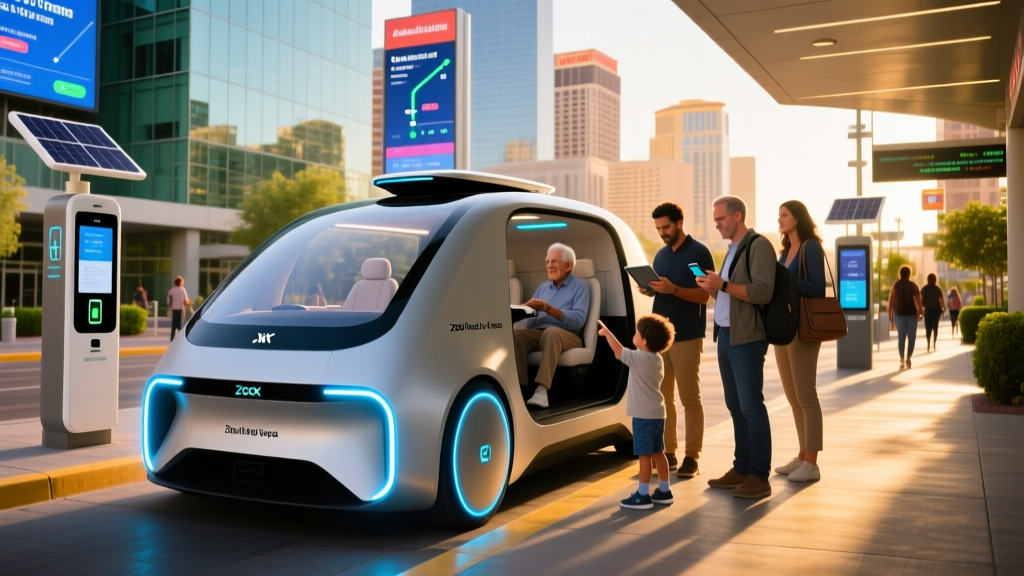
Riding Zoox in Las Vegas requires downloading the Zoox app (available on iOS and Android), creating an account, and requesting a ride just as you would with Uber or Lyft. The vehicle that arrives is the Zoox Gen 3 — a compact, symmetric, bidirectional carriage that seats four passengers facing each other. There is no driver, no steering wheel, and no front seat to claim. You select your pickup and drop-off points from a curated list of approved locations within the geofence; you cannot pin an arbitrary address the way you can with traditional rideshare.
| Service | Base Fare (Est.) | Per-Mile Rate (Est.) | Typical 2-3 mi Fare | Surge Pricing? |
|---|---|---|---|---|
| Zoox Robotaxi | Competitive / promotional | Comparable to UberX | $8–$15 | Limited / controlled |
| UberX | $2.50–$3.50 | $1.10–$1.50 | $10–$18 | Yes — frequent on Strip |
| Lyft Standard | $2.50–$3.50 | $1.10–$1.50 | $10–$18 | Yes — frequent on Strip |
| Motorsail / Waymo (where available) | Varies | Varies | $10–$20 | Limited |
Zoox has historically used promotional pricing and subsidized fares to build ridership in new markets, which means you may find rides cheaper than UberX during your first several trips. The company has not published a fixed public rate card as of early 2026, and pricing can adjust as the service matures. Expect fares to roughly track UberX once introductory periods expire, though Zoox's lack of a human driver removes the largest variable cost in rideshare economics — the driver's share of the fare.
Is Zoox Truly Self-Driving? Understanding SAE Level 4
Yes — Zoox is genuinely driverless. This is not a marketing stretch or a misapplied term. The Zoox vehicle operates at SAE Level 4 automation within its operational design domain (ODD), meaning the system performs all driving tasks without any human driver present, within defined geographic and environmental conditions. This is a fundamentally different category from consumer vehicles like Tesla's FSD (Supervised), Ford BlueCruise, or GM Super Cruise, all of which are SAE Level 2 systems that require a licensed, attentive driver behind the wheel at all times.
SAE Automation Levels — What They Actually Mean
| SAE Level | Name | Who Drives? | Examples |
|---|---|---|---|
| Level 0 | No Automation | Human always | Traditional vehicles |
| Level 1 | Driver Assistance | Human + one assist feature | Adaptive cruise OR lane-keep |
| Level 2 | Partial Automation | Human supervises, hands may leave wheel briefly | Tesla Autopilot/FSD, BlueCruise, Super Cruise |
| Level 3 | Conditional Automation | System drives in narrow conditions; human must take over on request | Mercedes DRIVE PILOT (limited markets) |
| Level 4 | High Automation | System drives fully within its ODD; no human driver needed | Zoox, Waymo (in geofenced areas) |
| Level 5 | Full Automation | System drives everywhere, all conditions | Not yet commercially deployed anywhere |
Key distinction: If a vehicle has a steering wheel and requires you to pay attention, it is Level 2 or below — regardless of marketing language. Zoox has no steering wheel. No human can intervene from inside the cabin. That is Level 4.
Zoox Technology Stack: Lidar, Cameras, and the Purpose-Built Vehicle
Unlike Tesla's camera-only approach to autonomy, Zoox uses a redundant, multi-sensor perception stack that combines:
- Lidar: Multiple solid-state and spinning lidar units provide a real-time 3D point cloud of the vehicle's surroundings, accurate to centimeter-level resolution at ranges exceeding 100 meters. Lidar works in darkness and is largely unaffected by glare — critical for Las Vegas's neon-lit Strip at night.
- Cameras: A surround-view camera array feeds object classification, traffic-light state detection, and sign reading. Zoox uses high-dynamic-range sensors to handle the extreme contrast of bright desert sunlight and deep shadows cast by casino overhangs.
- Radar: Forward and corner radar units detect velocity and distance of moving objects, particularly useful for tracking other vehicles at intersections and in rain or dust.
- Ultrasonic sensors: Short-range proximity detection for low-speed maneuvers, curb alignment, and pedestrian proximity near pickup zones.
- HD maps + localization: Zoox pre-maps every street in its geofence at centimeter precision. The vehicle continuously localizes itself against this map, which means it "knows" where every lane, crosswalk, and signal is before it arrives.
The vehicle itself — the Zoox Gen 3 carriage — is engineered from the ground up for autonomous operation. It is bidirectional (it can drive equally well "forward" or "backward" because both ends are identical), which simplifies maneuvers like three-point turns and tight urban pickups. Four-wheel steering enables crab-like lateral moves. The battery is a high-capacity pack designed for all-day operation with opportunity charging between shifts — Zoox has not published an exact kWh figure, but the vehicle is engineered to operate 16-20 hours per day with scheduled downtime.
Zoox Safety Record: What the Data Actually Shows
Robotaxi safety is the single most scrutinized question in the autonomous vehicle industry, and Zoox has a comparatively limited public safety dataset because its commercial operations began later than Waymo's. As of early 2026, Zoox has accumulated millions of autonomous miles across its test and commercial fleets in Las Vegas, San Francisco, and other development cities. The company reports disengagement (human-safety-driver intervention) rates during testing that are competitive with industry leaders, though it publishes less granular public data than Waymo does through its California DMV disengagement reports.
Zoox Safety & Operational Data — Available Metrics
| Metric | Zoox (Available Data) | Context |
|---|---|---|
| Autonomous miles driven (cumulative) | Millions (test + commercial combined) | Smaller public dataset than Waymo's 30M+ paid miles |
| Commercial incidents (Las Vegas, public report) | No widely reported at-fault collisions as of early 2026 | Zoox reports to NHTSA under Standing General Order |
| Disengagement rate (testing) | Competitive with Tier 1 operators | Exact figures published via CA DMV when operating in CA |
| Vehicle safety design | Purpose-built; symmetric crash structure, airbags for all seats | No driver compartment — all passengers are "rear-seat" equivalent |
| Top speed (commercial operation) | Limited to ~35 mph in current deployment | Appropriate for urban geofence; not highway-capable |
Source notes: Robotaxi operators report incidents to NHTSA under the Standing General Order for ADS-equipped vehicles. California disengagement data is filed with the California DMV. Zoox's Nevada operations are overseen by the Nevada DMV and state regulatory bodies.
For context, Waymo — the industry's most data-rich operator — has published data showing its robotaxis are involved in fewer police-reported crashes per million miles than human benchmarks in comparable urban environments. Zoox has not yet released an equivalent large-scale comparative study, which is a function of its smaller commercial fleet size and later market entry rather than an indication of inferior safety. The absence of at-fault collision reports from its Las Vegas commercial service is a positive early signal, but statistically robust conclusions require more cumulative miles.
Current Limitations: What Zoox Cannot Do (Yet)
Level 4 autonomy is powerful but bounded. Zoox's operational design domain (ODD) defines strict conditions under which the vehicle can and cannot operate. Here are the real limitations you will encounter:
- Geofence boundaries: You cannot ride Zoox to Harry Reid International Airport, Henderson, Summerlin, or anywhere outside the active Las Vegas geofence. The app will not allow it.
- Weather restrictions: Heavy rain, flooding, or dust storms — all possible in Las Vegas — can suspend service. The sensor stack handles light rain, but reduced lidar and camera performance in severe conditions triggers operational pauses.
- Speed limits: Zoox vehicles currently operate at speeds up to approximately 35 mph. They do not enter highways or freeways. If your route requires I-15, Zoox is not an option.
- Fixed pickup/drop-off points: Unlike Uber, which lets you pin a GPS coordinate, Zoox uses a curated list of approved stops. You may need to walk a short distance from your exact location to a designated pickup zone.
- Operating hours: Service is not 24/7. Zoox has gradually expanded hours since launch, but late-night and early-morning availability may be limited.
- Construction and road closures: The Las Vegas Strip is in a near-permanent state of construction. Temporary lane closures, detours, and event-related road blocks (F1 Grand Prix, New Year's Eve) can shrink the geofence or suspend service on affected routes.
- Accessibility: The Zoox vehicle is designed with ADA-compliant access, but riders with specific mobility needs should confirm compatibility through the app before relying on the service.
Regulatory Landscape: Who Approves Zoox in Nevada?
Nevada was one of the first U.S. states to create a regulatory framework for autonomous vehicles, and its laws are among the most permissive for commercial robotaxi deployment. The National Highway Traffic Safety Administration (NHTSA) sets federal vehicle safety standards, but states control operational licensing — who can run a driverless service, where, and under what conditions.
In Nevada, the Department of Motor Vehicles (DMV) and the Nevada Legislature's autonomous vehicle statutes govern testing and commercial deployment. Zoox obtained the necessary permits and authorizations to operate commercially in Las Vegas after extensive testing phases. Unlike California, where the Public Utilities Commission (CPUC) and DMV share oversight and public reporting requirements are more detailed, Nevada's framework gives operators more flexibility — which is one reason Zoox chose Las Vegas as a launch market alongside San Francisco.
Federal regulation remains comparatively light. NHTSA's Standing General Order requires all ADS (Automated Driving System) operators to report crashes and incidents, which creates a baseline safety transparency requirement. Beyond that, there is no comprehensive federal robotaxi licensing regime — the patchwork is state-by-state, which is why Zoox can be live in Las Vegas and San Francisco but unavailable in Phoenix, Miami, or New York.
Frequently Asked Questions About Zoox in Las Vegas
Where can I use Zoox in Las Vegas right now?
Zoox operates within a geofenced corridor along and near the Las Vegas Strip, roughly from Mandalay Bay in the south to The Strat in the north, extending about one to two miles east and west of Las Vegas Boulevard. The app will confirm whether your specific pickup and drop-off locations are within the service area before confirming a ride.
How much does a Zoox ride cost compared to Uber or Lyft?
Zoox fares are competitive with UberX and Lyft Standard, and promotional pricing during the service's growth phase may make rides cheaper. Expect a 2-3 mile Strip trip to cost roughly $8–$15, compared to $10–$18 on UberX depending on surge pricing. Zoox does not have driver-side surge multipliers, which can make it more predictable during peak demand.
Is Zoox actually self-driving, or is there a hidden driver?
Zoox is SAE Level 4 — fully driverless within its operational domain. There is no steering wheel, no pedals, and no human driver in the vehicle. Remote assistance operators can monitor and, in rare edge cases, provide high-level guidance, but they do not "joystick" the vehicle in real time. This is fundamentally different from Level 2 systems like Tesla FSD (Supervised), which require a licensed driver behind the wheel.
How safe are Zoox robotaxis?
As of early 2026, Zoox has not had widely reported at-fault collisions in its Las Vegas commercial service. The company reports to NHTSA under the Standing General Order. Zoox's cumulative autonomous mileage is in the millions, though smaller than Waymo's published 30+ million paid miles. The purpose-built vehicle design, with no driver compartment and airbags for all four passengers, provides a safety architecture that conventional retrofitted vehicles cannot match.
Can Zoox take me to the Las Vegas airport?
Not as of early 2026. Harry Reid International Airport falls outside Zoox's current Las Vegas geofence. You will need to use Uber, Lyft, a taxi, or the Las Vegas Monorail/bus system for airport transfers.
What happens if the Zoox vehicle encounters an emergency?
The vehicle is designed to execute a "minimal risk condition" — it will safely pull over, activate hazard lights, and contact remote support. Passengers can communicate with a remote operator via an in-cabin interface. Emergency services can be contacted through the vehicle's system or by calling 911 from your phone.
Does Zoox operate at night on the Las Vegas Strip?
Zoox has expanded its operating hours since launch, and the sensor stack (lidar in particular) performs well in darkness. However, service is not guaranteed 24/7. Check the app for current availability windows, especially for late-night or early-morning rides.