What Zoox Rides Actually Are (and What They Aren't)
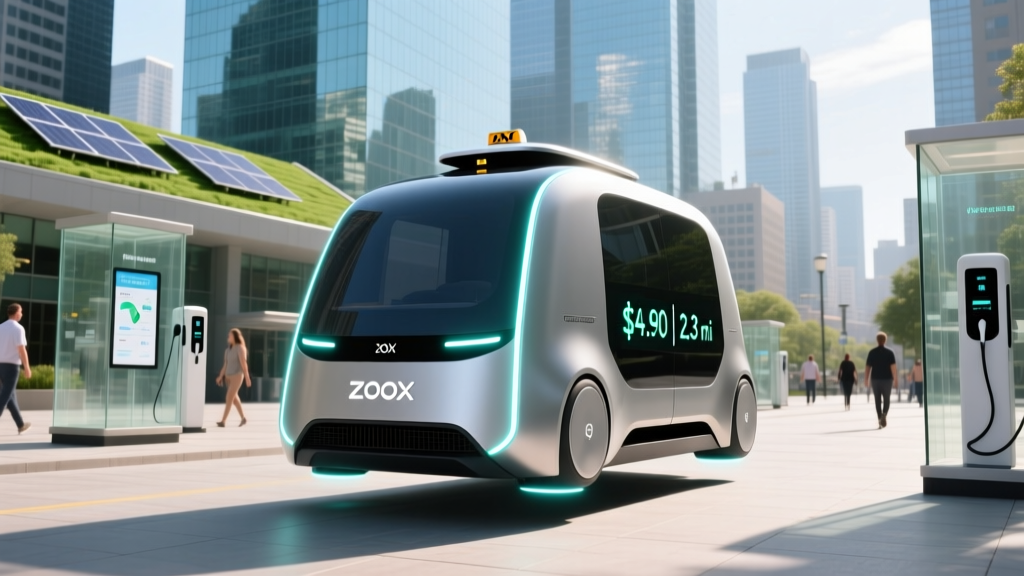
Zoox, the autonomous-vehicle subsidiary Amazon acquired in 2020, operates a purpose-built robotaxi — a carriage-style, bidirectional electric vehicle with no steering wheel, pedals, or driver's seat. Unlike the Level 2 driver-assist systems you'll find in consumer cars (Tesla Autopilot, GM Super Cruise, Ford BlueCruise), Zoox rides are classified as SAE Level 4 within their operational design domain. That means the vehicle handles all driving tasks without any human supervision inside the geofenced service area.
| Level | Description | Example |
|---|---|---|
| Level 0–1 | No automation / single-feature assist (cruise control) | Most conventional cars |
| Level 2 | Combined steering + speed assist; driver must monitor | Autopilot, Super Cruise, BlueCruise |
| Level 3 | Conditional automation; driver must take over on request | Mercedes Drive Pilot (limited markets) |
| Level 4 | High automation within geofenced ODD; no driver needed | Zoox, Waymo (in service areas) |
| Level 5 | Full automation everywhere, all conditions | Does not yet exist commercially |
Zoox operates at Level 4. The vehicle is fully driverless inside its approved zone but cannot operate outside that zone or in severe conditions.
This distinction matters because consumer marketing often blurs these lines. When you step into a Zoox vehicle, there is nobody in the front seat. The car navigates, merges, parks, and handles intersections autonomously. A remote fleet-assistance team monitors vehicles and can provide high-level guidance, but they do not joystick-drive the car in real time.
Where Can You Hail Zoox Rides Right Now?
As of early 2026, Zoox has moved beyond its long-running employee-only pilot in Foster City, California, and expanded commercial (or near-commercial) service to a handful of cities. Availability remains tightly geofenced — you can't hail a Zoox from one suburb to another across a metro area. You're limited to defined corridors.
| City | Status | Service Area Notes | Access |
|---|---|---|---|
| Foster City, CA | Operational | Core test zone; suburban corridors | Employees + early-access riders |
| Las Vegas, NV | Operational | Las Vegas Strip and downtown corridor | Waitlist / invite-based |
| San Francisco, CA | Testing / limited rides | Select neighborhoods; expanding zones | Invite / employee program |
| Austin, TX | Testing phase | Downtown and adjacent areas | Limited access |
| Atlanta, GA | Announced / early testing | Midtown corridor | Not yet public |
Regulatory approval is city-by-city and state-by-state. California's Public Utilities Commission (CPUC) and the DMV oversee permits, while Nevada's DMV and state legislature established the framework that allowed Las Vegas deployment. Texas and Georgia have their own approval processes. Zoox cannot simply flip a switch and expand — each city requires mapping, validation, and regulatory clearance.
How to Book and What Zoox Rides Cost vs. Uber
Booking a Zoox ride works similarly to Uber or Lyft through the Zoox mobile app: you enter a pickup and drop-off location within the geofenced zone, confirm, and the vehicle arrives. Because the vehicle is bidirectional (it can drive equally well in either direction), it can pull up facing either way, which simplifies curb-side pickup in tight urban areas.
Pricing during the current expansion phase has been heavily subsidized — early riders in Las Vegas and Foster City have reported free or deeply discounted rides as Zoox builds its rider base and collects operational data. For a sense of where commercial pricing will likely land once the service scales:
| Metric | Zoox (Projected Commercial) | UberX (2025–2026 Avg) | Waymo One (Phoenix/SF) |
|---|---|---|---|
| Base fare | ~$2.50–$3.50 | ~$2.50–$3.00 | ~$3.00–$4.00 |
| Per-mile rate | ~$1.20–$1.80 | ~$1.30–$1.90 | ~$1.50–$2.00 |
| Per-minute rate | ~$0.25–$0.40 | ~$0.20–$0.35 | ~$0.30–$0.45 |
| 3-mile city trip (est.) | $9–$14 | $10–$16 | $11–$17 |
| Surge pricing | Expected but unconfirmed | Yes, frequent | Yes |
| Tipping | No (no driver) | Expected | No |
The structural advantage for robotaxi operators is the elimination of the driver's cut — typically 55–75% of the fare goes to the human driver on Uber/Lyft. Zoox's challenge is that vehicle cost, sensor suites, remote fleet monitoring, and insurance are expensive. Over time, at scale, the per-ride cost should undercut human-driven rideshare, but during the current growth phase, expect pricing to be competitive with — not dramatically cheaper than — UberX.
The Zoox Vehicle: Tech Stack and Engineering
Zoox's purpose-built robotaxi is unlike any consumer EV on the market. It's a compact, symmetrical vehicle designed from the ground up for autonomous urban mobility — not a retrofitted production car with bolted-on sensors.
- Battery: ~33 kWh (LFP chemistry), sufficient for a full day of urban stop-and-go operation
- Range: ~100–120 miles per charge (urban cycle; no highway driving)
- Top speed: 75 mph (electronically limited; rarely reached in city zones)
- Dimensions: Compact footprint (~15.5 ft long), seating 4 passengers face-to-face
- Sensor suite: Roof-mounted lidar array (multiple units for 360° coverage), radar, and cameras — a sensor-fusion approach, not camera-only
- Compute: Onboard high-performance computing cluster processing lidar point clouds, camera feeds, and radar returns in real time
- Bidirectional driving: Identical sensor and propulsion hardware on both ends — the vehicle can drive equally well in either direction without turning around
- Connectivity: Continuous cellular/5G link to fleet operations for monitoring and remote guidance
The lidar-heavy approach is a deliberate contrast to Tesla's camera-only strategy. Zoox uses lidar to generate precise 3D point clouds of the environment, which provides reliable depth perception independent of lighting conditions. Radar adds velocity data for tracking moving objects. Cameras handle lane markings, traffic signals, and object classification. This redundant sensor fusion is standard across most Level 4 operators (Waymo also relies heavily on lidar).
The bidirectional design is more than a novelty — it eliminates the need for three-point turns or U-turns in narrow streets. If a Zoox vehicle enters a dead-end, it simply reverses out using its full sensor suite in the other direction, with the same level of perception as forward driving.
Safety Record: What the Data Actually Shows
Zoox's safety record is still being built in public. Unlike Waymo, which has published extensive safety reports covering tens of millions of driverless miles, Zoox has accumulated fewer public miles as a commercial service. Here's what we know:
- Total autonomous test miles: Several million miles across Foster City, Las Vegas, San Francisco, and other test cities (cumulative since 2020)
- Reported at-fault collisions: Very low count in public California DMV collision reports; most incidents during testing involved other vehicles contacting the Zoox at low speed
- Disengagement rate: Zoox reports disengagement data to the CA DMV annually; the trend has been declining (fewer interventions per 1,000 miles) as software matures
- No reported passenger injuries in public-facing ride operations to date
- NHTSA Standing General Order: Zoox is required to report all crashes involving ADS-equipped vehicles within 24 hours under NHTSA's crash-reporting mandate
Context matters here. Zoox has operated primarily in low-speed urban environments with extensive mapping and validation. The vehicle's conservative driving behavior — it yields generously, avoids aggressive lane changes, and maintains large following distances — reduces collision risk but can frustrate human drivers behind it. This is a common pattern across robotaxi operators: the vehicles are cautious to a fault, and most incidents involve human drivers rear-ending or side-swiping a robotaxi that stopped unexpectedly.
For comparison, Waymo reported in its 2024 safety study that its driverless vehicles in Phoenix and San Francisco had roughly 5.7x fewer police-reported injury crashes per million miles than human benchmarks in the same cities. Zoox has not yet published a comparable large-scale study, largely because its commercial mileage is still an order of magnitude smaller.
Current Limitations: Where Zoox Can't Go
Level 4 autonomy means full self-driving — but only within a tightly defined operational design domain (ODD). Step outside that domain, and the vehicle will not operate. Here are the hard constraints you'll encounter with Zoox rides today:
- Geofencing: Zoox vehicles will not leave their approved service zone. A ride from downtown Las Vegas to Henderson or the airport may not be available if those areas aren't mapped and approved.
- Weather restrictions: Heavy rain, fog, snow, or dust storms can ground the fleet. Lidar performance degrades in heavy precipitation, and camera visibility drops. Zoox will pause service rather than risk degraded perception.
- Construction zones: Unmapped road changes, temporary lane shifts, and complex construction zones can cause the vehicle to stop and request remote fleet assistance, adding delay.
- No highway driving: The vehicle is designed for urban speeds. You won't take a Zoox on an interstate at 70 mph — it stays within city streets inside its geofence.
- Accessibility: While the vehicle is designed with a low floor and wide doors, wheelchair accommodation and ADA compliance details vary by deployment city. Confirm accessibility options in the app before booking.
- Passenger limits: Maximum 4 passengers; no car seats or large cargo. This is a people-mover, not a delivery van.
- Wait times: Fleet sizes are still small (dozens to low hundreds of vehicles per city), so wait times during peak hours can be 10–20 minutes — longer than Uber/Lyft in the same area.
These limitations aren't unique to Zoox — they apply to every Level 4 robotaxi operator today. The technology has matured enormously, but it remains a city-specific service, not a replacement for personal vehicle ownership or long-distance travel.
The Regulatory Landscape: Who Approves Robotaxi Operations
Deploying a driverless taxi in the United States requires navigating a patchwork of state and local regulations. There is no single federal license for robotaxis. Instead:
- California: The DMV issues testing permits and deployment permits. The CPUC oversees commercial passenger service. Zoox holds both testing and limited deployment permits. After several high-profile incidents involving Cruise in San Francisco in late 2023, California regulators tightened oversight, requiring more granular reporting and incident response plans.
- Nevada: The state legislature passed enabling legislation for autonomous vehicles, and the Nevada DMV issues AV licenses. Las Vegas has been particularly welcoming to robotaxi testing, viewing it as a tourism differentiator.
- Texas: Austin has attracted multiple AV companies. State law permits AV operation with a safety framework, and local authorities coordinate on geofencing and curb access.
- Federal (NHTSA): The National Highway Traffic Safety Administration sets vehicle safety standards (FMVSS). Zoox received a notable exemption from certain FMVSS requirements (like steering wheels and mirrors) because its purpose-built vehicle doesn't have them. NHTSA also mandates crash reporting under its Standing General Order for all ADS-equipped vehicles.
This fragmented regulatory environment means expansion is slow and deliberate. Each new city requires months or years of engagement with local regulators, first responders, and community stakeholders before a single paying passenger gets picked up.
Frequently Asked Questions
Is Zoox truly self-driving, or is there a safety driver?
In its commercial service areas, Zoox vehicles are fully driverless — there is no human behind a wheel because there is no steering wheel. This is SAE Level 4 autonomy within the geofenced operational domain. A remote fleet-assistance team monitors operations but does not directly control the vehicle in real time. This is fundamentally different from Level 2 systems like Tesla Autopilot or GM Super Cruise, which require an attentive human driver at all times.
How much do Zoox rides cost compared to Uber or Lyft?
During the current expansion phase, many Zoox rides have been free or heavily subsidized. Once commercial pricing goes live, expect fares comparable to UberX — roughly $9–$14 for a typical 3-mile city trip. The elimination of driver pay gives robotaxi operators a structural cost advantage long-term, but vehicle, sensor, and fleet-operating costs offset that savings in the near term. No tipping is expected since there's no driver.
Where can I ride in a Zoox right now?
Zoox has operational or near-operational service in Foster City, CA (its headquarters test zone), Las Vegas, NV (Strip and downtown), and limited access in San Francisco. Austin, TX, and Atlanta, GA, are in earlier testing phases. Access is generally invite-based or waitlist-driven rather than fully open to the public. Check the Zoox app or website for current availability in your city.
What happens if the Zoox vehicle encounters an emergency?
Zoox vehicles are equipped with multiple redundant systems — dual braking, dual steering, and backup power. If a system fault is detected, the vehicle will execute a controlled stop at the nearest safe location. Passengers have an in-cabin communication system to contact fleet assistance. The vehicle will not continue driving if it detects a critical system degradation.
Can I use Zoox for airport runs or long trips?
Not currently. Zoox is designed for short urban trips within its geofenced zone. The vehicle's top speed is 75 mph, its range is roughly 100–120 miles, and it is not approved for highway or interstate operation. If your destination falls outside the service area, the app will not allow you to book the ride.
How does Zoox compare to Waymo?
Waymo (Alphabet's robotaxi unit) is significantly more mature commercially, with open commercial service in Phoenix, San Francisco, Los Angeles, and expanding to additional cities. Waymo uses modified Jaguar I-PACE and Zeekr vehicles with rooftop lidar, while Zoox uses its own purpose-built carriage-style vehicle. Waymo has accumulated far more driverless commercial miles and has published more extensive safety data. Zoox's advantage is its ground-up vehicle design optimized specifically for rider experience (face-to-face seating, bidirectional driving), but it is earlier in its commercial rollout.