When shoppers search for Hyundai self-driving cars, they encounter a confusing mix of marketing and reality. Hyundai sells consumer vehicles with advanced driver-assistance — but its true driverless ambitions live in Motional, the Hyundai-Aptiv joint venture operating Level 4 robotaxis in select U.S. cities. This guide separates what you can buy today from what you can ride, with exact specs, service boundaries, and safety data.
What Hyundai Actually Offers: Consumer ADAS vs. Motional Robotaxis
SAE Automation Levels — The Critical Distinction
| Level | Name | Who Drives | Hyundai Example |
|---|---|---|---|
| Level 2 | Driver Assistance | Human (eyes on road) | Highway Driving Assist (HDA) on Ioniq 5/6 |
| Level 3 | Conditional Automation | System in limited zones; human must take over on request | Not currently offered in U.S. consumer models |
| Level 4 | High Automation | System (no driver needed in geofenced area) | Motional robotaxi (Ioniq 5-based) |
| Level 5 | Full Automation | System everywhere, all conditions | Does not exist commercially |
Source: SAE International J3016
If you buy a 2026 Hyundai Ioniq 5, Ioniq 6, or Genesis Electrified GV70, you're getting Level 2 driver-assist — specifically Highway Driving Assist 2 (HDA2) and, on higher trims, Highway Driving Assist with lane-change assist. These systems require continuous driver supervision. You cannot nap, read, or look away.
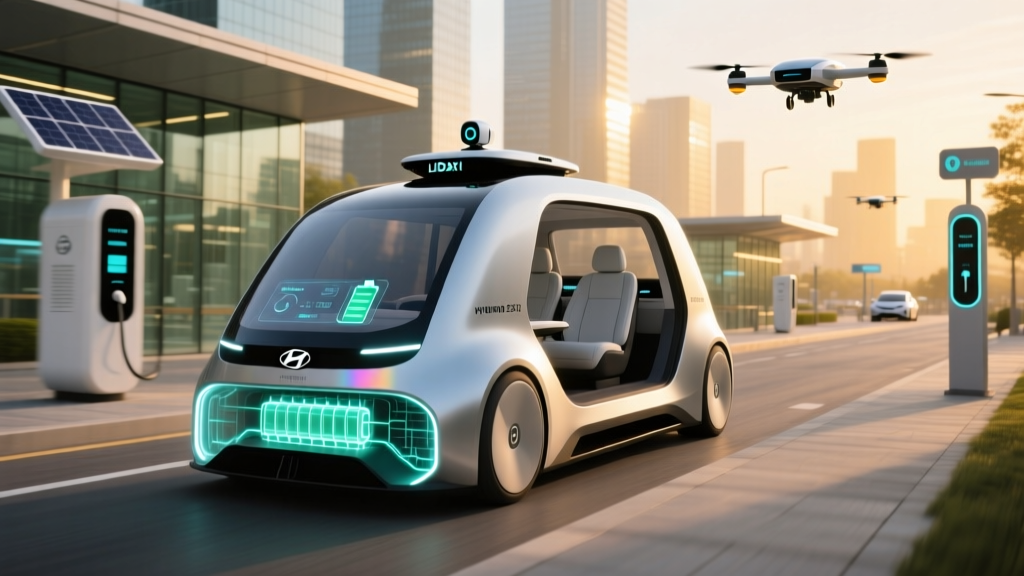
Motional's robotaxi is a fundamentally different product: a heavily modified Ioniq 5 equipped with a redundant sensor suite, operating without any human driver inside the vehicle, within a mapped geofence.
The Motional Robotaxi: Platform, Sensor Stack, and Geofencing
Motional Ioniq 5 Robotaxi Hardware
- Base vehicle: Modified Hyundai Ioniq 5 (77.4 kWh usable battery, NMC chemistry)
- LiDAR: Multiple solid-state and spinning units (Valeo, Luminar-class) for 360° 3D mapping up to ~200m
- Cameras: 12+ surround-view cameras for lane, sign, signal, and pedestrian detection
- Radars: Forward and corner radars for velocity/distance on moving objects in adverse weather
- HD Maps: Centimeter-precision pre-mapped routes, updated continuously
- Compute: Redundant NVIDIA-class AI compute with failover
- V2X: Vehicle-to-infrastructure communication at select intersections
Unlike Tesla's camera-only approach, Motional uses a LiDAR-first, multi-sensor fusion stack — similar to Waymo. This provides depth perception independent of lighting conditions, critical for night operations and sun glare. The tradeoff is higher per-vehicle hardware cost (estimated $100,000+ in sensor/compute additions over stock Ioniq 5).
Geofencing is non-negotiable: the vehicle will not operate outside its pre-mapped zone. If it approaches the boundary, it executes a safe pullover. This is a Level 4 requirement — the system only promises capability within its Operational Design Domain (ODD).
Where Can You Ride a Motional Robotaxi Right Now?
| City | Status (2026) | Service Area | Hours | Access |
|---|---|---|---|---|
| Las Vegas, NV | Live (public) | Las Vegas Strip, downtown, Convention Center corridor (~15 sq mi) | Typically 10am–11pm | Uber integration + Motional app |
| Los Angeles, CA | Limited public pilot | Santa Monica, West LA zones | Daytime hours | Invite-only / Lyft integration |
| Boston, MA | Testing / restricted | Seaport, select downtown corridors | Variable | Not publicly bookable |
| Singapore | Announced pilot | Select districts | TBD | Not live as of 2026 |
Where can I use this robotaxi service right now? Realistically, only Las Vegas offers consistent public access via Uber. If you're not in that geofence — which covers tourist corridors but excludes suburbs, the airport, and most residential areas — a Motional robotaxi is not an option. Los Angeles service has been slow to scale beyond a small zone.
Pricing: Motional vs. Uber, Lyft, and Waymo
| Service | Typical 3-Mile Fare (Vegas) | Surge Pricing | Wait Time |
|---|---|---|---|
| Motional (via Uber) | $8–$15 (often promotional) | Yes, Uber surge applies | 5–15 min |
| UberX (human driver) | $10–$18 | Yes | 3–8 min |
| Lyft (human driver) | $10–$17 | Yes | 3–8 min |
| Waymo One (Phoenix/SF) | $12–$22 | Limited surge | 5–12 min |
How much does it cost vs Uber/Lyft? Motional frequently subsidizes rides to build adoption, so you may pay less than a human-driven UberX on the same route. However, promotional pricing is not sustainable long-term. At parity pricing, Motional needs high utilization (15+ paid hours/day) to offset the six-figure vehicle cost.
How to book: Open the Uber app in Las Vegas, enter a destination inside the Motional geofence, and look for the "Autonomous" vehicle option. You'll confirm you're comfortable with a driverless ride, then be matched. The app shows the vehicle's approach on a map — no steering wheel, no driver seat occupant.
Safety Record: What the Data Actually Shows
Motional Safety Metrics (Public Filings & Reports)
- Total autonomous miles driven: ~2+ million driverless miles (cumulative across all test and commercial operations, per Motional disclosures)
- Reported at-fault collisions: Very low single digits; most incidents involve other vehicles rear-ending or sideswiping the robotaxi at low speed
- Disengagement rate: Not publicly broken out per 1,000 miles in the same format as California DMV reports (Motional's primary commercial operations are in Nevada)
- Compare to Waymo: Waymo reports ~7+ million driverless miles across Phoenix, SF, LA, Austin with detailed NHTSA standing-general-order data
Sources: NHTSA Standing General Order crash reporting, Motional press disclosures
How safe are robotaxis (real data)? The honest answer: Motional's commercial exposure is far smaller than Waymo's, so statistical comparison is premature. What we know from NHTSA crash reporting is that Level 4 robotaxis across the industry are involved in low-speed incidents at rates comparable to or below attentive human drivers in urban settings — but the sample sizes differ enormously.
Most Motional incidents have been minor: a human driver rear-ends the robotaxi at a stop, or clips it during a lane change. The vehicle's conservative driving style (long following distances, deliberate stops) reduces at-fault events but can frustrate surrounding human drivers.
Current Limitations: What Motional Robotaxis Cannot Do
Hard Constraints of Level 4 Operation
- Weather: Heavy rain, fog, or dust storms degrade LiDAR and camera performance. Service may be suspended or routes restricted. Snow/ice = no operation.
- Geofence rigidity: Cannot take you to the airport if it's outside the zone. Cannot reroute around a major closure if the detour exits the map.
- Construction zones: Major, unmapped construction can force the vehicle to pull over and wait for remote-assist resolution.
- Complex unprompted scenarios: Police directing traffic with hand signals, off-road detours, or unusual events (parades, protests) may trigger a safe-stop.
- Passenger assistance: No driver to help with wheelchairs, large luggage, or child seats. Vehicles are standard Ioniq 5 cabins — not purpose-built robotaxi pods.
- Hours of operation: Not 24/7; most services pause overnight.
What are the current limitations? Think of a Motional robotaxi as a very capable train on invisible rails. Inside its zone, in good conditions, it handles routine urban driving reliably. Outside those bounds — literal, meteorological, or situational — it cannot improvise the way a human driver can.
Regulatory Landscape: Who Approves Robotaxi Operations?
Robotaxi deployment is governed by a patchwork of state and federal authorities:
- NHTSA (federal): Sets vehicle safety standards (FMVSS); requires crash reporting via Standing General Order. Does NOT approve commercial robotaxi operations.
- State DMVs and PUCs: Nevada, California, Arizona, and a handful of other states have specific permitting frameworks for driverless testing and commercial deployment.
- Local jurisdictions: Cities and counties can restrict operations (e.g., San Francisco's friction with Cruise/Waymo in 2023-2024).
- Nevada's framework: Relatively permissive — requires a self-driving permit, insurance, and crash reporting. This is why Las Vegas is Motional's primary commercial beachhead.
- California DMV: Requires separate testing and deployment permits, with public disengagement reports. Motional has been slower to scale here versus Waymo and Zoox.
There is no single federal "robotaxi license." Each expansion city requires a new permit, local negotiations, and mapping work — which is why scaling is measured in years, not months.
What You Can Buy Today: Hyundai's Consumer ADAS Lineup
If you want a Hyundai with the most advanced driver-assist available to consumers in 2026, here's what's on dealer lots — all Level 2, all requiring active supervision:
| Model | ADAS Suite | Key Features | Starting MSRP (approx.) |
|---|---|---|---|
| Ioniq 5 (SEL/Limited) | HDA2 | Adaptive cruise + lane centering + lane-change assist on highways | $44,000–$54,000 |
| Ioniq 6 (Limited) | HDA2 | Same as Ioniq 5; lower drag for highway efficiency | $47,000–$55,000 |
| Genesis Electrified GV70 | HDA2 + remote parking | Highway assist + remote smart parking assist | $68,000+ |
| Ioniq 9 (3-row SUV) | HDA2 | Latest-gen HDA with enhanced curve speed management | $55,000–$72,000 |
Is this truly self-driving or driver-assist? Every Hyundai you can purchase is Level 2 driver-assist. HDA2 is competitive with Toyota Safety Sense 3.0, Honda Sensing, and GM's Super Cruise — but it is not self-driving. You are the driver. You are liable. Hands on or eyes on, per system design.
Frequently Asked Questions
Can I buy a Hyundai that drives itself?
No. No Hyundai, Genesis, or Kia consumer vehicle sold in the U.S. is Level 3 or higher. The closest experience is Highway Driving Assist 2 on highways, which still requires your supervision and input.
Is the Motional robotaxi an Ioniq 5 I can buy?
No. The Motional vehicle is a heavily modified Ioniq 5 with ~$100,000+ in added sensors and compute. It is not sold to consumers and cannot be registered for private ownership.
How does Motional compare to Waymo?
Waymo has far more commercial miles (7M+ driverless vs. Motional's ~2M+), operates in more cities (Phoenix, SF, LA, Austin), and uses the Jaguar I-PACE and purpose-built Zeekr vehicle. Motional's Ioniq 5 platform is competitive on sensor hardware but has scaled more slowly.
Will Hyundai release a Level 3 consumer car?
Hyundai has demonstrated Level 3-capable prototypes, but U.S. regulatory approval for hands-off, eyes-off consumer Level 3 has not been granted. Mercedes-Benz offers limited Level 3 (DRIVE PILOT) in Nevada and California on the EQS and S-Class — the only consumer Level 3 in the U.S. as of 2026.
What happens if the Motional robotaxi encounters a problem mid-ride?
The vehicle is designed to execute a "minimal risk condition" — typically a controlled pull-over to the curb with hazard lights. A remote-assist operator can provide guidance, but does not remotely drive the vehicle.
Do I need a special app to ride a Motional robotaxi?
In Las Vegas, you can book through the Uber app by selecting the Autonomous option. The standalone Motional app is also available in some markets but Uber integration is the primary consumer access point.
Is Hyundai investing in full Level 5 autonomy?
Hyundai and Motional do not publicly commit to Level 5 timelines — and neither does any credible industry player. Level 5 (everywhere, all conditions, no steering wheel) remains a research goal, not a product roadmap milestone.
The Bottom Line for Hyundai Buyers and Robotaxi Riders
If your search for "Hyundai self-driving cars" was driven by a desire to buy a self-driving Hyundai, the answer in 2026 is that no such vehicle exists for consumers. You can buy excellent Level 2 driver-assist in the Ioniq 5, Ioniq 6, and Ioniq 9 — but you remain the driver.
If you want to ride in a truly driverless Hyundai, your realistic option is a Motional robotaxi on the Las Vegas Strip via Uber — with Los Angeles slowly expanding. The technology is real, the safety record is cautiously encouraging, and the pricing is often promotional. But availability is narrow, weather-dependent, and geofence-bound.
For most EV buyers, the practical decision is this: evaluate Hyundai's HDA2 on its merits as a strong Level 2 system in a competitive EV lineup, and treat robotaxi access as an occasional novelty if you happen to live in or visit a deployment city. True autonomy at scale remains a multi-year, multi-billion-dollar project — not a 2026 model-year feature.