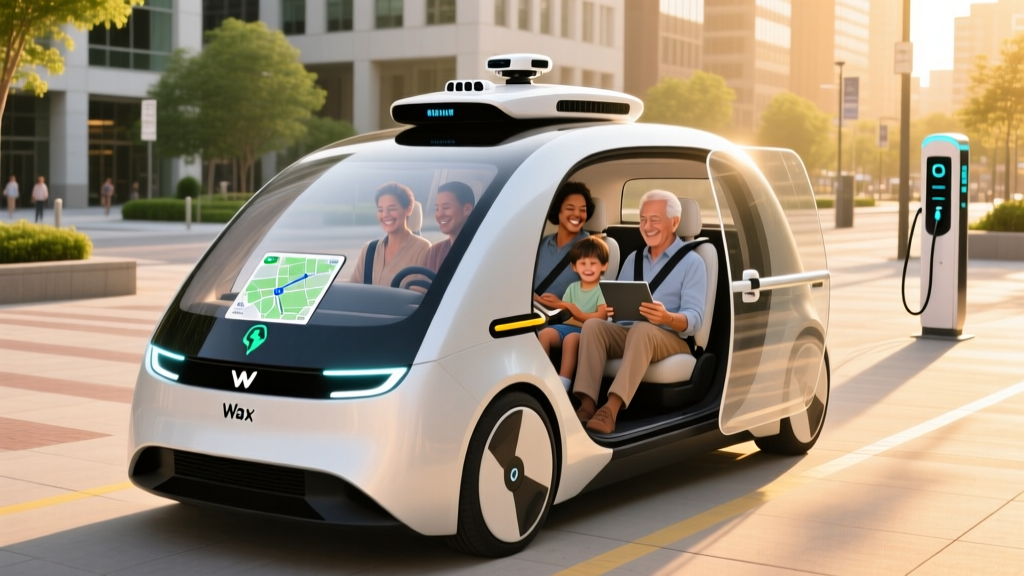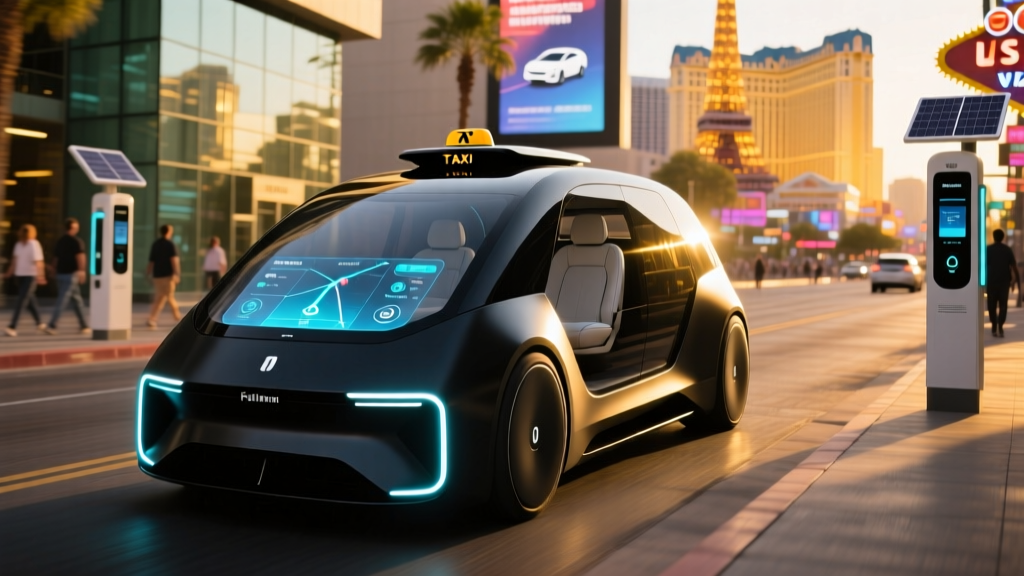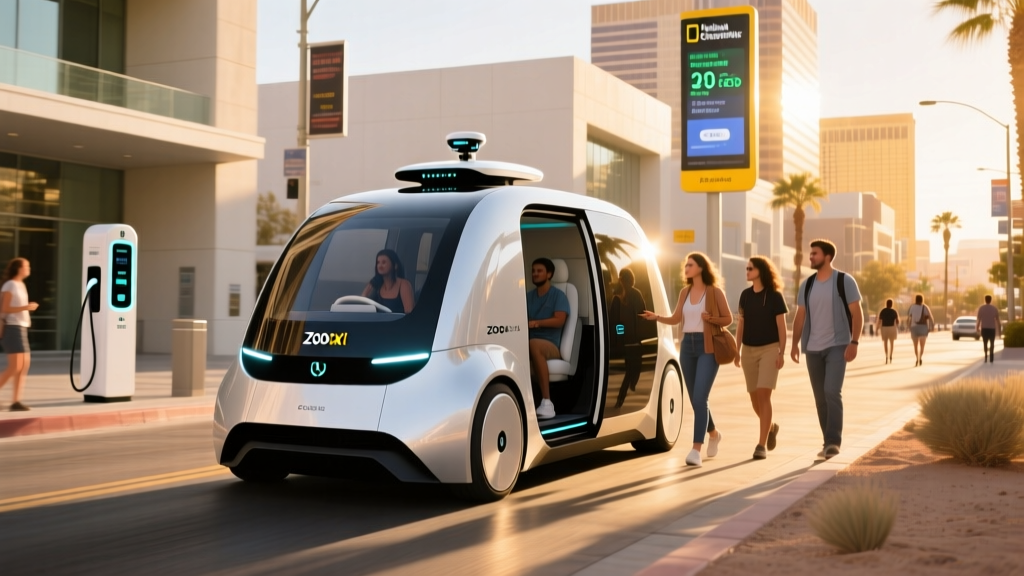
If you've spotted Zoox's compact, carriage-style vehicles navigating Las Vegas streets, you've probably wondered: how much does a ride actually cost, and can you hail one right now? Amazon's autonomous vehicle subsidiary has been quietly expanding its driverless footprint in Nevada, and understanding the real economics of riding in one requires separating marketing hype from operational reality.
This guide covers Zoox's current Las Vegas pricing structure, where the service operates, how it stacks up against traditional rideshare, and the hard data behind its safety record. Whether you're a visitor planning a trip or a local considering ditching your car, here's what you need to know about riding Zoox in 2026.
Is Zoox Actually Self-Driving? Understanding SAE Level 4
Before discussing pricing, it's critical to establish what Zoox actually is—and isn't. Zoox operates a SAE Level 4 autonomous vehicle, which means the system handles all driving tasks within its defined operational domain (specific geofenced areas under certain conditions) with no human driver present. There is no steering wheel, no pedals, and no safety operator in the vehicle.
| Level | Definition | Example |
|---|---|---|
| Level 2 | Driver assistance — human must supervise at all times | Tesla Autopilot, GM Super Cruise, Ford BlueCruise |
| Level 3 | Conditional automation — driver must be ready to take over | Mercedes Drive Pilot (limited markets/conditions) |
| Level 4 | High automation — no driver needed within operational domain | Zoox, Waymo (in defined geofences) |
| Level 5 | Full automation — any road, any condition (not yet achieved commercially) | None currently available |
Consumer vehicles like Tesla's FSD (Supervised) are Level 2 — the driver remains legally responsible. Zoox and Waymo are Level 4 — the system is responsible within its approved zone.
This distinction matters for liability, insurance, and your expectations as a rider. In a Zoox, you are a passenger, not a driver. The company bears operational responsibility for the vehicle's behavior within its approved service area.
Where Can I Ride Zoox Right Now?
Zoox's service availability is geofenced — the vehicles operate only within pre-mapped, regulator-approved zones. As of early 2026, Zoox has been testing and operating its purpose-built robotaxi on public roads in a growing number of locations.
| City | Status | Service Area Notes |
|---|---|---|
| Las Vegas, NV | Active — public road testing and limited rider access | Las Vegas Strip corridor and surrounding areas; expansion ongoing |
| San Francisco, CA | Active — headquarters and primary test market | Multiple neighborhoods; broadest operational footprint |
| Foster City, CA | Active — early deployment zone | Suburban environment near Zoox HQ |
| Austin, TX | Testing/expansion phase | Selected corridors under evaluation |
| Atlanta, GA | Testing/expansion phase | Initial mapping and validation underway |
| Seattle, WA | Testing/expansion phase | Amazon HQ city; phased rollout |
In Las Vegas specifically, Zoox received a Nevada Transportation Authority testing permit and has been operating on public roads including sections near the Las Vegas Strip. However, fully open, on-demand public rides (where anyone can hail via app without an invitation) remain limited. Access has primarily been through employee programs, invited riders, and phased public launches. Check the Zoox website or app for current availability before planning a trip around the service.
How Much Does a Zoox Ride Cost vs. Uber and Lyft?
This is the question most riders want answered, and the honest answer is: Zoox has not published a fixed, publicly available per-ride pricing menu as of early 2026. During its limited-access phases in Las Vegas and other cities, rides have largely been offered at no charge to invited riders or at promotional rates as the company builds operational data and rider familiarity.
However, based on the competitive landscape and statements from Zoox and Amazon leadership, here's the pricing framework to expect when Zoox transitions to full commercial fare-charging:
| Factor | Zoox (Projected) | Uber/Lyft (Las Vegas Avg.) |
|---|---|---|
| Base fare | ~$2.00–$3.00 | ~$2.50–$3.50 |
| Per-mile rate | ~$1.00–$1.50 | ~$1.25–$1.75 |
| Per-minute rate | ~$0.20–$0.35 | ~$0.25–$0.40 |
| Surge pricing | Lower volatility (fleet-managed) | Can spike 2–4× during events |
| Tip expected | No (no driver) | Yes (~15–20% customary) |
| Est. 5-mile Strip ride | ~$9–$14 | ~$12–$22 (varies with surge) |
Note: Zoox pricing is projected based on industry analysis and competitor positioning. Actual fares will be confirmed when Zoox launches full commercial service. Uber/Lyft figures are approximate Las Vegas averages and fluctuate with demand.
The key economic advantage for Zoox is the elimination of the driver's share. In a traditional rideshare, the driver typically takes 60–75% of the fare. Zoox's model replaces that with vehicle depreciation, sensor maintenance, remote fleet operations, and electricity costs — which, at scale, the company projects will undercut human-driven rideshare on a per-mile basis.
For a typical Las Vegas Strip ride — say, from the Wynn to MGM Grand (roughly 3–4 miles) — expect fares in the $8–$15 range once commercial pricing goes live, with the main savings coming from the absence of tipping and reduced surge pricing volatility. Zoox's fleet is centrally managed, so pricing spikes should be less extreme than Uber/Lyft's algorithmic surge.
How to Request a Zoox Ride in Las Vegas
Using Zoox is straightforward but differs from traditional rideshare in a few important ways:
- Download the Zoox app — available on iOS and Android. Create an account and verify your identity.
- Check service availability — the app will show whether you're within the active geofenced zone and whether service is currently operating (hours may be limited).
- Set pickup and dropoff — both must be within the approved service area. Zoox uses designated pickup zones rather than arbitrary curbside stops in some areas.
- Confirm your ride — the vehicle arrives autonomously. Look for the distinctive Zoox carriage-style vehicle (compact, symmetrical, no traditional front/back).
- Board and ride — the doors open via the app or vehicle interface. Inside, you'll find forward- and rear-facing seats with touchscreens showing your route.
- Arrive — the vehicle navigates to your destination. You exit, and it departs for the next rider.
Key differences from Uber/Lyft: You cannot request a specific route or make mid-trip stops. The vehicle follows its planned path. There is no driver to communicate with, but a remote support team monitors all rides and can be contacted via in-vehicle interface.
Zoox Safety Record: What the Data Shows
- Testing miles: Zoox has accumulated millions of autonomous testing miles across its fleet in multiple cities since beginning public-road operations.
- Disengagement rate: In California DMV disengagement reports, Zoox has reported disengagement rates (instances where a safety driver or remote operator must intervene) that have improved significantly year-over-year as the system matures. Exact rates vary by reporting period and operational domain complexity.
- At-fault collisions: As of the most recent publicly available data, Zoox has reported a small number of minor contact incidents during testing, consistent with the volume seen across the autonomous vehicle industry during validation phases. No fatal incidents involving Zoox vehicles have been publicly reported.
- NHTSA Standing General Order: Zoox, like all ADS-equipped vehicle operators, is required to report crashes to the National Highway Traffic Safety Administration under the Standing General Order for automated driving systems.
Source: California DMV Autonomous Vehicle Disengagement Reports, NHTSA crash reporting, Zoox safety publications. Data reflects publicly available figures as of early 2026.
For context, the Insurance Institute for Highway Safety (IIHS) and NHTSA continue to monitor robotaxi operations, and the broader autonomous vehicle industry has seen mixed safety outcomes. Waymo's larger operational footprint in Phoenix and San Francisco has generated more public incident data, while Zoox's more conservative rollout has produced fewer public data points — which can be interpreted as either cautious validation or insufficient real-world exposure, depending on your perspective.
The critical comparison is against human drivers. NHTSA data consistently shows that human error contributes to approximately 94% of traffic crashes. Robotaxis aim to eliminate impairment, distraction, and fatigue — the leading crash contributors. Whether the current generation of Level 4 systems has achieved statistical parity with or superiority to human drivers across all conditions remains an active area of research and debate.
Technology Stack: How Zoox Sees the Road
Zoox's purpose-built vehicle (not a retrofitted production car) carries a comprehensive sensor suite designed for 360-degree perception:
| Sensor Type | Function | Coverage |
|---|---|---|
| LiDAR | 3D point-cloud mapping of surroundings; precise distance measurement | 360° overlapping fields; multiple units per vehicle |
| Cameras | Object classification, traffic signal/ sign reading, lane detection | 360° high-resolution array |
| Radar | Velocity detection of moving objects; functions in rain/fog | Multi-directional |
| Ultrasonic | Near-field obstacle detection at low speeds | Close-proximity ring |
| HD Mapping | Pre-built centimeter-accurate maps of operational domain | Entire geofenced area |
| GNSS/IMU | Precise vehicle localization within the map | Continuous |
Unlike Tesla's camera-only approach (which relies on neural networks to infer depth from 2D imagery), Zoox uses a sensor-fusion architecture combining LiDAR, cameras, and radar. This redundancy is standard across most Level 4 operators — the philosophy being that no single sensor modality should be a single point of failure. If a camera is blinded by sun glare, LiDAR still provides depth data. If rain degrades LiDAR returns, radar still detects moving objects.
The vehicle's computing stack processes these sensor inputs in real time to build a dynamic model of the environment, predict the behavior of other road users, and plan a safe trajectory — all without human input within the approved operational domain.
Regulatory Landscape: Who Approves Zoox Operations?
Robotaxi operations in the United States require approval from multiple regulatory layers:
- State level: Each state sets its own rules for autonomous vehicle testing and commercial deployment. In Nevada, the Nevada Transportation Authority (NTA) and the Nevada Department of Motor Vehicles oversee autonomous vehicle permits. Zoox must hold valid state testing or deployment permits to operate on public roads.
- Federal level: NHTSA sets vehicle safety standards and can issue exemptions for vehicles without traditional controls (steering wheels, mirrors, pedals). Zoox received a notable NHTSA exemption for its purpose-built vehicle, which lacks these conventional features. The agency also mandates crash reporting through its Standing General Order.
- Local level: City governments and transportation authorities may impose additional requirements regarding pickup/dropoff zones, operating hours, and coordination with local traffic management.
This patchwork regulatory environment is why robotaxi services expand city-by-city rather than launching nationally. Each new market requires mapping, validation, permit applications, and ongoing compliance reporting.
Current Limitations: What Zoox Cannot Do
- Geofence boundaries: Zoox operates only within pre-mapped, approved zones. You cannot request a ride to a destination outside the geofence — even if it's just a few blocks beyond the boundary.
- Weather constraints: Heavy rain, flooding, dust storms (relevant in Las Vegas), or other conditions that degrade sensor performance may cause the service to reduce operations or pause entirely.
- Operating hours: Service may not be available 24/7 in all markets. Hours depend on local permits and operational readiness.
- No highway driving: Zoox's Las Vegas operations are focused on surface streets and the Strip corridor — not interstate highways. Long-distance trips are not possible.
- Construction zones: Unexpected road closures, lane shifts, or major construction can confuse the system or fall outside the pre-mapped environment, potentially requiring the vehicle to reroute or the ride to be terminated early.
- Accessibility: While Zoox has stated its vehicle is designed with accessibility in mind, confirm wheelchair-accessible vehicle availability through the app, as fleet composition varies by market.
- No mid-trip changes: You cannot change your destination mid-ride or ask the vehicle to make an unscheduled stop.
These limitations are inherent to the current state of Level 4 autonomy. The system excels within its defined domain but cannot handle the open-ended complexity of arbitrary roads and conditions that a human driver navigates without thought.
Frequently Asked Questions
How much is a Zoox ride in Las Vegas right now?
During its limited-access and testing phases, Zoox rides in Las Vegas have been offered at no cost to invited riders or at promotional rates. Once full commercial service launches, expect fares comparable to or slightly below Uber/Lyft — approximately $8–$15 for a typical Strip-area ride of 3–5 miles, with no tipping required.
Can anyone hail a Zoox in Las Vegas, or is it invite-only?
As of early 2026, Zoox access in Las Vegas has been primarily through invitation, employee programs, and phased public rollout. Full open-access availability (where any app user can request a ride) depends on regulatory approvals and operational scaling. Check the Zoox app for current access status.
Is Zoox safer than a human Uber driver?
Zoox's safety record shows a small number of minor incidents across millions of testing miles, with no publicly reported fatalities. The system eliminates drunk, distracted, and fatigued driving — leading causes of crashes. However, Level 4 systems still face edge cases (unusual construction, extreme weather, unpredictable pedestrian behavior) where human judgment may currently outperform AI. Definitive statistical comparison requires larger operational datasets.
What happens if the Zoox vehicle encounters a problem during my ride?
Zoox vehicles are monitored by a remote fleet assistance team. If the vehicle encounters a scenario it cannot resolve autonomously, it will safely pull over or stop, and remote operators can provide guidance or dispatch assistance. An in-vehicle interface allows you to contact support at any time.
Does Zoox operate at night on the Las Vegas Strip?
Operating hours depend on the current permit scope and operational readiness. LiDAR and radar sensors function effectively at night, and the system is designed for 24-hour operation in principle. However, specific hours of service in Las Vegas should be confirmed via the Zoox app, as they may be restricted during early deployment phases.
How does Zoox compare to Waymo?
Both are SAE Level 4 robotaxi services, but they differ in approach. Waymo uses retrofitted vehicles (Jaguar I-PACE, Zeekr minivans) with added sensor suites and has a larger operational footprint (Phoenix, San Francisco, Los Angeles, Austin). Zoox uses a purpose-built vehicle designed from the ground up for autonomy — no steering wheel or pedals — and has a more conservative city-by-city rollout. Pricing, wait times, and coverage vary by market.
The Bottom Line: Is Zoox Worth Riding in Las Vegas?
If you can access the service, riding in a Zoox in Las Vegas offers a genuine glimpse into the future of urban transportation — a truly driverless experience in a vehicle designed from scratch for autonomy. The expected pricing positions it as a competitive alternative to Uber and Lyft, particularly for short Strip-area trips where the no-tip, low-surge model saves real money.
However, availability remains the primary constraint. Zoox's phased, cautious rollout means you cannot yet rely on it as your sole transportation option in Las Vegas the way you might in parts of Phoenix with Waymo. Plan accordingly: download the app, check your zone, and have a backup rideshare option ready.
As Zoox scales its fleet, secures additional permits, and opens access to the general public, expect pricing details to become more concrete and service reliability to improve. For now, it's a compelling experience for the curious — and a preview of what urban mobility may look like within the decade.