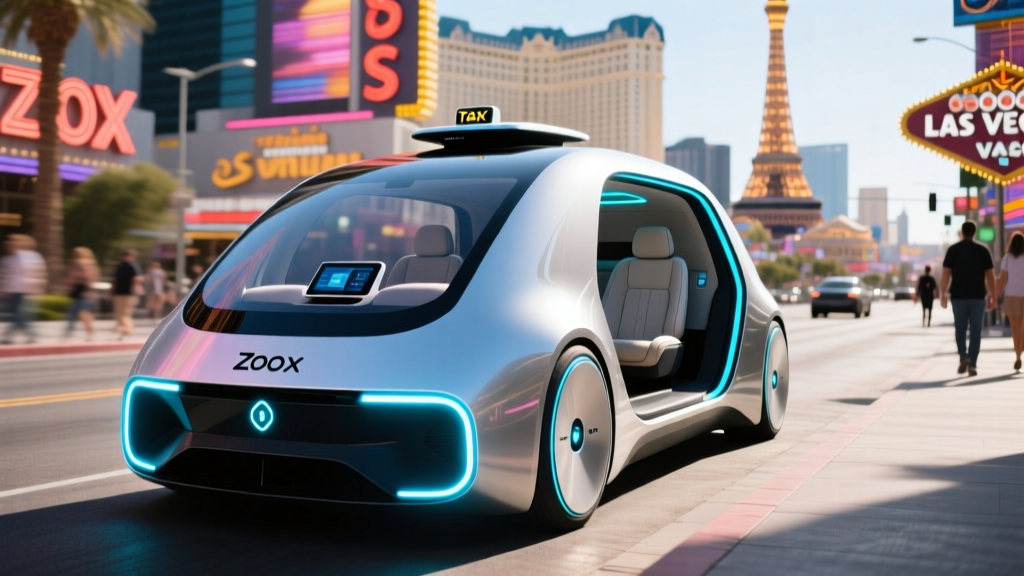
Las Vegas has become one of the most active testing grounds for autonomous ride-hailing in the United States. If you're searching for a driverless taxi in Vegas, two names dominate the conversation in 2026: Zoox (the Amazon-backed startup with its purpose-built carriage) and Motional (the Hyundai-Aptiv joint venture operating modified Ioniq 5s). Neither service is as broadly available as Waymo in Phoenix or San Francisco, but both have carved out meaningful operational footprints on and around the Strip.
This guide cuts through the hype and gives you what actually matters: where you can hail a ride today, what it costs, how the safety record stacks up, and where the technology still falls short.
Is a Driverless Taxi in Vegas Truly Self-Driving?
Yes — but only if we're precise about what "self-driving" means. The robotaxis operating in Las Vegas are classified as SAE Level 4 within their geofenced service areas. That's a critical distinction from the Level 2 driver-assist systems (Tesla Autopilot, Ford BlueCruise, GM Super Cruise) you might use in your own car.
SAE Automation Levels — Quick Reference
| Level | Name | Who Drives | Example |
|---|---|---|---|
| Level 2 | Driver Assistance | Human (hands on or eyes on) | Tesla Autopilot, BlueCruise |
| Level 3 | Conditional Automation | System in narrow conditions, human on standby | Mercedes DRIVE PILOT (limited markets) |
| Level 4 | High Automation | System fully, within geofence/conditions | Waymo, Zoox, Motional robotaxis |
| Level 5 | Full Automation | System everywhere, all conditions | Does not yet exist commercially |
Source: SAE International J3016
When you step into a Zoox carriage or a Motional Ioniq 5 in Las Vegas, there is no one in the driver's seat. The vehicle handles steering, braking, lane changes, and navigation entirely on its own — but only within its approved operational design domain (ODD). Leave that geofence, encounter a dust storm, or hit a construction zone the system hasn't mapped, and the vehicle will execute a safe stop or request remote assistance.
Where Can I Use a Driverless Taxi in Vegas Right Now?
Service availability in Las Vegas is more limited than in Waymo's core cities, and it's split between two operators with different footprints.
| Operator | Vehicle | Vegas Service Area | Hours | Public Access |
|---|---|---|---|---|
| Zoox | Zoox Carriage (purpose-built) | Las Vegas Strip corridor, parts of downtown, airport-adjacent zones | Limited hours (typically daytime/early evening) | Invite-only expanding to public waitlist |
| Motional | Hyundai Ioniq 5 (modified) | Strip corridor, Convention Center, select hotel zones | Limited operational windows | Partnership-based (Uber/Lyft integration in testing) |
Zoox has operated in Las Vegas since 2022, initially with safety drivers in modified Toyota Highlanders, and began testing its purpose-built carriage (a bidirectional, no-steering-wheel vehicle) on public roads in late 2023 and into 2024-2025. As of early 2026, Zoox carriage rides in Vegas remain primarily available to employees, invited riders, and a growing waitlist — not yet a walk-up service for any tourist.
Motional has maintained a Las Vegas presence since 2018, initially through a partnership with Lyft. After restructuring in 2024, Motional scaled back its public ride-hailing ambitions and refocused on the Hyundai Ioniq 5 robotaxi platform. Vegas operations continue, but with a smaller fleet and more constrained hours than the company's earlier Lyft integration offered.
Availability Reality Check
Unlike Waymo in Phoenix or San Francisco — where you can download an app and reliably hail a ride within minutes — driverless taxi services in Vegas in 2026 are not yet at the "open the app, get a car" stage for the general public. Plan accordingly: you may need to join a waitlist, be visiting during a partner event, or use a hotel/convention partnership to access a ride.
How Much Does a Robotaxi Cost vs. Uber or Lyft?
Pricing for robotaxi services is still evolving, and because neither Zoox nor Motional has published a full consumer rate card for Vegas (given their limited public access), exact per-ride costs aren't as transparent as Waymo's published fares in other cities. Here's what we know from available data and comparable markets:
| Service | Typical Base Fare | Per-Mile Rate | Estimated 3-Mile Strip Ride | Surge Pricing? |
|---|---|---|---|---|
| Waymo (Phoenix/SF reference) | $3-5 | $1.00-1.50/mi | $8-12 | Limited; no traditional surge |
| UberX (Vegas average) | $2-4 | $1.20-1.80/mi | $10-18 | Yes, significant during peak |
| Lyft (Vegas average) | $2-4 | $1.10-1.70/mi | $9-16 | Yes, significant during peak |
| Zoox (Vegas — when public) | Expected competitive with rideshare | TBD | TBD | Unlikely (fixed pricing model) |
| Motional (Vegas — when public) | Expected competitive with rideshare | TBD | TBD | Unlikely |
The robotaxi business model targets price parity or a slight discount versus Uber/Lyft — with the crucial advantage of no surge pricing. Because there's no human driver to pay, operators aim to undercut rideshare on cost over time. Waymo's fares in Phoenix and San Francisco have generally tracked within 10-20% of UberX, sometimes cheaper on short trips, sometimes slightly more on longer ones.
For Vegas specifically, expect that when Zoox and Motional open broader public access, pricing will be competitive with a standard UberX — roughly $8-15 for a typical Strip-to-Strip hop of 2-4 miles — without the 2-3x surge multipliers you'll see on a Saturday night or during CES.
Safety Record: What the Data Actually Shows
Safety is the most scrutinized — and most misunderstood — aspect of robotaxi operations. Let's look at what's documented.
Robotaxi Safety Data Points
- Waymo (largest dataset): Over 50 million autonomous miles driven across all cities as of late 2025. NHTSA-reported crash rates show Waymo vehicles involved in injury-causing crashes at approximately 85% lower rate than human benchmarks, per a 2024 study published by the Swiss Re/Waymo collaboration analyzing 25+ million miles.
- Zoox: Has operated in Las Vegas since 2022. In June 2024, Zoox self-reported a minor incident involving a construction zone interaction. The company has not published a comprehensive public safety mileage report comparable to Waymo's. Zoox received its first NHTSA exemption for its steering-wheel-free carriage in 2024, allowing limited deployment.
- Motional: Accumulated millions of autonomous miles in Las Vegas since 2018 (initially as Aptiv/Hyundai). The company reported no at-fault injury collisions during its initial Lyft integration phase. Post-restructuring in 2024, public mileage data is less frequently updated.
- NHTSA Standing General Order: All operators must report crashes involving ADS-equipped vehicles. This data is publicly searchable at nhtsa.gov and provides the most transparent incident tracking available.
The broader picture: robotaxis have demonstrated a lower serious-crash rate than human drivers per mile, but they are not incident-free. Most reported collisions involve the robotaxi being rear-ended or sideswiped at low speed — scenarios where the vehicle's conservative driving behavior (stopping for ambiguous obstacles, yielding when uncertain) sometimes creates unexpected situations for human drivers behind them.
For Las Vegas specifically, no fatal robotaxi collisions have been reported in the city as of early 2026. The most relevant incidents have been minor fender-benders, typically during complex construction-zone navigation or unusual pedestrian behavior on the Strip.
How These Robotaxis Actually Work: The Tech Stack
Both Zoox and Motional use a sensor-fusion approach — combining lidar, cameras, and radar — which contrasts sharply with Tesla's camera-only FSD system.
Sensor and Compute Overview
| Component | Zoox Carriage | Motional Ioniq 5 |
|---|---|---|
| Lidar | Multiple solid-state units, 360° coverage | Roof-mounted and bumper-integrated units |
| Cameras | High-res surround camera array | 12+ cameras for object detection and lane reading |
| Radar | Multiple units for velocity/distance | Corner and front-mounted radar modules |
| Compute | Custom Zoox AI hardware | Hyundai/Aptiv custom compute platform |
| HD Maps | Pre-mapped geofence with real-time updates | Pre-mapped geofence with real-time updates |
| Remote Assistance | Yes — teleoperations for edge cases | Yes — remote guidance available |
Why lidar matters here: Lidar provides precise 3D depth mapping regardless of lighting conditions — critical for nighttime Strip driving where neon lights, shadows, and pedestrian crowds create visual chaos that challenges camera-only systems. Both Zoox and Motional lean heavily on lidar as a redundancy layer that Tesla's vision-only approach does not have.
Geofencing is the other key technology. These vehicles don't drive anywhere — they operate within a digitally defined boundary that's been mapped at centimeter-level precision. Every lane, curb, crosswalk, and signal within the geofence is known to the system before the vehicle ever drives it autonomously. When you leave the geofence, the service simply won't operate.
Current Limitations: Where Robotaxis Still Fall Short
Being honest about limitations is essential. A driverless taxi in Vegas in 2026 is impressive — but it's not a universal replacement for transportation.
- Geofence boundaries: You can't take a robotaxi to Red Rock Canyon, Hoover Dam, or most suburban neighborhoods. Service is confined to the pre-mapped operational area — primarily the Strip corridor and immediate surroundings.
- Weather restrictions: Las Vegas doesn't face snow, but monsoon-season dust storms and heavy rain can trigger operational pauses. Lidar performance degrades in heavy particulate matter, and operators will pull vehicles from service rather than risk degraded perception.
- Construction zones: The Strip is perpetually under construction. While robotaxis can handle some lane shifts and temporary barriers, major reconfigurations may require remote assistance or cause the vehicle to stop and wait.
- Pickup/dropoff precision: You can't always get dropped at the exact hotel entrance. Robotaxis use designated or pre-approved stop points, which may mean a short walk from where a human Uber driver would pull up.
- No airport runs (yet): Harry Reid International Airport (LAS) has not fully integrated robotaxi pickup. Zoox has tested airport-adjacent routes, but a seamless terminal-to-Strip autonomous ride isn't yet a standard offering.
- Limited capacity: The Zoox carriage seats four passengers. Motional's Ioniq 5 accommodates a similar number. Large groups or those with significant luggage won't find these vehicles practical.
- Wait times: With smaller fleets than Uber or Lyft, expect longer wait times — potentially 10-20 minutes or more, depending on fleet availability and time of day.
Regulatory Landscape: Who Approves Robotaxi Operations?
Autonomous vehicle regulation in the United States is a patchwork of federal and state authority.
Federal level: NHTSA sets vehicle safety standards and requires crash reporting through its Standing General Order. For vehicles without traditional controls (steering wheel, pedals) like the Zoox carriage, manufacturers must apply for an FMVSS exemption — which Zoox received in 2024 for limited production.
State level (Nevada): Nevada was one of the first states to authorize autonomous vehicle testing and operation. The Nevada Department of Motor Vehicles issues autonomous vehicle testing and deployment permits. Nevada law (NRS 482A) permits fully driverless operation without a safety operator, provided the operator holds the appropriate permit and maintains insurance.
Local level: Clark County and the City of Las Vegas coordinate with operators on road access, particularly for the Strip corridor (which is partly unincorporated Clark County, partly City of Las Vegas, and partly Paradise/Spring Valley). Special event permitting (CES, Super Bowl, F1) may involve additional coordination.
This regulatory framework is why Las Vegas has attracted multiple operators: the state's permissive stance on driverless operation, combined with a well-defined urban corridor (the Strip) that's ideal for geofencing, makes it a practical deployment environment.
Should You Ride a Driverless Taxi in Vegas?
Decision Framework
Ride a robotaxi if:
- You can access one through a waitlist, partner hotel, or event — and you're curious about the technology
- You're traveling within the Strip corridor during service hours
- You value predictable, non-surging pricing on short trips
- You're comfortable with a slower, more conservative driving style
Stick with Uber/Lyft if:
- You need on-demand availability and can't wait 15+ minutes
- You're heading outside the Strip geofence (suburbs, airport, attractions)
- You're traveling in a group larger than 3-4 people
- You're traveling late at night when robotaxi service windows may be closed
- You have significant luggage or mobility equipment
Frequently Asked Questions
Can any tourist hail a driverless taxi in Vegas right now?
Not yet in the way you'd hail an Uber. Zoox is expanding its rider waitlist, and Motional's public access is limited. Your best bet in 2026 is to check Zoox's rider program page, stay at a partner hotel, or attend a tech/convention event where demo rides are offered. Waymo — the most publicly accessible robotaxi — does not yet operate in Las Vegas.
Is a driverless taxi safer than a human-driven Uber?
Based on available data from Waymo's 50+ million mile dataset, robotaxis show a significantly lower rate of injury-causing crashes compared to human benchmarks. However, they are not incident-free, and most collisions involve low-speed contact where the robotaxi was rear-ended. Las Vegas has not seen a fatal robotaxi crash as of early 2026.
How do robotaxis handle the chaos of the Las Vegas Strip?
Through a combination of HD mapping, lidar-based perception, and conservative driving logic. The vehicles are programmed to yield aggressively to pedestrians (common on the Strip), stop for ambiguous situations, and avoid lane changes in dense traffic. This makes for a noticeably cautious ride — slower than a human driver in many scenarios, but generally smooth and predictable.
What happens if the robotaxi encounters a situation it can't handle?
The vehicle will execute a "minimal risk condition" — typically pulling to the side of the road or stopping safely in place. A remote assistance operator can then provide guidance or authorize a path forward. The vehicle will not proceed if it cannot confidently resolve the situation.
Will Waymo come to Las Vegas?
Waymo has not announced a Las Vegas launch as of early 2026. The company's expansion has focused on Phoenix, San Francisco, Los Angeles, and Austin. Vegas would be a logical future market given its tourist density and permissive state regulations, but no timeline has been confirmed.
Do I need a special app to ride?
Yes. Zoox has its own rider app (available to approved riders on the waitlist). Motional previously integrated through Lyft, though that partnership's current status has evolved post-restructuring. When services open broader public access, expect standalone apps or integration with major ride-hailing platforms.
Sources: NHTSA Automated Driving Systems, NHTSA Standing General Order, Zoox, Motional, SAE International J3016.