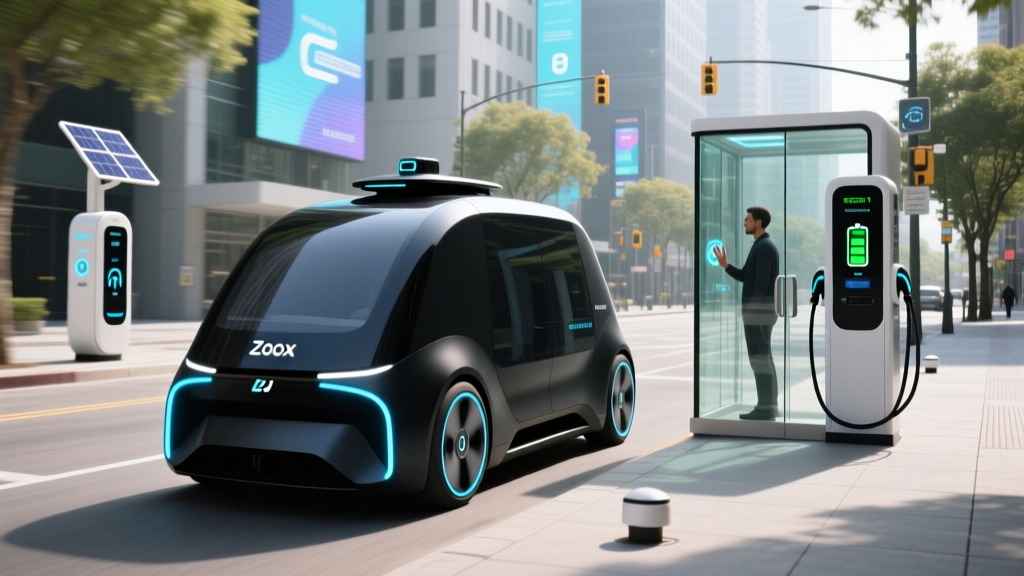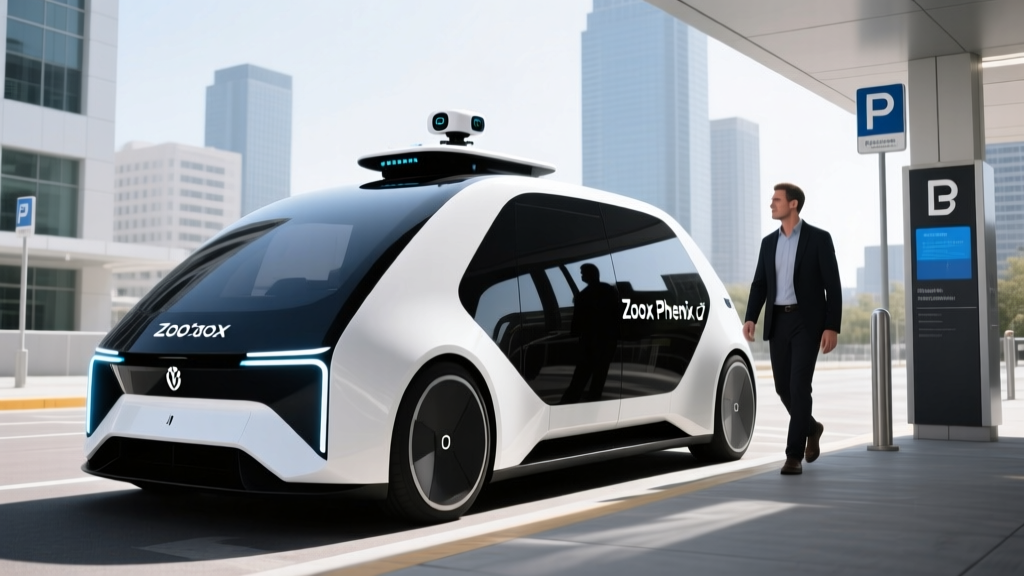
Phoenix has become one of the most important proving grounds for autonomous ride-hailing in the United States, and Amazon-backed Zoox is now a visible player in the Valley's driverless transportation scene. If you have seen the compact, carriage-style Zoox vehicle navigating Scottsdale Road or looping around downtown Tempe, you are witnessing a genuine SAE Level 4 robotaxi — no driver, no steering wheel, no pedals.
This guide covers what you need to know about hailing a Zoox ride in Phoenix, Arizona right now: where the service operates, what it costs, how safe the vehicles are, and the real-world limitations that still apply.
Is Zoox Truly Self-Driving? Understanding SAE Level 4
Before booking a ride, it is essential to understand what Zoox actually is — and what it is not. Consumer vehicles like Tesla's FSD (Supervised) or GM's Super Cruise are SAE Level 2 driver-assistance systems. The human driver remains responsible for the vehicle at all times and must stay engaged.
Zoox operates at SAE Level 4, which means the vehicle handles all driving tasks within its defined operational design domain (ODD) without any human intervention or fallback. There is no steering wheel, no brake pedal, and no driver's seat. If the system encounters a scenario it cannot handle, it performs a minimal-risk maneuver (pulling over safely) rather than handing control to a passenger.
| Level | Name | Who Drives? | Example |
|---|---|---|---|
| Level 2 | Driver Assistance | Human (always) | Tesla Autopilot, BlueCruise |
| Level 3 | Conditional Automation | System (human fallback) | Mercedes Drive Pilot (limited) |
| Level 4 | High Automation | System (in ODD) | Zoox, Waymo One |
| Level 5 | Full Automation | System (everywhere) | Does not yet exist |
The distinction matters because it defines what you can expect as a rider. In a Zoox, you are a passenger — not a backup driver. The vehicle's AI handles route planning, lane changes, intersection navigation, and obstacle avoidance entirely on its own, within its approved Phoenix geofence.
Where Can I Ride Zoox in Phoenix Right Now?
Zoox launched its Phoenix rider program after extensive testing in the metro area. As of early 2026, the service operates within a defined geofence covering key corridors across the East Valley and central Phoenix.
| Zone | Key Areas | Status |
|---|---|---|
| Downtown Phoenix | Roosevelt Row, Capitol area, Chase Field vicinity | Live |
| Tempe | ASU campus perimeter, Mill Avenue, Tempe Town Lake | Live |
| Scottsdale | Old Town, Scottsdale Fashion Square corridor | Live |
| Mesa (partial) | Downtown Mesa, select arterial routes | Limited |
| West Valley | Glendale, Surprise, Goodyear | Not available |
The geofence is not a simple city boundary. Zoox maps specific road segments and approved pickup/dropoff zones within these areas. If your requested trip starts or ends outside the operational zone, the app will not allow you to book. The coverage area has been expanding incrementally, but Zoox has been deliberate about adding new corridors only after extensive validation.
How to Use Zoox and What It Costs vs Uber and Lyft
Riding in a Zoox is straightforward but different from a traditional rideshare. Here is the process:
- Download the Zoox app (available on iOS and Android) and create an account.
- Request a ride within the Phoenix geofence. Pickup and dropoff must both fall inside the service area.
- Wait for your vehicle. The bidirectional Zoox vehicle pulls up — it looks like a compact, symmetrical pod with no distinct front or rear.
- Authenticate. Scan the QR code or use the app to unlock the doors.
- Ride. The interior features two forward-facing and two rear-facing seats (four-passenger capacity). A screen displays your route and vehicle status.
Zoox has historically offered promotional pricing during its rider-program rollout phase. As the service transitions toward commercial operations, pricing is expected to align with or undercut comparable rideshare options.
| Service | Estimated Fare | Surge Risk | Wait Time |
|---|---|---|---|
| Zoox | $6–$10 (promotional) / $10–$15 (projected commercial) | Low (fleet-managed pricing) | 5–12 min |
| UberX | $10–$18 | Moderate–High | 3–8 min |
| Lyft | $10–$17 | Moderate–High | 3–8 min |
| Waymo One | $10–$16 | Low–Moderate | 4–10 min |
The long-term economic advantage of robotaxis is the elimination of the driver cost, which typically accounts for 60–75% of a rideshare fare. As Zoox scales its Phoenix fleet and moves to full commercial pricing, rides are expected to undercut Uber/Lyft on comparable routes — though availability and wait times remain constrained by fleet size.
Zoox Vehicle and Technology Stack
The Zoox vehicle is a ground-up, purpose-built robotaxi — not a retrofitted production car. This is a significant engineering distinction from early autonomous vehicle programs that bolted sensors onto existing models like the Chrysler Pacifica or Jaguar I-PACE.
- Form factor: Symmetrical, bidirectional carriage design (no front/rear)
- Powertrain: Battery-electric, dual-motor AWD
- Battery: ~33 kWh usable capacity (estimated), sufficient for ~16 hours of urban operation
- Top speed: 75 mph (electronically limited; urban operation typically under 45 mph)
- Seating: 4 passengers, face-to-face configuration
- Sensors: Lidar, radar, and camera suite with 360-degree coverage and overlapping redundancy
- Compute: Custom onboard AI processing stack
Zoox uses a multi-sensor fusion approach — combining lidar, cameras, and radar — which contrasts with Tesla's camera-only strategy for FSD. The lidar sensors provide precise depth mapping regardless of lighting conditions, while cameras handle object classification, traffic-signal recognition, and lane-marking detection. Radar adds redundancy for detecting moving objects at distance and in adverse conditions.
The vehicle's bidirectional design means it can pull out of a dead-end or narrow alley without needing to turn around, a practical advantage in dense urban environments. All four wheels can steer, enabling tight turning radii and crab-like lateral movements.
Safety Record: What the Data Shows
Safety is the most scrutinized aspect of any robotaxi operation. Zoox, like all autonomous vehicle operators in Arizona, reports testing and deployment data to state regulators. Nationally, autonomous vehicle operators are required to report crashes to the National Highway Traffic Safety Administration (NHTSA) under a standing general order.
- Testing miles: Millions of autonomous miles logged across Phoenix, Las Vegas, San Francisco, and other test cities
- Crash reports: Zoox has reported minor incidents to NHTSA, predominantly low-speed contacts during testing phases — consistent with industry-wide AV reporting
- Disengagement rate: Zoox does not publish disengagement figures in the same format as California DMV reporters (since its primary operations are in Arizona), but internal data suggests continuous improvement in miles-between-interventions
- No passenger fatalities: As of early 2026, no Zoox robotaxi has been involved in a fatal crash during rider operations
- Redundancy: Dual-compute systems, redundant braking and steering, and remote-assistance capability for edge cases
For context, Waymo — the more mature robotaxi operator also active in Phoenix — has published data showing its vehicles are involved in fewer police-reported crashes per million miles than human drivers in comparable urban environments. Zoox has not published an equivalent large-scale safety study, which is a gap worth noting. The company's smaller fleet size and later commercial launch mean less publicly available statistical evidence, even though its engineering approach emphasizes redundant safety systems.
It is also worth noting that the Insurance Institute for Highway Safety (IIHS) has begun evaluating autonomous vehicle safety protocols, though formal crash-test ratings for purpose-built robotaxis like Zoox are not yet part of their standard testing program.
Regulatory Landscape: Who Approves Zoox in Arizona?
Arizona has been one of the most permissive states for autonomous vehicle deployment. The regulatory framework operates at both state and federal levels:
- Arizona Governor's Executive Order (2015, updated): Established the framework for testing and operating autonomous vehicles on public roads without special permits beyond standard business and vehicle registration requirements.
- Arizona Department of Transportation (ADOT): Oversees vehicle registration and road-use compliance for AV operators.
- NHTSA (federal): Sets vehicle safety standards and requires crash reporting. Zoox received a notable exemption from certain Federal Motor Vehicle Safety Standards (FMVSS) — such as the requirement for a steering wheel and mirrors — to deploy its purpose-built vehicle.
- City-level coordination: Phoenix, Tempe, and Scottsdale coordinate with Zoox on geofencing, pickup zones, and first-responder protocols.
The FMVSS exemption is particularly significant. NHTSA granted Zoox permission to operate a vehicle that does not conform to traditional occupant-protection standards designed around a human driver — a regulatory milestone that validates the vehicle's alternative safety approach but also means it operates under a different rule set than conventional vehicles.
Current Limitations: What Zoox Cannot Do Yet
- Geofence boundaries: Rides must start and end within the approved zone. No trips to Sky Harbor Airport terminals (as of early 2026), no West Valley coverage.
- Weather restrictions: Heavy rain, dust storms (haboobs), or flooding cause the system to reduce speed or pause operations. Phoenix monsoon season (July–September) can disrupt service.
- Construction zones: Major roadwork with shifted lanes or temporary barriers may cause the vehicle to stop and request remote assistance, adding delay.
- Night operations: Zoox operates during daytime and evening hours; late-night/early-morning availability is limited or unavailable depending on fleet deployment schedules.
- Passenger constraints: No car seats for infants/toddlers. Wheelchair-accessible vehicles are not yet part of the Phoenix fleet. Maximum 4 passengers per ride.
- No highway driving: The Phoenix geofence covers surface streets and arterials. Zoox does not currently operate on I-10, Loop 101, or Loop 202 freeway segments within its service area.
- Edge cases: Unusual scenarios — a police officer directing traffic with hand signals, an overturned truck spilling cargo, a parade route — may cause the vehicle to pull over safely and wait for remote guidance or the situation to clear.
These limitations are not unique to Zoox. Waymo's Phoenix service has similar geofence and weather constraints. The key difference is scale: Waymo has a larger fleet and a more mature Phoenix operation, so wait times tend to be shorter and coverage slightly broader.
Zoox vs Waymo in Phoenix: A Quick Comparison
Phoenix riders now have two Level 4 robotaxi options. Here is how they stack up:
| Attribute | Zoox | Waymo One |
|---|---|---|
| SAE Level | Level 4 | Level 4 |
| Vehicle | Purpose-built Zoox carriage | Jaguar I-PACE (retrofitted) |
| Phoenix coverage | Downtown, Tempe, Scottsdale, partial Mesa | Broader East Valley + expanding |
| Highway driving | No | Limited freeway segments |
| Fleet size (Phoenix) | Smaller (hundreds) | Larger (thousands regionally) |
| Ride experience | Face-to-face seating, novel design | Conventional SUV interior |
| Parent company | Amazon | Alphabet |
If you prioritize a novel ride experience and are within Zoox's geofence, it offers a genuinely different experience from any other vehicle on the road. If you need broader coverage, airport trips, or shorter wait times, Waymo currently has the operational edge in Phoenix.
Frequently Asked Questions
Is the Zoox Phoenix AZ service available to the general public?
Zoox has been progressively opening its Phoenix rider program beyond early-access and employee testers. As of 2026, members of the public within the geofence can request rides through the Zoox app, though availability may still be limited by fleet size and operational hours. Check the app for real-time service status in your area.
How much does a Zoox ride cost compared to Uber or Lyft?
During its promotional rider-program phase, Zoox rides have been heavily discounted or even free. As the service moves to commercial pricing, fares are projected in the $10–$15 range for a typical 3-mile urban trip — competitive with or slightly below UberX and Lyft. The elimination of driver pay gives robotaxi operators a structural cost advantage at scale.
How safe are Zoox robotaxis in real-world operation?
Zoox has logged millions of autonomous testing and rider miles across multiple cities with no reported passenger fatalities. Minor low-speed incidents have been reported to NHTSA, consistent with industry norms. The vehicle uses redundant lidar, radar, and camera systems plus dual-compute architecture. However, Zoox has not published a large-scale comparative safety study like Waymo has, so direct statistical comparison to human drivers is not yet available from Zoox itself.
Can I take a Zoox to Phoenix Sky Harbor Airport?
As of early 2026, Zoox's Phoenix geofence does not include Sky Harbor Airport terminals. Airport trips remain available through Waymo, Uber, and Lyft. Zoox has indicated airport coverage is a priority for future expansion, but no public timeline has been confirmed.
What happens if the Zoox vehicle encounters a situation it cannot handle?
The vehicle is designed to perform a "minimal-risk condition" maneuver — it will safely pull to the side of the road and stop. Zoox also has remote-assistance capability, where a human operator can assess the situation and guide the vehicle's next move. Passengers are never asked to take control because there are no driving controls in the vehicle.
Does Zoox operate in bad weather?
Light rain and typical Phoenix heat do not disrupt service. However, heavy monsoon downpours, haboob dust storms, or flooded roadways will cause the system to slow down, reroute, or pause operations entirely. If you are planning a ride during monsoon season (July–September), have a backup transportation plan.
How is Zoox different from Tesla's Full Self-Driving?
Tesla FSD (Supervised) is an SAE Level 2 driver-assistance system that requires an attentive human driver behind the wheel at all times. Zoox is a Level 4 robotaxi with no steering wheel, no pedals, and no driver — the system handles all driving within its geofenced area. They are fundamentally different categories of technology with different regulatory approvals and safety models.