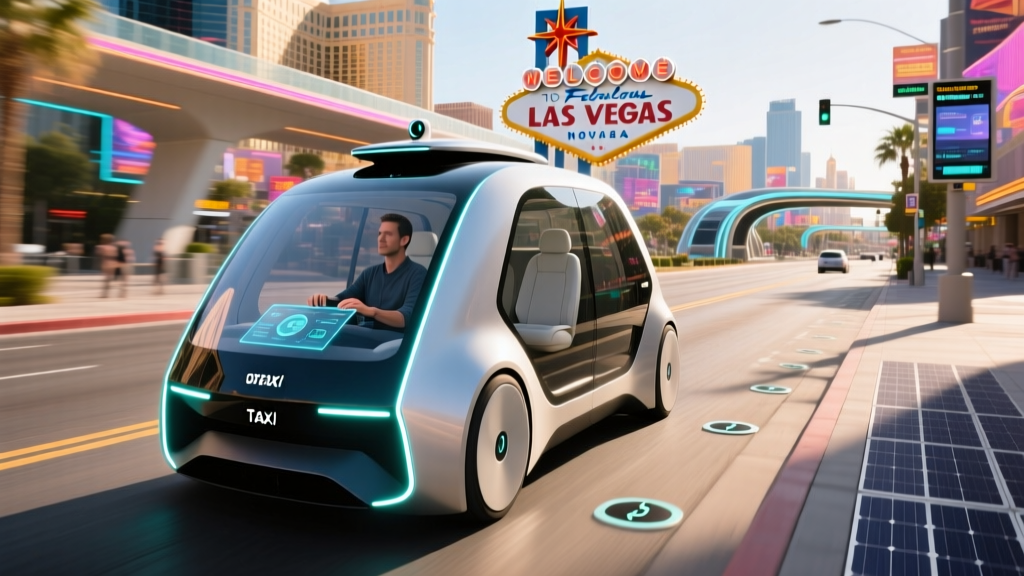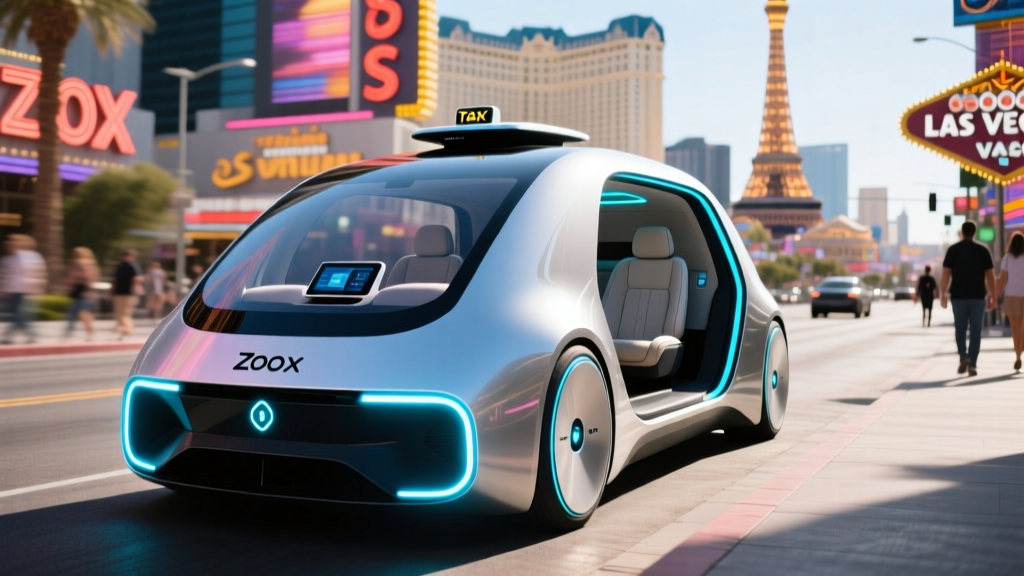
Las Vegas has become the proving ground for America's most ambitious robotaxi experiment. Zoox, the Amazon-backed autonomous vehicle company, has moved beyond limited pilot programs and is now operating its purpose-built, steering-wheel-free pod on public roads in the Las Vegas Valley. Unlike retrofitted SUVs from competitors, the Zoox vehicle was designed from the ground up as a robotaxi — bidirectional, symmetrical, and built for dense urban corridors rather than highway cruising.
If you've searched for Zoox Las Vegas and wondered whether you can actually hail one today, what it costs, and how safe the technology really is, this guide breaks down the service with concrete data, regulatory context, and the limitations no marketing video will show you.
Where Can You Ride a Zoox Robotaxi in Las Vegas Right Now?
Zoox's Las Vegas operations are geofenced to a defined service area that has expanded progressively since the company's initial Nevada testing permit. As of early 2026, the operational zone covers high-density corridors including:
- The Las Vegas Strip corridor — select routes between major resort properties
- Downtown Las Vegas — portions of the Fremont Street area and surrounding grid
- Summerlin and suburban connectors — limited residential and commercial zones used for testing and phased expansion
- Harry Reid International Airport (LAS) perimeter routes — select access roads, though direct terminal pickup is not yet part of the service
The geofence is not the entire city. Zoox vehicles will not travel outside mapped and validated zones, and routes are pre-approved based on extensive simulation and real-world validation. If your destination falls outside the geofence, the app simply won't let you book the ride.
| City | Status | Service Type | Geofence Scope |
|---|---|---|---|
| Las Vegas, NV | Active — rider service | Public rides (invite + waitlist) | Strip, Downtown, select suburbs |
| San Francisco, CA | Active — rider service | Public rides (waitlist) | SoMa, Mission, select corridors |
| Foster City, CA | Active — testing | Employee + invited riders | Limited suburban zone |
| Atlanta, GA | Announced — testing | Pre-commercial validation | Midtown select routes |
| Austin, TX | Announced — testing | Pre-commercial validation | Downtown select routes |
Access in Las Vegas has historically been managed through an invitation-based early rider program, though Zoox has progressively opened access to broader waitlists. Unlike Waymo's open-to-all app in Phoenix and San Francisco, Zoox still manages rider onboarding in phases — a deliberate approach tied to their newer vehicle platform and lower fleet density.
What Is the Zoox Vehicle? A Purpose-Built, Steering-Wheel-Free Pod
The first thing that strikes you about a Zoox ride is the vehicle itself. It looks nothing like a conventional car. The Zoox Gen 3 platform (internally referred to as their production vehicle) is a compact, carriage-style pod with these defining characteristics:
- No steering wheel, pedals, or mirrors — there is no human driver position whatsoever
- Bidirectional design — the vehicle is symmetrical front-to-back and can travel in either direction without turning around, which simplifies maneuvers in tight urban spaces
- Four-wheel steering — enables a tight turning radius and crab-like lateral movements for precise positioning
- Face-to-face seating — two bench seats facing each other, accommodating up to four passengers
- Top speed — electronically limited to approximately 75 mph, though urban operations rarely exceed 35-45 mph
- Electric powertrain — battery-electric with estimated 70+ kWh usable capacity (exact specs not publicly disclosed), designed for all-day operation with opportunity charging
This is not a retrofitted Jaguar I-PACE or Chrysler Pacifica. Zoox designed every element — chassis, sensor placement, passenger experience, thermal management — around the assumption that no human will ever drive this vehicle. That distinction matters for both safety architecture and passenger comfort.
SAE Level 4 Autonomy: What That Actually Means for Zoox
Zoox operates at SAE Level 4 automation within its geofenced service area. This is a critical distinction that gets confused constantly in EV and autonomous vehicle coverage.
| SAE Level | Name | Who Drives? | Examples |
|---|---|---|---|
| Level 2 | Driver Assistance | Human (system assists steering/speed) | Tesla Autopilot, GM Super Cruise, Ford BlueCruise |
| Level 3 | Conditional Automation | System in limited conditions; human must take over when requested | Mercedes DRIVE PILOT (limited markets) |
| Level 4 | High Automation | System handles all driving within defined ODD (operational design domain) | Waymo One, Zoox Las Vegas, Cruise (pre-suspension) |
| Level 5 | Full Automation | System drives everywhere, all conditions | Does not exist commercially |
Level 4 means the Zoox vehicle handles all driving tasks — steering, acceleration, braking, route planning, obstacle avoidance, traffic signal compliance — without any expectation that a human passenger will intervene. There is no fallback to a human driver. If the system encounters a scenario it cannot handle, it is designed to execute a minimal risk condition (MRC): safely pulling over, stopping, and requesting remote assistance.
This is fundamentally different from Tesla's Full Self-Driving (Supervised), which remains SAE Level 2 despite its name. With FSD, the human driver is legally and operationally responsible at all times. With Zoox, the company and its system bear that responsibility within the geofenced zone.
The Technology Stack: Lidar, Cameras, and Redundant Sensing
Zoox takes a multi-modal sensor approach — a deliberate contrast to Tesla's camera-only philosophy. The vehicle's perception stack includes:
- Lidar arrays — roof-mounted and body-integrated lidar units providing 360-degree, high-resolution 3D point clouds. Lidar excels at precise distance measurement and operates independently of lighting conditions, which is critical for nighttime and tunnel driving on the Strip.
- Camera systems — multiple high-dynamic-range cameras covering all directions, used for lane detection, traffic signal recognition, signage reading, and object classification.
- Radar — forward and surround radar for velocity detection of other vehicles, useful in rain or fog where lidar and camera performance degrade.
- Ultrasonic sensors — short-range proximity detection for low-speed maneuvers, curb alignment, and pedestrian awareness near the vehicle.
- Inertial measurement units (IMU) and GPS/RTK — high-precision localization combining satellite positioning with inertial data to maintain lane-level accuracy even when GPS signals degrade (urban canyons, overpasses).
The compute platform runs Zoox's proprietary prediction and planning software, which models the likely behavior of every detected agent (pedestrians, cyclists, other vehicles) and plans trajectories accordingly. The system processes sensor fusion data at high frequency — multiple times per second — to maintain a real-time world model.
Redundancy is engineered into critical systems: steering, braking, and compute all have backup pathways. If a primary system fails, the vehicle can still execute a safe stop without human intervention. This redundancy is a regulatory requirement for driverless operation and a core reason Level 4 vehicles cost significantly more to build than Level 2 consumer cars.
How to Ride Zoox in Las Vegas and What It Costs
Booking a Zoox ride is managed through the Zoox app (available on iOS and Android). The process mirrors rideshare:
- Download the app and join the rider waitlist (or accept an invitation if you've received one)
- Enter your pickup and drop-off locations — the app will confirm whether both fall within the active geofence
- Request a ride — the app provides an estimated wait time and vehicle arrival notification
- The Zoox pod arrives — unlock via the app, and the ride begins autonomously
- In-ride experience: a screen shows the vehicle's perception view (what it "sees"), route progress, and climate/audio controls
| Service | Base Fare | Per-Mile Rate | Per-Minute Rate | Typical 3-Mile Ride |
|---|---|---|---|---|
| Zoox (early rider program) | Often $0 (promotional) | N/A during early access | N/A | Free or heavily discounted |
| UberX (Las Vegas avg.) | ~$2.50 | ~$1.15 | ~$0.22 | ~$8–$12 |
| Lyft (Las Vegas avg.) | ~$2.25 | ~$1.10 | ~$0.20 | ~$7–$11 |
| Waymo One (where available) | ~$2.00 | ~$1.20 | ~$0.25 | ~$8–$13 |
During the early rider phase in Las Vegas, Zoox has largely offered rides at no cost or at steep discounts to build ridership data and gather feedback. Long-term commercial pricing has not been fully published, but industry expectations place Zoox in the same range as UberX/Lyft once fully commercialized — potentially lower over time, since there is no driver payout to account for. The absence of a human driver is the entire economic thesis of robotaxis: remove the largest cost component (driver earnings, typically 60-75% of a rideshare fare) and the unit economics shift dramatically at scale.
Safety Record: What the Data Actually Shows
Safety is the most scrutinized dimension of any robotaxi operation, and Zoox has published less public mileage data than Waymo due to its smaller fleet and later commercial launch. Here's what is known:
- Testing mileage: Zoox has logged hundreds of thousands of autonomous miles across Las Vegas, San Francisco, and Foster City, though the company does not publish a live mileage counter the way Waymo does (Waymo surpassed 30 million autonomous miles by late 2024).
- Disengagement reports: California DMV disengagement reports (required for testing permits) have shown Zoox's intervention rates declining year-over-year, though direct comparison to Waymo or Cruise is complicated by different operating domains and fleet sizes.
- No publicly reported serious injury incidents involving Zoox vehicles carrying passengers as of early 2026. This contrasts with Cruise's October 2023 pedestrian-dragging incident in San Francisco, which led to that company's permit suspension and operational reset.
- NHTSA Standing General Order: All ADS (automated driving system) operators must report crashes to the National Highway Traffic Safety Administration. Zoox is subject to this reporting requirement, and no major incident reports have surfaced in NHTSA's public database.
Context matters: Zoox's fleet is smaller and its operational footprint narrower than Waymo's, meaning fewer total exposure miles and fewer opportunities for statistically significant incident data. The company's cautious, phased expansion strategy — deliberately avoiding the rapid scaling that contributed to Cruise's safety failures — means the safety dataset is still maturing. For a thorough look at ADS crash reporting, the NHTSA automated vehicles safety page maintains public records.
Regulatory Landscape: Who Approves Zoox in Nevada?
Robotaxi operations in the United States are governed by a patchwork of state and federal regulations. In Nevada, the key regulatory bodies include:
- Nevada Department of Motor Vehicles (DMV): Issues autonomous vehicle testing and deployment permits. Nevada was one of the first states to pass AV legislation (2011), creating a relatively permissive framework for testing and commercial operations.
- Nevada Office of the Governor, Autonomous Vehicle Division: Oversees broader AV policy and coordination.
- NHTSA (federal): Sets vehicle safety standards (FMVSS). Zoox received a notable exemption from certain FMVSS requirements — specifically, the mandate for a steering wheel, mirrors, and manual controls — allowing the purpose-built pod to operate without these human-driver components. This exemption was granted under NHTSA's AV exemption authority and is limited in scope and volume.
- Local jurisdictions: Clark County and the City of Las Vegas have input on road usage, curb access, and operational hours within their boundaries.
The FMVSS exemption is significant. Most AVs on the road today (Waymo's Jaguar I-PACE, Cruise's Chevy Bolt) are built to standard vehicle safety regulations because they retain steering wheels and pedals. Zoox's exemption for a fully driverless, non-traditional vehicle design represents a regulatory precedent that could shape how future purpose-built robotaxis are certified. However, the exemption caps the number of vehicles Zoox can deploy, which constrains fleet scaling in the near term.
Current Limitations: Where Zoox Cannot Go and What It Cannot Do
Despite the impressive technology, Zoox's Las Vegas service has real-world constraints that riders should understand before booking:
- Geofence boundaries: The vehicle will not travel outside its validated operational zone. If your destination is across the geofence edge, the ride simply cannot be booked. This means large portions of the Las Vegas Valley — including most residential suburbs, Henderson, North Las Vegas, and outlying areas — are not yet served.
- Weather limitations: While Las Vegas is largely dry, heavy monsoon rain, flash-flood conditions, or dust storms can trigger operational pauses. The sensor suite degrades in heavy precipitation, and the system is programmed to pull over safely rather than operate in conditions exceeding its validated performance envelope.
- Construction zones: Major road construction with shifted lanes, temporary barriers, or flaggers can challenge the system. Zoox maps are updated frequently, but sudden overnight lane reconfigurations may cause the vehicle to reroute or request remote guidance.
- Special events: Massive crowd events (New Year's Eve on the Strip, major conventions, race weekends) create pedestrian densities and traffic patterns that may exceed the system's operational design domain. Zoox may restrict service or modify geofence boundaries during these periods.
- No highway operation: The Zoox pod is designed for urban and suburban surface streets. It does not operate on Interstate 15 or US-95. This limits its utility for airport transfers or cross-city trips that would normally use freeways.
- Wait times and fleet density: With a smaller fleet than Uber or Lyft, wait times can be longer — particularly during peak demand. Early rider program access also means not everyone can book at all times.
- Accessibility: While the vehicle is designed with a low floor and wide doors, full ADA-compliant wheelchair accessibility in the current production pod is still being validated. Riders with mobility devices should confirm accommodation through the app before booking.
Zoox vs. Waymo: How the Two Robotaxi Services Compare
Waymo (Alphabet/Google) is the only other major Level 4 robotaxi service operating commercially in the U.S. at scale. Here's how the two stack up for a Las Vegas rider or prospective rider:
| Attribute | Zoox (Las Vegas) | Waymo One (Phoenix, SF, LA) |
|---|---|---|
| Vehicle | Purpose-built bidirectional pod (no steering wheel) | Jaguar I-PACE (retrofitted SUV, retains steering wheel) |
| SAE Level | Level 4 (geofenced) | Level 4 (geofenced) |
| Autonomous miles logged | Hundreds of thousands (estimated) | 30+ million (as of late 2024) |
| Public access | Invite/waitlist-based | Open to all (via Waymo app) |
| Pricing | Free/discounted (early rider phase) | Comparable to UberX/Lyft |
| Highway capable | No (surface streets only) | Limited highway segments in some cities |
| Sensor suite | Lidar + cameras + radar + ultrasonic | Lidar + cameras + radar |
| Parent company | Amazon | Alphabet (Google) |
Waymo is significantly more mature in terms of fleet size, autonomous miles, and public accessibility. Zoox's advantage lies in its purpose-built vehicle — optimized for passenger experience and urban efficiency — and Amazon's logistics and capital resources. For Las Vegas specifically, Zoox is the only Level 4 robotaxi currently operating; Waymo has not launched a commercial service in the Las Vegas market as of early 2026.
Frequently Asked Questions About Zoox in Las Vegas
Is the Zoox vehicle truly self-driving, or is there a remote driver?
There is no driver — remote or in-vehicle. The Zoox pod operates at SAE Level 4, meaning the automated driving system handles all aspects of driving within its geofenced operational zone. Remote operators may provide guidance in edge cases (e.g., an unmapped construction zone), but they do not steer or control the vehicle in real time. The vehicle's planning and control systems make all driving decisions.
How much does a Zoox ride cost compared to Uber or Lyft?
During the early rider program, rides are typically free or heavily discounted. Once fully commercialized, pricing is expected to be competitive with UberX and Lyft — likely in the $8–$13 range for a typical 3-mile urban trip. The long-term economic advantage of robotaxis is the elimination of driver payouts, which could allow lower fares at scale, though Zoox has not published definitive commercial pricing.
Can I ride Zoox from the Las Vegas airport (Harry Reid)?
As of early 2026, direct airport terminal pickup and drop-off are not part of the active service area. Zoox operates on select perimeter routes near the airport, but travelers should not rely on Zoox for airport transfers. Uber, Lyft, and traditional taxis remain the standard options for LAS airport rides.
How safe are Zoox robotaxis compared to human drivers?
Zoox has not reported any serious injury incidents involving passengers. The company's sensor suite (lidar + cameras + radar) provides 360-degree perception without distraction, fatigue, or impairment — the leading causes of human crashes. However, Zoox's total autonomous mileage is far lower than Waymo's 30+ million miles, making direct statistical comparison to human crash rates premature. The Insurance Institute for Highway Safety (IIHS) continues to monitor ADS safety data as it matures.
What happens if the Zoox vehicle encounters a situation it can't handle?
The vehicle is programmed to execute a Minimal Risk Condition (MRC) — typically a controlled pull-over to the curb or a safe stop in place. The system then contacts a remote operations team for guidance. The vehicle does not continue driving in an uncertain state; it defaults to stopping safely.
Is Zoox available to everyone in Las Vegas?
Not yet. Access is managed through an invitation and waitlist system. Zoox has been gradually expanding access, but the service is not yet open to the general public on demand the way Uber or Lyft is. Signing up through the Zoox app and joining the waitlist is the path to getting a ride.
Does the Zoox pod have air conditioning and amenities?
Yes. The pod features individual climate controls, a digital display showing the vehicle's perception and route, and audio controls. The interior is designed for short urban trips — functional and modern, though not luxurious in the way a premium rideshare vehicle might be.
The Bottom Line for Las Vegas Riders
Zoox's Las Vegas operation represents a genuine technological achievement: a purpose-built, steering-wheel-free electric robotaxi carrying passengers on public roads at SAE Level 4. The ride experience is unlike anything else in the autonomous vehicle space — a compact, bidirectional pod that was never designed for a human driver.
For now, the service remains limited in geographic scope, fleet size, and public access. It is not a replacement for Uber, Lyft, or a rental car if you need to travel broadly across the Las Vegas Valley. But for rides within the active geofence — particularly along the Strip and downtown corridors — it offers a genuine glimpse of what driverless urban transportation looks like when the vehicle is designed for the mission from day one.
As the fleet scales, the geofence expands, and commercial pricing takes effect, Zoox could become a meaningful transportation option in Las Vegas. The technology works. The question is how fast the company can scale operations while maintaining the cautious safety posture that has so far kept its record clean.