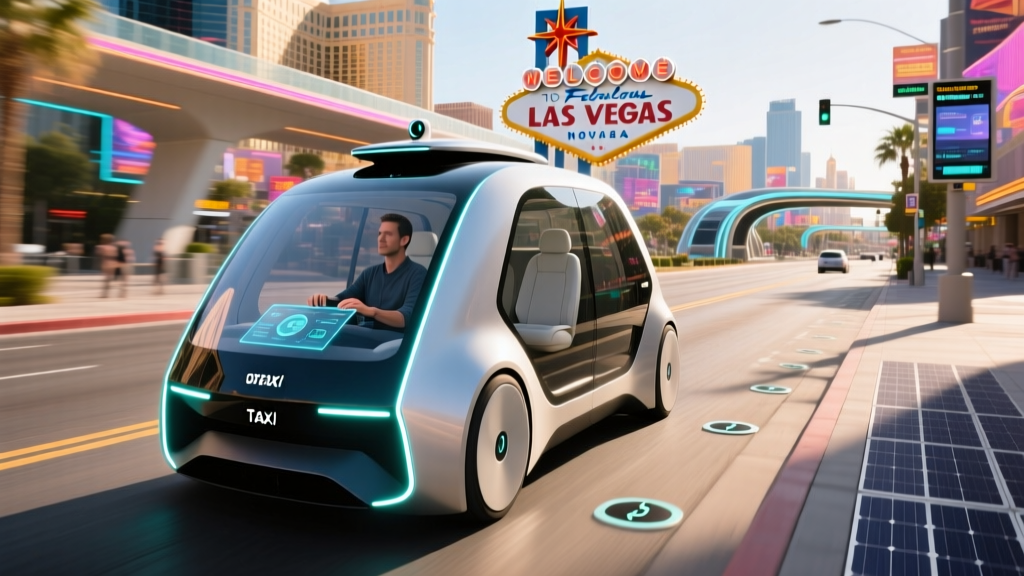
Are There Actually Free Driverless Cars in Las Vegas?
If you've searched for "free driverless cars Las Vegas," you've likely seen promotional clips, tech convention demos, and optimistic headlines. The reality in 2026 is more nuanced: fully driverless robotaxi service in Las Vegas is not broadly available to the public the way it is in Phoenix or San Francisco. What Las Vegas does have are limited autonomous shuttle pilots, convention-center loops, and restricted geofenced tests — none of which currently operate as a free, on-demand, city-wide robotaxi network comparable to Waymo's paid service elsewhere.
This guide breaks down exactly what autonomous ride services exist in Las Vegas right now, what "driverless" actually means under SAE standards, what the safety data shows, and when (or whether) you'll be able to hail a true robotaxi on the Strip.
Understanding Autonomy: What Level Are Las Vegas Robotaxis?
Before evaluating any service, you need to know what level of automation you're actually riding in. The Society of Automotive Engineers (SAE) defines six levels of driving automation, and the distinction between Level 2 and Level 4 is the single most important thing any rider or buyer should understand.
| Level | Name | Who Drives | Real-World Example |
|---|---|---|---|
| Level 0 | No Automation | Human does everything | Standard car, no ADAS |
| Level 1 | Driver Assistance | Human drives; system assists steering OR speed | Adaptive cruise control, lane-keep assist |
| Level 2 | Partial Automation | Human drives; system assists steering AND speed simultaneously | Tesla Autopilot, GM Super Cruise, Ford BlueCruise — driver must remain engaged |
| Level 3 | Conditional Automation | System drives in specific conditions; human must take over on request | Mercedes Drive Pilot (limited highway use, approved in NV and CA) |
| Level 4 | High Automation | System drives fully within its operational design domain — no human driver needed | Waymo One (Phoenix, SF, LA), Zoox (limited pilot areas) |
| Level 5 | Full Automation | System drives everywhere, all conditions | Does not exist in production anywhere |
Every autonomous shuttle or pilot operating in Las Vegas as of 2026 falls into either Level 4 within a tightly restricted geofence (fixed-route shuttles) or Level 3 (Mercedes Drive Pilot on select highways). There are no Level 5 vehicles anywhere in the world. And consumer vehicles like Tesla with FSD (Supervised) remain Level 2 — the driver is legally and operationally responsible at all times.
Where Can You Use Autonomous Rides in Las Vegas Right Now?
Las Vegas is a testing ground, not a full robotaxi market. Here's what's actually operational:
| Service / Operator | Type | Area | Public Access | SAE Level |
|---|---|---|---|---|
| Motional (Hyundai/Aptiv JV) | Robotaxi pilot | Limited Strip corridor, geofenced | Invite-only / partner app (Lyft) — not open public hailing | Level 4 |
| Beep / NAVYA shuttles | Fixed-route shuttle | Downtown LV, Innovation Corridor, select private campuses | Free, but fixed stops — not on-demand | Level 4 (geofenced) |
| Mercedes Drive Pilot | Production Level 3 sedan | Select Nevada highways (I-15, US-95 segments), ≤40 mph, daytime, clear weather | Available on 2024+ S-Class/EQS with option — owner's vehicle, not a ride service | Level 3 |
| Waymo | Robotaxi | Not operating in Las Vegas as of 2026 | N/A | Level 4 |
| Cruise (GM) | Robotaxi | Not operating in Las Vegas; limited return in other cities post-2024 suspension | N/A | Level 4 |
The short answer: there is no free, on-demand, city-wide driverless car service in Las Vegas. The fixed-route shuttles are free but serve limited corridors. The Motional robotaxi pilot requires an invite through Lyft's autonomous partner program and operates in a narrow geofence. Waymo — the largest paid robotaxi operator in the U.S. — does not serve Las Vegas.
How Much Do Robotaxis Cost vs. Uber and Lyft?
Since there's no open robotaxi market in Las Vegas yet, direct local pricing comparisons aren't possible. But looking at markets where Level 4 robotaxis operate (Phoenix, San Francisco, Los Angeles), here's how pricing stacks up against traditional rideshare:
| Service | Market | Avg. Cost (5-mi trip) | Surge Pricing | Promotional Free Rides |
|---|---|---|---|---|
| Waymo One | Phoenix, SF, LA | $12–$18 | Yes, but less volatile than Uber | Occasional first-ride credits; not ongoing free service |
| Uber (human driver) | Las Vegas | $14–$22 | Yes — heavy on Strip/weekends | Rare |
| Lyft (human driver) | Las Vegas | $13–$20 | Yes | Rare |
| LV fixed-route shuttles | Downtown / Innovation Corridor | Free | N/A | Always free — but fixed route, not on-demand |
Robotaxis in active markets are generally priced comparably to Uber/Lyft — sometimes slightly cheaper on short trips, sometimes more expensive during off-peak hours when human drivers discount. The "free" robotaxi concept exists only as short-term promotional periods (new-user credits) or fixed-route public shuttles subsidized by municipalities or testing grants. No major operator offers unlimited free on-demand driverless rides in any U.S. city.
How Safe Are Robotaxis? The Real Data
Safety is the most contested question in autonomous vehicles. Here's what the data actually shows — sourced from NHTSA standing general orders and operator transparency reports:
Waymo (through 2025 reporting):
- Over 50 million fully driverless miles completed across Phoenix, SF, and LA.
- Fatal crash involvement rate: significantly lower than human benchmarks per mile driven.
- Property-damage-only contact rate: approximately 5.3 per million miles, compared to human benchmark of ~13 per million miles (per Waymo's published safety data, validated by third-party analysis from the IIHS and academic researchers).
- Injury-causing crash rate: roughly 85% lower than human drivers in comparable urban environments.
Cruise (pre-suspension, 2023):
- Operated ~3 million driverless miles before its October 2023 permit suspension in California following a pedestrian-dragging incident in San Francisco.
- Gradual return to limited supervised operations in 2024–2025 in select cities with safety drivers present.
- As of 2026, Cruise has not resumed fully driverless commercial service at prior scale.
Motional (Las Vegas pilot):
- Has completed millions of supervised and unsupervised test miles on the Strip corridor since 2020.
- No publicly reported fatal incidents during Las Vegas operations.
- Operates with a safety driver present during most public-facing rides; fully driverless runs are limited and not broadly available.
The data supports that mature Level 4 robotaxi operations (specifically Waymo) have a meaningfully better safety record per mile than human drivers in urban environments. However, the sample size is still small relative to the trillions of miles humans drive annually, and edge-case incidents — particularly involving pedestrians, construction zones, and emergency vehicles — remain the primary challenge.
The Technology Stack: How Robotaxis Actually See the Road
Robotaxis operating in or testing near Las Vegas use fundamentally different technology approaches:
Lidar + Camera + Radar (Waymo, Motional, Cruise, Zoox):
- Roof-mounted lidar arrays (typically 360° coverage, 200+ meter range) create real-time 3D point clouds of the environment.
- Multiple high-resolution cameras (8–12 per vehicle) handle lane markings, traffic signals, text recognition, and object classification.
- Short- and long-range radar provides velocity data on moving objects and works in rain/fog where lidar and cameras degrade.
- HD maps with centimeter-level precision define the geofenced operational area.
- Redundant compute platforms (often dual NVIDIA DRIVE or custom silicon) process sensor fusion in real time.
Camera-Only (Tesla FSD — Level 2, not a robotaxi):
- 8 cameras, no lidar, no dedicated radar on current hardware.
- Neural-network-based perception without HD map dependency.
- Remains Level 2 — requires active driver supervision at all times.
- Tesla has announced a robotaxi concept (Cybercab) but it is not in commercial service anywhere as of 2026.
Why this matters in Las Vegas: The Strip's dense, chaotic environment — jaywalking pedestrians, neon light interference, construction zones, emergency vehicles, extreme heat shimmer — is one of the most challenging operational design domains for any sensor suite. This is precisely why no operator has launched open robotaxi service here yet.
Regulatory Landscape: Who Approves Robotaxis in Nevada?
Nevada was actually the first U.S. state to pass autonomous vehicle legislation (AB 511 in 2011), and the state remains one of the more permissive regulatory environments for AV testing. Here's how approval works:
- Nevada DMV issues autonomous vehicle testing permits and deployment licenses. Companies must demonstrate minimum insurance ($5 million), submit safety plans, and report disengagement data.
- Nevada Legislature sets the statutory framework — Nevada law explicitly permits fully driverless vehicles on public roads without a human occupant, provided the operator holds a valid deployment permit.
- NHTSA (federal) regulates vehicle safety standards but does not currently have a comprehensive federal framework for robotaxi deployment. The NHTSA Standing General Order requires crash reporting for all Level 2+ and Level 3–5 systems.
- Local jurisdictions (Clark County, City of Las Vegas) can impose additional restrictions on testing areas, hours, and routes.
Nevada's regulatory posture is favorable for robotaxi deployment, which is why multiple companies have tested here. But testing permits and commercial deployment permits are different — and no company currently holds a broad commercial robotaxi deployment license for Las Vegas comparable to Waymo's permits in Phoenix or San Francisco.
Current Limitations: Why You Can't Just Hail a Robotaxi on the Strip
Even in cities where robotaxis operate commercially, significant limitations apply. In Las Vegas, the barriers are even more pronounced:
- Geofencing: Every current robotaxi operates within a defined geographic boundary. Waymo's Phoenix service area covers ~225 square miles — but that's Phoenix, not Vegas. Any Las Vegas service would be similarly restricted initially.
- Weather: Las Vegas summer surface temperatures regularly exceed 140°F. Extreme heat stresses sensor calibration, battery thermal management, and compute cooling. Monsoon dust storms degrade lidar and camera performance.
- Pedestrian density: The Strip corridor sees some of the highest pedestrian volumes in the U.S., with frequent jaywalking, impaired pedestrians, and unpredictable crowd behavior — all edge cases that remain challenging for perception systems.
- Construction zones: Constant road reconfiguration on and around the Strip requires frequent HD map updates and can exceed the system's operational design domain.
- Emergency vehicle interaction: Robotaxis must detect and appropriately yield to emergency vehicles. This remains a documented failure mode across the industry.
- No highway operation: Current Level 4 robotaxi services operate on surface streets only. You cannot take a robotaxi from McCarran Airport to the Strip via I-15 at highway speeds.
- Accessibility: Wheelchair-accessible robotaxi options remain extremely limited across all operators.
- No alcohol-impaired rider protocols: Las Vegas's 24-hour alcohol culture creates scenarios (unresponsive passengers, vomit, property damage) that require remote assistance infrastructure still being developed.
Frequently Asked Questions
Can I ride in a free driverless car in Las Vegas today?
Only in very limited circumstances. Free fixed-route autonomous shuttles operate in downtown Las Vegas and the Innovation Corridor, but these are not on-demand rides. The Motional robotaxi pilot on the Strip is invite-only through Lyft and typically has a safety driver. There is no free, on-demand, fully driverless car service open to the general public in Las Vegas as of 2026.
Is Waymo coming to Las Vegas?
Waymo has not announced a Las Vegas launch date. The company is focused on expanding within Phoenix, San Francisco, Los Angeles, and has announced plans for additional cities. Las Vegas's regulatory environment is favorable, but the Strip's operational complexity makes it a challenging market. Any launch would likely begin with a limited geofenced pilot, not city-wide service.
Are Tesla FSD cars considered robotaxis?
No. Tesla's Full Self-Driving (Supervised) is a Level 2 driver-assist system. The driver must remain attentive, hands available, and legally responsible at all times. Tesla has announced a "Cybercab" robotaxi concept intended for Level 4 operation, but it is not in production or commercial service anywhere as of 2026. Do not confuse Tesla FSD with Waymo-style driverless service.
How do robotaxis compare on safety vs. human drivers?
Based on available data from Waymo's 50+ million driverless miles, robotaxis show approximately 85% fewer injury-causing crashes and roughly 60% fewer property-damage contacts per million miles compared to human benchmarks in similar urban environments. However, total industry robotaxi miles remain a tiny fraction of human driving miles, and edge-case incidents (pedestrians, construction zones, emergency vehicles) are the primary remaining risk category.
What's the cheapest way to get a driverless ride in Las Vegas?
The free downtown autonomous shuttles (Beep/NAVYA-type vehicles) are the only zero-cost option, but they run fixed routes at low speeds. For on-demand rides, Uber and Lyft with human drivers remain the practical choice, averaging $13–$22 for a 5-mile Strip trip. Watch for Motional/Lyft promotional invitations if you're in the area for a tech conference — these occasionally offer complimentary autonomous rides to select users.
Who regulates self-driving cars in Nevada?
The Nevada DMV issues testing and deployment permits under the framework established by state legislation (AB 511, 2011, and subsequent amendments). NHTSA regulates vehicle safety standards at the federal level and requires crash reporting. Local jurisdictions (Clark County, City of Las Vegas) can impose additional route and operational restrictions. Nevada remains one of the most AV-friendly regulatory environments in the U.S.
The Bottom Line for Las Vegas Visitors
If you came here searching for "free driverless cars Las Vegas" hoping to hop into a robotaxi on the Strip, the honest answer is: not yet. Las Vegas has the regulatory framework, the testing infrastructure, and the industry interest to become a robotaxi market — but the operational complexity of the Strip corridor, combined with the industry's post-Cruise-suspension caution, means commercial Level 4 service here is likely still years away, not months.
What you can do today: ride a free autonomous shuttle on a fixed downtown route, participate in a Motional pilot if you're invited, or drive a Mercedes with Level 3 Drive Pilot on select highway segments. None of these replace a conventional Uber or Lyft for getting around Las Vegas — and none of them are the seamless, on-demand, free robotaxi experience that promotional videos suggest.
For the latest on robotaxi availability, check the NHTSA automated vehicles portal and the Nevada DMV's autonomous vehicle permit registry before your trip.