If you've been searching for how much is Zoox in Las Vegas, the short answer is that Zoox does not charge riders a traditional per-mile fare the way Uber or Lyft do. As of early 2026, Amazon's Zoox operates its purpose-built, carriage-style robotaxi as a free ride-hail service in limited zones of Las Vegas and the San Francisco Bay Area — though the company has signaled a transition to paid fares as it scales. Here's a complete breakdown of what Zoox costs today, where you can catch one, how the technology works, and what the safety record actually shows.
What Zoox Actually Is: A Purpose-Built Level 4 Robotaxi
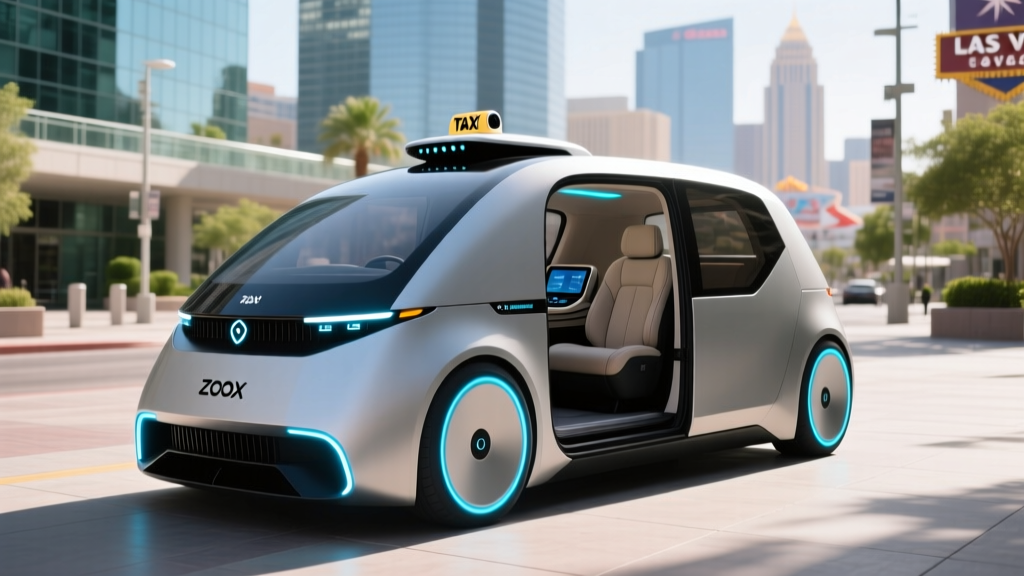
Zoox is not a modified consumer car with a sensor bolted on. The Zoox vehicle is a bidirectional, carriage-style electric shuttle with no steering wheel, no pedals, and no driver's seat. It seats up to four passengers face-to-face and is designed from the ground up as a Level 4 autonomous vehicle — meaning it operates without any human driver in the vehicle and without any expectation of human takeover within its operational design domain (ODD).
The Zoox robotaxi handles all driving tasks within its geofenced service area without a human driver onboard. This is fundamentally different from Level 2 driver-assist systems like Tesla Autopilot or GM Super Cruise, which require an attentive human driver at all times. Zoox riders are passengers, not drivers. If the vehicle encounters a situation it cannot handle, it is designed to pull over safely and contact a remote fleet-support operator — not hand control to a rider.
This distinction matters because many consumers conflate consumer driver-assist features (Level 2) with robotaxi services (Level 4). The Zoox vehicle has no steering controls because no one inside is expected to drive. The system — not a human — is responsible for the dynamic driving task at all times within its approved zone.
How Much Does Zoox Cost vs. Uber and Lyft?
As of 2026, Zoox has been operating its ride-hail service on an invitation-based and waitlist-based model in Las Vegas and San Francisco, and rides have been offered at no charge to riders. This is a strategic decision: Zoox is accumulating real-world passenger miles, refining its service model, and building demand before introducing per-ride pricing.
| Service | Base Fare | Per-Mile Estimate | 3-Mile Trip (Est.) | Notes |
|---|---|---|---|---|
| Zoox | $0.00* | $0.00* | $0.00 | Currently free; invite/waitlist access |
| UberX | ~$2.50 | ~$1.50–$2.00 | $7–$9 | Varies by demand/surge |
| Lyft Standard | ~$2.50 | ~$1.40–$1.90 | $7–$9 | Varies by demand/surge |
| Waymo One | ~$2.00 | ~$1.50–$2.50 | $7–$10 | Paid service in Phoenix, SF, LA |
* Zoox pricing is $0 as of early 2026 during its invitation-based service phase. Future paid fares have not been announced. Rideshare estimates are approximate and vary by time, demand, and exact route.
When Zoox does introduce paid fares, industry analysts expect pricing roughly on par with UberX and Lyft — the company's cost advantage lies in eliminating driver compensation (typically 60–75% of a rideshare fare), which gives it room to undercut competitors while still covering vehicle and operations costs over time.
Where Can I Ride Zoox Right Now?
Zoox's commercial robotaxi service is currently available in two metro areas, with geofenced operational boundaries that limit where you can request a ride:
| City | Status | Service Area | Access Model |
|---|---|---|---|
| Las Vegas, NV | Active | Las Vegas Strip corridor, parts of downtown, and surrounding commercial zones | Invitation / waitlist via Zoox app |
| San Francisco Bay Area, CA | Active | Select zones in San Francisco and Foster City | Invitation / waitlist via Zoox app |
| Austin, TX | Testing (not public ride-hail) | Limited test zones | Employee/authorized riders only |
| Atlanta, GA | Testing (not public ride-hail) | Limited test zones | Employee/authorized riders only |
To request a Zoox ride in Las Vegas, you need to download the Zoox app (available on iOS and Android), join the waitlist, and wait for an invitation. Once approved, you request a ride similarly to Uber or Lyft: set your pickup and drop-off within the geofenced zone, and the nearest Zoox vehicle navigates to you. The vehicle has no driver — you simply buckle in and the car handles the rest.
Keep in mind that Zoox's Las Vegas service area does not cover the entire metropolitan area. Rides are confined to mapped, approved corridors. If your destination falls outside the geofence, the app will not allow you to complete the request.
How Safe Are Zoox Robotaxis? The Data
Safety is the most scrutinized question in the robotaxi space. Zoox, like all autonomous vehicle operators in California and Nevada, is required to report disengagement data, collision reports, and operational metrics to state regulators.
- Autonomous miles driven: Zoox has accumulated millions of autonomous miles across its test and commercial fleets in Las Vegas, San Francisco, and other test cities. The company reports cumulative autonomous mileage figures in regulatory filings with the California DMV and Nevada DMV.
- Collision reports: Zoox has filed a small number of collision reports with NHTSA under the agency's Standing General Order requiring AV operators to report crashes. Most reported incidents involved low-speed contact with other road users (e.g., being rear-ended at a stop) rather than at-fault collisions caused by the AV system.
- No reported passenger fatalities: As of early 2026, Zoox has not reported any passenger fatalities or serious injuries in its robotaxi operations.
- Remote assistance: Zoox vehicles can contact a remote fleet-assistance team when encountering ambiguous scenarios (construction zones, unusual road closures). The remote operator does not "joystick-drive" the vehicle but can provide high-level guidance to help the system resolve the situation.
It's worth contextualizing robotaxi safety against human drivers. According to NHTSA data, human drivers are involved in approximately 5.5 million police-reported crashes annually in the U.S., with roughly 94% of crashes involving driver error. Robotaxis eliminate impairment, distraction, and fatigue — the leading crash causation factors. However, AV systems still struggle with edge cases that human drivers handle intuitively: unmapped construction zones, erratic pedestrian behavior, and severe weather.
Zoox's approach to safety includes extensive simulation (billions of virtual test miles), a purpose-built vehicle with symmetric crash structures and airbags on all sides, and a maximum operating speed of 75 mph (though in practice, city operations rarely exceed 35–45 mph).
Zoox Technology Stack: Lidar, Cameras, and Geofencing
Zoox uses a multi-sensor fusion approach — fundamentally different from Tesla's camera-only FSD architecture. The Zoox vehicle is covered with overlapping sensor arrays that provide 360-degree perception:
| Sensor Type | Role | Coverage |
|---|---|---|
| Lidar | 3D point-cloud mapping of surroundings; precise distance measurement to objects, pedestrians, vehicles | 360° overlapping arrays, ~150–200m range |
| Cameras | Traffic light/Sign recognition, lane detection, object classification, color/texture data | 360° multi-focal arrays |
| Radar | Velocity measurement of moving objects; reliable in rain/fog where lidar degrades | 360° coverage |
| Ultrasonic | Near-field obstacle detection during low-speed maneuvers, parking, pickup/drop-off | Short-range perimeter |
| HD Maps + GPS/IMU | Centimeter-level localization; route planning within geofenced ODD | Pre-mapped service area only |
The Zoox vehicle is also bidirectional — it can drive equally well in either direction, which simplifies maneuvers like three-point turns and allows symmetric sensor placement. The vehicle is powered by an all-electric battery pack (Zoox has not published the exact kWh capacity, but the vehicle is designed for all-day urban operations with opportunity charging between rides).
Unlike Tesla's FSD, which aims for a generalizable neural-network approach to any road, Zoox relies on high-definition pre-mapping of its service area. The vehicle knows every lane, intersection, and traffic signal in its zone before it ever drives there autonomously. This is a key safety advantage but also a key limitation — the car cannot operate outside its mapped geofence.
Regulatory Landscape: Who Approves Zoox Operations?
Robotaxi operations in the U.S. are regulated at the state level, with additional federal oversight for vehicle safety standards:
- Nevada: The Nevada DMV and the Nevada Department of Transportation issue autonomous vehicle testing and deployment permits. Zoox holds a commercial deployment permit for its Las Vegas service area. Nevada was one of the first states to create a regulatory framework for driverless commercial operations.
- California: The California DMV issues autonomous vehicle testing and deployment permits, while the California Public Utilities Commission (CPUC) regulates commercial passenger service. Zoox holds permits for testing and limited commercial operations in the Bay Area. California requires AV operators to submit annual disengagement reports and collision reports.
- Federal (NHTSA): The National Highway Traffic Safety Administration does not currently "approve" autonomous vehicles but sets Federal Motor Vehicle Safety Standards (FMVSS). Zoox received a notable exemption from NHTSA allowing its steering-wheel-free, pedal-free vehicle design to operate — a waiver from FMVSS requirements that assume a human driver position. NHTSA also mandates crash reporting under its Standing General Order for all AV operators.
This state-by-state patchwork means Zoox cannot simply "turn on" service in any city. Each new market requires navigating local permitting, insurance requirements, and regulatory approvals — a process that takes months to years, not weeks.
Current Limitations: What Zoox Cannot Do
Zoox operates as a Level 4 system within a tightly defined operational design domain. The following limitations apply:
- Geofenced only: The vehicle will not operate outside its pre-mapped, approved service area. You cannot request a ride to a suburb outside the geofence.
- Weather constraints: Heavy rain, flooding, snow, or ice can degrade lidar and camera performance. Zoox may suspend service during severe weather. Las Vegas's dry climate is an advantage here, but monsoon-season storms can still trigger service pauses.
- Construction zones: Major, unmapped road construction can confuse the system. The vehicle may stop and request remote assistance or reroute.
- No highway driving: Zoox currently operates on surface streets only. It does not merge onto freeways or handle high-speed highway driving.
- Limited passenger capacity: The vehicle seats up to four passengers. No wheelchair-accessible variant is currently in commercial service.
- No trunk/cargo space: The carriage-style design prioritizes passenger seating. Large luggage, groceries, or cargo do not fit.
- Waitlist access: Not everyone can hail a Zoox ride today. The service is still invitation-based, meaning you may wait weeks or months for access after signing up.
- Limited hours: Service may not operate 24/7 in all zones. Check the app for current operating hours in your area.
These limitations are not unique to Zoox — they apply broadly to all current Level 4 robotaxi services, including Waymo. The gap between a geofenced Level 4 system and a Level 5 "drive anywhere, anytime" vehicle remains substantial. Zoox has not announced a timeline for removing geofence constraints or expanding to highway driving.
How to Get Started With Zoox in Las Vegas
- Download the Zoox app from the Apple App Store or Google Play Store.
- Create an account and join the ride waitlist for Las Vegas.
- Wait for an invitation. Zoox onboards riders in waves. There is no published timeline for waitlist clearance.
- Request a ride. Once approved, open the app, set a pickup and drop-off within the Las Vegas service zone, and confirm.
- Board the vehicle. The carriage-style vehicle will pull up, doors open automatically, and you select your seat. Buckle in — the ride begins automatically.
- In-ride experience. The app shows your route, ETA, and a live visualization of what the vehicle's sensors see. A support button connects you to a live agent if needed.
Frequently Asked Questions
Is Zoox truly self-driving, or is there a driver somewhere?
Zoox is a true SAE Level 4 driverless robotaxi. There is no human driver in the vehicle — no steering wheel, no pedals, no driver's seat. The vehicle operates autonomously within its geofenced service area. A remote fleet-support team can assist with edge cases, but they do not directly steer or control the vehicle in real time.
How much is Zoox in Las Vegas — will it always be free?
As of early 2026, Zoox rides are free during the invitation-based service phase. The company has not announced a permanent fare structure. When paid service launches, expect fares competitive with UberX and Lyft Standard (roughly $7–$12 for a typical 3-mile trip in the Strip area). Zoox's elimination of driver pay gives it structural room to undercut traditional rideshare on price.
How does Zoox compare to Waymo?
Both are Level 4 robotaxis, but they differ in approach. Waymo uses modified production vehicles (Jaguar I-PACE, Zeekr) and operates a larger, fully paid commercial service in Phoenix, San Francisco, and Los Angeles. Zoox uses a purpose-built carriage-style vehicle and is currently in a free, invitation-only phase in fewer cities. Waymo has more cumulative autonomous miles and a broader service footprint; Zoox's purpose-built design offers a unique passenger experience but a smaller operational scale so far.
Can I use Zoox to get to the Las Vegas airport?
That depends on whether Harry Reid International Airport (LAS) falls within Zoox's current Las Vegas geofence. The service area has been expanding, but airport pickups and drop-offs are subject to specific permitting agreements. Check the Zoox app for the current service boundary map.
What happens if the Zoox vehicle encounters a problem mid-ride?
If the system encounters a scenario it cannot resolve (e.g., an unmapped road closure), it is designed to safely pull over and contact Zoox's remote fleet-support team. The support team can provide routing guidance to help the vehicle proceed. In-ride, passengers can press a support button to speak with a live agent at any time. The vehicle is also equipped with emergency communication systems.
Is the Zoox vehicle electric?
Yes. The Zoox robotaxi is a fully battery-electric vehicle (BEV) with zero tailpipe emissions. It charges between rides at Zoox-operated depots. Exact battery capacity (kWh) and range figures have not been published by the company, but the vehicle is designed for sustained urban operations throughout the day.