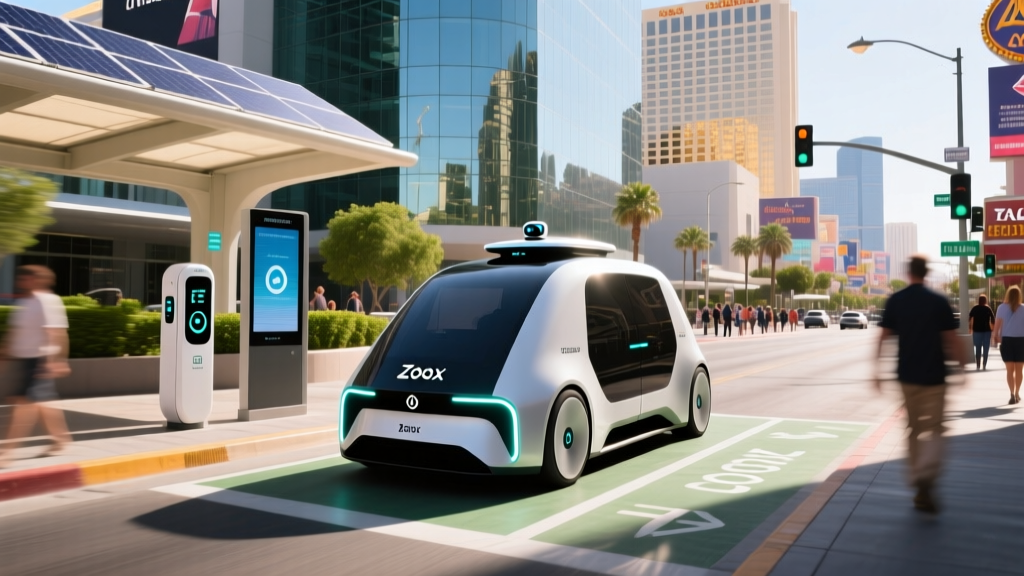
If you've seen Zoox's boxy, steering-wheel-free robotaxi gliding through downtown Las Vegas and wondered how to actually catch a ride, you're not alone. The Amazon-backed autonomous vehicle company has been expanding its Nevada operations steadily, but its service area remains tightly geofenced. This guide breaks down exactly where Zoox picks up in Las Vegas as of early 2026, how the service works, what it costs, and what the safety data actually shows.
Where Can You Catch a Zoox Ride in Las Vegas?
Zoox's Las Vegas service area is centered on the high-density corridor between downtown and the Strip, with pickup and drop-off limited to a defined geofence. As of 2026, the operational zone covers roughly the following boundaries:
- North boundary: Downtown Las Vegas / Fremont Street area
- South boundary: Approximately the southern end of the Las Vegas Strip (near Mandalay Bay)
- East boundary: Las Vegas Boulevard corridor and a few blocks east, including portions of Paradise Road
- West boundary: I-15 freeway corridor (the geofence generally does not extend west of the interstate)
Within this zone, Zoox designates specific pickup and drop-off nodes rather than allowing door-to-door service at any address. These nodes are typically located at major hotel entrances, convention center access points, and high-traffic intersections. When you request a ride through the Zoox app, the system directs you to the nearest approved node — usually within a one- to two-block walk.
- Downtown Summerlin (limited — verify in-app)
- Fremont Street Experience perimeter
- Las Vegas Convention Center
- Major Strip resorts within the geofence (app-dependent)
- Harry Reid International Airport — not currently serviced; Zoox does not yet operate to or from the airport
The most reliable way to confirm whether your specific origin and destination are within the service area is to open the Zoox app and enter your addresses. The app will either confirm availability or show you the nearest valid pickup node. Zoox has been gradually expanding this geofence over time, but growth is incremental and tied to regulatory approvals from the State of Nevada and safety validation milestones.
SAE Automation Level: This Is Level 4, Not Driver-Assist
It's critical to understand what Zoox actually is — and what it isn't. Consumer driver-assistance systems like Tesla Autopilot, Ford BlueCruise, and GM Super Cruise are SAE Level 2: the driver must remain engaged, monitor the road, and be ready to take over at any moment. These are not self-driving systems.
Zoox operates at SAE Level 4 — high automation within a defined operational design domain (ODD). Inside its geofenced service area and under approved conditions, the vehicle handles all driving tasks with no human driver present. There is no steering wheel, no pedals, and no driver's seat. If the system encounters a situation it cannot handle, it is designed to pull over safely rather than hand control to a passenger.
| Level | Name | Who Drives? | Examples |
|---|---|---|---|
| Level 0 | No Automation | Human only | Traditional vehicles |
| Level 1 | Driver Assistance | Human (with steering or speed aid) | Adaptive cruise, lane-keep |
| Level 2 | Partial Automation | Human must supervise at all times | Autopilot, FSD Supervised, BlueCruise, Super Cruise |
| Level 4 | High Automation (geofenced) | System drives — no human needed in ODD | Zoox, Waymo One |
| Level 5 | Full Automation | System drives everywhere, all conditions | Does not exist commercially |
The distinction matters: when you ride in a Zoox vehicle, no human is driving or monitoring from behind a screen in the car. Remote assistance may be available from a fleet operations center, but the vehicle itself makes real-time driving decisions.
How to Use Zoox in Las Vegas (and What It Costs)
Riding in a Zoox robotaxi follows a flow similar to Uber or Lyft, with a few autonomous-specific differences:
- Download the Zoox app (iOS/Android) and create an account. As of 2026, Zoox's Las Vegas service operates primarily through an early rider program and waitlist — you may need to request access before booking.
- Enter your pickup and destination. The app validates that both points fall within the geofence and directs you to the nearest approved pickup node.
- Wait for your vehicle. The app shows the approaching Zoox vehicle (easily identified by its symmetrical, carriage-style design with no visible hood or trunk). Wait times typically range from 3 to 10 minutes within the core service zone.
- Board and go. The vehicle has four inward-facing seats. There's no driver to interact with. The ride begins automatically once all passengers are seated and doors are closed.
- Monitor your ride via the in-cabin screen, which shows the vehicle's perception of surrounding traffic, pedestrians, and obstacles in real time.
Pricing: Zoox vs. Uber and Lyft
Zoox has historically offered free rides during its early rider and testing phases in Las Vegas, using the program to accumulate real-world miles and passenger feedback. As of early 2026, the company has not published a standard per-mile or per-minute fare structure for Las Vegas the way Waymo One has in Phoenix and San Francisco.
| Service | Base Fare | Per-Mile Rate | Per-Minute Rate | Typical 5-Mile Ride |
|---|---|---|---|---|
| UberX | ~$2.50 | ~$1.10 | ~$0.30 | $12–$18 |
| Lyft Standard | ~$2.25 | ~$1.05 | ~$0.28 | $11–$17 |
| Zoox | Free (early rider program) | N/A yet | N/A yet | $0 (promotional) |
| Waymo One (for reference — Phoenix/SF pricing) | ~$3.00 | ~$1.20 | ~$0.35 | $13–$20 |
Note: Uber and Lyft pricing fluctuates with surge demand, which is frequent on the Las Vegas Strip during weekends, conventions, and events. Zoox's promotional pricing eliminates this variable for now, but commercial fares will likely land in the range of UberX/Lyft Standard once the service transitions to paid operation.
Safety Record: What the Data Shows
Zoox's safety record must be evaluated differently from consumer vehicles because the company operates under specific permits and reports disengagement and incident data to state regulators. Here's what is publicly known:
- Testing and operations states: California, Nevada, Arizona, Texas (permits vary by state)
- Autonomous miles driven: Zoox has accumulated millions of autonomous miles across its test fleet, though exact cumulative figures are reported through California DMV disengagement reports and Nevada regulatory filings
- Disengagement rate: In California DMV reports, Zoox's disengagement rate (times a safety driver or remote operator had to intervene) has trended downward year-over-year, reflecting system maturation — though direct comparison with Waymo's rates requires normalizing for ODD complexity and miles driven
- At-fault collisions: As of the latest available NHTSA standing general orders for automated driving systems, Zoox has reported minor incidents typical of urban testing (e.g., low-speed contact events), with no publicly reported serious injuries or fatalities attributed to the Zoox system
- Vehicle design safety: The Zoox purpose-built vehicle includes a bidirectional crash structure (since either end can be the "front"), enhanced airbag coverage for inward-facing seats, and a lower maximum speed (~75 mph) suited to urban geofenced operation
Sources: California DMV Autonomous Vehicle Disengagement Reports; NHTSA Standing General Order on ADS crashes.
It's worth noting that Zoox, like all robotaxi operators, benefits from a controlled environment: geofenced routes, moderate speeds, and no highway merging in most Las Vegas operations. This is fundamentally different from testing full autonomy on unrestricted roads. The safety question for robotaxis isn't "are they perfect?" — it's "are they safer than human drivers in the same ODD?" The data is still accumulating, but early indicators from the industry suggest robotaxis in geofenced urban zones have collision rates at or below human benchmarks for equivalent environments.
Technology Stack: How the Zoox Vehicle Sees the World
Unlike Tesla's camera-only approach to autonomy, Zoox employs a multi-sensor fusion stack that combines lidar, cameras, and radar for redundant perception. This is the standard architecture for Level 4 robotaxi operators (Waymo uses a similar approach).
- Lidar: Multiple roof-mounted lidar units provide 360° 3D point-cloud mapping, detecting objects, pedestrians, and road geometry out to 150+ meters regardless of lighting
- Cameras: High-resolution camera arrays cover all directions, handling lane-line detection, traffic-signal recognition, and object classification
- Radar: Radar units supplement lidar and cameras for velocity detection of moving objects and performance in rain or fog where lidar and cameras can degrade
- HD maps: Zoox pre-maps its geofenced service area at centimeter-level precision; the vehicle localizes against these maps in real time
- Compute platform: Custom onboard computing handles sensor fusion, path planning, and prediction algorithms, with redundant systems so a single hardware failure does not disable the vehicle
- Connectivity: Cellular connectivity to Zoox's fleet operations center enables remote assistance if the vehicle encounters an ambiguous scenario (e.g., a construction zone not reflected in HD maps)
The purpose-built Zoox vehicle (often called the "Gen 5" platform internally) was designed from the ground up as a robotaxi — it is not a retrofitted production car. Its symmetrical, bidirectional design means it can drive equally well in either direction, which is useful for tight urban maneuvers and dead-end streets. The vehicle seats four passengers face-to-face, with no driver compartment at all.
Regulatory Landscape: Who Approves Zoox Operations?
Robotaxi operations in the United States are governed by a patchwork of state and local regulations — there is no single federal license for autonomous vehicle deployment. In Nevada, Zoox operates under the state's autonomous vehicle testing and deployment framework, which was among the first in the nation to permit driverless commercial operations.
- Nevada: The Nevada DMV and the Governor's Office of Economic Development oversee autonomous vehicle permits. Companies must demonstrate safety validation, insurance coverage, and compliance with state-specific reporting requirements before carrying paying passengers.
- California: The California DMV issues testing permits (with and without safety drivers), while the California Public Utilities Commission (CPUC) regulates commercial passenger service. Zoox holds testing permits in California.
- Federal (NHTSA): The National Highway Traffic Safety Administration does not currently "approve" autonomous vehicles but requires operators to report crashes under Standing General Orders and can issue recalls or investigations if safety defects are identified. Zoox received a notable NHTSA exemption for its purpose-built vehicle, which lacks traditional controls (steering wheel, mirrors) that are otherwise required under Federal Motor Vehicle Safety Standards.
This regulatory fragmentation means Zoox must negotiate each new city individually. Expansion is slow by design — regulators require extensive safety data before approving passenger service in new geofences.
Current Limitations: What Zoox Cannot Do
Level 4 autonomy is powerful within its domain, but the domain is narrow. Here are the real-world constraints riders should understand before planning a trip:
- Geofence boundaries: If your origin or destination falls outside the approved zone, Zoox simply won't service the trip. There is no partial autonomy or handoff to a human driver — the trip either fits the geofence or it doesn't.
- Weather restrictions: While Zoox's multi-sensor stack handles light rain better than camera-only systems, heavy rain, flooding, or dust storms (relevant in Las Vegas) can trigger operational pauses. The vehicle may pull over safely and wait, or the service may be suspended entirely during severe conditions.
- No highway driving: Zoox's Las Vegas operations are restricted to surface streets within the geofence. The vehicle does not merge onto I-15 or US-95 for longer trips. This limits the service to relatively short urban hops.
- Airport service: Harry Reid International Airport is not currently within the Zoox geofence. If you need a ride to or from the airport, you'll need Uber, Lyft, or a traditional taxi.
- Construction and road closures: Unplanned road closures, emergency vehicle activity, or significant construction can confuse HD-map-based navigation. Zoox vehicles may reroute conservatively or pause until the path clears, which can add time to a trip.
- Limited hours: Depending on permit terms and operational validation, Zoox may not operate 24/7 in all zones. Late-night service availability should be confirmed in the app.
- Passenger capacity: The vehicle seats exactly four passengers. There is no option for larger groups, and luggage space is limited — this is a people-mover, not an airport shuttle.
Frequently Asked Questions
Is Zoox free in Las Vegas?
As of early 2026, Zoox's Las Vegas service has operated primarily through an early rider / invitation program where rides are offered at no charge. This is a promotional and data-gathering phase, not a permanent pricing model. Commercial fares will be introduced as the service scales. Check the Zoox app for current pricing status.
Can I hail a Zoox on the street like a taxi?
No. All Zoox rides must be requested through the Zoox mobile app. You cannot flag one down, and the vehicle will not stop for pedestrians outside the app-based booking flow.
Is there a human driver or safety operator inside the Zoox vehicle?
No. The Zoox purpose-built vehicle has no steering wheel, no pedals, and no driver's seat. It operates at SAE Level 4 with no human driver in the vehicle. Remote fleet operators can provide guidance in edge cases but do not directly drive the vehicle in normal operation.
How does Zoox compare to Waymo?
Both are SAE Level 4 robotaxi services, but Waymo (Alphabet/Google) has a larger commercial footprint with Waymo One operating paid service in Phoenix, San Francisco, Los Angeles, and expanding to additional cities. Waymo uses a retrofitted vehicle platform (Jaguar I-PACE, Zeekr), while Zoox uses a purpose-built, bidirectional vehicle. Waymo's paid pricing is comparable to UberX/Lyft Standard. Zoox's Las Vegas service area is currently smaller than Waymo's Phoenix or San Francisco footprints.
What happens if the Zoox vehicle encounters an emergency?
The vehicle is designed to detect emergencies (including approaching emergency vehicles) and respond by pulling to the side of the road and stopping. Passengers can contact Zoox support via the in-cabin interface or the app at any time. The vehicle includes standard safety equipment (airbags, seatbelts) and is built with a bidirectional crash structure.
Will Zoox expand beyond the current Las Vegas geofence?
Zoox has signaled ongoing expansion in Las Vegas and other test cities, but each geofence expansion requires regulatory approval and safety validation. Expect incremental growth measured in blocks and corridors, not city-wide coverage overnight. Monitor the Zoox app for real-time service area updates.