If you've been searching for how to book a Waymo in Austin, you're not alone — the Texas capital has become one of the key battlegrounds for commercial robotaxi services in the United States. Waymo, Alphabet's autonomous driving subsidiary, has been progressively expanding its Waymo One ride-hailing service beyond its original Phoenix stronghold, and Austin features prominently in its growth strategy. But availability, access requirements, and pricing differ meaningfully from what you might expect from a standard Uber or Lyft ride. This guide breaks down exactly what's live right now, how the technology works, and what the safety data actually shows.
Is Waymo Available in Austin Right Now?
As of early 2026, Waymo's Austin operations remain in an early rider / limited access phase. Unlike Phoenix and San Francisco — where Waymo One operates as a fully open commercial service available to any user who downloads the app — Austin has been in a staged rollout. This means access may require joining a waitlist, receiving an invitation, or being part of a trusted tester program before the service opens to the general public.
Here's where Waymo One currently stands across its major U.S. markets:
| City | Status | Access Type | Approximate Service Area |
|---|---|---|---|
| Phoenix, AZ (Metro) | Fully Open | Anyone via app | ~315 sq mi (Chandler, Tempe, Mesa, Scottsdale, Phoenix) |
| San Francisco, CA | Fully Open | Anyone via app | ~50 sq mi (city core + expanding corridors) |
| Los Angeles, CA | Commercial Launch | Open to public (expanding zones) | ~80+ sq mi (Santa Monica, Beverly Hills, Downtown, Hollywood) |
| Austin, TX | Early Rider / Limited | Waitlist / invitation-based | Initial geofenced zones (downtown + select corridors) |
If you're in Austin, download the Waymo One app (iOS/Android) and check whether your pickup location falls within the active service geofence. If Austin is still in early-rider status when you check, you'll be prompted to join the waitlist. For guaranteed immediate access, Phoenix and San Francisco remain the fully open markets.
How to Book a Waymo Ride: Step by Step
The booking process mirrors conventional rideshare apps once you have access, but with important differences tied to the autonomous nature of the service:
- Download the Waymo One app — available on iOS and Android. This is a separate app from Google Maps, though Google Maps may surface Waymo as a routing option in fully open markets.
- Create an account and verify eligibility — you'll need a valid payment method and must be 18+. In early-access markets like Austin, this is also where you'll see waitlist status.
- Enter your pickup and dropoff locations — the app will confirm whether both points fall within the active geofence. If either point is outside the service area, the ride cannot be booked.
- Confirm your ride — the app matches you with the nearest available Waymo vehicle (currently the Jaguar I-PACE-based 6th-generation platform). You'll see the vehicle's license plate and a live map of its approach.
- Board the vehicle — when the Waymo arrives, you unlock it through the app. There is no human driver in the front seat. The vehicle will not depart until all doors are closed and seatbelts are fastened.
- Ride and monitor — the in-vehicle screen displays the route, speed, and what the vehicle's sensors are detecting. You can adjust music and climate but cannot alter the destination mid-trip without pulling over.
- Exit and rate — the vehicle will stop only at approved dropoff points within the geofence. Payment is automatic.
Waymo Austin Pricing vs. Uber and Lyft
One of the most common questions from new robotaxi users is cost. Waymo has generally aimed for pricing parity with UberX and Lyft Standard — not cheaper, not significantly more expensive — though real-world pricing varies by time of day, distance, and demand.
| Service Tier | Base Fare (Est.) | 5-Mile Trip (Est.) | Surge/Dynamic Pricing | Tipping |
|---|---|---|---|---|
| Waymo One | ~$5.50 | $12–$18 | Yes (demand-based) | Not applicable (no driver) |
| UberX | ~$4.00 | $11–$17 | Yes (surge pricing) | Expected ($2–$5) |
| Lyft Standard | ~$4.00 | $10–$16 | Yes (prime time) | Expected ($2–$5) |
| Waymo One (no tip) | — | Comparable or slightly higher | — | $0 saved vs. rideshare |
SAE Automation Level: What "Self-Driving" Actually Means Here
This is where precise terminology matters enormously, because the automotive industry is full of misleading claims about autonomy.
| SAE Level | Name | Who Drives? | Examples |
|---|---|---|---|
| Level 0 | No Automation | Human does everything | Conventional cars with no ADAS |
| Level 1 | Driver Assistance | Human drives; system assists steering OR speed | Adaptive cruise control, lane-keeping assist |
| Level 2 | Partial Automation | Human drives and monitors; system assists steering AND speed | Tesla Autopilot, GM Super Cruise, Ford BlueCruise |
| Level 3 | Conditional Automation | System drives in specific conditions; human must take over on request | Mercedes DRIVE PILOT (limited markets, low speed) |
| Level 4 | High Automation | System drives entirely within its operational domain; no human needed | Waymo One, Zoox (geofenced robotaxis) |
| Level 5 | Full Automation | System drives everywhere, all conditions | Does not exist commercially |
Waymo's Technology Stack: How the 6th-Gen Vehicle Sees the Road
Waymo's current fleet vehicles (based on the all-electric Jaguar I-PACE platform, transitioning to the custom-built Zeekr-based 6th-generation vehicle) rely on a multi-sensor fusion approach — a deliberate contrast to Tesla's camera-only strategy.
- LiDAR: Multiple spinning and solid-state LiDAR units providing high-resolution 3D point clouds up to 500+ meters. LiDAR is the backbone of Waymo's perception, enabling precise depth mapping regardless of lighting conditions.
- Cameras: 29+ cameras covering 360° visibility, including long-range forward-facing units for highway-speed object detection and close-range cameras for pedestrian/cyclist tracking.
- Radar: 6 radar units for velocity detection and all-weather object tracking, particularly useful in rain or fog where camera and LiDAR performance degrades.
- External audio sensors: Microphones that detect emergency vehicle sirens and adjust behavior accordingly (pulling over, yielding).
- HD mapping: Waymo vehicles operate on pre-built centimeter-accurate maps of every road within the geofence, updated regularly. The vehicle cross-references live sensor data against these maps continuously.
- Compute: Custom-designed autonomous driving computers processing sensor fusion, prediction, and planning in real time.
The geofencing approach means Waymo does not attempt to drive on unmapped roads. Every street in the Austin service area has been scanned, mapped, and validated before the vehicle is permitted to operate there autonomously. This is a key limitation compared to a human driver who can navigate anywhere — but it's also what makes Level 4 operation safe within the defined domain.
Safety Record: What the Data Actually Shows
Robotaxi safety is the most scrutinized aspect of the industry, and for good reason. Here's what we know from published data:
- Cumulative autonomous miles driven: Over 50 million fully driverless miles across all markets as of late 2025 (Waymo Safety Page).
- Injury-causing crash rate: Waymo's published research (peer-reviewed with Swiss Re) found a 85% reduction in injury-causing crash rates compared to human driver benchmarks in comparable operating environments.
- Property-damage crash rate: Approximately 57% lower than human benchmarks in the same geographies.
- Contact rate: Waymo's vehicles make contact with objects (including curbs, cones, and other vehicles) at a significantly lower rate per million miles than human drivers, though the types of contacts differ (low-speed, often stationary-object related).
However, context matters. Waymo operates in geofenced, mapped urban areas, often at moderate speeds, and avoids the most extreme conditions. The comparison to human drivers is fair within the same operational domain but should not be extrapolated to all driving scenarios. The National Highway Traffic Safety Administration (NHTSA) continues to monitor and investigate autonomous vehicle incidents, and Waymo has been subject to recalls related to software behavior — as have all AV operators.
It's also important to note that high-profile incidents in the broader robotaxi industry (including Cruise's suspension in California in late 2023 following a pedestrian-dragging incident) demonstrate that Level 4 autonomy, while statistically safer in aggregate, is not infallible. Edge cases — construction zones, erratic human behavior, unusual road configurations — remain the frontier challenge.
Regulatory Landscape: Who Approves Robotaxi Operations
Robotaxi services in the United States operate under a patchwork of state and federal regulations:
- Federal (NHTSA): Sets vehicle safety standards (FMVSS). Currently, NHTSA has granted limited exemptions to AV manufacturers for vehicles without traditional controls (steering wheels, pedals). NHTSA also mandates crash reporting for vehicles equipped with Level 2+ and above automation.
- State level: This is where most operational authority lies. In Texas, the Texas Department of Transportation (TxDOT) and state legislature govern autonomous vehicle operation. Texas passed AV-enabling legislation (SB 2017, HB 2835) that permits driverless vehicle operation provided the vehicle is properly registered, insured, and compliant with all traffic laws.
- Local/municipal: Cities like Austin can influence AV operations through local ordinances, permitting for commercial ride services, and coordination on road construction data sharing. Austin has historically been AV-friendly, with multiple companies (Waymo, Cruise, and others) having tested there.
- Insurance: Texas requires autonomous vehicles to carry minimum liability insurance. Waymo carries commercial insurance well above state minimums for its fleet operations.
Unlike California, where the California Public Utilities Commission (CPUC) directly regulates commercial robotaxi fares and permits, Texas currently has a lighter-touch regulatory framework for AV ride-hailing — which has made it an attractive expansion market for Waymo.
Current Limitations: What Waymo Cannot Do
Understanding the boundaries of robotaxi service is essential for setting realistic expectations:
- Geofencing: The vehicle will only pick up and drop off within the pre-mapped service area. If your destination falls outside the geofence, the app will not allow the booking. The service area expands over time but remains a fraction of the total metro area.
- Weather restrictions: Heavy rain, flooding, fog, and icy conditions can cause the service to restrict operations or pause entirely. Waymo's sensors degrade in precipitation, and the system is programmed to be conservative.
- No highway operation (in most markets): Waymo has begun limited freeway testing, but most commercial rides remain on surface streets. Airport runs that require extended highway segments may not yet be available.
- Construction zones: While Waymo handles routine construction, major road reconfigurations or unmarked detours can cause the vehicle to stop and request remote assistance. This means your ride may pause unexpectedly.
- No rider intervention: There is no steering wheel or pedal accessible to passengers. If the vehicle encounters an unresolvable situation, it will pull over safely and a remote support agent will assist — but you cannot "take over" driving.
- Accessibility: Waymo's current Jaguar I-PACE fleet is not wheelchair-accessible. The company has committed to adding WAV (wheelchair-accessible vehicle) options, but availability is limited.
- Passenger limits: Typically limited to 1–3 adult passengers in the rear seats. No front-seat riding, no pets (service animals excepted), and no unaccompanied minors.
- Wait times: In early-access markets like Austin, fleet size is smaller, so wait times can be longer than Uber/Lyft — often 8–15 minutes versus 3–7 minutes for conventional rideshare.
Frequently Asked Questions
How do I join the Waymo waitlist in Austin?
Download the Waymo One app from the App Store or Google Play, create an account, and enter your typical Austin pickup address. If the service is still in early-access mode, you'll be placed on a waitlist and notified when your area opens. Waymo has been onboarding Austin riders in waves, often prioritizing users in the initial geofence zone.
Can I schedule a Waymo ride in advance?
Waymo One supports scheduled rides in some markets, but availability of this feature depends on fleet density. In early-access markets like Austin, on-demand rides are the primary mode. Check the app for whether advance scheduling is available in your zone.
Is Waymo cheaper than Uber in Austin?
On a per-ride basis, Waymo One pricing is generally comparable to UberX — within 10–15% in either direction depending on demand and distance. The main cost advantage is the absence of tipping, which can save $2–$5 per ride. During peak hours, both services apply dynamic/surge pricing.
Is this truly self-driving or driver-assist?
Waymo One is a SAE Level 4 fully autonomous service — no human driver is present in the vehicle. This is categorically different from Level 2 driver-assist systems like Tesla Autopilot or GM Super Cruise, which require continuous human supervision. In a Waymo, you are a passenger, not a driver.
What happens if the Waymo gets confused or stuck?
The vehicle is designed to pull over safely and contact Waymo's remote support team. A human agent can assess the situation via the vehicle's cameras and sensors and provide guidance — but they do not remotely "drive" the car in real time. If the situation cannot be resolved, the ride may be terminated and you'll be credited accordingly.
Does Waymo operate 24/7 in Austin?
In fully open markets like Phoenix, Waymo One operates around the clock. In Austin's early-access phase, hours of operation may be more limited (typically early morning through late evening). The app will show available service hours for your specific zone.
What vehicle will pick me up?
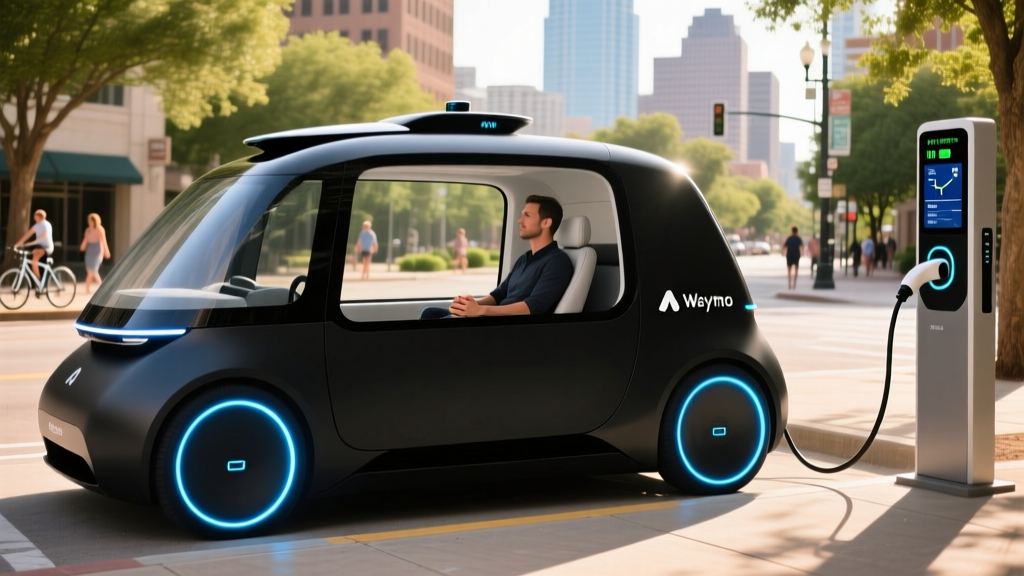
Waymo's current fleet primarily uses the all-electric Jaguar I-PACE equipped with its 6th-generation autonomous driving hardware (LiDAR, cameras, radar, and custom compute). Waymo is also deploying its custom-built Zeekr-designed vehicle in select markets, which features a more spacious, lounge-like interior optimized for rider comfort rather than driver controls.