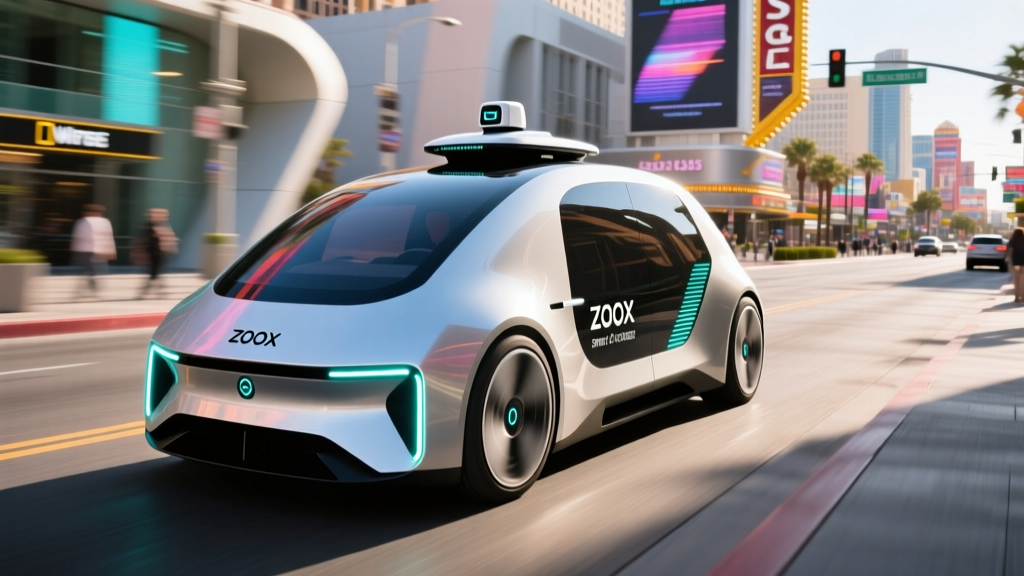
If you've seen the boxy, carriage-style Zoox vehicle gliding down the Las Vegas Strip without anyone behind the wheel, you probably have two questions: how do I get in one, and what does it cost? Amazon's autonomous-vehicle subsidiary has been quietly expanding its commercial robotaxi service in Sin City, and the pricing model is unlike anything you'd expect from Uber or Lyft.
This guide breaks down everything a visitor or resident needs to know about hailing a Zoox in Las Vegas — from real ride costs and service boundaries to the Level 4 technology that makes it possible, the safety record so far, and the limitations you should expect in 2026.
Zoox operates as a Level 4 autonomous vehicle within its geofenced service area. This means the vehicle handles all driving tasks without a human driver present — no steering wheel, no pedals, no safety operator onboard. This is fundamentally different from Level 2 driver-assist systems like Tesla Autopilot or GM Super Cruise, which require an attentive human driver at all times. Zoox passengers are riders, not drivers.
Where Can You Ride Zoox in Las Vegas Right Now?
Zoox's Las Vegas operations are centered on the high-traffic corridor between the Strip and downtown, but the service is not citywide. The operational geofence has expanded incrementally since the company began testing in Nevada, and as of 2026 the service area covers a defined zone that includes key tourist and residential destinations.
| Zone | Coverage Status | Key Destinations |
|---|---|---|
| Las Vegas Strip Corridor | Active | Major resorts, convention center area |
| Downtown / Fremont Area | Active | Fremont Street Experience, Arts District |
| Mid-Strip to Convention Center | Active | LVCC, nearby hotels |
| Suburban Henderson / Summerlin | Not available | Residential areas outside geofence |
| Harry Reid Airport (LAS) | Limited / pending | Airport pickups vary by agreement |
The geofence is mapped at lane level. If your destination falls outside the operational boundary, the Zoox app will not let you book the ride — there is no partial-autonomy fallback with a human driver taking over, because there is no driver seat. The vehicle simply cannot service routes outside its approved and validated area.
Zoox also operates in a handful of other cities, including San Francisco and portions of the San Francisco Bay Area, with testing and phased expansion in additional metro areas. But Las Vegas remains one of the company's primary commercial markets due to the relatively predictable grid layout of the Strip corridor and the high volume of short-distance tourist trips.
Zoox Las Vegas Cost: Pricing Breakdown vs. Uber and Lyft
The question most riders search for — zoox las vegas cost — doesn't have a single flat-rate answer, because Zoox pricing is dynamic, much like rideshare surge pricing. However, Zoox has positioned itself competitively against traditional rideshare, and in many cases rides come in at or below what you'd pay for an UberX or Lyft standard ride on the same route.
| Service | Short Trip (2-3 mi) | Medium Trip (5-7 mi) | Pricing Model |
|---|---|---|---|
| Zoox | $8 – $15 | $14 – $25 | Dynamic (distance + demand) |
| UberX | $10 – $18 | $16 – $30 | Dynamic (surge pricing) |
| Lyft Standard | $10 – $17 | $15 – $28 | Dynamic (surge pricing) |
| Waymo One (where available) | $9 – $16 | $15 – $27 | Dynamic |
Key pricing notes for Zoox in Las Vegas:
- No surge multipliers in the traditional sense. Zoox adjusts pricing based on demand and fleet availability, but the company has historically avoided the extreme surge spikes (3x-5x) that Uber and Lyft are known for during peak hours.
- Promotional and free-ride periods. During its initial commercial launch phases, Zoox offered free rides to early adopters and through promotional partnerships. These have largely transitioned to standard paid fares as of 2026, though new-rider promotions still appear periodically.
- No tipping. There is no driver to tip. The fare you see is the fare you pay.
- Wait times affect effective cost. Because Zoox operates a finite fleet within a geofenced area, wait times during peak evening hours on the Strip can stretch to 15-20 minutes. Your time has value too.
For a typical tourist trip — say, from the Bellagio to the Fremont Street Experience (roughly 5 miles) — expect to pay in the $14-$22 range on Zoox, comparable to or slightly cheaper than an UberX on the same route without surge.
How to Use Zoox in Las Vegas: Step by Step
Getting a ride is straightforward, but the experience is different from what you're used to with rideshare apps:
- Download the Zoox app (available on iOS and Android). You'll need to create an account, verify your identity, and agree to the rider terms.
- Set your pickup and drop-off. Both locations must fall within the active geofence. The app will flag any out-of-bounds address before you confirm.
- Confirm your ride. You'll see an estimated fare, wait time, and the vehicle's approach on a map. Zoox vehicles are distinctive — symmetrical, carriage-style designs with no visible driver compartment.
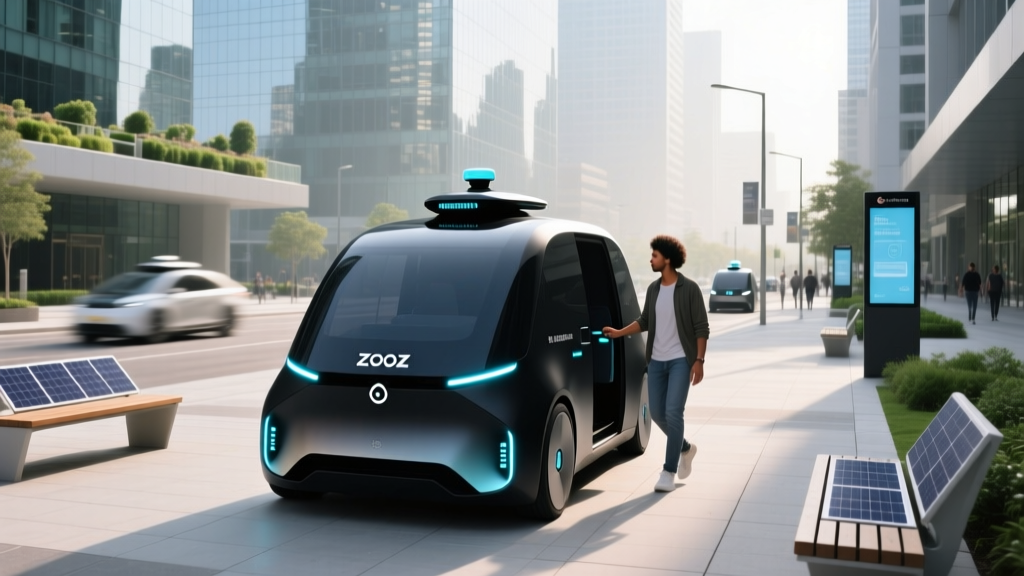
- Board the vehicle. The vehicle pulls to your designated pickup point. Doors open automatically. Inside, you'll find two forward-facing and two rear-facing seats (four-passenger capacity). There is no steering wheel, no pedals, and no driver.
- Ride and monitor. A screen inside shows your route and what the vehicle's sensors are detecting in real time. You can play music and control climate settings through the in-vehicle interface.
- Exit at your destination. The vehicle stops, doors open, and you walk away. Payment is processed automatically through the app.
One practical note: Zoox vehicles are designed for urban speeds and typically operate at or below posted speed limits, which on the Strip are 35-40 mph. They will not take highway routes. If your trip requires freeway travel (for instance, from the Strip to Henderson), Zoox is not the right option — the geofence and vehicle design are built for surface streets.
Zoox Safety Record: What the Data Shows
Safety is the most scrutinized aspect of any robotaxi service. Zoox, like all autonomous vehicle operators in Nevada and California, is required to report disengagement data and collision reports to state regulators. Here's what we know from publicly available filings and NHTSA reporting:
- Total autonomous miles driven (testing + commercial): Millions of miles across all operational cities, with Las Vegas representing a significant share of commercial passenger miles.
- Disengagement rate: Zoox reports disengagement data (instances where a remote operator or safety protocol intervenes) to the California DMV. Rates have improved year-over-year as the system's software stack has matured, though exact per-mile figures vary by reporting period and operational zone complexity.
- Reported collisions: Zoox has filed collision reports with NHTSA's Standing General Order for crashes involving ADS-equipped vehicles. Most reported incidents involve low-speed contact where the Zoox vehicle was struck by another road user (rear-ended at a stop, sideswiped by a turning vehicle) — a pattern consistent with NHTSA's aggregate ADS collision data, which shows the majority of robotaxi incidents are caused by human drivers in other vehicles.
- No reported passenger fatalities in Zoox vehicles as of early 2026.
It's important to contextualize these numbers. Robotaxis like Zoox operate millions of miles in dense urban environments where low-speed collisions are common even for human drivers. The relevant metric is not "zero incidents ever" — it's the incident rate per million miles compared to human benchmarks. The IIHS fatality statistics show that human drivers are involved in roughly 1.33 fatalities per 100 million vehicle miles traveled nationally. Robotaxi operators have not reported passenger fatalities at anywhere near that rate, though total miles are still a fraction of the national fleet.
Zoox's purpose-built vehicle (the Gen 3 carriage-style model used for commercial service) was designed from the ground up for autonomous operation, with redundant braking, steering, and computing systems. It also features a symmetrical crash structure — because there's no driver's side, the vehicle can protect occupants equally from impacts on either end.
Under the Hood: Zoox's Technology Stack
Unlike Tesla's camera-only approach to autonomy, Zoox uses a multi-sensor fusion stack that combines several complementary perception systems:
| Technology | Role | Detail |
|---|---|---|
| LiDAR | 3D environment mapping | Multiple roof-mounted units provide 360° point-cloud data for object detection and distance measurement regardless of lighting conditions |
| Cameras | Visual recognition | High-resolution cameras for traffic light state, sign reading, lane markings, and object classification |
| Radar | Velocity and range | Tracks moving objects, particularly useful for measuring relative speed of other vehicles and cyclists |
| HD Maps + Geofencing | Route planning and boundaries | Centimeter-accurate maps of the operational area define where the vehicle can and cannot drive |
| Redundant compute | Failover safety | Dual computing platforms — if one fails, the other can safely stop the vehicle |
| Remote assistance | Edge-case resolution | Human operators can provide high-level guidance (not direct steering) when the vehicle encounters an ambiguous scenario |
The LiDAR-first approach is a defining distinction. While Tesla's FSD (Supervised) relies exclusively on cameras and neural networks — a Level 2 system that still requires driver attention — Zoox's LiDAR provides precise depth data that cameras alone cannot reliably produce in all conditions (direct sun glare, nighttime darkness, fog). This sensor redundancy is a core reason regulators have approved Level 4 driverless operations for Zoox and competitors like Waymo, while camera-only systems remain classified as Level 2 driver-assist.
Zoox's vehicle is also bidirectional — it can drive equally well in either direction, with four-wheel steering. This means it doesn't need to perform three-point turns or back up in the traditional sense. It simply reverses its driving direction, which simplifies maneuvering in tight urban environments like Las Vegas hotel pickup lanes.
Regulatory Landscape: Who Approves Zoox to Operate?
Robotaxi operations in the United States are governed by a patchwork of state and local regulations — there is no single federal "robotaxi license." Here's how Zoox is authorized to run in Las Vegas:
- Nevada DMV — Autonomous Vehicle Testing and Deployment: Nevada was one of the first states to pass autonomous vehicle legislation. Zoox holds a Nevada autonomous vehicle testing permit and, subsequently, authorization for driverless commercial deployment. The Nevada DMV oversees permitting and incident reporting.
- NHTSA — Federal Safety Oversight: At the federal level, the National Highway Traffic Safety Administration requires all ADS-equipped vehicles to report collisions under a Standing General Order. NHTSA also has the authority to investigate and issue recalls for autonomous systems. Zoox's purpose-built vehicle received a notable exemption from certain FMVSS (Federal Motor Vehicle Safety Standards) requirements — specifically the requirement for a steering wheel and mirrors — because the vehicle has no human driver position.
- Local jurisdiction coordination: Clark County and the City of Las Vegas coordinate with Zoox on geofence boundaries, pickup/dropoff zones, and integration with existing traffic infrastructure.
This regulatory framework is state-specific. A Zoox vehicle permitted to operate driverless in Nevada cannot simply drive to Arizona or California and start picking up passengers — each state has its own permitting process, and some states have no ADS legislation at all. This is a significant constraint on expansion speed.
Current Limitations: What Zoox Cannot Do
Zoox is a Level 4 system, which means full autonomy within a defined operational design domain (ODD). Outside that domain, the vehicle simply will not operate. This is not a limitation of capability that will be "fixed with a software update next month" — it is a fundamental design boundary.
- Geofence boundaries are hard limits. If your destination is outside the mapped zone, you cannot book the ride. There is no manual-drive fallback.
- Weather restrictions. Heavy rain, dense fog, or dust storms (common in Las Vegas during monsoon season) can cause the system to limit operations or pull over safely. LiDAR and camera performance degrades in heavy precipitation. Zoox will typically pause service rather than operate in conditions that exceed its validated sensor envelope.
- No highway driving. Zoox vehicles are designed for urban surface streets, typically at speeds up to 45 mph. They will not merge onto I-15 or US-95.
- Construction zones and temporary detours. While the system can handle minor road changes, significant construction that alters lane geometry beyond what HD maps reflect can cause the vehicle to stop and request remote assistance, adding time to your trip.
- Limited cargo and accessibility. The four-passenger cabin is compact. Large luggage, strollers, or wheelchairs may not fit. Zoox is not a substitute for an UberXL or an accessible vehicle option.
- No pets (service animals excepted). Standard Zoox rider policy restricts animals other than service animals.
- Peak-hour availability. Fleet size is finite. On busy Friday and Saturday nights on the Strip, expect longer wait times or temporary unavailability in high-demand zones.
Zoox vs. Waymo: How the Two Major Robotaxis Compare
If you're in a city where both services operate, the choice often comes down to availability and route fit rather than price (which tends to be similar). Here's a high-level comparison:
| Attribute | Zoox | Waymo One |
|---|---|---|
| SAE Level | Level 4 | Level 4 |
| Vehicle | Purpose-built Zoox Gen 3 (no steering wheel) | Jaguar I-PACE (modified, with steering wheel retained but unused) |
| Las Vegas availability | Active commercial service | Testing / limited availability |
| Sensor stack | LiDAR + cameras + radar | LiDAR + cameras + radar |
| Highway capable | No (urban surface streets) | Limited (some freeway segments in approved zones) |
| Parent company | Amazon | Alphabet (Google) |
| Passenger capacity | 4 | 3-4 (I-PACE cabin) |
In Las Vegas specifically, Zoox currently has the advantage in commercial availability and Strip-corridor coverage. Waymo's presence in the city has been primarily in the testing phase, though the company has signaled interest in broader deployment. If you're visiting Vegas and want a guaranteed driverless ride today, Zoox is the more reliable bet.
Frequently Asked Questions
Is Zoox truly self-driving, or is there a remote human controlling it?
Zoox vehicles drive themselves autonomously within their geofenced service area — no human is steering, braking, or accelerating the vehicle in real time. Remote assistance operators exist to help the vehicle resolve ambiguous situations (for example, a police officer directing traffic with hand signals that the AI cannot interpret). The remote operator provides high-level guidance, not direct vehicle control. This is the distinction between Level 4 autonomy and teleoperation.
How much does a Zoox ride cost compared to an Uber in Las Vegas?
For a typical 3-5 mile trip on or near the Strip, a Zoox ride generally costs $8-$22, which is comparable to or slightly less than an UberX on the same route. The advantage is most noticeable during moderate demand periods, where Uber and Lyft surge pricing pushes fares higher. During extreme peak times (New Year's Eve, major conventions), both services will see elevated pricing.
Can I take a Zoox from the Las Vegas airport to my hotel?
Airport pickup availability depends on current agreements between Zoox and Harry Reid International Airport (LAS). As of 2026, airport service is limited and may not be available for all terminals or at all times. Check the Zoox app for real-time availability — if your pickup point at the airport falls within the active geofence and the service is live there, the app will allow the booking.
What happens if the Zoox vehicle encounters an emergency?
The vehicle has redundant systems for braking, steering, and computing. If a critical system failure is detected, the vehicle is designed to execute a "minimal risk condition" — essentially pulling over to the nearest safe stopping point and alerting Zoox's operations center. There is also an in-cabin button to contact Zoox support at any time during the ride. Emergency services can be dispatched if needed.
Is Zoox available 24/7 in Las Vegas?
Zoox operates extended hours in Las Vegas, but not necessarily 24/7. Service hours are defined by the operational permit and may be reduced during late-night hours when fleet maintenance is scheduled or when sensor conditions are degraded (heavy rain, extreme dust). The app will show real-time service availability when you attempt to book.
How does Zoox handle Las Vegas heat and dust?
Las Vegas summer temperatures routinely exceed 110°F, and dust storms (haboobs) occur during monsoon season. Zoox vehicles are engineered for the desert climate, with thermal management systems for both the battery pack and the sensor suite. However, during active dust storms or heavy rain, Zoox may temporarily suspend service in affected areas because sensor visibility drops below the safety threshold. This is a deliberate safety decision, not a system failure.
Does Zoox accept cash?
No. All Zoox rides are booked and paid through the Zoox app, which requires a linked payment method (credit/debit card). There is no cash option, consistent with the fully digital experience of the service.