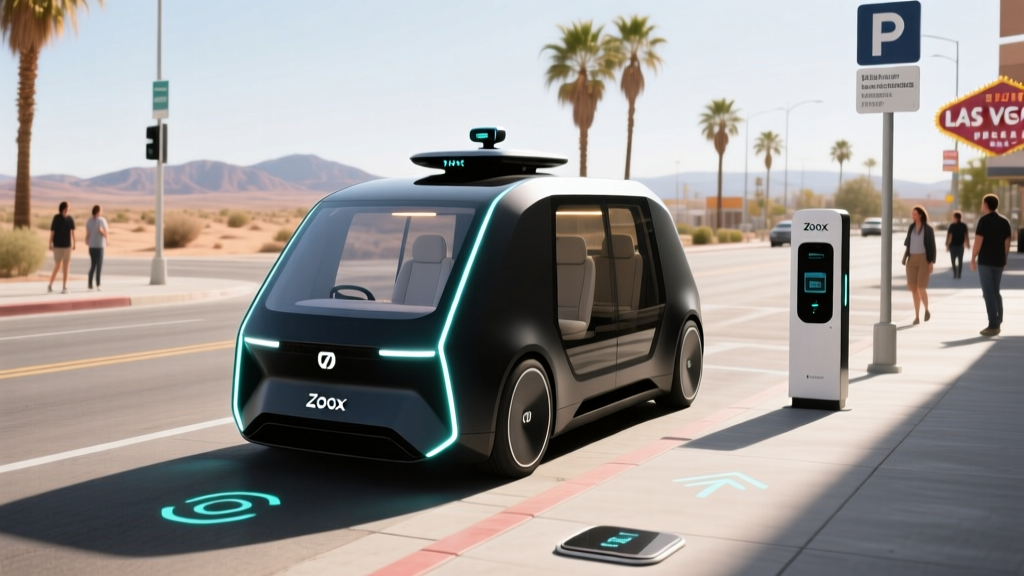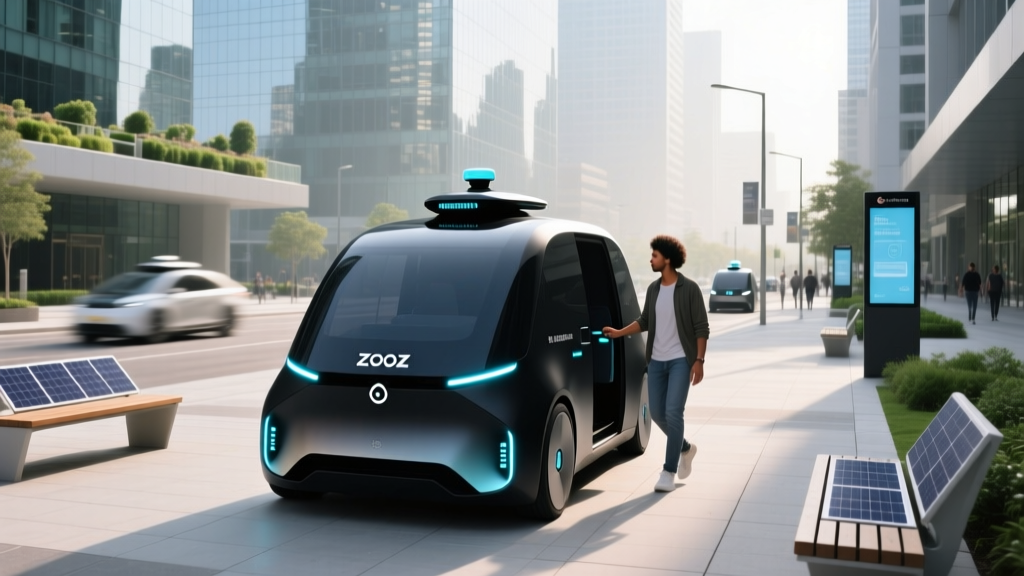
Zoox, the Amazon-backed autonomous vehicle company, has been steadily expanding its driverless ride-hail service across select U.S. cities. If you've seen the compact, carriage-style Zoox vehicle gliding through Las Vegas or San Francisco streets without a human behind the wheel, you probably have one immediate question: how much is a Zoox ride, and can you actually hail one right now?
As of early 2026, Zoox operates a commercial robotaxi service in limited geofenced zones. Pricing, availability, and the experience differ meaningfully from Uber, Lyft, and even competitor Waymo. Below is a data-driven breakdown of what Zoox costs, where it runs, how safe it is, and what the technology actually does — and doesn't — handle.
Where Can I Use Zoox Right Now?
Zoox does not operate everywhere. The service is restricted to specific geofenced areas within approved cities, and expansion has been deliberate rather than rapid. As of 2026, Zoox offers commercial rides in the following locations:
| City | Service Area | Status | Hours of Operation |
|---|---|---|---|
| Las Vegas, NV | Las Vegas Strip corridor, downtown, airport zone | Commercial (open to public) | Limited hours, expanding |
| San Francisco, CA | Select neighborhoods (SoMa, Mission Bay, Financial District) | Commercial (open to public) | Limited hours |
| Foster City, CA | Testing zone; limited public access | Testing / early access | Restricted |
Unlike Waymo, which covers broader swaths of Phoenix, San Francisco, and Los Angeles, Zoox's operational footprint remains tightly constrained. The company has announced intentions to expand to additional cities, but no new commercial markets have launched as of this writing. Always check the Zoox ride page for the latest availability before planning a trip.
How Much Does a Zoox Ride Cost vs. Uber and Lyft?
Zoox has positioned its pricing to be competitive with conventional rideshare, not premium. During its initial commercial phases, Zoox offered free or heavily subsidized rides to build its rider base and gather operational data. As of 2026, paid fares are active in Las Vegas and San Francisco.
| Metric | Zoox | UberX | Lyft Standard | Waymo One |
|---|---|---|---|---|
| Base fare | ~$2.00–$3.00 | ~$2.50–$3.50 | ~$2.50–$3.50 | ~$2.50–$4.00 |
| Per-mile rate | ~$1.00–$1.50 | ~$1.25–$1.75 | ~$1.15–$1.65 | ~$1.20–$1.80 |
| Per-minute rate | ~$0.25–$0.40 | ~$0.30–$0.50 | ~$0.28–$0.45 | ~$0.30–$0.50 |
| Typical 3-mile trip | $7–$12 | $9–$15 | $8–$14 | $9–$16 |
| Surge pricing | Not currently implemented | Yes (can 2–3x) | Yes (can 2–3x) | Limited surge |
| Tipping | No (no driver) | Expected ($2–$5) | Expected ($2–$5) | No (no driver) |
Key takeaway: A Zoox ride typically costs 10–25% less than an equivalent UberX or Lyft trip for the same distance, largely because there's no human driver to pay and no tipping expectation. The savings become more noticeable on shorter trips where the base fare dominates. However, Zoox's limited service area means you can't rely on it for most trips the way you would a conventional rideshare.
Zoox fares are calculated in-app, similar to Waymo One. You request a ride, see the upfront price, and confirm. Payment is processed through the Zoox app via credit card or linked payment method.
What SAE Automation Level Is Zoox? (It's Level 4, Not Level 2)
Zoox vehicles operate at SAE Level 4 within their approved operational design domain (ODD). This means the vehicle handles all driving tasks — steering, braking, navigation, obstacle avoidance — without any human intervention within its geofenced service area. There is no steering wheel, no pedals, and no human driver onboard.
This is fundamentally different from SAE Level 2 systems like Tesla Autopilot, Ford BlueCruise, or GM Super Cruise, which require continuous driver supervision and keep a human behind the wheel. Zoox is a true driverless robotaxi, comparable to Waymo's Level 4 service.
| SAE Level | Name | Who Drives? | Example |
|---|---|---|---|
| Level 0 | No Automation | Human | Conventional car |
| Level 1 | Driver Assistance | Human (with steering or speed aid) | Adaptive cruise control |
| Level 2 | Partial Automation | Human (must supervise) | Tesla Autopilot, BlueCruise |
| Level 3 | Conditional Automation | System (in limited conditions, human on standby) | Mercedes Drive Pilot (limited markets) |
| Level 4 | High Automation | System (no human needed, geofenced) | Zoox, Waymo One |
| Level 5 | Full Automation | System (everywhere, all conditions) | Does not exist commercially |
Zoox Technology Stack: Sensors, Compute, and the Purpose-Built Vehicle
Zoox takes a fundamentally different approach from most autonomous vehicle developers. Rather than retrofitting existing production cars with sensors, Zoox designed a purpose-built robotaxi from the ground up — a compact, bidirectional, carriage-style vehicle with no steering wheel or driver controls.
- LiDAR: Multiple solid-state and spinning LiDAR units providing 360° 3D point-cloud mapping out to ~150+ meters. LiDAR is the primary depth-sensing modality.
- Cameras: High-resolution camera arrays covering 360° for object classification, traffic light/sign recognition, and lane detection. Zoox uses a sensor-fusion approach, not camera-only.
- Radar: Forward and corner radar units for velocity detection and redundancy in low-visibility conditions.
- Compute: Custom onboard computing platform with redundant processing channels. The vehicle can continue operating safely if a compute module fails.
- HD Mapping: Pre-built high-definition maps of every operational zone, updated regularly. The vehicle localizes against these maps in real time.
- V2X / Connectivity: Continuous cellular connection to Zoox's remote operations center for edge-case escalation and fleet management.
This sensor-heavy approach contrasts with Tesla's camera-only FSD system. Zoox, like Waymo, relies on LiDAR as a primary sensor, arguing that redundant depth sensing is critical for safety in complex urban environments. The trade-off is higher per-vehicle hardware cost — each Zoox vehicle is estimated to carry $100,000–$150,000 in sensor and compute hardware, though costs have been decreasing with each hardware generation.
The Zoox vehicle itself is notable: it seats four passengers face-to-face, is fully symmetrical (it can drive equally well in either direction), and is designed for urban speeds up to ~75 mph. Its compact footprint makes it nimble in dense city traffic but limits its utility for highway or suburban trips.
How Safe Are Zoox Robotaxis? Real Data and Safety Record
- Total autonomous miles driven: Estimated 1M+ driverless miles across testing and commercial operations (Zoox does not publish a live counter; this is based on NHTSA Standing General Order filings and public disclosures).
- Reported collisions: A small number of low-severity incidents reported to NHTSA under the Standing General Order. Most involved the Zoox vehicle being rear-ended or side-swiped by human-driven vehicles at low speed — not at-fault events.
- Disengagement rate: Zoox reports remote-assistance interventions (where a remote operator provides guidance, not direct steering) at rates declining over successive quarters. Exact per-thousand-mile figures are not publicly broken out as granularly as Waymo's disclosures.
- Injuries: No reported serious injuries to passengers or pedestrians in Zoox commercial operations as of early 2026.
Note: Robotaxi safety data is still limited compared to human drivers' billions of annual miles. Statistical equivalence claims require far larger sample sizes.
Zoox, like all operators of automated driving systems, is required to report crashes to the National Highway Traffic Safety Administration (NHTSA) under the Standing General Order issued in 2021. The company has maintained a relatively clean record, though its total commercial mileage is significantly lower than Waymo's 30M+ driverless miles.
For context, human drivers in the U.S. experience approximately 1.33 fatalities per 100 million vehicle miles (NHTSA, 2022 data) and roughly 190 police-reported crashes per 100 million miles. Robotaxi operators aim to beat these benchmarks, but the sample sizes for Zoox specifically are not yet large enough to draw definitive statistical conclusions.
Regulatory Landscape: Who Approves Zoox Operations?
Robotaxi operations in the U.S. require a patchwork of state and local approvals. Zoox does not simply launch in a city — it must navigate a multi-layer regulatory process:
- State level: In California, the California Public Utilities Commission (CPUC) and the California DMV both regulate autonomous vehicle testing and commercial deployment. Zoox holds a DMV testing permit and CPUC authorization for commercial passenger service. In Nevada, the state's autonomous vehicle framework allows testing and commercial operations with appropriate licensing.
- Federal level: NHTSA oversees vehicle safety standards. Zoox's purpose-built vehicle required an exemption from certain Federal Motor Vehicle Safety Standards (FMVSS) that assume a human driver (e.g., requirements for a steering wheel, mirrors, and pedals). Zoox received a limited FMVSS exemption to operate its custom vehicle.
- Local level: City permits, fire department coordination, and local law enforcement agreements govern where and when robotaxis can operate within city limits.
This regulatory complexity is a primary reason Zoox's expansion has been slower than some expected. Each new city requires separate negotiations, permits, and safety case reviews.
Current Limitations: What Zoox Can't Do
Level 4 autonomy is powerful but bounded. Zoox operates within a strict Operational Design Domain (ODD), and stepping outside that domain is not possible. Here are the concrete limitations riders should understand:
- Geofencing: Zoox only operates within pre-mapped, approved zones. You cannot hail a Zoox to a destination outside the geofence — the ride simply won't be offered.
- Weather restrictions: Heavy rain, fog, snow, or icy conditions can trigger service suspension. LiDAR and camera performance degrades in precipitation, and Zoox takes a conservative approach to weather-related pullbacks.
- Construction zones: Unmapped road changes, temporary lane closures, or major construction can cause the vehicle to stop and request remote guidance, adding delay.
- Speed and road type: Zoox vehicles are optimized for urban and suburban roads. They do not operate on high-speed freeways or rural highways.
- Limited hours: Service is not 24/7. Operating windows vary by city and are expanding gradually.
- No stops or detours: Unlike Uber/Lyft, you can't ask the vehicle to make an extra stop or change route mid-trip. The ride follows a pre-planned path.
- Accessibility: While the Zoox vehicle is designed for wheelchair access, availability of accessible vehicles may be limited in early deployment phases.
- Pets and cargo: Policies on pets, large items, or food delivery are more restrictive than conventional rideshare.
These limitations are not unique to Zoox — Waymo faces similar constraints. But they mean Zoox is best understood as a supplement to, not a replacement for, conventional rideshare and personal transportation.
How to Use Zoox: Requesting a Ride Step-by-Step
- Download the Zoox app (iOS/Android) and create an account with payment information.
- Check availability — the app will show whether you're within a service zone and if rides are currently operating.
- Enter your pickup and drop-off — both must be within the geofenced area.
- Confirm the upfront fare — pricing is locked before you confirm, similar to Waymo One.
- Walk to the pickup spot — Zoox vehicles pull to the curb. The app identifies your specific vehicle by its color, number, and location pin.
- Board and ride — doors unlock via the app. Inside, there are no driver controls. A screen displays your route, and you can contact remote support if needed.
- Arrive and exit — the vehicle waits for you to exit before departing. The fare is charged automatically.
Frequently Asked Questions
Is Zoox completely free to ride?
No. Zoox initially offered free promotional rides during its early commercial launch, but as of 2026, paid fares are active in Las Vegas and San Francisco. Fares are competitive with Uber/Lyft, typically 10–25% lower for equivalent trips, but are not free.
How much is a Zoox ride from the Las Vegas airport to the Strip?
A typical Zoox ride from the Harry Reid International Airport zone to a mid-Strip hotel (approximately 3–4 miles) costs roughly $8–$14, depending on exact pickup/drop-off points and time of day. Compare this to an UberX fare of $10–$18 for the same route. Note that airport pickup availability depends on current geofence boundaries and may not always be offered.
Is there a human driver in the Zoox vehicle?
No. Zoox is an SAE Level 4 driverless robotaxi. There is no steering wheel, no pedals, and no human onboard. The vehicle is monitored remotely by Zoox's operations center, which can provide guidance in edge cases but does not directly steer or brake the vehicle in real time.
Can I use Zoox in any city?
No. As of 2026, Zoox operates commercially only in Las Vegas and San Francisco, with testing in Foster City, CA. Expansion to additional cities has been announced but no new markets are live. Check the Zoox app for real-time availability.
What happens if the Zoox vehicle encounters a problem during my ride?
The vehicle is designed to pull over safely and contact Zoox's remote operations team. In most cases, the remote team can provide guidance to resolve the situation (e.g., navigating around an obstacle). If the vehicle cannot continue, Zoox coordinates an alternate ride or refund. In-app support is available throughout the trip.
How does Zoox compare to Waymo?
Both are Level 4 robotaxis, but Waymo has a significantly larger operational footprint (Phoenix, San Francisco, Los Angeles, and expanding) and many more driverless miles logged. Zoox differentiates with its purpose-built vehicle (no retrofit) and competitive pricing. For riders in cities where both operate, the choice often comes down to which has better coverage for your specific origin and destination.