Why Zoox HQ Matters in the Robotaxi Race
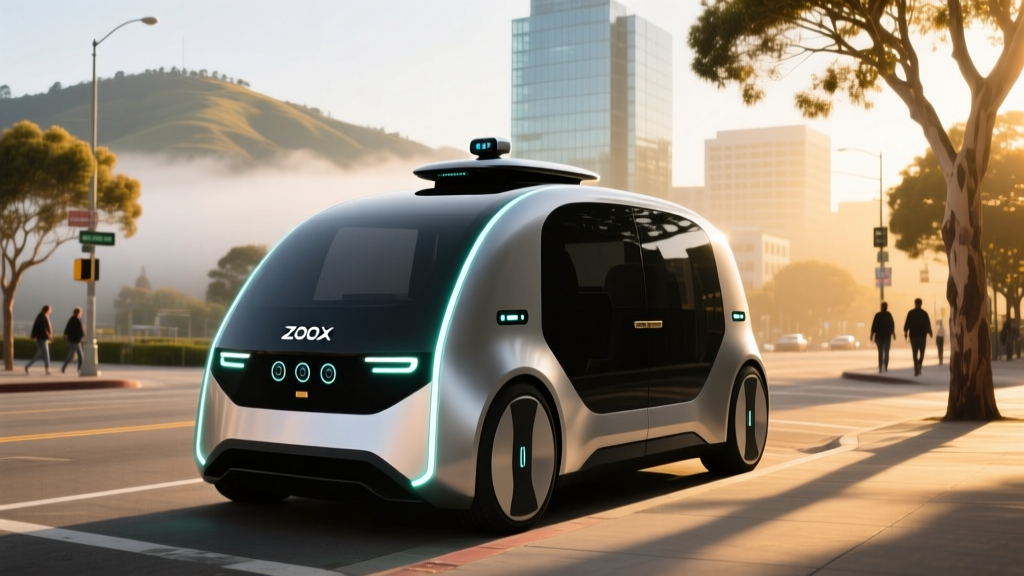
When people search for "Zoox HQ," they're usually looking for one of two things: where the company actually operates, and whether its driverless robotaxi is something they can ride today. Zoox, the Amazon-backed autonomous vehicle company headquartered in Foster City, California, has spent years developing a purpose-built, carriage-style robotaxi with no steering wheel or pedals. Unlike companies that retrofit existing consumer vehicles, Zoox designed its vehicle from the ground up for autonomous ride-hailing — a distinction that shapes everything from sensor placement to passenger experience.
This guide cuts through the hype to give you concrete facts: where Zoox operates, what its technology stack looks like, how its safety record stacks up, what a ride actually costs, and where the hard limitations remain. If you're evaluating whether robotaxis are a viable transportation option in your city, or you're tracking the autonomous vehicle industry with a data-driven eye, this is your briefing.
Is Zoox Truly Self-Driving? SAE Automation Level Explained
Zoox operates at SAE Level 4 within its approved operational design domain (ODD). This means the vehicle handles all driving tasks — steering, acceleration, braking, route planning, and hazard response — without any human driver inside the vehicle and without expecting a human to take over. However, Level 4 is geofenced: the system only operates in pre-mapped, approved areas under defined conditions. Outside those boundaries, the vehicle cannot operate autonomously.
This is fundamentally different from SAE Level 2 systems like Tesla Autopilot, GM Super Cruise, or Ford BlueCruise, which require an attentive human driver at all times. Zoox carries no driver. There is no steering wheel. There are no pedals. The vehicle is either fully autonomous or it does not move.
| SAE Level | Name | Who Drives? | Example |
|---|---|---|---|
| Level 2 | Partial Automation | Human (always) | Tesla Autopilot/FSD Supervised, BlueCruise, Super Cruise |
| Level 3 | Conditional Automation | System (limited); human on standby | Mercedes Drive Pilot (select markets, ≤40 mph) |
| Level 4 | High Automation | System (geofenced, no human needed) | Zoox, Waymo One, Cruise (pre-suspension) |
| Level 5 | Full Automation | System (everywhere, all conditions) | Does not yet exist commercially |
Where Can You Ride a Zoox Robotaxi Right Now?
Zoox has been methodical about its geographic rollout, prioritizing dense urban environments with favorable regulatory frameworks and manageable weather. As of early 2026, here is the current operational picture:
| City / Region | Status | Service Type | Notes |
|---|---|---|---|
| Foster City, CA (near Zoox HQ) | Active | Employee + invited-rider testing | Primary development and validation zone |
| San Francisco, CA | Active (limited) | Public ride-hail (expanding zones) | CPUC-licensed; geofenced to approved corridors |
| Las Vegas, NV | Active | Public rides on Las Vegas Strip corridor | High-density tourist routes; favorable weather |
| Seattle, WA | Testing | Validation drives (no public rides) | Mapping and rain-weather data collection |
| Austin, TX | Testing | Validation drives | Expansion candidate; not yet open to riders |
Key point: Testing in a city does not mean you can hail a ride there. Only San Francisco and Las Vegas have offered public-facing ride access, and even within those cities, service is restricted to geofenced zones. You cannot currently summon a Zoox to an arbitrary address the way you can with Uber.
How to Use Zoox and What It Costs vs Uber/Lyft
Riding a Zoox robotaxi is closer to a traditional ride-hail experience than most people expect — with a few important differences. Here's how the process works in active service areas:
- Request via app: Use the Zoox app (available in service cities) to set pickup and dropoff within the geofenced zone.
- Vehicle arrives driverless: The carriage-style vehicle pulls up with no one in the front. Passengers sit in rear-facing or forward-facing bench seats (configuration varies).
- Ride and monitor: Interior screens show the route and what the vehicle "sees." A remote support team monitors the fleet but does not drive the vehicle in real time.
- Payment: Charged automatically to the app payment method at ride completion.
| Service | Estimated Fare | Surge Pricing? | Wait Time | Driver Present? |
|---|---|---|---|---|
| Zoox (public rides) | $8–$14 | No traditional surge; demand-limited availability | 5–15 min (limited fleet) | No |
| UberX | $10–$18 | Yes, frequent in peak hours | 2–8 min | Yes |
| Lyft Standard | $9–$17 | Yes | 3–10 min | Yes |
| Waymo One (where available) | $9–$16 | Limited surge model | 3–10 min | No |
Zoox has historically subsidized early rides to build adoption, so promotional pricing may apply. As fleet size grows and subsidies decrease, expect pricing to converge with conventional rideshare — the long-term value proposition is lower per-mile cost once human driver compensation is removed from the equation. For context, driver compensation typically accounts for 60–75% of a rideshare fare.
Technology Stack: Sensors, Compute, and the Purpose-Built Vehicle
Zoox takes a sensor-fusion approach — combining lidar, cameras, and radar — rather than the camera-only strategy pursued by Tesla. This is a deliberate engineering choice that prioritizes redundancy across sensing modalities.
Sensor Suite
- Lidar: Multiple roof-mounted lidar units provide 360-degree, high-resolution 3D point-cloud mapping out to ~150+ meters. Lidar operates independently of ambient light, giving the system reliable depth perception at night and in glare conditions where cameras struggle.
- Cameras: A surround-camera array covers the full 360-degree field of view, handling lane detection, traffic-light state recognition, sign reading, and object classification.
- Radar: Forward and corner radar units detect velocity and range of moving objects, performing well in rain and fog where lidar and cameras degrade.
Compute and Software
Onboard compute runs Zoox's proprietary perception, prediction, and planning stack. The system processes sensor data in real time to build a world model — identifying every pedestrian, cyclist, vehicle, construction zone, and signal in the environment — then plans a safe trajectory. Zoox has emphasized its "symmetrical" vehicle design (the vehicle can drive equally well in either direction) as both a maneuverability advantage and a redundancy feature.
Geofencing and HD Mapping
Before Zoox operates in any neighborhood, the area is mapped at centimeter-level precision using high-definition (HD) maps. These maps encode lane geometry, curb positions, crosswalk locations, speed limits, and signal positions. The vehicle localizes itself against this map in real time. If the vehicle exits its approved geofence or encounters a road configuration that doesn't match its map data, it will pull over safely rather than attempt to navigate unmapped territory.
Safety Record: What the Data Actually Shows
Zoox has logged millions of autonomous miles across its test and service fleets. As with all robotaxi operators, safety performance is tracked through several metrics: disengagement rates (how often a remote operator must intervene), collision rates per million miles, and NHTSA-reported incidents. According to NHTSA's Standing General Order data, Zoox has reported a small number of minor incidents — predominantly low-speed contact events during testing, with no fatalities attributed to Zoox autonomous operations as of early 2026.
For comparison, the IIHS reports that human drivers are involved in approximately 1.35 fatal crashes per 100 million vehicle miles traveled nationally. Robotaxi operators, including Zoox, have not yet accumulated enough public-road miles to produce statistically equivalent fatality-rate comparisons — a limitation worth stating plainly.
Disengagement and Intervention
California's DMV requires autonomous vehicle testers to report disengagements — moments when the autonomous system hands off control (or would have, if a safety driver were present). Zoox files these reports annually. Disengagement rates have trended downward year over year as the system matures, but they remain non-zero. Common triggers include:
- Construction zones with temporary lane reconfigurations not yet reflected in HD maps
- Unusual road-user behavior (e.g., a person directing traffic outside normal signal patterns)
- Sensor degradation in heavy rain or dense fog
Remote Assistance vs Remote Driving
An important distinction: Zoox uses remote assistance, not remote driving. A remote operator does not joystick the vehicle in real time. Instead, if the vehicle encounters an ambiguous scenario (e.g., a delivery truck blocking the only lane), the vehicle stops safely and requests guidance from the remote team, which may approve an alternate route or confirm it's safe to proceed around the obstacle. The vehicle still executes all driving maneuvers autonomously.
Regulatory Landscape: Who Approves Robotaxi Operations?
Robotaxi operations in the United States are governed by a patchwork of state and local regulations. There is no single federal "robotaxi license." Here's how the approval chain works for Zoox:
- California Public Utilities Commission (CPUC): In California, the CPUC issues permits for autonomous ride-hail services. Zoox holds a TCP (Transportation Charter-Party Carrier) license with autonomous vehicle authorization, allowing it to charge passengers for rides.
- California DMV: The DMV issues testing permits and collects disengagement data. Separate from CPUC commercial operations.
- Nevada: The Nevada DMV and state legislature have created a framework for autonomous vehicle testing and commercial deployment, which Zoox has utilized for its Las Vegas operations.
- NHTSA (Federal): At the federal level, NHTSA sets vehicle safety standards (FMVSS). Zoox's purpose-built vehicle, which lacks a steering wheel and mirrors, required an NHTSA exemption from certain FMVSS requirements designed for human-driven vehicles. This exemption was a significant regulatory milestone.
The regulatory environment remains in flux. Some municipalities have pushed back against robotaxi expansion citing emergency-vehicle interaction concerns and traffic obstruction incidents (issues that affected Cruise's operations in San Francisco in 2023–2024). Zoox's more cautious, limited-zone rollout strategy has so far avoided the most contentious regulatory confrontations.
Current Limitations: What Zoox Cannot Do
Honest assessment of limitations is essential for anyone evaluating robotaxi viability. Here are the hard constraints as of 2026:
Weather Restrictions
Zoox vehicles reduce speed or pull over in heavy rain, dense fog, and any conditions that significantly degrade lidar and camera performance. Snow and ice operations remain extremely limited — the Las Vegas and San Francisco focus reflects this weather constraint.
Geofence Boundaries
You can only request rides within pre-approved zones. Suburban areas, highways outside the mapped corridor, and newly constructed roads are off-limits until mapped and approved. A Zoox cannot take you from downtown San Francisco to SFO airport unless that specific route is within its ODD.
Edge Cases
- Construction zones: Temporary barriers, lane shifts, and flaggers can cause the vehicle to stop and request remote assistance, adding delay.
- Emergency vehicles: While the system is trained to yield to sirens and lights, complex multi-vehicle emergency scenes can trigger cautious stop-and-hold behavior.
- Unprotected left turns: Some complex intersections remain challenging, and the vehicle may choose longer routes to avoid them.
- No manual override: Because there is no steering wheel or pedals, passengers cannot take control in any scenario. If the system cannot proceed, the vehicle stops.
Fleet Size and Availability
Zoox operates a small fleet compared to Waymo or conventional rideshare. Wait times can be 10–15 minutes or longer, and service may be unavailable during peak demand simply because all vehicles are occupied. This is not yet a replacement for Uber/Lyft at scale — it's a complementary option in specific corridors.
Zoox HQ and the Road Ahead: Expansion Realities
Zoox's headquarters in Foster City, California, sits in the heart of the Bay Area's autonomous vehicle corridor — within commuting distance of Waymo's Mountain View base and numerous AV suppliers. The HQ houses engineering, simulation, and fleet-operations teams that manage the test and service vehicles remotely.
Looking ahead, Zoox has announced plans to expand service to additional cities, but announced expansion is not the same as live service. Each new city requires months of HD mapping, regulatory approval, local fleet deployment, and validation driving before a single paying passenger is carried. Based on the pace of expansion to date, expect 1–2 new service cities per year rather than a rapid national rollout.
The economics of robotaxis hinge on fleet utilization. A vehicle that runs 18–20 hours per day (vs. ~4–6 hours for a personal car) can amortize its higher hardware cost — Zoox's sensor suite and redundant compute systems add significant per-vehicle cost compared to a standard rideshare sedan. The path to profitability requires high utilization in dense urban cores, which is why Zoox prioritizes cities like Las Vegas and San Francisco over sprawling suburbs.
Frequently Asked Questions
Where can I use a Zoox robotaxi right now?
Public rides are available in limited zones of San Francisco, CA, and Las Vegas, NV. Foster City, CA (near Zoox HQ) hosts employee and invited-rider testing. Seattle and Austin are in testing phases with no public access.
How much does a Zoox ride cost compared to Uber or Lyft?
A typical 3-mile Zoox ride costs approximately $8–$14, which is competitive with UberX ($10–$18) and Lyft ($9–$17) for similar distances. Zoox does not use traditional surge pricing, but limited fleet size means availability can be restricted during peak demand.
How safe are Zoox robotaxis based on real data?
Zoox has reported no fatalities in its autonomous operations as of early 2026. NHTSA Standing General Order data shows a small number of minor low-speed incidents during testing. Disengagement rates have decreased year over year. However, total autonomous miles logged remain too low to draw statistically equivalent comparisons to the national human-driver fatality rate of ~1.35 per 100 million miles (IIHS).
What are the main limitations of Zoox robotaxis?
Service is geofenced to specific approved zones, unavailable in heavy rain or fog, and limited by a small fleet. The vehicle cannot navigate unmapped construction zones without remote assistance, and passengers have no manual override capability because the vehicle has no steering wheel or pedals.
Is Zoox truly self-driving, or is it like Tesla Autopilot?
Zoox is SAE Level 4 — fully autonomous within its geofenced operational area, with no human driver inside the vehicle and no steering controls. This is fundamentally different from Tesla Autopilot/FSD Supervised, GM Super Cruise, or Ford BlueCruise, which are all SAE Level 2 systems requiring an attentive human driver at all times.
Can I use Zoox for airport runs or long trips?
Currently, no. Zoox operates within tightly geofenced urban corridors, typically covering a few square miles. Airport routes, highway driving, and intercity trips are outside the current operational design domain.
Who regulates Zoox and other robotaxis?
Regulation is split: California's CPUC licenses commercial ride-hail operations, the CA DMV handles testing permits, NHTSA sets federal vehicle safety standards (and granted Zoox an exemption for its steering-wheel-free design), and individual states like Nevada have their own AV deployment frameworks.