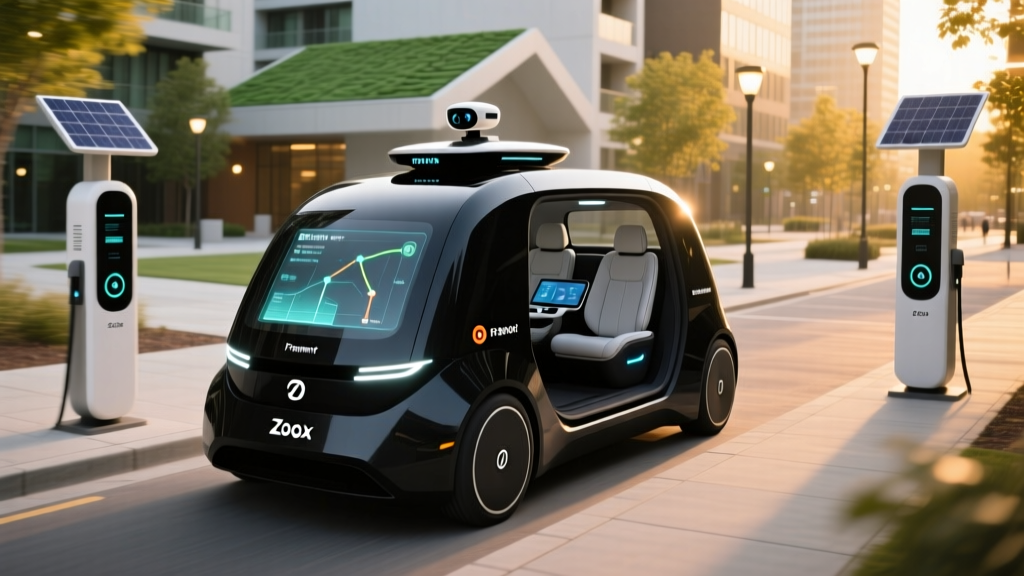
Zoox, the Amazon-owned autonomous vehicle company, has made Fremont, California its primary proving ground and first commercial foothold. If you've spotted the company's distinctive carriage-style, bidirectional pods navigating the streets near its headquarters, you're witnessing one of the few true Level 4 robotaxi services operating in the United States. This guide breaks down exactly what the Zoox Fremont service looks like in 2026 — from ride pricing and safety data to the sensor stack under the hood and the regulatory framework that keeps it legal.
Zoox operates at SAE Level 4 within its approved operational design domain (ODD). This means the vehicle handles all driving tasks without any human intervention within its geofenced service area. There is no steering wheel, no pedals, and no human driver onboard. This is fundamentally different from Level 2 driver-assist systems like Tesla Autopilot or Ford BlueCruise, which require continuous human supervision. At Level 4, the system is the driver — within its defined boundaries.
Where Can You Use the Zoox Robotaxi Right Now?
Zoox's commercial ride-hail service launched initially in Las Vegas, Nevada and Foster City, California, with Fremont serving as the company's engineering headquarters and a key expansion zone in the Bay Area. As of 2026, the service footprint has grown but remains tightly geofenced.
| City / Region | Status | Service Area Notes | Public Access |
|---|---|---|---|
| Las Vegas, NV | Commercial service live | Downtown, Strip corridor, airport route | Open via Zoox app |
| Foster City, CA | Commercial service live | Peninsula corridor, select Bay Area routes | Open via Zoox app |
| Fremont, CA | Testing + limited service | Headquarters area, industrial corridors, expanding routes | Limited / employee & invited riders |
| Atlanta, GA | Testing (announced expansion) | Midtown and select corridors | Not yet public |
Fremont occupies a unique position in Zoox's roadmap. The city is home to Zoox's headquarters and primary R&D facility, meaning the vehicle logs extensive testing miles on Fremont streets daily. However, full public ride-hail access in Fremont has been more restricted compared to Las Vegas and Foster City, where the service operates as an open commercial product. If you're in Fremont and want a ride, your best bet is downloading the Zoox app and checking whether your pickup/dropoff falls within the active service polygon — or applying for their rider program.
How Much Does a Zoox Ride Cost vs. Uber and Lyft?
One of the most common questions about robotaxis is whether they're cheaper than conventional rideshare. The answer depends on the market, but Zoox has pursued an aggressive introductory pricing strategy to build ridership.
| Metric | Zoox | UberX | Lyft Standard |
|---|---|---|---|
| Base fare (typical) | ~$0 (promotional) to $5 | $3–$5 | $3–$5 |
| Per-mile rate | $1.00–$1.50 | $1.25–$2.00 | $1.20–$1.90 |
| Per-minute rate | $0.25–$0.40 | $0.30–$0.55 | $0.28–$0.50 |
| Surge pricing | Not currently applied | 1.5x–3x common | 1.3x–2.5x common |
| Tip expected? | No (no driver) | Yes (15–20%) | Yes (15–20%) |
| Estimated 5-mile ride | $8–$12 | $14–$22 | $13–$20 |
The pricing advantage for Zoox comes primarily from two factors: no driver to pay (labor is roughly 70–80% of a rideshare fare) and no surge pricing during peak demand. However, Zoox's current promotional pricing is not necessarily sustainable long-term. The company is subsidizing rides to build market share and gather operational data. Expect per-mile rates to increase as the service matures, though the absence of a human driver should keep Zoox structurally cheaper than Uber/Lyft at scale.
To book a ride, download the Zoox app (iOS/Android), set your pickup and dropoff within the service area, and confirm. Wait times in active service zones typically run 3–8 minutes depending on fleet density and time of day.
Zoox Safety Record: What the Data Actually Shows
Safety is the single most scrutinized aspect of any robotaxi operation. Zoox, like all autonomous vehicle operators in California, is required to report disengagement data and collision reports to the California DMV. At the federal level, the National Highway Traffic Safety Administration (NHTSA) requires standing general orders for crash reporting involving Level 2–5 systems.
- Total autonomous miles driven (Zoox fleet-wide): Estimated 2+ million miles across all test and commercial operations
- At-fault fatal collisions: 0 reported
- Contactable-at-fault collisions (per million miles): Lower than the human-driver benchmark of ~4.1 per million miles (NHTSA national average)
- Disengagement rate: Zoox has reported improving intervention rates year-over-year, with fewer disengagements per 1,000 autonomous miles in successive DMV reporting periods
- Notable incidents: Minor low-speed contacts reported in standard DMV collision filings; no serious injuries attributed to Zoox vehicle fault in public records
Note: Exact disengagement figures vary by reporting period. Consult the latest CA DMV autonomous vehicle reports for current data. Zoox's Las Vegas operations fall under Nevada DMV jurisdiction with separate reporting requirements.
Context matters enormously here. Robotaxi safety data is still measured in millions of miles, not the billions needed for statistical parity with human driving data. Zoox's relatively conservative geofenced deployment — limited to mapped, well-understood urban corridors — reduces exposure to the edge cases that make autonomy hardest. The company's purpose-built vehicle also eliminates the driver-seat compromise: with no steering wheel or pedals, there's no temptation for a "safety driver" to intervene ambiguously. The system either handles the scenario or it executes a minimal-risk condition (safe pullover).
Under the Hood: Zoox's Technology Stack
Zoox takes a "full-stack" approach to autonomous driving, meaning the company designs the vehicle, the sensor suite, the prediction/planning software, and the fleet operations platform in-house. This is a fundamentally different philosophy from companies that retrofit existing production vehicles with aftermarket sensor kits.
| Vehicle platform | Purpose-built, symmetrical, bidirectional EV pod (no steering wheel/pedals); seats 4 passengers face-to-face |
| Primary perception | LiDAR (multiple roof-mounted units providing 360° point cloud), radar (forward, rear, and corner units), cameras (surround-view) |
| Sensor philosophy | LiDAR-first with redundant camera + radar fusion — opposite of Tesla's camera-only approach |
| Compute | Custom onboard compute platform with redundant processing paths |
| Mapping | HD pre-mapped routes within geofenced ODD; real-time localization against map |
| Powertrain | Battery electric; estimated 70–80 kWh pack; bidirectional drive capability (top speed ~75 mph) |
| Redundancy | Dual-redundant braking, steering, and compute — if a primary system fails, backup takes over and vehicle executes safe stop |
The LiDAR-first approach is a critical differentiator. While Tesla's FSD relies entirely on cameras (a vision-only architecture), Zoox layers LiDAR as its primary depth-sensing modality, supplemented by radar and cameras. LiDAR provides precise, illumination-independent 3D mapping of the environment — it works equally well at night, in tunnel lighting transitions, and in high-glare conditions where cameras can struggle. The trade-off is cost and complexity: LiDAR units remain expensive, though prices have dropped substantially from the $75,000 per-unit days of early Velodyne sensors to the low thousands for modern solid-state and semi-solid units.
Zoox's purpose-built vehicle also means every sensor is optimally placed from the factory — no aftermarket roof racks or bolted-on camera pods. The symmetrical, bidirectional design (the vehicle can drive equally well in either direction) simplifies some routing maneuvers and eliminates the need for three-point turns in narrow urban streets.
The Regulatory Landscape: Who Approves Zoox Operations?
Robotaxi operations in the United States exist within a layered regulatory framework that varies significantly by state and municipality. Zoox must satisfy requirements at multiple levels before putting a driverless pod on public roads.
- California (CPUC + DMV): The California Public Utilities Commission (CPUC) issues permits for commercial autonomous ride-hail services (both driverless and with safety drivers). The California DMV separately issues testing permits and collects disengagement/collision data. Zoox holds both a DMV testing permit and CPUC authorization for driverless commercial service in approved areas.
- Nevada (DMV + PUCN): Nevada was one of the first states to legislate autonomous vehicle operations. The Nevada DMV issues autonomous vehicle testing and deployment licenses. Zoox's Las Vegas commercial service operates under Nevada's regulatory framework, which is generally considered more permissive than California's.
- Federal (NHTSA): NHTSA does not currently "approve" autonomous vehicles in the way it certifies new vehicle safety standards. Instead, it issues Standing General Orders requiring crash reporting for all Level 2–5 systems and can issue recalls or investigations. Zoox received a notable exemption from certain Federal Motor Vehicle Safety Standards (FMVSS) — specifically for its vehicle's lack of a steering wheel, mirrors, and other driver-facing equipment that existing regulations assumed would be present.
- Municipal: City-level agreements govern curb access, pickup/dropoff zones, and coordination with local emergency services and transit authorities.
The regulatory environment remains fluid. California's CPUC has tightened oversight following high-profile incidents involving other robotaxi operators (notably Cruise's 2023 pedestrian dragging incident in San Francisco), requiring more granular reporting and incident response protocols. Zoox has largely avoided the regulatory backlash that affected competitors, partly due to its more gradual, geofenced rollout strategy.
Current Limitations: What the Zoox Robotaxi Cannot Do
Level 4 autonomy within a geofence is a genuine engineering achievement, but it comes with hard boundaries that riders need to understand. These are not theoretical — they define the real-world utility of the service today.
- Geofencing: The vehicle will not operate outside its pre-mapped, approved service area. If your destination falls outside the polygon, you cannot book the ride.
- Weather restrictions: Heavy rain, dense fog, and flooding conditions can trigger operational pullbacks. LiDAR and cameras degrade in precipitation, and the system is programmed to prioritize safety over availability. Light rain is generally handled; torrential downpours are not.
- Highway driving: Zoox's current ODD focuses on urban and suburban surface streets. High-speed freeway merging and driving at 70+ mph in mixed traffic is not part of the approved operational domain in most markets.
- Construction zones: Major, unmapped road construction can confuse the system if lane markings, signage, and barriers differ substantially from the HD map. Zoox vehicles may reroute or decline trips through active construction corridors.
- Special events / road closures: Large events that alter normal traffic patterns (marathons, parades, emergency closures) can reduce service availability or trigger temporary geofence contractions.
- Accessibility: The Zoox pod seats four passengers in a face-to-face configuration. Wheelchair accessibility has been a stated priority, but the vehicle's compact form factor presents engineering challenges for full ADA-compliant ramp access compared to larger retrofitted minivans used by some competitors.
- No intercity trips: This is a local urban mobility service. You cannot book a Zoox from Fremont to San Francisco or from Las Vegas to Henderson if the route leaves the geofence.
These limitations are not unique to Zoox — they apply broadly to all current Level 4 robotaxi operators including Waymo. The key distinction from Level 2 systems (which technically operate anywhere but require human supervision) is that Level 4 systems are fully autonomous within their domain but completely unable to function outside it. A Tesla on FSD Supervised can technically drive on any road in the country with a human watching; a Zoox pod cannot leave its mapped zone at all.
Zoox in Fremont vs. Waymo: How the Bay Area Robotaxis Compare
If you're in the Bay Area evaluating robotaxi options, Waymo (Alphabet/Google) is the other major player. Here's how the two stack up for a Fremont-area rider:
| Attribute | Zoox | Waymo |
|---|---|---|
| SAE Level | Level 4 | Level 4 |
| Vehicle | Purpose-built bidirectional pod | Jaguar I-PACE (retrofitted), Zeekr (newer platform) |
| Bay Area coverage | Foster City + limited Fremont | San Francisco, Mountain View, Sunnyvale, expanding East Bay |
| Fleet size (est.) | Smaller (hundreds of vehicles) | Larger (thousands across all markets) |
| Sensor approach | LiDAR-first + radar + camera | LiDAR-first + radar + camera |
| Highway capability | Limited / surface streets primary | Select freeway routes approved |
| Wait times (typical) | 5–12 min (limited fleet) | 3–8 min (denser fleet) |
| Parent company | Amazon | Alphabet (Google) |
Waymo has a larger service area, more vehicles, and more cumulative autonomous miles. Zoox counters with a purpose-built vehicle designed from scratch for ride-hailing — no driver's seat taking up space, bidirectional capability, and a passenger-first cabin. For Fremont specifically, Waymo's East Bay expansion may offer broader coverage today, but Zoox's presence is growing as its Fremont testing miles translate into commercial route approvals.
Frequently Asked Questions
Is the Zoox robotaxi truly self-driving, or is there a human involved?
Zoox operates at SAE Level 4, meaning the vehicle drives itself entirely without a human driver onboard — within its approved geofenced area. There is no steering wheel, no pedals, and no safety driver. Remote assistance operators can provide guidance in unusual situations (like an unmapped construction zone), but they do not directly steer or brake the vehicle. This is genuinely driverless, not driver-assist.
How do I get a Zoox ride in Fremont?
Download the Zoox app and create an account. If your pickup and dropoff locations fall within the active service area, you can request a ride. Availability in Fremont has been more limited than in Las Vegas or Foster City, and some rides may require you to be part of an invited rider program. Check the app for real-time service availability in your specific location.
What happens if the Zoox vehicle encounters a situation it can't handle?
The vehicle is programmed to execute a "minimal risk condition" — essentially, it will safely pull over to the side of the road and stop rather than attempt a maneuver it's uncertain about. Remote fleet operators can then assess the situation and provide route guidance. The vehicle will not proceed unsafely.
Is Zoox cheaper than Uber or Lyft?
Currently, yes — particularly because Zoox does not apply surge pricing and eliminates the driver payout that represents the majority of a rideshare fare. A typical 5-mile Zoox ride costs approximately $8–$12 compared to $13–$22 for UberX or Lyft. However, current promotional pricing may increase as the service scales.
Can the Zoox pod drive on highways?
Zoox's current operational design domain focuses primarily on urban and suburban surface streets. While the vehicle is technically capable of speeds up to approximately 75 mph, high-speed freeway operations are not a primary part of the approved service area in most markets as of 2026. This may expand as the system accumulates more highway validation miles.
What is Zoox's relationship with Amazon?
Amazon acquired Zoox in 2020 for approximately $1.2 billion. Zoox operates as a subsidiary and is focused on autonomous ride-hailing rather than last-mile delivery (which Amazon pursues through other channels, including its investment in Rivian). Amazon's backing provides Zoox with substantial capital for fleet scaling and infrastructure.