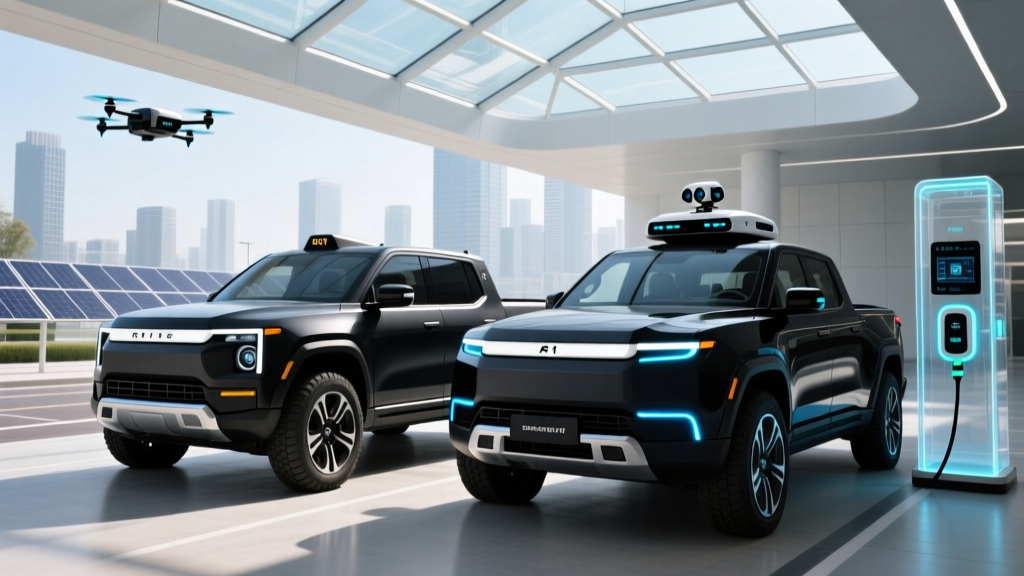
Rivian's R1T pickup and R1S SUV are among the most capable electric adventure vehicles on the market, and their driver-assistance suite has steadily improved through over-the-air updates. But if you're searching for Rivian self-driving technology, you need a clear picture of what the system actually does today — and what it emphatically does not do. This guide covers the current Rivian Driver+ system, its SAE autonomy classification, the hardware behind it, real-world limitations, and how it stacks up against competitors in the ADAS space.
SAE Autonomy Level: Where Rivian Actually Sits
Rivian Driver+ is an SAE Level 2 system
Under the SAE J3016 framework, Rivian's Driver+ suite is classified as Level 2: Partial Driving Automation. The system can simultaneously manage steering and speed on qualified highways, but the human driver must remain fully engaged — eyes on the road, hands available to take over at any moment. This is the same classification as Tesla Autopilot, Ford BlueCruise, and GM Super Cruise. Rivian does not offer a Level 3, Level 4, or Level 5 system. No production Rivian vehicle can drive itself without an attentive human in the driver's seat.
This distinction matters because marketing language around "autonomy" and "self-driving" often blurs the line between driver-assist (Level 2) and true driverless operation (Level 4, like Waymo's robotaxi service). Rivian's system is an advanced helper, not a chauffeur.
| Level | Name | Who Drives? | Example |
|---|---|---|---|
| 0 | No Automation | Human does everything | Basic cruise control |
| 1 | Driver Assistance | Human + one assist (steering OR speed) | Adaptive cruise OR lane-keeping |
| 2 | Partial Automation | Human supervises; system steers AND manages speed | Rivian Driver+, Tesla Autopilot, BlueCruise |
| 3 | Conditional Automation | System drives in limited conditions; human takes over on request | Mercedes Drive Pilot (limited markets) |
| 4 | High Automation | No human needed in geofenced area | Waymo One robotaxi |
| 5 | Full Automation | No human needed, anywhere | Does not yet exist |
Rivian Driver+ Hardware: The Sensor Stack Explained
2026 Rivian R1T / R1S Sensor Suite (Gen 2 Platform)
- Cameras: 11 cameras providing 360° surround view — forward-facing, side repeaters, rear, and cabin-monitoring
- Radars: Multiple radar units (forward long-range and corner radars) for object detection at distance and in poor visibility
- Ultrasonic sensors: Short-range proximity sensors for low-speed parking and close-object detection
- No lidar: Rivian does not equip production vehicles with lidar, aligning more with Tesla's camera-and-radar philosophy than with Waymo's lidar-heavy stack
- Compute: Rivian's in-house developed ADAS compute platform, enabling over-the-air feature improvements
The absence of lidar is a deliberate engineering choice. Lidar provides precise depth mapping and is favored by robotaxi operators like Waymo and Zoox, but it adds significant cost. For a Level 2 consumer vehicle, Rivian's camera-and-radar approach is consistent with industry norms — though it means the system relies heavily on computer vision algorithms that can struggle in specific edge cases (more on that below).
The cabin-monitoring camera is a critical component: it tracks driver attention. If the system detects your eyes are off the road for an extended period, it issues escalating alerts — visual, audible, and eventually haptic — before disengaging and bringing the vehicle to a controlled stop. This is standard practice for all Level 2 systems and a regulatory expectation under NHTSA guidance.
What Rivian Driver+ Actually Does: Feature Breakdown
Rivian's ADAS suite is branded as Driver+ and includes several sub-features that work in concert:
Highway Assist
The flagship feature. On divided, limited-access highways, Highway Assist combines adaptive cruise control with lane-centering to manage speed, following distance, and steering simultaneously. It handles curves, maintains lane position, and adjusts speed for traffic ahead. It does not automatically change lanes, navigate interchanges, or stop at traffic signals.
Adaptive Cruise Control (ACC)
Available on any road, ACC maintains a set speed and following distance, including stop-and-go traffic. It works independently of lane-centering.
Lane Keeping Assist
Provides gentle steering corrections to keep the vehicle within detected lane markings. Can be used with or without ACC.
Automatic Emergency Braking (AEB)
Forward collision warning with automatic braking if an imminent collision is detected and the driver hasn't responded. Includes pedestrian detection.
Blind Spot Monitoring and Rear Cross-Traffic Alert
Warns of vehicles in blind spots during lane changes and crossing traffic when reversing.
How Rivian Driver+ Compares to Competitor ADAS Systems
| Feature | Rivian Driver+ | Tesla Autopilot | Ford BlueCruise | GM Super Cruise |
|---|---|---|---|---|
| SAE Level | 2 | 2 | 2 | 2 |
| Hands-free on qualified roads? | No (hands-on) | No (hands-on) | Yes (pre-mapped) | Yes (pre-mapped) |
| Eyes-free? | No | No | No | No |
| Auto lane change? | Driver-initiated | Yes (w/ EAP/FSD) | Yes (select models) | Yes |
| Lidar? | No | No | No | No |
| Driver monitoring | Camera-based | Camera + torque | Camera-based | Camera-based |
| Included or subscription? | Included | Basic incl.; EAP/FSD extra | Trial, then sub | Trial, then sub |
The key differentiator: Rivian's Driver+ is included with the vehicle at no additional subscription cost. Ford and GM both charge ongoing subscription fees after an initial trial period, and Tesla upsells Enhanced Autopilot and FSD (Supervised) at significant additional cost. Rivian's approach is more consumer-friendly, though its feature set is somewhat less ambitious — there's no automatic lane change on Rivian without driver confirmation, for example.
Safety Data: What We Know About Rivian's ADAS Record
Rivian ADAS Safety — The Available Evidence
- NHTSA Standing General Order: Since June 2022, NHTSA has required all manufacturers to report crashes involving Level 2+ systems. Rivian, like all OEMs, submits data under this order. As of early 2026, Rivian has not been the subject of a major NHTSA defect investigation specifically targeting its Driver+ system.
- IIHS Ratings: The Rivian R1T and R1S have earned strong crashworthiness ratings from the Insurance Institute for Highway Safety, including top marks in crash avoidance evaluations. Good AEB performance contributes to these scores.
- No public intervention-rate data: Unlike Tesla (which publishes quarterly safety reports), Rivian does not publicly disclose miles-per-intervention or disengagement statistics for its Driver+ system. This makes direct safety comparisons difficult.
- Recall history: Rivian has issued software-related recalls for certain ADAS behaviors (e.g., updating AEB calibration), which is standard industry practice and indicates active monitoring rather than systemic failure.
The honest assessment: Rivian's safety record with Driver+ appears solid, but the lack of published intervention-rate data means buyers are relying on regulatory compliance and crash-test performance rather than transparent operational metrics. Tesla's quarterly safety reports, while sometimes criticized for methodology, at least provide a public data point. Rivian could strengthen buyer confidence by publishing similar transparency reports.
Real-World Limitations of Rivian's Self-Driving Tech
⚠️ What Rivian Driver+ Cannot Do
- Drive without your attention: The system requires continuous driver supervision. Looking at your phone, closing your eyes, or turning around will trigger disengagement warnings.
- Navigate city streets autonomously: Highway Assist is designed for divided, limited-access highways. Surface streets, intersections, traffic signals, and roundabouts require full manual driving.
- Handle all weather conditions: Heavy rain, snow, fog, and direct sun glare can degrade camera and radar performance. The system may disengage or refuse to activate in poor visibility.
- Manage construction zones reliably: Temporary lane shifts, missing lane markings, and cone configurations are common edge cases where the system may behave unpredictably or disengage.
- Perform fully automatic lane changes: Lane changes require driver initiation and confirmation. The system will not independently decide to change lanes.
- Operate on unmapped or unmarked roads: Off-road trails, rural roads without clear markings, and private roads are outside the system's operational design domain.
- Stop at red lights or stop signs autonomously: The system does not recognize or respond to traffic control devices on surface streets.
These limitations are not unique to Rivian — they apply to every Level 2 system on the market. But they're critical to understand if you're expecting "self-driving." The gap between Level 2 driver-assist and Level 4 driverless is enormous, and no consumer vehicle currently bridges it.
Rivian's Autonomous Future: R2, In-House Software, and What's Next
Rivian has been investing heavily in its in-house autonomy stack, moving away from reliance on third-party ADAS suppliers. The company's engineering team has been building out machine-learning pipelines for perception, prediction, and planning — the core components of any advanced driver-assistance or autonomous system.
The upcoming Rivian R2 (expected to launch for the 2026 model year) will feature Rivian's next-generation compute platform and an evolved sensor suite. While Rivian has not announced any Level 3 or Level 4 capability for the R2, the hardware architecture is being designed with future autonomy upgrades in mind. Over-the-air updates have been a core part of Rivian's software strategy since launch — the R1T and R1S have received significant ADAS improvements via OTA since their 2021 debut.
However, it's worth noting that timelines for full autonomy have consistently slipped across the entire industry. Tesla has been promising "full self-driving" since 2016; as of 2026, FSD (Supervised) remains a Level 2 system. Rivian's approach appears more measured — focusing on delivering reliable, safe Level 2+ features today while building the foundation for more advanced capabilities tomorrow.
Is Rivian Self-Driving Technology Worth It?
If you're buying a Rivian R1T or R1S and hoping for a vehicle that drives itself, you'll be disappointed. Rivian's Driver+ is a competent Level 2 ADAS suite — not a self-driving system. It handles highway cruising well, includes thoughtful safety features, and comes standard without subscription fees, which is a genuine advantage over Ford, GM, and Tesla's upsell models.
Where Rivian's system excels:
- Smooth, predictable highway lane-centering
- Reliable adaptive cruise in stop-and-go traffic
- No additional cost — included with every R1T and R1S
- Continuous improvement via OTA updates
Where it falls short compared to the best competitors:
- No hands-free operation (BlueCruise and Super Cruise allow hands-off on pre-mapped highways)
- No automatic lane change without driver confirmation
- Limited transparency on intervention-rate data
- No surface-street autonomous features (unlike Tesla FSD Supervised, however imperfect)
For the adventure-oriented buyer who values a capable EV with solid highway assist, Rivian's technology is a strong package. For the buyer expecting autonomous driving, no consumer vehicle in 2026 delivers that — regardless of brand.
Frequently Asked Questions
Is Rivian's Driver+ system truly self-driving?
No. Rivian Driver+ is an SAE Level 2 driver-assistance system. It can manage steering and speed simultaneously on qualified highways, but the driver must remain fully attentive and ready to take over at any time. No production Rivian vehicle offers self-driving capability. Only Level 4 services like Waymo One operate without a human driver, and those are geofenced robotaxis, not consumer vehicles.
Does Rivian have any plans for Level 3 or Level 4 autonomy?
Rivian has not publicly announced a timeline for Level 3 or Level 4 capability. The company is investing in in-house autonomy software and next-generation hardware for future platforms like the R2, but all current and announced features remain within the Level 2 framework. Any future autonomy upgrades would require regulatory approval and extensive validation.
How does Rivian's ADAS compare to Tesla's Autopilot or FSD?
Tesla's FSD (Supervised) offers more ambitious features — including city-street navigation, traffic-light recognition, and automatic lane changes — but remains classified as Level 2 and requires constant driver supervision. Rivian's Driver+ is more conservative in scope but has the advantage of being included at no extra cost. Tesla charges $8,000 for FSD or $15,000 depending on the current pricing, while Rivian includes Driver+ with every vehicle.
Can I use Highway Assist on any road?
No. Rivian's Highway Assist is designed for divided, limited-access highways (interstates, freeways, and similar roads). It requires clear lane markings and does not function on surface streets, rural roads without markings, or off-road trails. The system uses GPS and map data to determine eligibility.
Does Rivian Driver+ work in bad weather?
Performance degrades in adverse conditions. Heavy rain, snow, fog, and direct sun glare can impair camera and radar sensors, potentially causing the system to disengage or refuse to activate. Rivian, like all ADAS providers, recommends manual driving in poor weather conditions. The system is not designed for winter storm conditions or low-visibility scenarios.
Is Rivian's driver-assist technology safe?
Rivian's Driver+ system has a generally clean safety record and the R1T/R1S have earned strong IIHS crash-test ratings. However, Rivian does not publish intervention-rate data, making it difficult to compare safety performance quantitatively against competitors like Tesla. As with all Level 2 systems, safety depends heavily on the driver remaining attentive — the system is an assist, not a replacement for an engaged human driver. Review NHTSA's guidance on ADAS safety for best practices.
Do I need to pay a subscription for Rivian Driver+?
No. Unlike Ford BlueCruise and GM Super Cruise, which require paid subscriptions after an initial trial, Rivian includes the full Driver+ suite with every R1T and R1S at no additional ongoing cost. OTA updates continue to improve the system for all owners.