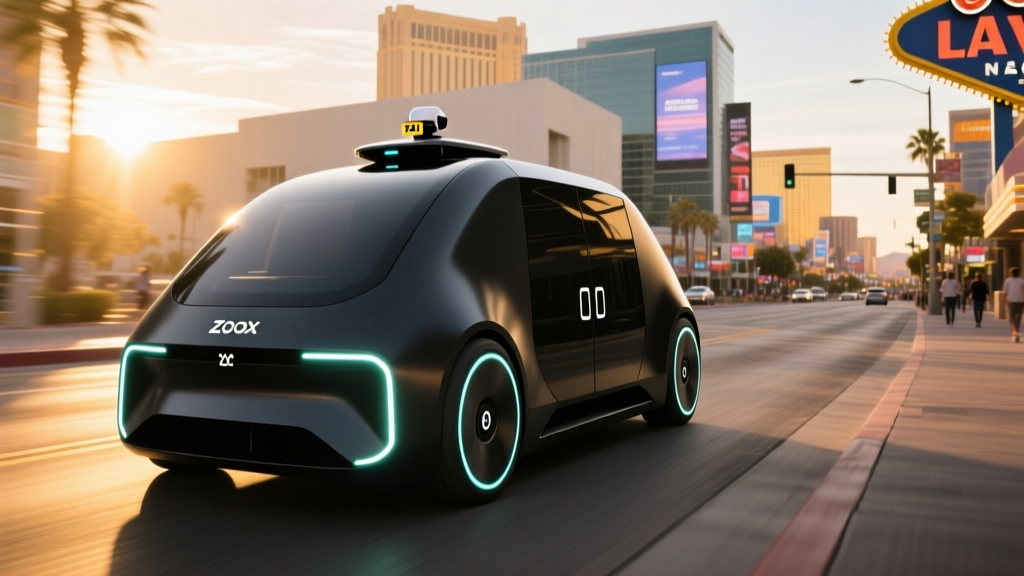
If you have visited the Las Vegas Strip recently, you may have spotted a small, symmetrical, steering-wheel-free pod gliding through traffic near Mandalay Bay or the Convention Center. That is the Zoox driverless taxi — a purpose-built, Level 4 robotaxi developed by Amazon's autonomous-vehicle subsidiary. Las Vegas is one of Zoox's earliest commercial markets, and in 2026 the service has expanded well beyond its initial pilot zone.
This guide covers exactly where Zoox operates in Las Vegas today, what a ride actually costs compared to Uber and Lyft, the hard safety data behind the service, the sensor suite that makes it possible, and the real-world limitations you will encounter. No hype, no speculation — just what you need to know before you book.
Where Can You Ride the Zoox Driverless Taxi in Las Vegas?
Zoox launched its Las Vegas commercial robotaxi service after receiving the necessary permits from the Nevada Department of Public Safety and completing extensive testing on public roads. As of early 2026, the service operates within a geofenced zone that covers the core tourist and business corridors.
The current geofence spans roughly from Sahara Avenue to the north, down to the Las Vegas Strip's southern end near Mandalay Bay, and from the I-15 corridor eastward to Maryland Parkway. Key destinations include:
- Harry Reid International Airport (LAS) — designated pickup/dropoff zones
- Las Vegas Convention Center
- Major Strip resorts: Bellagio, Caesars Palace, Venetian, MGM Grand, Aria, Mandalay Bay
- Downtown Las Vegas / Fremont Street area (limited zones)
- Allegiant Stadium (event-day service with modified routing)
The geofence is not the entire city. Zoox does not serve suburban Henderson, Summerlin, or the far north Las Vegas corridor. If your destination falls outside the operational zone, the app will notify you before booking and suggest the nearest valid dropoff point.
| City | Status | Launch Date | Coverage Notes |
|---|---|---|---|
| Las Vegas, NV | ✅ Commercial service | 2025 | Strip, airport, convention center, downtown (partial) |
| San Francisco, CA | ✅ Commercial service | 2024 | Most of SF proper; expanded beyond initial pilot zone |
| Foster City, CA | ✅ Commercial service | 2024 | Initial launch market; full city coverage |
| Seattle, WA | 🟡 Testing / limited rides | TBD | Employee and invited-rider program |
| Austin, TX | 🟡 Testing | TBD | Mapping and validation phase |
| Atlanta, GA | 📢 Announced | Expected 2027 | Not yet operational |
Is the Zoox Robotaxi Truly Self-Driving?
Yes — and this is a critical distinction. The Zoox vehicle operates at SAE Level 4 autonomy within its geofenced service area. That means there is no human driver in the vehicle, no steering wheel, and no expectation that a passenger will intervene. The system handles all driving tasks within its operational design domain (ODD).
This is fundamentally different from Tesla's Full Self-Driving (Supervised), GM's Super Cruise, or Ford's BlueCruise — all of which are SAE Level 2 driver-assistance systems that require an attentive human driver behind the wheel at all times.
| SAE Level | Name | Who Drives? | Examples |
|---|---|---|---|
| Level 0 | No Automation | Human | Traditional vehicles |
| Level 1 | Driver Assistance | Human (with steering or speed aid) | Adaptive cruise, lane-keeping |
| Level 2 | Partial Automation | Human (must supervise constantly) | Tesla Autopilot/FSD, BlueCruise, Super Cruise |
| Level 3 | Conditional Automation | System (in narrow conditions; human on standby) | Mercedes Drive Pilot (limited markets) |
| Level 4 | High Automation | System (no human needed in geofence) | Waymo, Zoox, Cruise (pre-suspension) |
| Level 5 | Full Automation | System (everywhere, all conditions) | Does not yet exist commercially |
Zoox's Level 4 designation means the vehicle can complete an entire trip — including pulling over safely if it encounters a scenario it cannot handle — without any human input. However, Level 4 is geofence-limited. Take the same vehicle outside its mapped operational area, and it will not operate autonomously.
How Much Does a Zoox Ride Cost vs. Uber and Lyft?
Zoox positions its pricing to be competitive with standard rideshare, not premium. In Las Vegas, a typical Zoox ride within the Strip corridor costs between $8 and $18 depending on distance and demand, which is broadly comparable to UberX and Lyft standard fares for the same routes.
| Route | Zoox (estimated) | UberX (estimated) | Lyft Standard (estimated) |
|---|---|---|---|
| Harry Reid Airport → Bellagio (~4 mi) | $12–$16 | $14–$20 | $13–$19 |
| Convention Center → Mandalay Bay (~5 mi) | $13–$17 | $15–$22 | $14–$21 |
| Bellagio → Fremont Street (~7 mi) | $15–$20 | $18–$26 | $17–$25 |
| Short Strip hop (1–2 mi) | $8–$11 | $9–$14 | $9–$13 |
Key pricing notes:
- Zoox does not currently implement surge pricing in the same aggressive manner as Uber/Lyft, though wait times may increase during peak demand.
- Tipping is not expected (there is no driver), though the app provides an option to rate and provide feedback.
- Zoox occasionally offers promotional free or discounted rides to new users in expansion markets.
- Pricing is subject to change; check the Zoox app for real-time fare estimates before confirming.
How Safe Are Zoox Robotaxis? The Hard Data
Safety is the most scrutinized aspect of any robotaxi service, and it should be. Zoox, like Waymo, is required to report disengagement and collision data to state regulators. Let's look at what we know.
- Testing and commercial miles driven (cumulative): Over 1 million autonomous miles across all markets as of late 2025, per NHTSA filings and company disclosures.
- Reported collisions: Zoox has reported a small number of minor-contact incidents to NHTSA's Standing General Order (SGO) crash reporting system. The majority involved low-speed contact where the Zoox vehicle was stationary or near-stationary and was struck by a human-driven vehicle.
- Autonomous disengagement rate: In California DMV disengagement reports, Zoox's rate has improved year over year, trending toward fewer than 1 disengagement per 1,000–2,000 miles in mature testing zones. (Disengagements include both system-initiated and operator-initiated events during testing.)
- No reported serious injuries: As of this writing, no Zoox robotaxi has been involved in a collision resulting in serious or fatal injury to any road user.
Note: Safety data evolves rapidly. Check NHTSA's AV crash reporting dashboard for the most current figures.
For context, Waymo — the most established US robotaxi — has published peer-reviewed research showing its vehicles are involved in roughly 85% fewer injury-causing crashes per million miles compared to human benchmarks. Zoox has not published an equivalent peer-reviewed study, but its safety record to date has not revealed systemic issues.
The Zoox vehicle's design contributes to passive safety: it is symmetrical (can drive in either direction), compact (easier to maneuver in tight urban spaces), and features a reinforced battery structure low in the chassis. The absence of a traditional steering column and dashboard also allows for novel airbag placement and crash-energy management.
Under the Hood: Zoox's Sensor and Technology Stack
Zoox takes a sensor-fusion approach — combining lidar, cameras, and radar — which contrasts with Tesla's camera-only ("Tesla Vision") strategy. This multi-sensor redundancy is standard across Level 4 robotaxi operators (Waymo uses a similar stack).
- Lidar: Multiple solid-state and spinning lidar units provide 360-degree, high-resolution 3D point clouds. Lidar excels at precise distance measurement and works reliably in darkness — a key advantage over camera-only systems at night.
- Cameras: A suite of high-dynamic-range cameras covers the full surround, enabling traffic-light recognition, sign reading, lane-marking detection, and pedestrian intent classification.
- Radar: Long-range and short-range radar units supplement lidar for velocity detection of other moving objects, especially in rain or fog where lidar performance can degrade.
- HD Maps: Zoox pre-maps every inch of its geofenced service area at centimeter-level precision. The vehicle localizes itself within this map in real time, providing a layer of redundancy beyond real-time perception.
- Compute: Custom onboard computing hardware processes sensor data and runs the driving policy in real time. The system is designed with redundant compute paths so that a single hardware failure does not disable the vehicle.
- V2X (Vehicle-to-Everything): Zoox vehicles can communicate with infrastructure in equipped zones (e.g., smart traffic signals), though the system does not rely on V2X to function safely.
The Zoox vehicle is purpose-built from the ground up as a robotaxi — it is not a retrofitted consumer car. This gives engineers freedom to place sensors optimally (no concern for aesthetics or driver sightlines) and to design the interior entirely around passengers. The cabin seats four, face-to-face, with no front seat or dashboard.
Regulatory Landscape: Who Approves Robotaxi Operations?
Robotaxi deployment in the United States is governed by a patchwork of state and local regulations. There is no single federal "robotaxi license." Instead, operators must navigate multiple layers of approval.
Federal level (NHTSA): The National Highway Traffic Safety Administration sets vehicle safety standards (FMVSS) and requires crash reporting via Standing General Orders. Zoox received an exemption from certain FMVSS requirements (such as having a steering wheel and mirrors) because its vehicle has no human driver position. NHTSA does not "approve" robotaxi services for operation, but it can investigate and issue recalls for safety defects.
State level (Nevada): Nevada was one of the first states to pass autonomous-vehicle legislation. The Nevada DMV issues testing and deployment permits. Zoox holds a commercial deployment permit in Nevada, which requires ongoing safety reporting, insurance coverage, and compliance with state-specific operational rules.
Local level (City of Las Vegas / Clark County): Local jurisdictions control road access, pickup/dropoff zones, and coordination with first responders. Zoox works with local authorities to ensure that emergency vehicles can communicate with and override robotaxi behavior when necessary.
California comparison: In California, the DMV issues testing permits while the California Public Utilities Commission (CPUC) issues commercial passenger-service permits. This dual-agency structure is unique to California and adds a regulatory layer that Nevada does not have.
Current Limitations: What Zoox Cannot Do (Yet)
Level 4 autonomy is impressive within its domain, but the domain has hard boundaries. Here are the real-world limitations you will encounter with the Zoox driverless taxi in Las Vegas.
- Geofence restrictions: The vehicle will not drive outside its mapped zone. If you request a ride to a location beyond the geofence, the app will not let you book it.
- Weather limitations: Heavy rain, dust storms (a real concern in Las Vegas monsoon season), or extremely low-visibility conditions may cause the service to restrict operations or increase wait times. Lidar performance degrades in heavy precipitation, and the system is programmed to be conservative.
- Construction zones: While Zoox can handle mapped, long-term construction, sudden or unmapped lane closures may cause the vehicle to reroute or, in rare cases, pull over and request remote assistance.
- No highway driving: The Zoox vehicle is designed for urban environments at speeds up to approximately 75 mph, but its Las Vegas geofence primarily covers surface streets and the Strip corridor. Highway merges and high-speed lane changes are among the most challenging scenarios for Level 4 systems.
- Pickup/dropoff precision: In crowded areas (e.g., outside a busy casino at 11 PM), the vehicle may stop slightly offset from your exact pin location. You may need to walk a short distance to the designated pickup point.
- Accessibility: Zoox has stated that its vehicle is designed to accommodate wheelchair users, but availability of wheelchair-accessible vehicles in the fleet may be limited during early deployment phases. Check the app for accessibility options.
- No stops mid-trip: Unlike an Uber where you can ask the driver to stop at a convenience store, Zoox rides are point-A to point-B with no intermediate stops.
How to Book and Ride: A Quick Walkthrough
Using the Zoox service in Las Vegas is straightforward once you have the app installed.
- Download the Zoox app (available on iOS and Android) and create an account with a valid payment method.
- Enter your pickup and dropoff locations. The app will confirm that both are within the service area and show an estimated fare and wait time.
- Confirm your ride. The app will direct you to the nearest safe pickup point, which may be a designated zone rather than the exact curb you are standing on.
- Identify your vehicle. The app shows the vehicle's location in real time and provides a visual identifier (color/lighting pattern) so you can spot it in a crowd of vehicles.
- Unlock and ride. The doors unlock automatically when the vehicle arrives and verifies your identity via the app. Inside, you will find four seats, a screen showing your route, and controls for climate and music. The ride begins automatically.
- Arrive and exit. The vehicle will pull over at your destination, unlock the doors, and prompt you to exit. The fare is charged automatically.
Frequently Asked Questions
Can I ride the Zoox driverless taxi in Las Vegas right now?
Yes. Zoox operates a commercial, fare-charging robotaxi service in Las Vegas as of 2025–2026. The service covers the Strip corridor, Harry Reid International Airport, the Convention Center, and parts of downtown. Download the Zoox app to check real-time availability and book a ride.
Is there a human driver or safety operator in the Zoox vehicle?
No. The Zoox robotaxi is a true SAE Level 4 vehicle with no steering wheel, no pedals, and no human driver. The vehicle operates entirely autonomously within its geofenced service area. Remote assistance is available if the vehicle encounters an unusual scenario, but a remote operator does not "drive" the vehicle in real time.
How does Zoox compare to Waymo in Las Vegas?
As of early 2026, Waymo operates primarily in Phoenix, San Francisco, Los Angeles, and Austin. Waymo does not have a commercial service in Las Vegas. Zoox is currently the primary robotaxi option in the Las Vegas market, though Waymo has indicated interest in expanding to additional cities.
What happens if the Zoox vehicle encounters a situation it cannot handle?
The vehicle is programmed to execute a "minimal risk condition" — it will safely pull over to the side of the road, activate hazard lights, and contact a remote assistance team. The remote team can provide high-level guidance (e.g., confirming it is safe to proceed around an obstacle), but they do not directly steer the vehicle. If the situation cannot be resolved, Zoox will dispatch a support vehicle to assist passengers.
Is the Zoox vehicle electric?
Yes. The Zoox robotaxi is a fully electric vehicle (BEV) with a battery pack integrated into the vehicle's low-slung platform. The exact battery capacity and range have not been publicly disclosed in kWh, but the vehicle is designed for urban duty cycles with opportunistic charging between rides. Its compact size and efficiency are optimized for short, frequent trips rather than long highway runs.
Does Zoox share my ride data with Amazon?
Zoox is a wholly owned subsidiary of Amazon. Zoox's privacy policy governs data collection for ride operations (location, route, in-cabin audio for safety). Review the Zoox privacy policy for specifics on data retention, sharing, and your rights as a rider.
What is the top speed of the Zoox robotaxi?
The Zoox vehicle has a top speed of approximately 75 mph. In practice, it operates at or below posted speed limits within its urban geofence, which in Las Vegas typically means 25–45 mph on surface streets and the Strip.