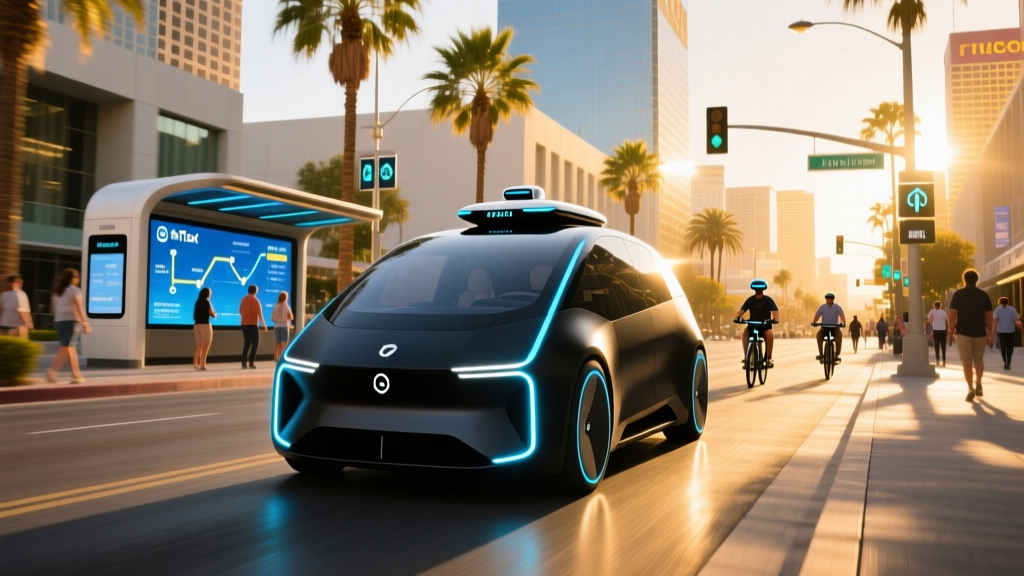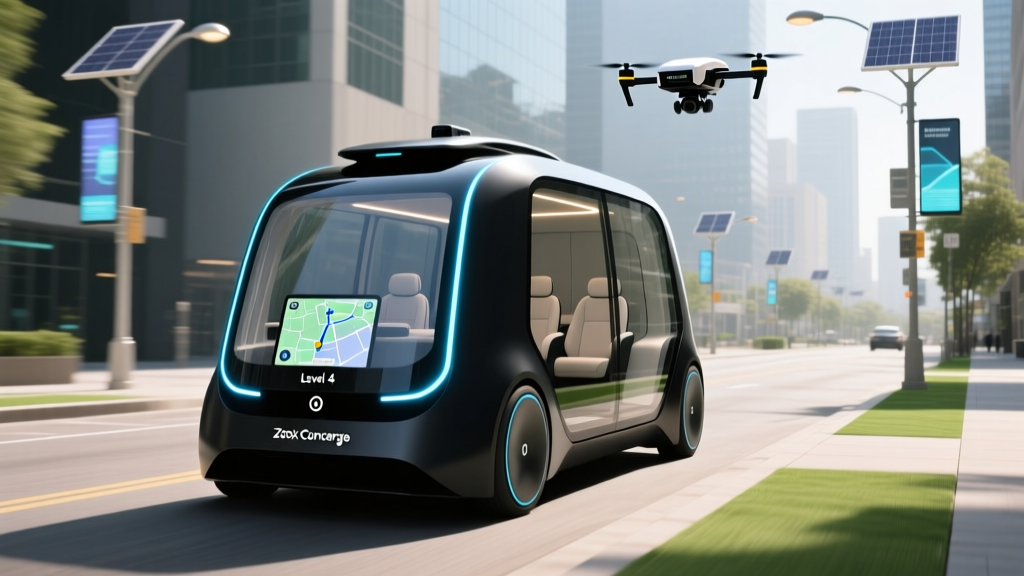
Zoox Concierge is Amazon's bid to build a ground-up robotaxi — not a retrofit sedan with a sensor rack bolted to the roof, but a purpose-built, bidirectional, no-steering-wheel carriage designed from day one to be driven by software. After years of closed testing, employee shuttles, and regulatory filings, the service has moved into limited public availability. Here's what that actually means for riders, cities, and the broader autonomous-vehicle landscape.
What Zoox Concierge Actually Is — And Isn't
Zoox (acquired by Amazon in 2020 for ~$1.3B) engineered a symmetric, four-passenger vehicle with inward-facing seats, no driver controls, and a dense sensor suite on every corner. The current production-intent carriage is roughly the footprint of a Toyota Prius but taller, with sliding doors on both sides and a top speed around 75 mph. It's a Level 4 robotaxi, meaning it operates without any human driver inside the vehicle — within a defined operational design domain (ODD).
SAE Automation Levels — Where Zoox Sits
| Level | Name | Who Drives | Example |
|---|---|---|---|
| 0 | No Automation | Human | Basic cruise control |
| 1 | Driver Assistance | Human + system (one axis) | Adaptive cruise OR lane-keep |
| 2 | Partial Automation | Human + system (both axes) | Tesla Autopilot, GM Super Cruise, Ford BlueCruise |
| 3 | Conditional Automation | System, human on standby | Mercedes Drive Pilot (limited conditions) |
| 4 | High Automation | System, no human needed in ODD | Zoox Concierge, Waymo One |
| 5 | Full Automation | System, anywhere | Does not exist commercially |
Sources: SAE J3016, NHTSA. Level 2 systems still require an attentive driver at all times.
This is the critical distinction shoppers often miss: Tesla's FSD (Supervised), GM's Super Cruise, and Ford's BlueCruise are Level 2 — the human is the driver of record and must monitor the road. Zoox Concierge is a fundamentally different product category. There is no steering wheel, no pedals, no human fallback inside the cabin.
Where Can I Use Zoox Concierge Right Now?
As of early 2026, Zoox Concierge operates as a limited public service in a handful of geofenced zones. Availability has expanded cautiously, with employee-only programs running longer in additional cities.
| City / Region | Status (2026) | Notes |
|---|---|---|
| Foster City / Bay Area, CA | Limited public rides | Core development hub; longest-running public exposure |
| Las Vegas Strip corridor, NV | Limited public rides | Tourist-heavy loop; nighttime operation included |
| San Francisco, CA | Employee + invited riders | Regulatory approvals via CPUC permitting process |
| Seattle, WA | Employee testing | Amazon HQ proximity; weather-stress testing |
| Austin, TX | Employee testing | Announced expansion; public timeline TBD |
| Atlanta, GA | Mapping / pre-launch | Announced; no public rides yet |
The California Public Utilities Commission (CPUC) issues the permits that govern commercial robotaxi operations in the state. Zoox has operated under the CPUC's Tier 3 Driverless Pilot and subsequent deployment permits, which require reporting of disengagements, collisions, and rider complaints. Nevada's regulatory path runs through the state DMV and a separate autonomous-vehicle testing framework that is generally more permissive than California's.
Pricing: Zoox vs. Uber, Lyft, and Waymo
During its limited public phase, Zoox has offered many rides at no charge to riders — a deliberate strategy to accumulate miles, edge-case data, and rider feedback without the friction of payment. This won't last. When Zoox transitions to a paid model, pricing is expected to target the mid-tier rideshare bracket, not premium.
| Service | Typical 5-Mile Fare | Surge Exposure | Driver in Vehicle |
|---|---|---|---|
| Zoox Concierge (current) | $0 (promo phase) | None yet | No |
| Zoox (projected paid model) | $9 – $14 est. | Low (fleet-managed) | No |
| Waymo One (SF/LA/Phoenix) | $11 – $18 | Moderate | No |
| UberX | $12 – $20 | High during peak | Yes |
| Lyft Standard | $12 – $19 | High during peak | Yes |
The long-run economic thesis for robotaxis is that removing the driver (who takes ~60–75% of a rideshare fare) allows operators to undercut human-driven services while still margining. Zoox's carriage economics are unproven at scale — vehicle cost is estimated north of $100k per unit given the sensor stack — but fleet utilization, energy cost (~$0.12/kWh commercial charging), and zero driver payout are structural advantages.
Safety Record: What the Data Actually Shows
Robotaxi safety claims are only as good as the reporting behind them. Zoox, like every California-permitted operator, files disengagement reports (instances where a remote operator or safety protocol intervenes) and collision reports with the CPUC and NHTSA.
Zoox Safety Data Points (as reported, 2024–2025 filings)
- Autonomous miles driven: Hundreds of thousands in mixed traffic (Foster City, SF, Las Vegas combined); still an order of magnitude below Waymo's 30M+ cumulative autonomous miles.
- At-fault collisions: Zero reported severe-injury or fatal collisions involving a Zoox carriage in autonomous mode through late 2025.
- Disengagement rate: Reported in the range of 1–5 interventions per 1,000 autonomous miles during public-road testing — higher than Waymo's mature fleet but improving with each software revision.
- Low-speed contact incidents: A small number of minor contact events (parking, construction-zone edge cases) reported in CPUC filings, none with passenger injury.
Source: CPUC AV program filings, NHTSA Standing General Order on ADS crashes.
Context matters. Zoox's mileage base is smaller than Waymo's, so statistical confidence intervals are wider. The absence of a severe incident is encouraging but not yet proof of system-wide safety at scale. For comparison, Waymo's 30M+ autonomous miles show a fatal-collision rate dramatically below the human US average (~1.35 per 100M vehicle-miles per NHTSA), but that denominator advantage took a decade to build.
Tech Stack: How the Carriage Sees the World
Zoox's sensor architecture is deliberately redundant — a philosophical bet against the camera-only approach Tesla uses for FSD.
Zoox Sensor & Compute Architecture
| Layer | Specification | Purpose |
|---|---|---|
| LiDAR | Multi-unit roof + corner-mounted, 360° coverage | Precise 3D point clouds, range-independent of lighting |
| Cameras | Multiple high-resolution RGB per corner | Traffic-light state, signage, lane markings, object classification |
| Radar | Long- and short-range units | Velocity measurement, all-weather object detection |
| Ultrasonics | Close-proximity array | Low-speed maneuvering, curb/pedestrian detection |
| Compute | Custom NVIDIA-class GPU stack (in-vehicle) | Real-time perception, prediction, planning at ~10 Hz+ cycle |
| HD Mapping | Centimeter-accurate geofenced maps | Prior knowledge of lane geometry, signal locations |
| Remote Assistance | Human teleoperations team | Edge-case guidance (not remote driving) |
Two architectural choices define Zoox's approach. First, bidirectional drive: the carriage is mechanically symmetric and can travel equally well in either direction, which simplifies recovery from dead-end scenarios and tight urban maneuvers. Second, geofencing with HD maps: the vehicle only operates in pre-mapped zones and will refuse a ride that exits its ODD. This is more conservative than a "go anywhere" promise but dramatically reduces the long-tail of unknown roads.
Regulatory Landscape: Who Has to Say Yes
Deploying a driverless vehicle commercially in the United States requires threading multiple regulatory needles simultaneously:
- Federal (NHTSA): Zoox petitioned NHTSA for an FMVSS exemption because its carriage lacks a steering wheel, mirrors, and pedals — all of which are mandated for conventional vehicles. NHTSA granted a limited exemption allowing up to 2,500 vehicles per year, a ceiling that will bind hard if Zoox scales.
- State (DMV + CPUC in CA): Testing permits, then deployment permits, then paid-deployment permits — each a separate gate with reporting requirements.
- Local (city / county): Fire-lane access, curb-management, accessibility (ADA compliance for the carriage interior), and first-responder interaction protocols.
- Insurance: Commercial AV liability policies that allocate fault between operator, manufacturer, and software vendor.
The patchwork nature of this regime is the single largest non-technical bottleneck to robotaxi expansion. A carriage legal in Las Vegas requires an entirely separate approval track in California, and neither approval transfers to Texas.
Current Limitations: What Zoox Concierge Cannot Do
- Geofence-bound: The carriage will not operate outside its mapped ODD. A ride request with an out-of-zone destination is simply declined.
- Weather sensitivity: Heavy rain, fog, and snow degrade lidar and camera performance. Service is suspended or restricted in severe conditions — Seattle and Northeast deployments will stress-test this.
- Construction zones: Rapidly changing lane geometry and temporary signage remain a high-disengagement scenario across every Level 4 operator.
- Unprotected left turns in dense traffic: A known edge case; Zoox handles them but conservatively, which can mean long wait times at busy intersections.
- Accessibility: The current carriage accommodates standard wheelchairs but not all mobility-device configurations; ADA compliance is an evolving design target.
- No highway operation: Zoox's ODD is urban and suburban surface streets. Freeway-speed merging and high-speed lane changes are not in the current service envelope.
- Remote assistance latency: When the system escalates to a human teleoperator, there's a brief pause (seconds, occasionally longer) while the edge case is triaged.
- Child seats / pets / unusual cargo: The cabin is configured for four seated adults; pet transport and child-restraint compatibility are not yet broadly supported.
Zoox vs. Waymo: The Two Level 4 Paths
Zoox is often compared to Waymo, but the engineering philosophies diverge sharply. Waymo retrofits existing OEM platforms (Jaguar I-PACE, soon Zeekr and Hyundai Ioniq 5) with a sensor suite. Zoox builds the entire vehicle. Waymo has vastly more autonomous miles and a mature paid service across multiple metros. Zoox has a purpose-built cabin optimized for rider experience — inward-facing seats, no driver's seat, more interior volume per exterior footprint.
For riders, the practical difference today is availability: Waymo One is bookable by the general public in Phoenix, San Francisco, Los Angeles, and Austin. Zoox Concierge remains invitation- or zone-limited. For the industry, the question is whether ground-up design yields a better unit-economic model at scale, or whether Waymo's OEM-partnership approach (lower vehicle cost, faster iteration) wins the deployment race.
Ownership, Economics, and What Comes Next
You cannot buy a Zoox. The carriage is a fleet-only asset, operated by Zoox/Amazon. This is relevant because it shapes incentives: the operator bears maintenance, charging, sensor calibration, and insurance costs, and prices rides to recover them over a multi-year vehicle life.
Charging infrastructure for the fleet is depot-based DC fast charging, likely at 150–350 kW per stall, turning carriages overnight and topping up during midday lulls. The battery chemistry is reported as an NMC pack sized for an all-day urban duty cycle (estimated 60–80 kWh usable), though Zoox has not published detailed powertrain specs the way a consumer OEM would.
If you're a rideshare-heavy urban dweller in a Zoox city, the practical question is simple: try the service when it opens to you, compare the wait time and ride quality to Uber/Lyft, and watch whether the free-ride window closes as the fleet scales. For everyone else, Zoox is a leading indicator of what robotaxi service will feel like when it reaches your metro — and a reminder that Level 4 autonomy, while real, is still geographically and operationally narrow.
Frequently Asked Questions
Is Zoox Concierge truly self-driving, or is there a hidden driver?
Truly self-driving within its operational domain. There is no steering wheel, no pedals, and no human driver in the vehicle. It is an SAE Level 4 system. A remote teleoperations team can advise the vehicle on edge cases but does not "drive" it in real time.
How much does a Zoox ride cost compared to Uber?
Currently $0 during the limited public / promotional phase. When paid service launches, estimates place a 5-mile ride in the $9–$14 range — competitive with or slightly below UberX, without surge pricing. Final pricing has not been published.
How safe are Zoox robotaxis in real-world operation?
Through late 2025, Zoox has reported zero severe-injury or fatal collisions in autonomous mode, across hundreds of thousands of mixed-traffic miles. Disengagement rates are higher than Waymo's mature fleet but trending down. The mileage base is still too small for definitive statistical comparison to the human driving average.
Can I hail a Zoox in any city?
No. As of 2026, limited public rides are available in select Bay Area zones and the Las Vegas Strip corridor. Employee programs run in additional cities (Seattle, Austin), and Atlanta has been announced for future expansion.
Does Zoox operate in rain or snow?
Light rain: yes. Heavy rain, fog, and snow: service is restricted or suspended. Lidar and camera performance degrade in these conditions, and Zoox takes a conservative approach to weather ODD limits.
Can I use Zoox for airport runs or highway trips?
Not currently. The carriage is limited to urban and suburban surface streets within its geofenced zone. Highway operation is outside its approved ODD.
Who regulates Zoox, and can they be shut down?
Zoox is regulated by NHTSA at the federal level (FMVSS exemption), the California DMV and CPUC at the state level (permits and reporting), and local authorities for curb and access issues. Permits can be suspended — as happened to Cruise in California in late 2023 — for safety incidents or reporting failures.