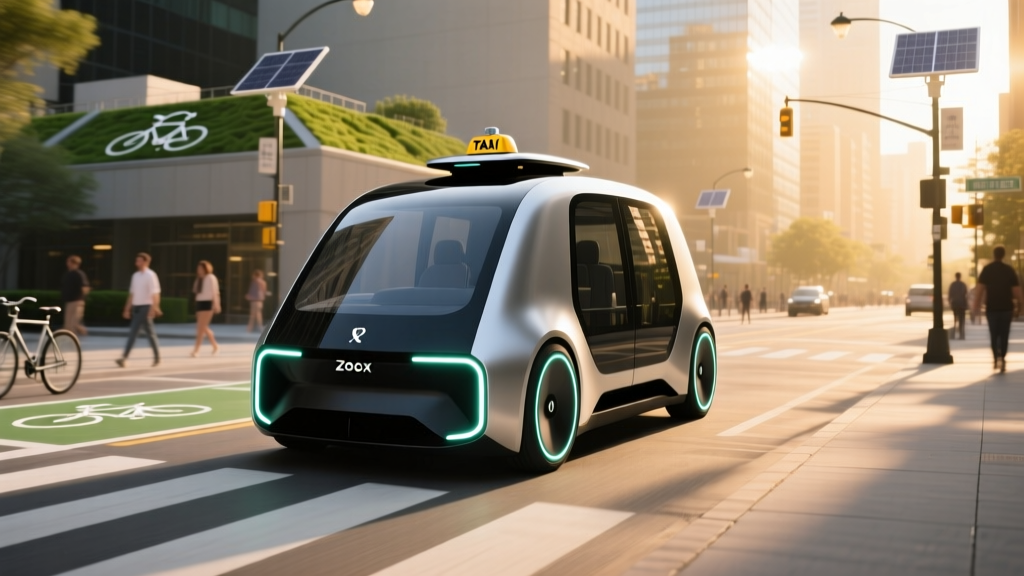
Zoox, the Amazon-owned autonomous vehicle company, has spent years testing its purpose-built robotaxi on public roads. Unlike companies that retrofit existing consumer cars with sensor suites, Zoox engineered a carriage-style vehicle from the ground up — no steering wheel, no pedals, bidirectional driving capability. As of early 2026, Zoox has moved beyond closed-campus testing into limited public ride-hail operations, but availability remains tightly restricted to a handful of cities under specific regulatory approvals.
This guide maps out exactly which Zoox cities currently have live or early-access service, what the technology under the skin looks like, how safety data stacks up, and what it actually costs to hail a ride versus a conventional Uber or Lyft.
SAE Automation Level: What Zoox Actually Is
Zoox operates at SAE Level 4 — High Automation. This means the vehicle handles all driving tasks within its defined Operational Design Domain (ODD) with no human driver present and no expectation of human takeover. If the system encounters a scenario it cannot handle, it executes a minimal-risk maneuver (pulling over safely) rather than handing control to a passenger.
This is fundamentally different from Level 2 systems like Tesla Autopilot or GM Super Cruise, which require continuous driver supervision. Zoox passengers are riders, not drivers.
| SAE Level | Name | Driver Required? | Example |
|---|---|---|---|
| Level 2 | Partial Automation | Yes — full-time supervision | Tesla Autopilot, GM Super Cruise, Ford BlueCruise |
| Level 3 | Conditional Automation | Yes — must be ready to take over | Mercedes Drive Pilot (limited market, low-speed) |
| Level 4 | High Automation | No — within geofenced ODD | Zoox, Waymo One |
| Level 5 | Full Automation | No — anywhere, any condition | Does not exist commercially |
Zoox does not claim Level 5. The vehicle operates within geofenced urban zones, in mapped areas, and under weather conditions its system can handle. Heavy rain, dense fog, or unmapped construction zones fall outside its current ODD.
Zoox Cities: Where Can You Ride Right Now?
Zoox has taken a measured approach to public deployment. The company spent years accumulating test miles in several cities before opening any service to paying (or even early-access) passengers. Here is the current status by city as of early 2026:
| City | Status | Service Type | Notes |
|---|---|---|---|
| Foster City, California | Early-access rides | Limited public ride-hail | Initial public-facing service area; San Mateo County approval required |
| Las Vegas, Nevada | Employee + early-access testing | Limited service on the Strip corridor | Testing since 2023; expanded geofence in 2025 |
| San Francisco, California | Testing (no public rides) | Permitted test operations | CPUC and SFMTA permits for driverless testing; public service pending |
| Seattle, Washington | Testing (no public rides) | Permitted test operations | Amazon HQ proximity; mapped routes in South Lake Union area |
| Atlanta, Georgia | Testing (no public rides) | Permitted test operations | Expansion announced late 2025; early-access rides expected later in 2026 |
Foster City, a small San Francisco Peninsula city of roughly 33,000 residents, is Zoox's primary public-facing launch zone. The choice is deliberate: relatively low traffic density, wide streets, predictable suburban geometry, and proximity to Zoox's headquarters. Las Vegas represents the company's first high-traffic tourist-corridor test, operating along portions of the Strip and adjacent areas.
For context, California's Public Utilities Commission (CPUC) issues the permits that govern commercial robotaxi service in the state. Zoox holds a driverless testing permit and has been working toward a commercial deployment permit, which is a separate and more rigorous approval.
How to Hail a Zoox and What It Costs
In cities where Zoox offers early-access rides, the process mirrors conventional ride-hail:
- Download the Zoox app (available in approved service zones).
- Request a ride within the geofenced area — pickup and dropoff must both fall inside the operational zone.
- The vehicle arrives driverless. Doors open automatically; you sit in one of four inward-facing seats.
- The ride proceeds autonomously. An in-cabin screen shows the vehicle's perception of the environment.
- Arrival and exit. The vehicle stops, doors open, and the ride ends.
During early-access phases, Zoox has offered rides at no cost or at heavily subsidized promotional rates. As commercial pricing rolls out, the expectation based on industry benchmarks is per-mile and per-minute pricing similar to Uber/Lyft, with potential introductory discounts.
| Service | Base Fare | Per-Mile Rate | Per-Minute Rate | Notes |
|---|---|---|---|---|
| Zoox (early access) | $0 (promotional) | $0.00 | $0.00 | Free during launch phase; commercial pricing TBD |
| Waymo One (where available) | ~$2.50 | ~$1.50–$2.00 | ~$0.30–$0.50 | Comparable to UberX; varies by city |
| UberX (US average) | ~$2.50 | ~$1.25–$1.75 | ~$0.25–$0.40 | Surge pricing can double or triple rates |
| Lyft Standard (US average) | ~$2.00 | ~$1.10–$1.60 | ~$0.20–$0.35 | Prime Time pricing applies during demand |
The long-term economic thesis for robotaxi operators is that removing the driver — who typically takes 60–80% of a rideshare fare — allows per-mile pricing below human-driven alternatives once fleets reach sufficient scale. Zoox has not published firm commercial pricing for 2026.
Zoox Safety Record: What the Data Shows
Key safety data points for Zoox (through 2025 reporting):
- Test miles accumulated: Over 1 million autonomous miles driven across all test cities, per Zoox's disclosures to California's DMV and NHTSA's Standing General Order crash-reporting program.
- Disengagement rate: Zoox does not publish a public disengagement-per-1,000-miles figure in the same format as California DMV reports for other operators. However, the company has reported decreasing intervention rates year-over-year as its software stack has matured.
- Reported incidents: As of early 2026, Zoox has reported a small number of minor-contact incidents to NHTSA under the Standing General Order — primarily low-speed contacts during complex urban scenarios. No serious passenger injuries have been publicly reported.
- Vehicle design safety: The Zoox carriage vehicle includes a proprietary crash-attenuation system, bidirectional airbags for all four seats, and a reinforced battery enclosure. The vehicle was designed to meet FMVSS standards, though Zoox received a limited NHTSA exemption for its non-traditional seating layout (no forward-facing seats).
For comparison, Waymo — the most-deployed Level 4 robotaxi in the US — has accumulated over 30 million autonomous miles and published peer-reviewed research showing a reduction in injury-causing crashes relative to human benchmarks in its operating cities. Zoox's mileage base is substantially smaller, which means its safety data set is less statistically robust at this stage.
All robotaxi operators with vehicles on public roads must report crashes to NHTSA under the Standing General Order, which mandates reporting within one day for incidents involving injury and within five days for property-damage-only events. This data is publicly searchable.
Under the Skin: Zoox Technology Stack
The Zoox vehicle is sensor-dense by design, using a redundant perception architecture that differs significantly from camera-only approaches (such as Tesla's FSD stack).
Sensor suite:
- LiDAR: Multiple solid-state and spinning LiDAR units providing 360-degree 3D point-cloud mapping out to approximately 150+ meters. LiDAR provides precise depth data independent of lighting conditions.
- Cameras: A surround-camera array (multiple high-resolution units) for object classification, traffic-light state detection, signage reading, and lane-marking recognition.
- Radar: Forward and corner radar units for velocity measurement of moving objects and performance in precipitation where LiDAR and cameras degrade.
- Ultrasonic sensors: Short-range proximity detection for low-speed maneuvers, docking, and close-object awareness.
Compute and software:
- Custom onboard compute platform running Zoox's proprietary perception, prediction, and planning stack.
- HD maps of all operational geofences, updated regularly to reflect construction, lane changes, and road modifications.
- Machine-learning models trained on millions of miles of real-world driving data and simulation scenarios.
Vehicle platform:
- Purpose-built battery-electric carriage — no steering wheel, pedals, or driver controls.
- Bidirectional: the vehicle can drive equally well in either direction (all four wheels steer).
- Battery: estimated 75–100 kWh pack (exact capacity not publicly disclosed), supporting Level 2 AC and DC fast charging.
- Top speed: approximately 75 mph (electronically limited), though operational speeds in urban geofences are well below this.
The multi-sensor approach is a deliberate contrast to Tesla's camera-only FSD (which operates at SAE Level 2). Zoox, like Waymo, argues that sensor redundancy — particularly LiDAR's reliable depth perception in varied lighting — is essential for Level 4 operations where no human is available as a fallback.
Regulatory Landscape: Who Approves Zoox Operations?
Robotaxi deployment in the US involves overlapping layers of state and local regulation. There is no single federal "robotaxi license." Instead:
- Federal (NHTSA): Sets vehicle safety standards (FMVSS). Zoox received a limited exemption from certain FMVSS requirements (like the mandate for a steering wheel and driver-side mirror) to operate its carriage vehicle. NHTSA also mandates crash reporting under the Standing General Order.
- State — California (CPUC + DMV): California's DMV issues autonomous vehicle testing permits. The CPUC separately regulates commercial passenger service (ride-hail). Zoox needs both to offer paid rides in California. As of early 2026, Zoox holds a DMV driverless testing permit and has been progressing through CPUC approval stages for commercial deployment.
- State — Nevada: Nevada was an early adopter of autonomous vehicle legislation. The Nevada DMV issues autonomous vehicle testing and operation licenses. Zoox has held a Nevada testing license since 2023.
- Local (city/county): Cities like San Francisco have exercised local authority over robotaxi operations, with the SFMTA and Board of Supervisors imposing restrictions on fleet size, operating hours, and zones after incidents involving other operators.
This patchwork means Zoox can be testing in one city, offering early-access rides in another, and be entirely absent from a third — even within the same state. Regulatory approval is the primary bottleneck for expansion, not technology readiness alone.
Current Limitations: What Zoox Cannot Do
Level 4 autonomy within a geofence is a significant engineering achievement, but it comes with meaningful constraints that riders should understand:
- Geofenced zones only: The vehicle will not travel outside its pre-mapped, approved operational area. You cannot hail a Zoox for an intercity trip or to an unmapped suburb.
- Weather restrictions: Heavy rain, dense fog, snow, and ice degrade LiDAR and camera performance. Zoox will suspend service or refuse certain routes during adverse weather — unlike a human driver who might proceed cautiously.
- Construction and road closures: While HD maps are updated regularly, sudden unmarked construction zones or temporary traffic-control setups can challenge the system. The vehicle will execute a minimal-risk maneuver (pull over and stop) rather than attempt an uncertain path.
- No highway driving: Current Zoox operations are limited to surface streets within urban geofences. Highway merging and high-speed driving are not part of the operational profile.
- Limited passenger capacity: The carriage seats four passengers maximum, all inward-facing. There is no trunk or large cargo space — this is a people mover, not a cargo hauler.
- No manual override: There is no steering wheel or pedal set. If the system fails, remote assistance (teleoperations) guides the vehicle to a safe stop. Passengers cannot intervene directly.
- Accessibility limitations: While Zoox has stated commitment to ADA compliance, the carriage vehicle's entry height and interior layout may not accommodate all wheelchair configurations without advance coordination.
These limitations are typical of current Level 4 systems. Waymo faces similar geofence, weather, and construction constraints. The key difference from Level 2 driver-assist systems is that Zoox takes full responsibility for the driving task within its ODD — if it cannot handle a situation, it stops safely rather than expecting you to take over.
Zoox vs. Waymo: How the Two Level 4 Services Compare
| Attribute | Zoox | Waymo One |
|---|---|---|
| SAE Level | Level 4 (geofenced) | Level 4 (geofenced) |
| Vehicle | Purpose-built carriage (no steering wheel) | Retrofit Jaguar I-PACE (with steering wheel, no driver) |
| Cities with public service | Foster City, CA (early access); Las Vegas (limited) | Phoenix, San Francisco, Los Angeles, Austin |
| Autonomous miles driven | ~1M+ | 30M+ |
| Sensor stack | LiDAR + camera + radar + ultrasonic | LiDAR + camera + radar + ultrasonic |
| Pricing model | Free (promotional) → TBD | Per-mile/per-minute (comparable to UberX) |
| Highway capability | No | Limited (Phoenix freeway segments) |
| Parent company | Amazon | Alphabet (Google) |
Waymo is significantly further along in commercial deployment, with millions of paid rides completed across multiple metro areas. Zoox's advantage lies in its purpose-built vehicle — no legacy steering components, bidirectional driving, and a cabin designed from scratch for passengers rather than converted from a driver-oriented car. But in terms of where you can actually get a ride today, Waymo covers far more Zoox cities than Zoox itself does.
Frequently Asked Questions
Where can I use the Zoox robotaxi service right now?
As of early 2026, Zoox offers early-access rides in Foster City, California, with limited operations in Las Vegas, Nevada. San Francisco, Seattle, and Atlanta are active test cities but do not yet have public ride service. Availability is expanding gradually as regulatory approvals progress.
How much does a Zoox ride cost compared to Uber or Lyft?
During its early-access phase, Zoox has offered rides free of charge or at heavily subsidized promotional rates. Once commercial pricing launches, industry expectations place robotaxi fares at or slightly below UberX/Lyft Standard rates (roughly $1.25–$2.00 per mile plus per-minute charges), since the operator does not pay a human driver. Exact Zoox commercial pricing has not been published.
How safe are Zoox robotaxis based on real data?
Zoox has accumulated over 1 million autonomous test miles and has reported a small number of minor low-speed incidents to NHTSA under the Standing General Order crash-reporting mandate. No serious passenger injuries have been publicly reported. However, Zoox's mileage base is far smaller than Waymo's 30+ million miles, so its safety data set is less statistically robust. All crash data is publicly searchable via NHTSA.
What are the current limitations of Zoox robotaxis?
Zoox operates only within geofenced urban zones, cannot drive on highways, suspends service in heavy rain or dense fog, seats a maximum of four passengers, has no manual steering override, and cannot travel outside its pre-mapped operational area. Construction zones and temporary road changes may also trigger a safe-stop maneuver.
Is Zoox truly self-driving or is it driver-assist like Tesla Autopilot?
Zoox is a true SAE Level 4 driverless system — there is no steering wheel, no pedals, and no human driver present. This is fundamentally different from Level 2 driver-assist systems like Tesla Autopilot, GM Super Cruise, or Ford BlueCruise, which require a licensed, attentive driver behind the wheel at all times. Zoox passengers are riders, not drivers.
When will Zoox expand to more cities?
Zoox has announced testing in Atlanta and continues to expand its geofenced areas in existing cities. The pace of expansion depends on regulatory approvals from state and local authorities (CPUC in California, state DMVs elsewhere) as well as operational readiness. No firm timeline has been published for a large-scale multi-city rollout.
Can I hail a Zoox for an airport run or intercity trip?
Not currently. Zoox operates within geofenced surface-street zones only. Highway driving and intercity routes are outside the vehicle's current operational design domain. Airport service would require specific geofence inclusion and regulatory approval for the airport route.