The State of Robotaxis in San Francisco Right Now
If you've visited San Francisco in the past year, you've likely seen them: white Jaguar I-PACE SUVs or custom-built pods gliding through the fog without anyone behind the wheel. The autonomous car in San Francisco isn't a concept anymore — it's a daily transportation option processing tens of thousands of paid trips per week across the city.
But the robotaxi landscape has changed dramatically since the early 2020s. Cruise suspended operations in late 2023 after a serious incident and subsequent regulatory action, restructuring its approach before slowly returning to limited testing. Waymo, backed by Alphabet, emerged as the dominant commercial operator, while Amazon's Zoox has been expanding its purpose-built vehicle testing. For riders, this means your options are more concentrated but the service that remains has accumulated billions of autonomous miles.
This guide covers exactly where you can hail a driverless ride, what it costs compared to Uber or Lyft, the real safety data behind the headlines, and the technology making it work — plus the hard limitations you should know before you book.
SAE Automation Levels: Why Robotaxis Aren't the Same as Autopilot
The single most important distinction in autonomous driving is the SAE automation level. Consumer vehicles with features like Tesla's FSD (Supervised), GM's Super Cruise, or Ford's BlueCruise are SAE Level 2 systems — the driver must remain engaged, monitor the road, and be ready to take over at any moment. These are driver-assist systems, not self-driving cars.
Robotaxis operating commercially in San Francisco are SAE Level 4 — they handle all driving tasks within a defined operational design domain (geofenced area, weather conditions, speed range) with no human driver present. If the system encounters a situation it can't handle, it pulls over safely rather than handing control to a passenger.
| Level 2 (Driver-Assist) | Human driver required, monitoring road. Examples: Tesla FSD Supervised, GM Super Cruise, Ford BlueCruise. |
| Level 4 (Robotaxi) | No human driver. Vehicle handles all driving in geofenced area. Examples: Waymo One, Zoox. System pulls over if confused. |
| Level 5 (Full Autonomy) | Drives anywhere, any condition, no geofence. Does not exist commercially as of 2026. |
Where Can You Ride a Robotaxi in San Francisco?
As of early 2026, the autonomous car in San Francisco is primarily served by one commercial operator, with another in limited return-to-road testing.
| Service | SF Status | Service Area | Hours | Vehicle |
|---|---|---|---|---|
| Waymo One | ✅ Fully commercial | ~80 sq mi across SF (most neighborhoods, SFO airport runs) | 24/7 | Jaguar I-PACE (5th-gen sensor suite) |
| Cruise | ⚠️ Limited supervised testing | Restricted zones, safety driver present | Daytime hours | Chevrolet Bolt EV / Origin (testing) |
| Zoox | ⚠️ Employee/invite-only testing | Select corridors (SoMa, Financial District) | Limited windows | Zoox purpose-built carriage (no steering wheel) |
Waymo One is the only service any San Francisco resident or visitor can download, book, and ride today without special invitations. The geofenced zone covers most of the city north of Daly City, including rides to and from SFO (San Francisco International Airport). Waymo has also expanded commercial service to Los Angeles, Phoenix, and parts of the Bay Area beyond SF proper.
Cruise, once Waymo's main rival in SF, suspended all driverless operations in October 2023 after a pedestrian was dragged beneath a Cruise vehicle that failed to stop. The National Highway Traffic Safety Administration (NHTSA) and California DMV both took regulatory action. Cruise returned to roads in 2024-2025 with human safety drivers and has been gradually working toward re-certification, but as of early 2026 is not offering paid driverless rides to the public in SF.
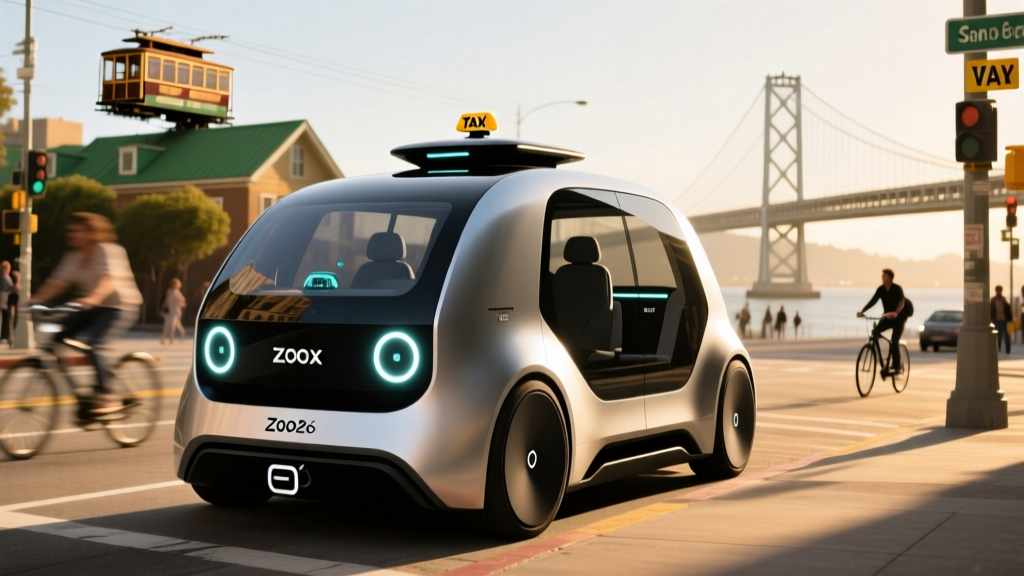
Zoox, Amazon's autonomous vehicle subsidiary, operates its distinctive carriage-style vehicle (bidirectional, no steering wheel) in limited testing. Public commercial service in SF has been announced but is not yet live.
How to Book and What It Costs vs. Uber or Lyft
Booking a Waymo One ride is nearly identical to using Uber or Lyft: download the Waymo One app, enter your destination, get a price quote, and a vehicle arrives — typically within 3-7 minutes in well-covered SF neighborhoods. The car pulls up, you verify the ride details on an exterior screen, unlock the doors via the app, buckle up, and the trip begins. An in-vehicle screen shows your route, and you can pull over or contact support at any time.
| Route (approx.) | Waymo One | UberX | Lyft |
|---|---|---|---|
| Mission District → Financial District (3 mi) | $12–$16 | $11–$18 | $10–$17 |
| SoMa → SFO Airport (14 mi) | $38–$52 | $35–$60 | $33–$55 |
| Sunset → North Beach (7 mi) | $22–$30 | $20–$35 | $18–$32 |
| Wait time (avg) | 3–7 min | 2–6 min | 2–8 min |
| Surge pricing | Minimal / none | 1.2x–3x+ common | 1.2x–2.5x+ common |
The headline: Waymo One pricing is broadly competitive with UberX and Lyft, often falling in the middle of their range. The key advantage is price consistency — Waymo does not use aggressive surge pricing during peak demand. During a rainy Friday evening when Uber might surge to 2.5x, Waymo's fare stays near its quoted range, though wait times may increase as fleet capacity is finite.
Tipping is not expected (there's no driver), and the app offers a "Waymo One Pass" subscription for frequent riders that can reduce per-ride costs by roughly 10-15%.
Safety Data: What the Numbers Actually Show
Safety is the most scrutinized — and most politicized — aspect of robotaxis. Here's what the available data tells us, stripped of marketing and fear.
- Autonomous miles driven: Over 40 million fully driverless miles across all markets (Phoenix, SF, LA, etc.)
- Contacted police-reportable crashes: Waymo's published data shows a rate approximately 5.7x lower than human benchmarks for police-reportable crashes per million miles, and roughly 6.7x lower for injury-causing crashes, based on Waymo's safety reports benchmarked against NHTSA data.
- Most common incident type: Low-speed contact with stationary objects or other vehicles in complex urban scenarios — not high-speed collisions.
- Serious injury incidents: Extremely rare in Waymo's driverless operations. No reported fatalities in Waymo One commercial service.
For context, the NHTSA reports that human drivers in the US experience roughly 2.0 police-reportable crashes per million miles and about 0.7 injury-causing crashes per million miles. Waymo's data suggests its vehicles are involved in fewer such incidents per million miles, though direct comparison requires caution — robotaxis operate in geofenced urban zones at moderate speeds, not on rural highways at 75 mph.
The Cruise incident of October 2023 is the most significant robotaxi safety event in San Francisco history. A Cruise vehicle struck a pedestrian who had been thrown into its path by a human-driven car, then pulled to the curb while the pedestrian remained partially beneath it, dragging her approximately 20 feet. The California DMV suspended Cruise's driverless permit, and the company paused nationwide operations. Cruise ultimately paid a $1.5 million settlement with the pedestrian and restructured its safety protocols. This incident demonstrated that Level 4 autonomy, while statistically safer overall, can still fail in edge cases involving unpredictable multi-actor scenarios.
Key nuance: Robotaxi safety data is self-reported by the operators. Unlike human crash data collected by NHTSA and insurance companies, there is no fully independent, standardized third-party audit of robotaxi crash rates. California requires autonomous vehicle operators to file disengagement and collision reports with the DMV, but the granularity and consistency of these reports vary.
How Robotaxis Work: The Technology Stack
Understanding the tech helps you understand both the capabilities and the limitations of hailing an autonomous car in San Francisco.
Waymo's 5th-Generation Sensor Suite (Jaguar I-PACE)
| LiDAR | Multiple roof-mounted units providing 360° 3D point cloud mapping up to ~500 meters. Detects shape, distance, and movement of all objects regardless of lighting. |
| Cameras | 29+ cameras covering 360° at varying focal lengths. Reads traffic lights, signs, hand signals. Functions in daylight and well-lit night conditions. |
| Radar | Multiple radar units for velocity detection of moving objects, effective in rain and fog where cameras and LiDAR degrade. |
| HD Mapping | Pre-built centimeter-accurate maps of every road in the geofence. The car knows lane widths, curb positions, and speed limits before it arrives. |
| Compute | Custom AI processors running perception, prediction, and planning models. Processes millions of data points per second to model the behavior of every pedestrian, cyclist, and vehicle nearby. |
The critical distinction in the industry is LiDAR-based (Waymo, Cruise, Zoox) vs. camera-only (Tesla's approach). Waymo and its peers use LiDAR as the primary depth sensor, supplemented by cameras and radar. This provides redundancy — if heavy rain scatters LiDAR returns and obscures cameras, radar still detects moving objects. Tesla's FSD system, by contrast, relies entirely on cameras and neural networks, which Tesla argues is more scalable but which has not achieved Level 4 certification for driverless commercial use anywhere.
Geofencing is the other core concept. Waymo's Level 4 system operates within a precisely mapped zone. The car has driven every street in that zone thousands of times in simulation and in real-world testing. It knows where construction zones are (updated frequently), where school zones have reduced speed limits, and which intersections have complex signal phasing. Outside the geofence, the system simply won't operate — it's not a limitation of intelligence, but of certification. The system is validated only within its mapped domain.
Current Limitations: What Robotaxis Can't Do Yet
These are not theoretical — they affect real rides:
- Heavy fog and rain: San Francisco's famous fog can degrade LiDAR and camera performance. Waymo has improved its fog handling significantly, but during the densest "Karl the Fog" events, the system may reduce speed, increase following distance, or in extreme cases, pause service in affected neighborhoods.
- Geofence boundaries: You cannot ride a Waymo to destinations outside the mapped zone. If you try to book a trip to Half Moon Bay or Marin County, the app will decline. The geofence has expanded over time but is not the entire Bay Area.
- Construction zones: While Waymo updates its maps frequently, sudden or unannounced construction can cause the vehicle to stop, reroute, or pull over and wait for remote assistance. Expect occasional 2-5 minute pauses in areas with active road work.
- Complex unprompted scenarios: A police officer directing traffic with hand signals, a funeral procession, or a protest blocking a street can cause the vehicle to stop and request remote guidance. Resolution usually takes 1-3 minutes.
- Pickup/drop-off precision: The vehicle will only stop at locations it has mapped as safe pullover points. It may drop you at the corner rather than directly in front of a specific address, especially on narrow streets or near fire hydrants.
- No highway driving (mostly): Waymo's SF service includes highway segments for SFO airport runs (US-101, I-280) but does not cover long-distance highway trips. You can't take a Waymo from SF to Sacramento.
- Accessibility: Current Waymo vehicles (Jaguar I-PACE) require passengers to enter a standard SUV. Wheelchair-accessible vehicles are in testing but not yet widely deployed in SF.
- No food delivery or package stops: Unlike Uber or Lyft, you can't ask the driver to "wait here for 5 minutes" or make an extra stop. The trip is point A to point B.
Regulatory Landscape: Who Approves Robotaxi Operations
Operating an autonomous car in San Francisco requires navigating a layered regulatory framework that is unique to California and more stringent than most US jurisdictions.
California DMV: Issues the foundational autonomous vehicle testing and deployment permits. Companies must submit disengagement reports (how often a human had to intervene or the system stopped itself) and collision reports. The DMV can suspend permits — as it did with Cruise in October 2023.
California Public Utilities Commission (CPUC): Regulates robotaxis as passenger carriers, similar to how it regulates Uber and Lyft. The CPUC grants permits for commercial paid service and can impose operational restrictions (nighttime-only, no freeways, etc.). In August 2023, the CPUC voted to allow Waymo and Cruise to expand to 24/7 paid service across SF — a decision that was highly controversial and preceded Cruise's suspension.
NHTSA (Federal): Sets vehicle safety standards (FMVSS) and investigates safety defects. Current FMVSS rules assume a human driver (steering wheel, mirrors, pedals), which required Zoox to obtain a special exemption for its steering-wheel-free carriage. NHTSA has opened investigations into both Waymo and Cruise incidents.
City of San Francisco: The city government, through SFMTA and the Mayor's office, has been vocal about concerns regarding robotaxi operations blocking traffic, interfering with emergency vehicles, and operating near construction zones. The city does not issue permits directly but lobbies the CPUC and DMV for operational restrictions.
This regulatory complexity means that expansion to new cities is slow. Waymo's expansion to Los Angeles and other markets required separate negotiations with each jurisdiction's regulators, and the rules differ by state. Arizona, where Waymo first launched in Phoenix, has far less restrictive regulation than California.
Should You Ride? A Practical Decision Framework
Choose a Robotaxi If:
- You want a consistent, surge-free fare for airport runs or cross-town trips
- You're curious about autonomous technology and want to experience Level 4 firsthand
- You value not having to make conversation with a driver or worry about tipping
- Your trip is within the geofenced zone during normal conditions
Stick With Uber/Lyft If:
- You need a ride outside the geofence (Marin, East Bay, Peninsula beyond SFO)
- You need wheelchair accessibility right now
- You're making multiple stops or need the driver to wait
- It's an extremely foggy or stormy night and you want a human driver's judgment
- You're uncomfortable with the idea of no human behind the wheel
Frequently Asked Questions
Is the autonomous car in San Francisco truly self-driving?
Yes — Waymo One operates at SAE Level 4, meaning there is no human driver in the vehicle. The car handles all driving tasks within its geofenced service area. This is fundamentally different from Tesla's FSD (Supervised), which is Level 2 and requires an attentive human driver at all times.
How much does a Waymo ride cost compared to Uber?
Waymo One fares are comparable to UberX and Lyft, typically within $1-3 of a standard rideshare fare for the same route. The key difference is no surge pricing — Waymo fares remain stable even during peak demand, though wait times may increase.
Has anyone been injured or killed in a San Francisco robotaxi?
No fatalities have been reported in Waymo One's commercial driverless service. The most serious incident in SF involved a Cruise vehicle (not Waymo) in October 2023 that struck and dragged a pedestrian who had been thrown into its path by another vehicle. Cruise's operations were suspended as a result. Waymo's published safety data indicates lower crash rates per million miles than human drivers, though independent verification is limited.
Can I take a robotaxi from SFO to downtown San Francisco?
Yes. Waymo One supports rides to and from San Francisco International Airport (SFO) as part of its expanded geofence. The trip typically takes 20-35 minutes depending on traffic and costs approximately $38-$52.
What happens if the robotaxi gets confused or encounters something unexpected?
The vehicle will pull over to a safe location and contact Waymo's remote assistance team. A human operator reviews the situation via the vehicle's cameras and can provide guidance or authorize a new path. This typically adds 1-5 minutes to your trip. The vehicle will not attempt a maneuver it isn't confident about.
Are robotaxis available 24/7 in San Francisco?
Waymo One operates 24 hours a day, 7 days a week in San Francisco. However, late-night availability depends on fleet positioning — you may experience longer wait times between 1 AM and 5 AM in outer neighborhoods.
What electric vehicle does Waymo use?
Waymo's current fleet in San Francisco consists of Jaguar I-PACE electric SUVs equipped with the company's 5th-generation sensor suite. The I-PACE has a 90 kWh battery pack and an EPA range of approximately 234 miles, though Waymo's vehicles are charging frequently throughout their operational shifts. Waymo has announced a partnership with Hyundai/Genesis for next-generation vehicles and with Zeekr (Geely) for a custom robotaxi platform, but these are not yet in commercial SF service.