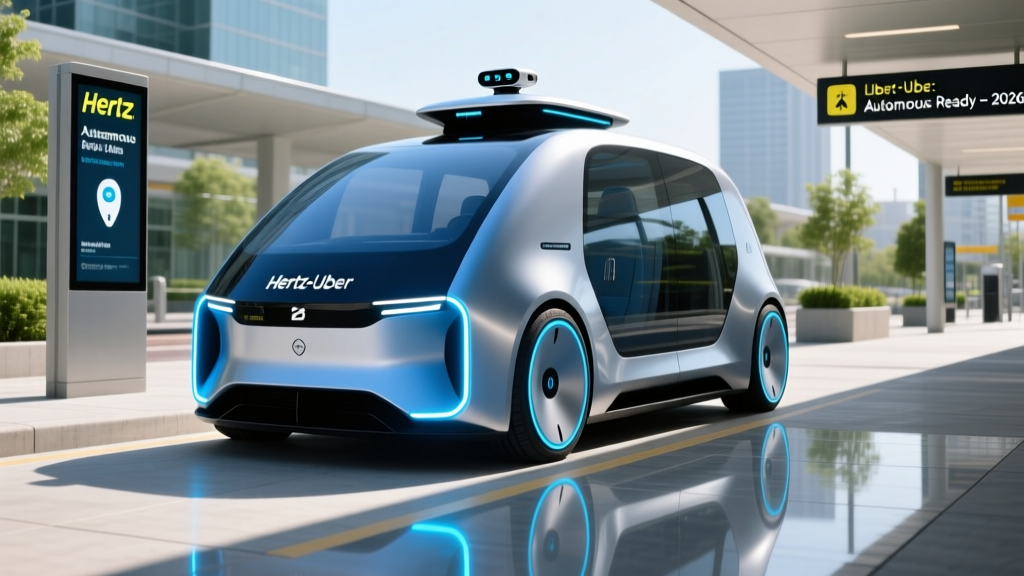
The Hertz Uber autonomous vehicle partnership has become one of the most visible attempts to put driverless robotaxis into the hands of everyday travelers — not just tech-savvy locals in a single test city. By pairing Hertz's airport-adjacent rental footprint with Uber's massive ride-hailing demand and Waymo's Level 4 autonomous driving system, the collaboration aims to make robotaxi rides as routine as ordering a standard UberX. But how much of that vision is live right now in 2026, and how much is still roadmap?
This guide breaks down the operational reality: where you can actually hail a driverless ride through the partnership, what it costs, the safety data behind it, the technology stack doing the driving, and the hard limitations that still define the robotaxi experience today.
What the Hertz Uber Autonomous Vehicle Partnership Actually Is
Announced in late 2024 and expanded through 2025 and into 2026, the partnership layers three companies together:
- Waymo supplies the autonomous driving technology and the vehicle fleet (primarily the Jaguar I-PACE equipped with Waymo Driver, and increasingly the Zeekr RT robotaxi platform).
- Uber provides the ride-hailing marketplace, dispatch, and payment infrastructure — riders request a Waymo robotaxi directly inside the Uber app in supported cities.
- Hertz manages fleet logistics: vehicle staging, cleaning, charging, light maintenance, and airport-area depot operations, drawing on its century of rental-car fleet management.
The practical result: in supported metros, you open Uber, select the Waymo autonomous option, and a driverless vehicle arrives. Hertz's role is mostly invisible to the rider but critical to uptime — keeping hundreds of robotaxis charged, clean, and mechanically sorted is a fleet-operations problem, not a software one.
SAE Automation Level: What "Self-Driving" Actually Means Here
| SAE Level | Description | Example |
|---|---|---|
| Level 2 | Driver-assist; human must monitor at all times | Tesla Autopilot, GM Super Cruise, Ford BlueCruise |
| Level 3 | Conditional automation; human must take over when prompted | Mercedes Drive Pilot (limited markets/conditions) |
| Level 4 | High automation within a defined ODD (geofence, weather); no human driver needed | Waymo One, Zoox — this is what the Hertz-Uber fleet operates at |
| Level 5 | Full automation everywhere, all conditions | Does not exist commercially |
The Waymo vehicles in this partnership are SAE Level 4. There is no driver behind the wheel, no steering wheel for a passenger to grab, and no expectation that you will intervene. This is fundamentally different from Tesla's FSD (Supervised), which remains Level 2 and requires an attentive driver. The Level 4 system handles all driving tasks within its approved Operational Design Domain (ODD) — a geofenced area with mapped roads and acceptable weather conditions.
Where Can You Use This Robotaxi Service Right Now?
As of early 2026, the Hertz-Uber-Waymo robotaxi service is live in a defined set of metros, with service areas expanding incrementally. Availability is not citywide in most locations — it's constrained to the geofenced zones Waymo has mapped and validated.
| City | Service Area | Airport Access | Status (2026) |
|---|---|---|---|
| Phoenix, AZ | ~300+ sq mi across Chandler, Tempe, Mesa, Scottsdale, downtown Phoenix | Phoenix Sky Harbor (PHX) — yes | Live, most mature market |
| San Francisco, CA | Most of SF proper, portions of Daly City | SFO — limited/pilot | Live |
| Los Angeles, CA | Santa Monica, Beverly Hills, West Hollywood, downtown LA expanding | LAX — announced, not yet live | Live (expanding zone) |
| Austin, TX | Central Austin, downtown, South Austin corridors | AUS — announced for 2026 | Live (limited zone) |
Phoenix remains the flagship. It's the only market where you can reliably hail a Waymo via Uber from a major airport terminal to a suburban hotel — exactly the use case Hertz's fleet infrastructure is designed to support. San Francisco is the densest and most technically demanding environment. Los Angeles is scaling but still geographically constrained compared to the metro's sprawl.
Key point: If your origin or destination falls outside the geofence, the Uber app will not offer the Waymo option. You'll see standard UberX, Comfort, or Black instead. The geofence expands over time, but it is not the entire metro area in any city today.
How to Hail a Robotaxi and What It Costs
Using the service is straightforward if you're already an Uber user:
- Open the Uber app in a supported city.
- Enter your destination. If both endpoints fall within the Waymo geofence, a "Waymo Autonomous" ride option appears alongside standard Uber tiers.
- Select it, confirm, and wait for dispatch. Typical wait times in Phoenix: 3–8 minutes during non-peak hours; 8–15 minutes during evening rush.
- The vehicle arrives with no driver. Unlock via the app when it arrives, buckle up, and tap "Start Ride" on the rear-seat screen.
| Ride Type | Typical Cost (5-mi trip, Phoenix) | Surge Behavior |
|---|---|---|
| Waymo Autonomous (via Uber) | $14–$22 | Moderate surge; capped in some markets |
| UberX (human driver) | $11–$18 | Standard surge pricing |
| Waymo One (direct Waymo app) | $13–$21 | Comparable; sometimes promotional pricing |
| Uber Comfort | $16–$24 | Standard surge pricing |
Robotaxi pricing sits between UberX and Comfort in most markets. You're paying a premium over the cheapest human-driven option, but the novelty, consistency, and zero-tipping expectation offset the delta for many riders. There's no driver to tip — a $15 robotaxi ride costs exactly $15 plus tax and fees.
For airport runs in Phoenix (e.g., Sky Harbor to a Scottsdale hotel, roughly 8 miles), expect $22–$35 in a Waymo vs. $18–$28 in UberX. The gap narrows on longer trips where per-mile rates dominate over base fares.
Safety Record: What the Data Actually Shows
Waymo's safety data is the most extensively documented in the robotaxi industry, and it's critical to separate real numbers from marketing narratives.
Waymo Safety Data (Through Late 2025)
- Total fully autonomous miles driven: Over 10 million driverless miles across Phoenix, SF, and LA (per Waymo's published safety reports).
- Injury-causing crash rate: Approximately 85% lower than human benchmarks in comparable urban driving environments, per Waymo's analysis submitted to NHTSA.
- Police-reportable crash rate: Approximately 57% lower than human benchmarks.
- Contact rate (any physical contact): Significantly lower than human drivers, with the majority of incidents involving other human drivers rear-ending or sideswiping the robotaxi — not the robotaxi initiating contact.
Source: Waymo Safety Report series; NHTSA Standing General Order crash data. Independent verification by the IIHS and academic researchers has generally corroborated the direction of these findings, though exact comparison methodologies vary.
The important context: robotaxis drive conservatively. They obey speed limits strictly, maintain generous following distances, and execute cautious unprotected left turns. This means they are occasionally rear-ended by human drivers not expecting a vehicle to brake as early as a Waymo does. The safety record reflects a vehicle that avoids causing crashes but cannot entirely prevent being involved in them.
NHTSA's Standing General Order requires all Level 4 operators to report crashes. Waymo's reports are public and granular — a meaningful transparency advantage over some competitors.
Technology Stack: How the Waymo Driver Actually Works
The vehicles in the Hertz-Uber fleet use Waymo's 5th-generation (and increasingly 6th-generation) Waymo Driver system. This is a sensor-fusion approach — not camera-only.
Sensor Suite (5th-Gen, Jaguar I-PACE Platform)
- LiDAR: Multiple roof-mounted and body-integrated LiDAR units providing a 360° 3D point cloud, effective to ~300+ meters. LiDAR works in darkness and is not dependent on visible light.
- Cameras: High-resolution cameras covering 360° for lane detection, traffic-light state recognition, signage, and object classification.
- Radar: Millimeter-wave radar for velocity detection of moving objects, redundant object tracking, and performance in rain/fog where LiDAR and cameras degrade.
- Audio detection: External microphones to detect emergency-vehicle sirens and adjust behavior (pull over, yield).
- HD Maps: Pre-mapped, centimeter-accurate maps of every road in the geofence, updated continuously. The vehicle always knows exactly where it is relative to lanes, curbs, and intersections.
This multi-sensor approach is a deliberate contrast to Tesla's camera-only FSD system. Waymo's redundancy philosophy: if one sensor modality is degraded (e.g., heavy rain scattering LiDAR returns), radar and cameras provide overlapping coverage. The tradeoff is cost — a Waymo-equipped vehicle carries well over $100,000 in sensor and compute hardware, which is why fleet-scale operations (and Hertz's fleet-management expertise) are essential to making the economics work.
The 6th-generation system, rolling into the Zeekr RT platform joining the fleet in 2026, reduces sensor count and cost while maintaining performance, using improved LiDAR units and more efficient compute.
Regulatory Landscape: Who Approves Robotaxi Operations?
Robotaxi deployment in the United States is governed at the state level, not by a single federal permit. This creates a patchwork:
- Arizona: The most permissive major market. No specific legislative framework was required; Waymo has operated commercially in Phoenix since 2020 under general business and transportation regulations. The Arizona Department of Transportation oversees connected-vehicle infrastructure.
- California: The most regulated. The California Public Utilities Commission (CPUC) issues permits for commercial robotaxi service. The California DMV issues testing and deployment permits. Both agencies require extensive safety data, incident reporting, and public-comment processes. Waymo holds full commercial deployment permits in SF and LA.
- Texas: Austin's robotaxi operations fall under a combination of state autonomous-vehicle legislation (passed in 2017) and city-level coordination. Texas requires AV operators to carry insurance and comply with traffic laws but does not impose a CPUC-style permitting regime.
At the federal level, NHTSA sets vehicle safety standards and requires crash reporting under the Standing General Order, but does not currently approve or deny robotaxi service launches — that authority rests with states. The FAA has no jurisdiction over ground robotaxis, but airport access (a key Hertz contribution) requires individual airport-authority agreements, which is why PHX is live but LAX is still pending.
Current Limitations: What Robotaxis Still Cannot Do
Level 4 autonomy within a geofence is a genuine achievement, but it is not universal self-driving. The limitations are concrete and affect real trips:
- Geofence boundaries: The vehicle will not drive outside its mapped zone. If your trip crosses the geofence line, the option simply won't appear in Uber. This means suburban and rural destinations remain inaccessible.
- Weather constraints: Heavy rain, fog, and dust storms can trigger operational pauses or degraded routing. Phoenix monsoon season (July–September) occasionally forces Waymo to pull vehicles from service. The system does not operate in snow — which is why there's no Chicago, Denver, or Boston service.
- Construction zones: Major, unmapped road-construction changes can cause the vehicle to reroute conservatively or, in rare cases, pull over and request remote assistance. Minor construction with clear lane markings is handled well.
- Complex unprompted scenarios: A police officer directing traffic with hand signals (not standard traffic-control patterns) can confuse the system. Waymo has improved here, but it remains an edge case.
- No trunk access for riders: The Jaguar I-PACE robotaxi's trunk is occupied by compute hardware. You cannot bring large luggage — a backpack or carry-on fits in the cabin, but airport runs with multiple suitcases are impractical.
- Wait times in fringe zones: If you're near the edge of the geofence, vehicle density drops and wait times can stretch to 15–20+ minutes during peak demand.
- Passenger behavior monitoring: In-cabin cameras monitor for unsafe behavior (not buckling up, opening doors mid-ride). Repeated violations can end the ride early and flag your account.
The luggage limitation is particularly relevant for the Hertz angle: airport travelers with checked bags and rolling suitcases may find a standard UberX or UberXL more practical until the Zeekr RT platform (with more passenger and cargo space) reaches full fleet saturation.
How This Compares to Other Robotaxi and Rideshare Options
| Feature | Waymo via Uber (Hertz fleet) | Waymo One (direct app) | Standard UberX | Tesla FSD (Supervised) rideshare |
|---|---|---|---|---|
| SAE Level | Level 4 (driverless) | Level 4 (driverless) | N/A (human driver) | Level 2 (driver present) |
| Human driver | None | None | Yes | Yes, must supervise |
| Cities (2026) | Phoenix, SF, LA, Austin | Phoenix, SF, LA, Austin | Nationwide | Nationwide (feature, not service) |
| Airport service | PHX live; others announced | PHX live; others announced | All major airports | N/A |
| Avg 5-mi cost | $14–$22 | $13–$21 | $11–$18 | N/A |
| Tipping | Not applicable | Not applicable | Expected ($2–$5) | N/A |
For riders in supported cities, the Waymo-via-Uber experience is essentially equivalent to using the Waymo One app directly. The Uber integration matters most for travelers who already have Uber installed, have payment methods saved, and want a single app for both autonomous and human-driven rides depending on the geofence.
Frequently Asked Questions
Is the Hertz Uber robotaxi truly self-driving, or is there a safety driver?
There is no driver in the vehicle — no one in the front seat, no steering wheel accessible to passengers. This is SAE Level 4 autonomy. The vehicle handles all driving tasks within its geofenced service area. Remote assistance is available if the vehicle encounters an ambiguous scenario, but no human is physically driving.
Can I use the Hertz Uber autonomous vehicle at any airport?
Currently, Phoenix Sky Harbor (PHX) is the primary airport with live Waymo-via-Uber service. LAX, SFO, and Austin-Bergstrom (AUS) have been announced or are in pilot phases, but full commercial airport pickup is not yet available at those locations as of early 2026. Airport access requires individual agreements with airport authorities, which take time.
What happens if the robotaxi gets confused or can't complete the trip?
The vehicle will pull over safely and contact Waymo's remote-assistance team. In most cases, the remote team provides guidance (e.g., confirming it's safe to proceed through an unusual construction zone), and the ride continues. In rare cases, the ride may be rerouted or ended early, and you'll be credited for the incomplete portion.
Does Hertz let me rent a Waymo robotaxi to drive myself?
No. The vehicles in Hertz's fleet management program are robotaxis only — you cannot rent one for personal driving. Hertz's role is fleet operations (charging, cleaning, maintenance, staging), not consumer rental of autonomous vehicles. You access the vehicles exclusively through Uber or the Waymo One app as a rider.
How does robotaxi pricing compare during surge hours?
Waymo rides via Uber do experience demand-based pricing, but the surge multipliers tend to be less extreme than human-driven UberX during the same period. This is partly because Waymo fleet supply is managed centrally and doesn't depend on individual drivers deciding whether to go online. During major events in Phoenix, we've observed Waymo pricing holding at 1.3–1.6x while UberX surged to 2.0–2.5x in the same zone.
Are Waymo robotaxis safe at night?
Yes. The LiDAR and radar sensor suite does not depend on visible light, and the system performs equivalently at night and during the day. In fact, some of Waymo's safety data suggests slightly better performance at night due to reduced traffic density and fewer unpredictable pedestrian interactions. The vehicles operate 24/7 in Phoenix and San Francisco.
Will this partnership expand to more cities in 2026?
Yes, but incrementally. Austin is scaling, and additional markets are expected to be announced — likely including Miami and Atlanta based on Waymo's public statements. Each new city requires extensive mapping, regulatory approval, and Hertz depot infrastructure buildout. Expansion is measured in quarters, not weeks. Avoid treating any announced city as "live" until rides are actually bookable in the Uber app.