If you've searched for is Zoox available in SF, the short answer is yes — Amazon-owned Zoox has been operating its purpose-built, bidirectional robotaxi on public roads in San Francisco since mid-2023, and has steadily expanded its service footprint through 2025 and into 2026. But availability isn't as simple as opening an app anywhere in the city. Zoox runs within a defined geofence, currently offers free rides to a limited rider pool, and operates under a specific set of California regulatory permits that dictate when, where, and how its vehicles can travel.
This guide breaks down everything a prospective rider or EV-curious observer needs to know: exact service boundaries, how the ride-hailing process works, the vehicle's technology stack, safety performance data, pricing trajectory, and the real-world limitations that still constrain Level 4 robotaxi operations in 2026.
Where Can You Ride Zoox in San Francisco Right Now?
Zoox holds a Driverless Deployment Permit from the California Public Utilities Commission (CPUC), which authorizes it to offer passenger rides in its autonomous vehicles without a human safety operator behind the wheel. This is the highest tier of robotaxi permit available in California and is shared only with Waymo, which operates its own fleet in SF, Phoenix, and Los Angeles.
As of early 2026, Zoox's San Francisco operational zone covers a roughly 10-square-mile corridor stretching from the Embarcadero and SoMa neighborhoods southward through the Mission District and parts of Bernal Heights, with western boundaries near the Castro and Potrero Hill areas. The geofence does not currently extend to the Golden Gate Bridge, the Sunset or Richmond districts, or the steep northern hills of Nob Hill and Russian Hill.
| City / Region | Status | Operational Zone | Hours |
|---|---|---|---|
| San Francisco, CA | Live (limited rider pool) | ~10 sq mi: SoMa, Mission, Embarcadero, Potrero Hill, Bernal Heights | Select hours, typically daytime/evening |
| Foster City, CA | Live (testing + limited rides) | San Mateo County suburban corridors | Daytime operations |
| Las Vegas, NV | Announced / Pre-launch testing | Limited corridor near Strip and downtown | Not yet open to general public |
| Atlanta, GA | Announced / Mapping phase | TBD | Not yet open |
Zoox has also been testing in Foster City on the San Francisco Peninsula and has announced expansion plans for Las Vegas and Atlanta, though those markets have not yet opened to fare-paying or general-access riders. Expansion timelines remain fluid and depend on regulatory approvals in each jurisdiction.
Is Zoox Truly Self-Driving? Understanding the SAE Level
This is where precision matters. Consumer vehicles equipped with features like Tesla Autopilot, Ford BlueCruise, or GM Super Cruise operate at SAE Level 2 — meaning the human driver must remain engaged, hands on or near the wheel, and is legally responsible for the vehicle at all times. These are driver-assist systems, not autonomous vehicles.
Zoox operates at SAE Level 4 within its geofenced service area. Level 4 means the vehicle handles all driving tasks — steering, braking, route navigation, obstacle avoidance — without any human intervention or supervision, but only within defined operational design domains (ODDs). Outside that geofence, or in conditions that exceed the ODD (heavy snow, unmapped construction zones), the system is not designed to operate. There is no steering wheel or driver's seat in the Zoox vehicle; it is a Level 4 robotaxi by design.
| SAE Level | Name | Human Role | Example |
|---|---|---|---|
| Level 0 | No Automation | Full control | Traditional gas car |
| Level 1 | Driver Assistance | Hands on wheel, feet on pedals | Adaptive cruise control |
| Level 2 | Partial Automation | Must supervise, hands near wheel | Tesla Autopilot, BlueCruise |
| Level 3 | Conditional Automation | Can disengage, must take over on request | Mercedes DRIVE PILOT (limited markets) |
| Level 4 | High Automation | No supervision needed within ODD | Zoox, Waymo (in geofence) |
| Level 5 | Full Automation | No human needed anywhere, ever | Does not exist commercially |
The distinction is not academic. When you ride in a Zoox, no human is driving. When you use Tesla FSD (Supervised), you are still the driver, legally and practically. Conflating the two is the most common error in autonomous vehicle coverage.
How to Hail a Zoox Ride (and What It Costs)
Accessing Zoox in San Francisco is not yet as simple as downloading an app and requesting a car. As of 2026, Zoox operates a waitlist-based rider program. Prospective riders sign up through the Zoox website or mobile app, and accepted riders receive access to the ride-hailing interface within the app.
Once in the program, the process is straightforward:
- Open the Zoox app and enter your pickup and drop-off locations.
- The app confirms whether both points fall within the active geofence.
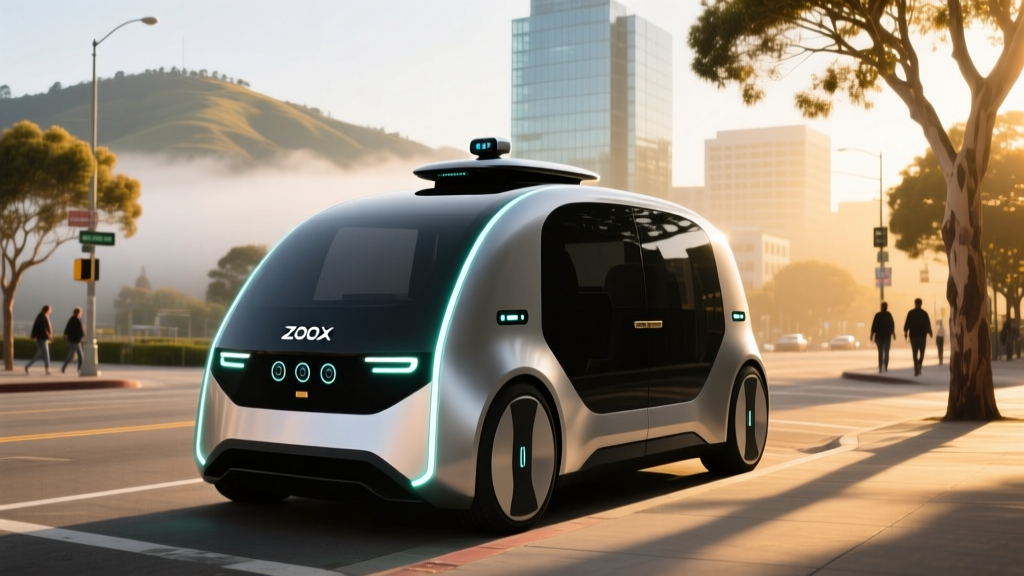
- A Zoox vehicle — the distinctive, carriage-style bidirectional pod — is dispatched to your location.
- You unlock the vehicle via the app, step inside (seating for up to four passengers, facing each other), and the ride begins autonomously.
- Interior screens display the route, speed, and the vehicle's perception of surrounding traffic and pedestrians in real time.
| Service | Typical Fare (3-mile trip) | Surge Pricing | Human Driver? |
|---|---|---|---|
| Zoox | Currently free (limited program) | No | No — Level 4 autonomous |
| Waymo One | $12–$18 | Yes (peak hours) | No — Level 4 autonomous |
| UberX | $14–$22 | Yes | Yes |
| Lyft Standard | $13–$20 | Yes | Yes |
Zoox has not yet announced a public fare structure. Current riders in the limited program ride for free, similar to how Waymo initially launched in Phoenix before introducing per-ride pricing. Industry analysts expect Zoox to introduce fares competitive with Waymo One — likely in the $1.50–$2.50 per mile range once commercial service scales — but Amazon's deep pockets could allow aggressive introductory pricing to build ridership.
Zoox's Technology Stack: Lidar, Cameras, and a Purpose-Built Vehicle
Unlike Waymo, which retrofits existing vehicles (currently the Jaguar I-PACE and Zeekr RT1) with autonomous sensor suites, Zoox designed its robotaxi from the ground up. The result is a compact, symmetrical vehicle with no steering wheel, no pedals, and no designated "front" — it drives equally well in either direction, which simplifies maneuvers like three-point turns and tight urban U-turns.
Sensor and Compute Overview
- Lidar: Multiple solid-state and spinning lidar units providing a 360-degree, high-resolution 3D point cloud of the vehicle's surroundings, effective to roughly 150+ meters.
- Cameras: A surround-camera array covering all angles, used for lane detection, traffic signal recognition, pedestrian classification, and construction-zone interpretation.
- Radar: Forward and rear-facing radar for velocity detection of other vehicles and objects, particularly useful in low-visibility conditions where lidar and cameras degrade.
- Compute: Onboard high-performance computing running Zoox's proprietary perception, prediction, and planning stack, with redundant systems for safety-critical functions.
- HD Mapping: Zoox relies on centimeter-precision pre-mapped routes within its geofence, updated continuously as road conditions change.
This multi-sensor approach contrasts sharply with Tesla's camera-only "Tesla Vision" strategy. Zoox, like Waymo and Cruise (now defunct in SF), uses lidar as a core sensor — a deliberate engineering choice that provides direct depth measurement independent of lighting conditions. The trade-off is cost and complexity, but for a fleet-operated robotaxi where per-unit cost can be amortized across thousands of paid rides, the redundancy is considered essential for Level 4 safety.
The Zoox vehicle is fully electric, with a battery pack estimated in the 70–80 kWh range (exact specs remain unpublished by the company), designed for all-day urban operation with opportunity charging between rides. Its compact footprint — roughly the length of a Toyota Prius but significantly narrower — is optimized for dense city streets and tight curb-side pickups.
Safety Record: What the Data Actually Shows
Safety is the single most scrutinized dimension of robotaxi operations, and for good reason. Following Cruise's October 2023 incident in San Francisco — in which a pedestrian was dragged after being struck by a human-driven vehicle and then run over by a Cruise robotaxi that failed to properly stop — public and regulatory trust in autonomous vehicles took a measurable hit. Cruise subsequently suspended all operations nationwide and never resumed service in SF before GM shut the program down.
Zoox has not been involved in a comparable high-profile incident. However, evaluating robotaxi safety requires looking at structured data, not just headlines.
Zoox Safety & Disengagement Data — Key Points
- Regulatory reporting: California DMV requires all autonomous vehicle permit holders to file annual disengagement reports, documenting every instance where a human safety operator (or remote assistance) had to intervene. Zoox, operating without in-vehicle operators under its Driverless Deployment Permit, reports remote-assistance interventions.
- Miles driven: Zoox has accumulated hundreds of thousands of autonomous miles across its SF and Foster City operations, though exact cumulative figures are not publicly broken out as granularly as Waymo's published mileage data.
- Collision reports: Under California and NHTSA rules, Zoox is required to report all collisions involving its vehicles. As of early 2026, Zoox has reported minor contact incidents (typically low-speed, property-damage-only events common in dense urban driving) but no serious injuries or fatalities attributed to its autonomous operation.
- Comparison context: Waymo, the most data-transparent robotaxi operator, has published peer-reviewed research showing its vehicles are involved in ~85% fewer injury-causing crashes per million miles compared to human-driven benchmarks in comparable urban environments. Zoox has not published an equivalent comparative study.
For the most current and detailed safety data, the National Highway Traffic Safety Administration (NHTSA) maintains a standing general order requiring all automated driving system operators to report crashes. The California DMV's disengagement reports are also publicly available and provide year-over-year intervention-rate trends.
The honest assessment: robotaxi safety data is still maturing. The sample sizes, while growing, remain small relative to the billions of miles driven by human drivers annually. Early indicators suggest Level 4 systems in geofenced urban environments can match or exceed human safety performance in their operational domains — but the data is not yet definitive at scale, and edge cases (construction zones, erratic human behavior, sensor occlusion) remain active engineering challenges.
Current Limitations: Where Zoox Cannot Go
Level 4 autonomy is powerful but bounded. Understanding these constraints is essential for anyone planning to rely on a robotaxi for daily transportation.
- Geofence boundaries: Zoox will not pick up or drop off outside its mapped operational zone. If your destination is even one block beyond the geofence, the app will not allow the request.
- Weather constraints: Heavy rain, fog, and any snow or ice conditions can trigger operational pauses. Lidar performance degrades in heavy precipitation, and the system is designed to pull over safely rather than operate beyond its validated ODD.
- Construction zones: While Zoox can handle minor, temporary lane shifts, major unmapped construction zones with altered lane markings or temporary signals may cause the vehicle to stop and request remote assistance, adding time to your trip.
- No highway operation: Zoox is optimized for urban streets at speeds up to approximately 35–45 mph. It does not operate on freeways or highways.
- Limited rider access: The service is not yet open to the general public on demand. You must be accepted into the rider program, and waitlist times vary.
- No stops or multi-destination trips: Unlike Uber or Lyft, you cannot add a stop (e.g., pick up a friend or grab coffee) mid-route. The trip is point-A to point-B only.
- Accessibility: While the Zoox vehicle is designed with a low floor and wide doors, wheelchair-accessible configurations and ADA-specific accommodations are still being validated and are not yet universally available.
These limitations are not unique to Zoox. Waymo operates under similar geofence and weather constraints, though its longer operational history and larger fleet give it somewhat broader coverage within its active cities.
The Regulatory Landscape: Who Approves Robotaxi Operations?
Robotaxi deployment in the United States is governed by a patchwork of state and federal regulations, with no single national framework.
In California, three agencies share oversight:
- California DMV: Issues testing permits and collects disengagement and collision data. Zoox holds a Driverless Testing Permit (no in-vehicle operator required).
- CPUC (California Public Utilities Commission): Issues deployment permits that authorize charging fares or offering rides to the public. Zoox's Driverless Deployment Permit from the CPUC is what allows it to carry passengers commercially.
- NHTSA (federal): Sets vehicle safety standards (FMVSS) and investigates safety defects. Zoox received a notable NHTSA exemption in 2024 allowing its purpose-built vehicle — which lacks a steering wheel, mirrors, and other traditional controls — to operate on public roads despite not meeting certain FMVSS requirements designed for human-driven vehicles.
Outside California, the regulatory picture varies significantly. Arizona (where Waymo first launched) has a comparatively permissive framework. Nevada requires separate state-level permitting. Many states have no specific robotaxi legislation at all, effectively blocking deployment by default. Federal legislation that would create a uniform national framework has been proposed repeatedly but has not passed as of 2026.
Zoox vs. Waymo: How SF's Two Robotaxis Compare
| Attribute | Zoox | Waymo One |
|---|---|---|
| SAE Level | Level 4 (geofenced) | Level 4 (geofenced) |
| Vehicle | Purpose-built Zoox pod (bidirectional, no steering wheel) | Jaguar I-PACE / Zeekr RT1 (retrofitted) |
| SF Coverage | ~10 sq mi (SoMa, Mission, Embarcadero) | ~60+ sq mi (most of SF proper) |
| Public Access | Limited rider program (waitlist) | Open to public via Waymo One app |
| Pricing | Free (current program) | $12–$18 typical (3-mi trip) |
| Operating Hours | Limited hours | 24/7 in most SF zones |
| Parent Company | Amazon | Alphabet (Google) |
| Other Cities | Foster City (live); Las Vegas, Atlanta (announced) | Phoenix, Los Angeles (live); Austin, Atlanta (expanding) |
Waymo is the more mature service by nearly every metric — larger fleet, broader coverage, open public access, and years more operational data. Zoox's advantage, long-term, lies in its purpose-built vehicle design, which eliminates the cost and complexity of retrofitting consumer vehicles, and in Amazon's logistics and capital resources. But as of 2026, Waymo is the robotaxi you can actually use today for most SF trips, while Zoox remains a more limited, invitation-based experience.
Frequently Asked Questions
Is Zoox available in SF for anyone to use right now?
Yes, Zoox operates in San Francisco, but access is currently limited to riders accepted into its invitation-based program. It is not yet a fully open, on-demand service like Waymo One or Uber. You can join the waitlist through the Zoox app or website.
How much does a Zoox ride cost compared to Uber or Lyft?
Current Zoox rides in the limited program are free. Once commercial pricing is introduced, industry estimates place fares in the $1.50–$2.50 per mile range, roughly comparable to Waymo One and competitive with UberX and Lyft Standard on similar urban trips. Surge pricing has not been announced.
Is Zoox really self-driving, or is someone watching remotely?
Zoox is a Level 4 autonomous vehicle — there is no human driver in the car, no steering wheel, and no pedals. The vehicle drives itself entirely within its operational geofence. Remote assistance operators can be consulted if the vehicle encounters an ambiguous situation (e.g., an unusual construction zone), but they do not "drive" the vehicle in real time the way a teleoperation joystick might suggest. The vehicle's onboard systems make all immediate driving decisions.
How safe are Zoox robotaxis compared to human drivers?
Zoox has not published a comprehensive comparative safety study like Waymo's peer-reviewed research showing ~85% fewer injury-causing crashes per million miles. Zoox's publicly reported incidents to date have been minor, low-speed events with no serious injuries. The overall safety case for robotaxis is promising but still being validated at scale — cumulative autonomous miles remain a fraction of human-driven miles nationally.
Can Zoox drive on highways or in the rain?
No on both counts, currently. Zoox operates on urban streets within its geofence at speeds up to roughly 35–45 mph and does not enter freeways. Heavy rain or fog can trigger operational pauses, as precipitation degrades lidar and camera performance. The vehicle is designed to stop safely rather than operate outside its validated conditions.
What cities will Zoox expand to next?
Zoox has announced plans for Las Vegas and Atlanta, and has been testing in Foster City, CA (San Mateo County). No firm public launch dates have been confirmed for these markets as of 2026. Expansion depends on regulatory approvals in each jurisdiction and on Zoox's fleet production timeline.