The Short Answer: Tesla's Robotaxi Status in Arizona (2026)
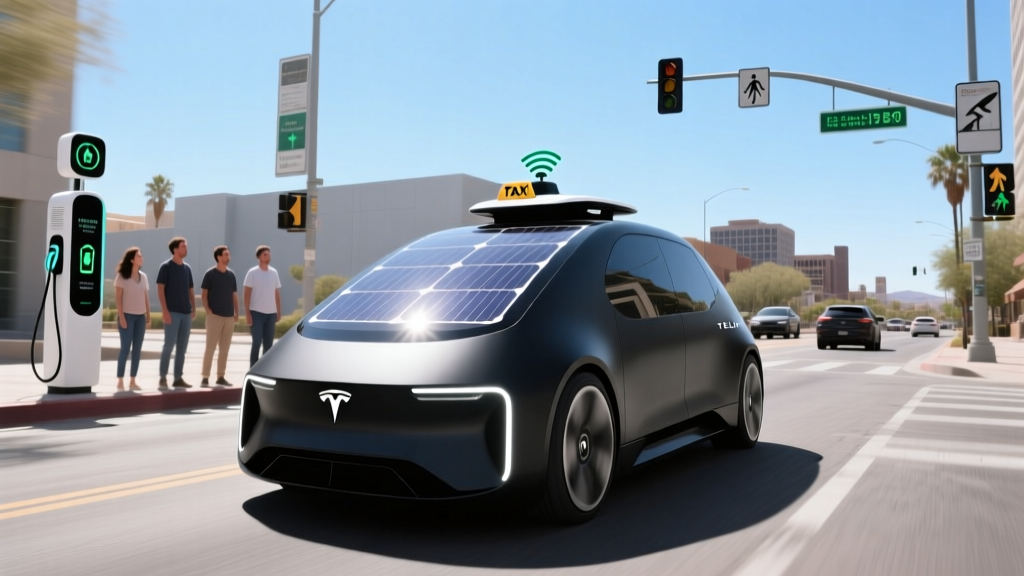
As of early 2026, Tesla does not operate a driverless robotaxi service in Arizona — or anywhere else. Despite the October 2024 "We, Robot" event unveiling the Cybercab concept and repeated executive promises of unsupervised full self-driving, no Tesla vehicle has received regulatory approval to carry paying passengers without a human driver present. Arizona, one of the most permissive states for autonomous vehicle (AV) testing, has not granted Tesla a driverless deployment permit.
This article breaks down exactly where Tesla's autonomous technology stands, what Arizona's regulatory framework requires, how Tesla's approach compares to Waymo's proven Level 4 service, and what buyers and riders should actually expect.
SAE Automation Levels — What They Actually Mean
| Level | Name | Who Drives? | Example |
|---|---|---|---|
| Level 2 | Driver Assistance | Human (always) | Tesla Autopilot, FSD (Supervised), BlueCruise |
| Level 3 | Conditional Automation | System in limited conditions; human on standby | Mercedes Drive Pilot (selected markets) |
| Level 4 | High Automation | System (within geofence); no human needed | Waymo One, Zoox |
| Level 5 | Full Automation | System (everywhere, all conditions) | Does not exist commercially |
Critical distinction: Tesla's FSD (Supervised) — even at its most advanced 2026 version — remains SAE Level 2 per NHTSA classification. The driver must remain engaged, hands available, eyes on the road. A Level 4 robotaxi like Waymo operates with no driver present, no steering wheel, within a defined operational design domain (ODD).
Where Can You Actually Ride a Robotaxi Right Now?
The only scaled, commercial, driverless robotaxi service available to the public in the U.S. is Waymo One. Tesla has no equivalent offering.
| Service | City | Availability | SAE Level | Driver Present? |
|---|---|---|---|---|
| Waymo One | Phoenix, AZ (metro-wide) | 24/7, open to public | Level 4 | No |
| Waymo One | San Francisco, CA | 24/7, open to public | Level 4 | No |
| Waymo One | Los Angeles, CA | Open to public (expanding zones) | Level 4 | No |
| Waymo One | Austin, TX | Launched/launching 2025-2026 | Level 4 | No |
| Tesla "Robotaxi" | None | Not operational | N/A | N/A |
| Tesla FSD (Supervised) | Anywhere (personal vehicle) | Owner-operated only | Level 2 | Yes — required |
If you are in Phoenix and want a driverless ride today, you download the Waymo One app, request a ride, and a Jaguar I-PACE-based vehicle (being supplemented by the Hyundai Ioniq 5-based 6th-gen vehicle) arrives with an empty driver's seat. There is no equivalent Tesla app, no Tesla ride-hailing service, and no Tesla vehicle approved for unsupervised commercial passenger transport in any state.
Arizona's AV Regulatory Framework: Why Approval Isn't Automatic
Arizona has been the most AV-friendly state in the country since Governor Doug Ducey's 2015 executive order opened the door to autonomous testing. Current law (ARS §28-9601 et seq.) requires:
- Testing permit: Companies must register with the Arizona Department of Transportation (ADOT) and provide proof of insurance ($5M minimum for driverless operations).
- Driverless deployment: To operate without a safety driver, the AV must demonstrate the ability to reach a "minimal risk condition" (safe stop) if systems fail, and the company must submit a law enforcement interaction plan.
- No pre-approval of technology: Arizona does not certify specific sensor stacks or software. Instead, it relies on self-certification by the operator plus compliance with federal motor vehicle safety standards (FMVSS) — or an NHTSA exemption if the vehicle lacks a steering wheel.
- Incident reporting: Any collision involving an AV must be reported to ADOT within a defined window.
Waymo met these requirements and has operated driverless in the Phoenix metro (Chandler, Tempe, Mesa, Scottsdale, and expanded Phoenix proper) since 2020. Tesla has not applied for or received a driverless deployment permit in Arizona. Tesla vehicles can be tested on Arizona roads under standard registration — any Tesla owner can drive with FSD (Supervised) enabled — but that is fundamentally different from operating a commercial robotaxi service.
The Cybercab, as unveiled, lacks a steering wheel and pedals. To deploy it on public roads, Tesla would need either FMVSS compliance or an NHTSA exemption petition — a process that takes months to years and requires extensive safety documentation. As of 2026, no such exemption has been publicly granted for the Cybercab.
Tesla's Technology Stack: Camera-Only vs. the Lidar Consensus
How Tesla Sees the World
Tesla's approach is philosophically and technically distinct from every other robotaxi operator:
- Sensors: 8 cameras (Tesla Vision). No lidar. No radar (removed from Model 3/Y in 2021-2022, though radar returned to some refreshed models for redundancy).
- Compute: HW4 (AI4) computer, ~300+ TOPS inference capability.
- Software: End-to-end neural network (v13/v14 FSD stack as of 2026), trained on billions of miles of fleet driving data.
- Mapping: No HD lidar maps; relies on real-time perception plus standard navigation maps.
- Geofencing: None — FSD (Supervised) is designed to work on any road, which is both its ambition and its regulatory challenge.
The industry consensus (Waymo, Cruise/Zoox, Aurora, Motional): Camera + lidar + radar fusion, HD-mapped geofenced operational design domains, and remote assistance infrastructure. Lidar provides depth perception independent of lighting; radar handles adverse weather; HD maps constrain the problem space.
| Feature | Tesla FSD (Supervised) | Waymo Driver (6th Gen) |
|---|---|---|
| Camera count | 8 | 29+ |
| Lidar | None | 5+ (custom) |
| Radar | Limited/none (model-dependent) | 6 (4D imaging) |
| Audio sensors | No | Yes (sirens, horns) |
| HD Mapping | No | Yes (geofenced ODD) |
| Remote assistance | None (driver is the fallback) | Yes (fleet operations center) |
| Operational design domain | Any road (Level 2) | Mapped urban zones (Level 4) |
Tesla's camera-only approach has improved dramatically — FSD v13 and v14 show significantly smoother, more human-like behavior than earlier versions. But camera-only systems remain inherently challenged in low-contrast conditions (sun glare, heavy rain, fog, nighttime construction zones) where lidar's active illumination provides reliable depth data. This is not theoretical: it is why every other operator pursuing driverless deployment uses lidar.
How Safe Are Robotaxis? Real Data, Not Marketing
Waymo Safety Record (Published Data)
Waymo has published peer-reviewed safety data covering over 50 million fully driverless miles (as of mid-2025, continuing to grow). Key findings from their NHTSA-submitted reports and independent analyses:
- Injury-causing crash rate: ~85% lower than human benchmarks in comparable urban environments (per Waymo's actuarial studies, methodology debated but directionally consistent).
- Police-reported crash rate: Lower than human drivers, though robotaxis are disproportionately involved in low-speed rear-end and sideswipe incidents due to conservative stopping behavior.
- Disengagement rate: Not directly comparable to Tesla's California DMV disengagement reports (Tesla does not participate in California's AV testing program in the same reporting framework).
Tesla FSD Safety Data: What We Know
Tesla publishes a quarterly "Vehicle Safety Report" claiming ~1 accident per ~4-5 million miles driven with Autopilot/FSD engaged, versus ~1 per ~1.5 million miles without. However, these reports have significant methodological limitations:
- No independent verification: Data is self-reported and not audited.
- Engagement bias: Autopilot/FSD is predominantly used on highways (lower crash-risk environment) rather than complex urban streets.
- NHTSA Standing General Order (SGO): Tesla has reported hundreds of crashes involving Autopilot/FSD under NHTSA's mandatory reporting requirement — far more than any other manufacturer, reflecting both fleet size and scrutiny.
- NHTSA investigations: Multiple ongoing investigations into Autopilot/FSD behavior around emergency vehicles, construction zones, and driver monitoring adequacy.
For context on regulatory scrutiny, see NHTSA's ADS investigation timeline.
| Metric | Waymo (Driverless, Level 4) | Tesla FSD (Supervised, Level 2) |
|---|---|---|
| Verified driverless miles | 50M+ (publicly documented) | 0 (always supervised) |
| Third-party safety audit | Yes (published studies) | No (self-reported) |
| NHTSA SGO crash reports | Low (relative to miles) | High (absolute; reflects scale + scrutiny) |
| Fatalities during driverless ops | 0 (as of early 2026) | N/A (no driverless ops) |
Pricing: Robotaxi vs. Rideshare vs. Owning a Tesla
Because Tesla's robotaxi service does not exist, there is no Tesla robotaxi pricing to compare. However, here is how Waymo One pricing stacks up against Uber/Lyft, and how owning an FSD-equipped Tesla compares economically:
| Service | Typical 5-Mile Fare (Phoenix) | Per-Mile Cost | Surge Pricing? | Availability |
|---|---|---|---|---|
| Waymo One | $12–$18 | ~$2.00–$3.00/mi | Rare (no human driver supply constraint) | Phoenix metro |
| UberX (Phoenix) | $10–$20 | ~$1.50–$3.50/mi | Yes, frequent | Everywhere |
| Lyft (Phoenix) | $10–$19 | ~$1.50–$3.30/mi | Yes | Everywhere |
Ownership comparison: A 2026 Tesla Model 3 Long Range starts at approximately $42,490 MSRP. Add the $8,000 FSD (Supervised) package (or $99/month subscription). Over 5 years and 75,000 miles, total cost of ownership including depreciation, insurance (typically 15-25% higher for Tesla), electricity (~$0.04/mile at $0.14/kWh), and maintenance runs roughly $45,000–$55,000 depending on financing. That is approximately $0.60–$0.73 per mile all-in. Robotaxis make economic sense for low-mileage urban users; ownership wins for high-mileage commuters.
Current Limitations: What Tesla's Robotaxi Cannot Do (Even When It Arrives)
Hard Constraints of Camera-Only, Unmapped Autonomy
- Weather degradation: Heavy rain, snow, fog, and dust significantly impair camera-only perception. Waymo's lidar-equipped vehicles handle moderate rain but also pull over in severe conditions. Tesla would face the same or worse limitations.
- Nighttime construction zones: Temporary lane shifts, orange barrels, and uneven lighting remain edge cases for all AVs but are harder without lidar depth confirmation.
- Unmapped/road-change scenarios: Without HD maps, the system must interpret novel road configurations in real time — higher cognitive load on the neural network, higher failure probability.
- Regulatory geofencing: Even if Tesla achieves Level 4 capability, regulators will likely restrict initial deployment to geofenced, well-mapped areas — defeating the "anywhere" promise.
- No remote assistance infrastructure: Waymo employs fleet response teams who can remotely assess situations (not remote-drive, but advise). Tesla has no public equivalent.
- FMVSS compliance: The Cybercab's steering-wheel-free design requires an NHTSA exemption — not guaranteed, and historically slow to process.
- Insurance/liability framework: Arizona requires $5M insurance for driverless ops. Tesla's current insurance products are designed for human-supervised driving.
Is This Truly Self-Driving or Driver-Assist?
If you are reading this as a Tesla owner or prospective buyer: Every Tesla vehicle delivered to date, including all 2026 models with FSD (Supervised), is an SAE Level 2 driver-assistance system. You are the driver. You are liable. You must monitor the road. NHTSA, the IIHS, and Tesla's own owner's manual all state this explicitly.
Tesla's long-term vision — a fleet of unsupervised Cybercabs operating as a ride-hailing network — would require Level 4 capability, regulatory approval in each jurisdiction, FMVSS compliance or exemption, commercial insurance, and public safety validation. None of these milestones have been publicly achieved as of 2026.
Waymo took approximately 15 years and billions of dollars in investment (from Google/Alphabet) to reach its current Level 4 deployment across four cities. Tesla's timeline promises have consistently slipped: "next year" for full autonomy has been stated annually since 2016.
Frequently Asked Questions
Has Tesla received any robotaxi approval in Arizona?
No. Arizona requires a driverless deployment permit for commercial robotaxi operations. Tesla has not applied for or received this permit. Tesla owners can use FSD (Supervised) on Arizona roads, but this is Level 2 driver-assist, not a robotaxi service.
When will Tesla's robotaxi actually launch?
Tesla has announced the Cybercab concept and targeted a production start, but no firm date for regulatory-approved, driverless commercial operations has been confirmed. NHTSA exemption approval, state-level permits, and safety validation are all prerequisites with no guaranteed timeline.
Can I hail a driverless Tesla in Phoenix today?
No. There is no Tesla ride-hailing app, no Tesla robotaxi fleet, and no regulatory approval for driverless Tesla operations. The only driverless ride-hailing service available in Phoenix is Waymo One.
Is Tesla FSD (Supervised) safe to use without paying attention?
No. FSD (Supervised) is an SAE Level 2 system. The driver must remain engaged, hands available, and eyes on the road at all times. NHTSA has investigated multiple crashes involving inattentive drivers using Autopilot/FSD. You are legally and practically the driver.
Why doesn't Tesla use lidar like Waymo?
Elon Musk has publicly stated that lidar is a "crutch" and that a vision-only approach, modeled on human driving, will ultimately scale better and cheaper. The engineering tradeoff is that camera-only systems lack active depth sensing, making them more vulnerable to lighting and weather conditions. Every other Level 4 robotaxi operator uses lidar.
How does Waymo's Phoenix service compare in cost to Uber?
Waymo One fares in Phoenix are generally comparable to UberX/Lyft for similar distances — typically $12–$18 for a 5-mile trip. Waymo pricing rarely surges because there is no human driver supply constraint, though wait times can be longer in low-density areas at the edge of the service zone.