The Short Answer: Waymo's Current Robotaxi Fleet
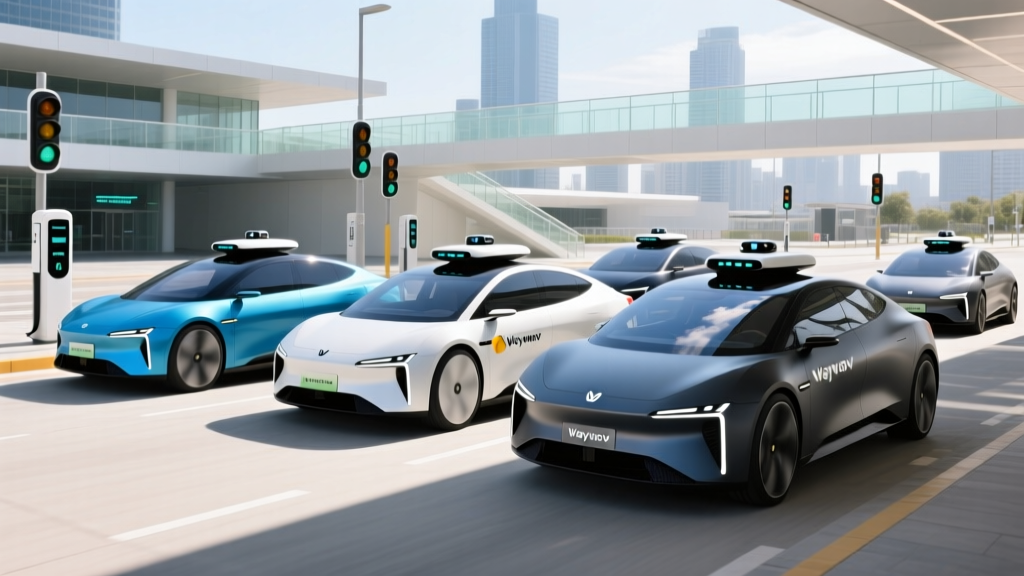
If you've seen a white SUV cruising without a driver through Phoenix or San Francisco, you've likely spotted a Waymo vehicle. As of 2026, Waymo operates two primary vehicle platforms across its commercial service, branded as Waymo One:
- Jaguar I-PACE (5th-generation hardware) — The backbone of the fleet since 2022, a fully electric luxury crossover retrofitted with Waymo's custom sensor suite.
- Zeekr RT (6th-generation hardware) — The purpose-built robotaxi introduced in late 2024 and scaled through 2025–2026, designed from the ground up for driverless ride-hailing.
Waymo previously tested Chrysler Pacifica Hybrid minivans (2017–2022), but those have been fully retired from commercial service. The current fleet is 100% battery-electric.
Jaguar I-PACE: The Workhorse of the Waymo Fleet
The Jaguar I-PACE was Waymo's first mass-produced integration partner, and the 5th-generation Waymo Driver hardware package was engineered around its chassis. Here's what matters for understanding this vehicle in robotaxi service:
| Spec | Value |
|---|---|
| Powertrain | Dual-motor AWD, BEV |
| Battery (usable) | 84.7 kWh, NMC lithium-ion |
| EPA Range (stock) | 246 miles |
| Real-World Range (robotaxi ops) | ~160–190 miles (sensor/compute draw, HVAC, stop-and-go) |
| Peak DC Fast Charge | 100 kW (10–80% in ~45 min) |
| Level 2 AC Charge | 11 kW (~7 hours 0–100%) |
| 0–60 mph (stock) | 4.5 seconds |
| Horsepower | 394 hp |
| Cargo Volume | 25.3 cu ft (rear seats up) |
Why the I-PACE? Jaguar's EV architecture offered a flat battery floor, predictable thermal management, and a premium cabin that riders associate with quality. However, the I-PACE was never designed as a robotaxi — Waymo had to engineer significant aftermarket modifications to mount lidar units on the roof, integrate compute hardware in the cargo area, and wire redundant steering and braking actuators.
Zeekr RT: The Purpose-Built Robotaxi (6th-Gen Hardware)
The Zeekr RT represents a fundamental shift in Waymo's approach. Built by Geely's Zeekr brand, this vehicle was co-engineered with Waymo from day one as a driverless ride-hailing platform — no steering wheel, no pedals, no driver's seat.
| Spec | Value |
|---|---|
| Powertrain | Rear-motor RWD, BEV |
| Battery (usable) | ~76 kWh, NMC (estimated) |
| EPA Range | ~220 miles (estimated, pending final certification) |
| Peak DC Fast Charge | ~150 kW (estimated) |
| Seating | 4 passengers (no driver position) |
| Doors | Power sliding (automatic open/close) |
| Interior | Flat floor, lounge-style seating, center console screen |
The 6th-generation Waymo Driver hardware suite integrated into the Zeekr RT is notably cheaper and more compact than the 5th-gen system. Waymo has stated that each successive hardware generation has reduced sensor costs by roughly 50%, and the 6th-gen system uses fewer custom components in favor of scaled automotive-grade parts. The lidar units are lower-profile, cameras use higher-resolution sensors, and the compute platform draws less power — all contributing to better energy efficiency and easier maintenance.
SAE Automation Level: This Is Level 4, Not Driver-Assist
| Level | Name | Who Drives? | Examples |
|---|---|---|---|
| Level 0 | No Automation | Human | Traditional cars |
| Level 1 | Driver Assistance | Human (one assist) | Adaptive cruise OR lane-keep |
| Level 2 | Partial Automation | Human (must supervise) | Tesla Autopilot, BlueCruise, Super Cruise |
| Level 3 | Conditional Automation | System (in specific conditions, human on standby) | Mercedes DRIVE PILOT (limited markets) |
| Level 4 | High Automation | System (geofenced, no driver needed) | Waymo One, Zoox |
| Level 5 | Full Automation | System (everywhere, all conditions) | Does not yet exist commercially |
The distinction is critical. When you ride in a Waymo, there is no steering wheel, no one in the front seat, and no expectation that you will intervene. The vehicle is the driver. With Level 2 systems like Tesla's FSD (Supervised), the human in the driver's seat is legally and operationally responsible at all times.
Where Can You Ride a Waymo Right Now?
| City | Status | Service Area Notes |
|---|---|---|
| Phoenix, AZ (Metro) | Fully operational | Largest coverage area — Chandler, Tempe, Mesa, Scottsdale, Phoenix Sky Harbor Airport. ~600+ sq mi |
| San Francisco, CA | Fully operational | City-wide coverage including downtown, Mission, Sunset, Richmond districts. Expanded to SFO airport service. |
| Los Angeles, CA | Fully operational | Santa Monica, Hollywood, Downtown LA, Beverly Hills, West Hollywood, Mid-City. Coverage expanding. |
| Austin, TX | Operational (scaled) | Initial commercial service launched, covering central Austin and select corridors. |
Waymo has announced plans to expand to additional cities, but as of this writing, the four markets above are where you can actually request a ride today. Service areas are geofenced — you cannot hail a Waymo outside the mapped operational zone, and the vehicle will not drive into unmapped territory.
Technology Stack: Lidar-First, Multi-Sensor Fusion
5th-Gen (Jaguar I-PACE) Sensor Suite:
- Lidar: Custom-designed spinning roof-mounted unit plus short-range lidar at corners — provides precise 3D point-cloud mapping up to ~500 meters
- Cameras: 29 cameras covering 360° around the vehicle, including long-range forward-facing units
- Radar: 6 automotive radar units for velocity detection and adverse-weather performance
- External microphones: Detect sirens from emergency vehicles
- Compute: Custom Waymo-designed compute platform in the rear cargo area, drawing ~2–3 kW continuous
6th-Gen (Zeekr RT) Sensor Suite:
- Lidar: Lower-profile integrated units (fewer total units, improved range and resolution)
- Cameras: Higher-resolution sensors with improved low-light performance, integrated into the body rather than bolted on
- Radar: Next-gen imaging radar with better object classification
- Compute: More power-efficient platform, reduced cooling requirements
Geofencing and HD Mapping: Waymo vehicles operate on pre-mapped routes using high-definition maps that include lane geometry, traffic signal positions, speed limits, and curb data. The vehicle continuously localizes itself against this map using lidar and camera data. If the map is outdated (e.g., construction zone not reflected), the vehicle can detect discrepancies and either navigate cautiously or pull over safely.
Safety Record: What the Data Shows
Key safety context:
- Contact rates: Waymo's police-reported crash rate per million miles is lower than human drivers in the same cities, but the comparison requires nuance — Waymo operates in geofenced, mapped urban areas at moderate speeds, not highways or rural roads.
- Incident types: Most incidents involving Waymo vehicles have been low-speed contacts (parking lots, stop-and-go traffic) where other road users struck the Waymo vehicle, not the reverse.
- Safe-stop behavior: When the system encounters uncertainty (e.g., an unmapped construction zone, sensor degradation, or a scenario outside its training), it executes a controlled stop rather than guessing. This can cause traffic disruption but avoids collisions.
- NHTSA oversight: All robotaxi operators must file Standing General Orders (SGOs) reporting crashes involving ADS-equipped vehicles. Waymo's SGO filings are publicly accessible via NHTSA's crash reporting portal.
Pricing: Waymo vs. Uber and Lyft
| Service | Short Trip (~3 mi) | Medium Trip (~7 mi) | Airport Run (~15 mi) | Surge Pricing? |
|---|---|---|---|---|
| Waymo One | $10–$15 | $18–$28 | $35–$50 | No dynamic surge |
| UberX | $10–$18 | $17–$30 | $35–$55 | Yes (1.2x–3x+) |
| Lyft Standard | $9–$17 | $16–$28 | $33–$52 | Yes (Prime Time) |
Waymo's pricing is broadly competitive with Uber and Lyft for standard rides, but the key advantage is no surge pricing. During high-demand periods when Uber and Lyft prices spike, Waymo holds steady — though wait times may increase if the fleet is saturated. Waymo does not offer a tip screen, since there's no driver. The fare is the fare.
Wait times vary by city and time of day. In Phoenix, Waymo typically arrives in 3–7 minutes. In San Francisco, expect 4–10 minutes during peak hours, with longer waits at the edges of the service area.
Current Limitations: What Waymo Cannot Do
- Weather constraints: Heavy rain, fog, and snow degrade lidar and camera performance. In San Francisco, Waymo service continues in light-to-moderate rain but may reduce fleet availability during heavy atmospheric river events. Phoenix rarely has weather issues. Waymo does not currently operate in cities with frequent heavy snow.
- Geofence boundaries: You cannot travel outside the mapped service area. A trip from San Francisco to Oakland, for example, is not possible — the vehicle will not cross the Bay Bridge. Similarly, in LA, you cannot take a Waymo from Santa Monica to Pasadena if that corridor is outside the current ODD.
- Highway driving: Waymo vehicles use surface streets within their geofence. They may use limited-access roads within the mapped area but are not designed for long-distance highway travel between cities.
- Construction zones: Major, unmapped road construction can cause the vehicle to stop and wait for remote assistance or reroute. Waymo's remote guidance team can intervene to provide routing instructions, but they do not teleoperate the vehicle (i.e., they don't steer or brake remotely).
- Accessibility: The Jaguar I-PACE requires passengers to enter a standard SUV-height vehicle. The Zeekr RT's flat floor and sliding doors improve accessibility, but neither platform currently accommodates wheelchair passengers without a ramp or lift, which remains a gap versus ADA-compliant paratransit and some rideshare WAV options.
- No stops or errands: You cannot ask a Waymo to stop at a drive-through, wait while you pick up a package, or make multiple stops on a single trip. It's point A to point B.
Regulatory Landscape: Who Approves Robotaxi Operations?
Robotaxi operations in the United States require approval from multiple regulatory bodies:
- State Public Utilities Commissions / DMVs: In California, the California Public Utilities Commission (CPUC) issues permits for commercial robotaxi service. The California DMV separately issues testing and deployment permits. In Arizona, regulation is lighter — the state has broadly permitted autonomous vehicle operations since 2018 via executive order.
- NHTSA (Federal): The National Highway Traffic Safety Administration sets Federal Motor Vehicle Safety Standards (FMVSS) and requires crash reporting via Standing General Orders. NHTSA can investigate and issue recalls for ADS-equipped vehicles.
- Local municipalities: Cities can influence operations through permitting for airport access, curb management, and coordination with local emergency services.
The regulatory patchwork means that expansion to a new city requires navigating a unique approval process in each jurisdiction. This is one reason Waymo's geographic expansion has been deliberate rather than rapid.
Frequently Asked Questions
Can I buy a car with the same technology as Waymo?
No. Waymo's hardware and software are proprietary and not available for consumer purchase. The closest consumer-available systems (Tesla FSD Supervised, GM Super Cruise, Ford BlueCruise) are SAE Level 2 driver-assist features that require an attentive human driver at all times. Waymo's Level 4 system is only available as a ride-hailing service.
Does Waymo use Tesla vehicles?
No. Waymo has never used Tesla vehicles in its fleet. Waymo's sensor-first approach (lidar + radar + cameras) is fundamentally different from Tesla's camera-only (vision-based) approach to autonomy. The two companies represent competing philosophies on how to achieve self-driving capability.
How many cars are in Waymo's fleet?
Waymo does not publish exact fleet counts, but industry estimates place the total active fleet at over 1,000 vehicles across all operational cities as of early 2026, with the majority being Jaguar I-PACEs and a growing number of Zeekr RTs. The company has indicated plans to scale to thousands of vehicles as the Zeekr RT platform ramps up.
What happens if a Waymo vehicle gets into an accident?
Waymo vehicles carry commercial insurance. If an incident occurs, the vehicle's sensors record comprehensive data (video, lidar, vehicle telemetry). Waymo's safety team reviews the event, and reports are filed with NHTSA under Standing General Order requirements. Passengers can contact Waymo support via the in-app help button or the in-vehicle screen.
Is Waymo safer than a human driver?
Based on available data, Waymo vehicles have lower at-fault crash rates per million miles than human drivers in comparable urban environments. However, this comparison is imperfect — Waymo operates in geofenced, well-mapped areas at moderate speeds and does not drive on highways or in severe weather. The data supports the conclusion that Waymo is safer within its operational domain, but that domain is narrower than where human drivers operate.