The Great Robotaxi Schism: Three Paths to Autonomy
The race to dominate the autonomous ride-hailing market has evolved from a simple engineering challenge into a philosophical battleground. As the industry transitions from localized pilot programs to commercialized, city-wide deployments, three distinct technology approaches have emerged as the frontrunners. Waymo, Zoox, and Tesla are not merely building competing products; they are betting on fundamentally different visions of how machines should perceive, interpret, and navigate the physical world. Understanding these divergent technology stacks is critical for consumers, investors, and urban planners looking to anticipate the future trends of autonomous transportation.
While Waymo relies on high-definition mapping and a multi-modal sensor suite, Zoox is entirely rethinking the physical architecture of the automobile for dense urban cores. Meanwhile, Tesla is leveraging its massive consumer fleet to train end-to-end neural networks using a pure vision approach. This comprehensive analysis breaks down the technical nuances, scalability challenges, and future outlooks of the Waymo, Zoox, and Tesla robotaxi paradigms.
Waymo: LiDAR, HD Maps, and the Geofenced Fortress
Alphabet’s Waymo has long been considered the industry benchmark for safety and reliability, largely due to its conservative, hardware-heavy approach to autonomy. The core of the Waymo Driver—now in its 6th generation—relies on a sophisticated sensor fusion stack that includes custom-built 360-degree LiDAR, high-resolution cameras, and radar. LiDAR (Light Detection and Ranging) provides a mathematically precise, real-time 3D point cloud of the vehicle's surroundings, allowing the system to measure exact distances to obstacles regardless of lighting conditions or glare.
However, Waymo’s true secret weapon is its reliance on High-Definition (HD) maps. Before a Waymo vehicle can operate in a new city, the company must meticulously map the environment down to the centimeter, encoding lane widths, curb heights, and traffic light coordinates. This creates a highly secure Operational Design Domain (ODD), often referred to as a geofence. Within this geofence, the vehicle's AI acts more as a hyper-vigilant executor of known routes rather than an explorer of the unknown.
Future Outlook: Waymo's approach offers unparalleled safety in known environments, making it the preferred partner for traditional ride-hailing networks like Uber. However, the reliance on HD maps creates a scalability bottleneck. Expanding to a new city requires months of mapping and regulatory approval, limiting Waymo's ability to rapidly scale globally. The future trend for Waymo will likely involve automating the HD mapping process and slowly expanding geofences into suburban corridors, but cross-country, point-to-point autonomy remains outside its current architectural scope.
Zoox: Rethinking the Carriage for the Autonomous Era
Backed by Amazon, Zoox has taken a radically different approach by questioning the very form factor of the automobile. While Waymo and Tesla retrofit autonomy into traditional car shapes, Zoox engineered a purpose-built autonomous carriage from the ground up. Zoox's purpose-built autonomous carriage features a symmetrical, bidirectional design, eliminating the traditional 'front' and 'back' of the vehicle. This allows for seamless curb-to-curb drop-offs in dense urban environments without the need for complex multi-point turns.
Technologically, Zoox utilizes a robust sensor fusion approach similar to Waymo, integrating LiDAR, radar, and cameras. However, its vehicle architecture introduces unprecedented maneuverability. The carriage features independent four-wheel steering, allowing it to 'crab' sideways out of tight parking spots or navigate around double-parked delivery trucks with ease. Furthermore, Zoox successfully petitioned the National Highway Traffic Safety Administration (NHTSA) for exemptions to several Federal Motor Vehicle Safety Standards (FMVSS), allowing them to remove steering wheels and pedals while implementing over 100 custom safety innovations, such as a unique airbag system designed for a face-to-face seating layout.
Future Outlook: Zoox is optimizing for the 'last-mile' urban transit problem rather than highway cruising. Its future relies heavily on securing manufacturing partnerships to scale the production of its custom carriage. Expect Zoox to dominate high-density, low-speed urban corridors and airport campuses, functioning more like an automated people-mover than a traditional highway-capable taxi.
Tesla: Pure Vision, End-to-End AI, and the Scalability Play
Tesla’s approach to autonomy is the most polarizing and ambitious in the industry. Rejecting LiDAR and HD maps as 'crutches,' Tesla relies exclusively on a pure vision camera suite paired with its custom silicon (Hardware 3.0 and the upcoming AI5). The philosophical core of Tesla's strategy is that if human beings can navigate the world using only biological cameras (eyes) and a neural network (the brain), an artificial intelligence should be able to do the same using optical cameras and artificial neural networks.
With the release of Full Self-Driving (FSD) v12, Tesla made a monumental architectural shift to 'end-to-end' neural networks. Instead of relying on hundreds of thousands of lines of C++ heuristic code written by engineers to dictate rules (e.g., 'if red light, then stop'), FSD v12 ingests millions of video clips of human driving and outputs steering and acceleration commands directly. Tesla's AI and neural network training infrastructure processes this vast 'shadow mode' data gathered from millions of consumer vehicles on the road, giving Tesla an insurmountable lead in edge-case data collection.
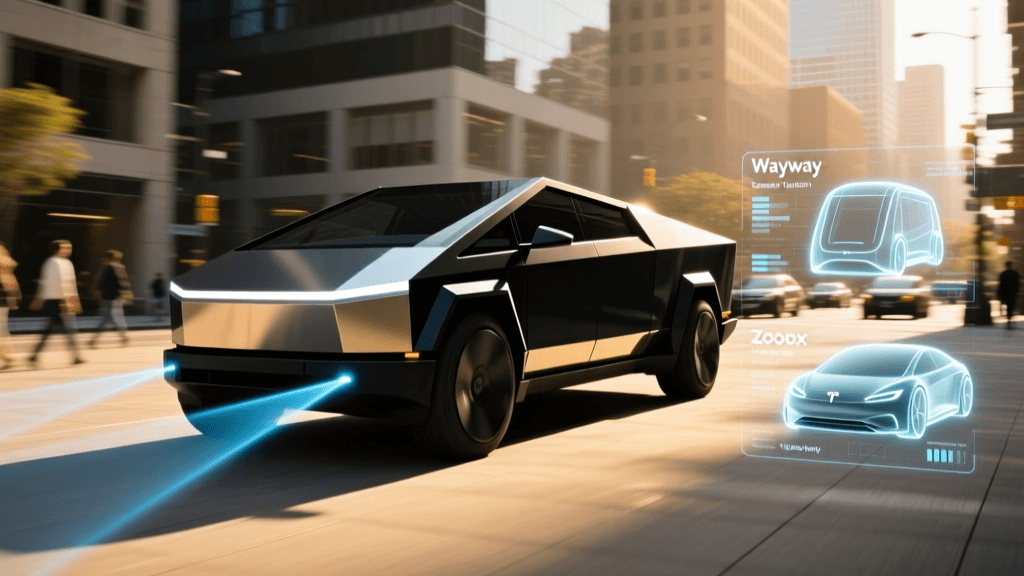
Future Outlook: Tesla’s 'Cybercab' concept envisions a steering-wheel-free robotaxi that can operate anywhere, on any road, without prior mapping. The scalability is virtually infinite. The primary hurdle is regulatory: proving to agencies like NHTSA that a vision-only, probabilistic neural network is statistically safer than a deterministic, LiDAR-backed system. If Tesla solves the 'long tail' of edge cases, its robotaxi network could achieve global scale overnight via over-the-air software updates.
Head-to-Head: Technology & Strategy Comparison
| Feature | Waymo | Zoox | Tesla (FSD / Cybercab) |
|---|---|---|---|
| Primary Sensors | LiDAR, Radar, Cameras | LiDAR, Radar, Cameras | Cameras Only (Pure Vision) |
| Mapping Reliance | Heavy (Centimeter HD Maps) | Moderate (Semantic Urban Maps) | None (Real-time Vision Only) |
| Vehicle Platform | Retrofitted (Zeekr, Jaguar I-PACE) | Purpose-Built Carriage | Retrofitted & Cybercab Concept |
| AI Architecture | Modular Perception & Planning | Modular Perception & Planning | End-to-End Neural Networks |
| Scalability | Low (City-by-City Geofencing) | Medium (Urban Core Focus) | High (Global OTA Deployment) |
| Current Status | Commercial Ops in SF, Phoenix, LA | Employee Testing & Limited Public | Supervised Consumer Beta |
Future Trends & Industry Outlook: Navigating the Decade Ahead
As we look toward the latter half of the decade, the robotaxi industry will be defined by the friction between technological capability and regulatory approval. The 'generalizability' of Tesla's vision system will constantly clash with the 'provable safety' of Waymo's geofenced LiDAR approach. Regulators, burdened by the complexity of validating black-box neural networks, are likely to favor modular, explainable systems in the short term, giving Waymo and Zoox a distinct advantage in securing municipal permits.
Furthermore, the economics of robotaxis will shift from R&D burn rates to fleet utilization metrics. Zoox’s bidirectional design and Tesla’s potential for peer-to-peer fleet sharing represent two different solutions to the 'deadheading' problem (vehicles driving empty to their next pickup). The company that can minimize empty miles while maximizing passenger throughput will win the unit economics war.
Actionable Advice: What Riders and Investors Should Monitor
For consumers and industry stakeholders navigating this rapidly evolving landscape, tracking the right metrics is essential for making informed decisions regarding adoption and investment:
- Monitor NHTSA SGORD Data: Do not rely solely on company press releases. Review the NHTSA's Standing General Order for ADS crash reporting. This database provides unfiltered, mandatory crash data for all Level 2 and Level 4 autonomous systems, offering a true picture of real-world safety performance.
- Track Disengagement Rates vs. ODD Complexity: Miles Per Intervention (MPI) is a flawed metric if not contextualized. A high MPI in a geofenced, sunny suburb is less impressive than a lower MPI in the chaotic, unprotected left-turn environments of downtown San Francisco. Evaluate these metrics against the complexity of the operational domain.
- Watch for FMVSS Exemption Grants: The true commercialization of purpose-built robotaxis (like the Zoox carriage and Tesla Cybercab) hinges on NHTSA granting exemptions to legacy safety standards (like the requirement for physical mirrors and steering wheels). Legislative updates on FMVSS exemptions will be the primary catalyst for stock movements in this sector.
- Evaluate Fleet Utilization Costs: For prospective robotaxi riders, compare the cost-per-mile of Waymo against subsidized UberX or Lyft rides. Waymo's pricing is currently competitive in launch cities, but long-term viability depends on whether they can reduce hardware costs (specifically LiDAR) to achieve profitability without venture subsidies.
Conclusion
The Waymo, Zoox, and Tesla robotaxi technology approaches represent three distinct bets on the future of mobility. Waymo is building an impenetrable fortress of safety within mapped cities; Zoox is redesigning the urban carriage for maximum passenger comfort and density; and Tesla is attempting to digitize human intuition to unlock global, unrestricted autonomy. As sensor costs plummet and AI models become exponentially more capable, the lines between these approaches may eventually blur. However, for the foreseeable future, the battle between deterministic mapping and probabilistic neural networks will dictate the pace at which the steering wheel is finally retired.