The Waymo Valuation Story: From Side Project to $45 Billion Robotaxi Leader
When Alphabet's autonomous vehicle division rebranded from the Google Self-Driving Car Project to Waymo in 2016, skeptics questioned whether a robotaxi business could ever justify its R&D spend. By mid-2024, Alphabet had invested over $30 billion into Waymo. Then came the inflection: a 2025 funding round valued Waymo at approximately $45 billion — cementing it as the most valuable autonomous driving company on the planet and signaling that the Level 4 robotaxi model has moved from experiment to scalable commercial service.
But valuation headlines don't tell riders what actually matters: where can you hail one, what does it cost, how safe is the technology, and what are the real limitations? This analysis breaks down the Waymo business case and the on-the-ground rider experience as of 2026.
Understanding Waymo's SAE Automation Level: Level 4, Not Level 2
Waymo operates as a SAE Level 4 autonomous service. This means the vehicle handles all driving tasks — steering, braking, navigation, hazard response — without any human driver inside the car, within its approved operational design domain (ODD). This is fundamentally different from Level 2 systems like Tesla Autopilot, GM Super Cruise, or Ford BlueCruise, which require an attentive human driver behind the wheel at all times.
Level 4 does not mean Level 5 (full autonomy everywhere, all conditions). Waymo vehicles operate within mapped, geofenced areas and have defined weather and road-condition limitations.
| Level | Name | Human Required? | Examples |
|---|---|---|---|
| Level 2 | Partial Automation | Yes — always supervising | Tesla Autopilot/FSD Supervised, GM Super Cruise, Ford BlueCruise |
| Level 3 | Conditional Automation | Yes — must take over on request | Mercedes Drive Pilot (limited highway, <40 mph, Germany/CA/NV) |
| Level 4 | High Automation | No — within geofenced ODD | Waymo One, Zoox (limited areas) |
| Level 5 | Full Automation | No — anywhere, any condition | Does not exist commercially |
The distinction matters enormously. When consumer vehicles advertise "self-driving" features, they are describing Level 2 driver-assist. Waymo's robotaxis have no steering wheel accessible to passengers and no expectation of human intervention during a ride.
Where Can You Use Waymo One Right Now?
Waymo One, the company's commercial ride-hailing service, has expanded significantly since its Phoenix launch in 2020. As of early 2026, here is the current operational footprint:
| City | Status | Service Area Size | Hours | Notes |
|---|---|---|---|---|
| Phoenix, AZ (Metro) | Fully commercial | ~225 sq mi | 24/7 | Largest and longest-running market; includes Chandler, Tempe, Mesa, Scottsdale, Sky Harbor Airport |
| San Francisco, CA | Fully commercial | ~50 sq mi (city-wide) | 24/7 | Full city coverage approved in 2024; includes highway segments |
| Los Angeles, CA | Fully commercial | ~80+ sq mi | 24/7 | Covers Santa Monica, Hollywood, Downtown LA, Westside; expanding |
| Austin, TX | Commercial (expanding) | ~40+ sq mi | Limited hours initially | Launched commercial service in 2025; Uber integration available |
| Mountain View, CA | Employee/limited | ~15 sq mi | Limited | Headquarters market; limited public access |
Waymo has also announced planned expansion into additional cities, but as of this writing, the above represents where riders can actually book and complete trips. If you're outside these geofenced zones, the Waymo One app will not allow you to request a ride.
How to Ride and What It Costs vs. Uber and Lyft
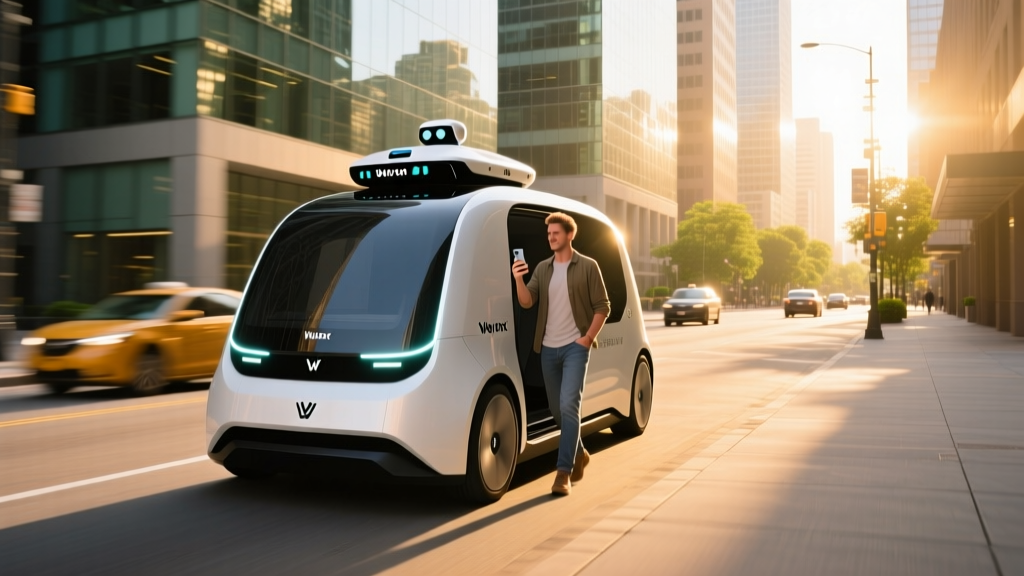
Using Waymo One is straightforward: download the Waymo One app (iOS/Android), enter your pickup and dropoff within the service area, and a vehicle — currently the all-electric Geely Zeekr M-Vision (custom robotaxi) or the Jaguar I-PACE (older fleet) — arrives within minutes. There is no driver to rate, no surge pricing in the traditional sense, and no tipping.
| Route Example | Waymo One | UberX | Lyft Standard |
|---|---|---|---|
| Short trip (~3 miles, Phoenix) | $8–$12 | $9–$14 | $8–$13 |
| Medium trip (~8 miles, SF) | $15–$22 | $16–$25 | $15–$24 |
| Airport run (~15 miles, PHX Sky Harbor) | $25–$35 | $28–$42 | $27–$40 |
| Surge/Peak pricing (SF Friday night) | No surge | $35–$60+ | $30–$55+ |
The key pricing advantage Waymo holds is no surge pricing. During peak demand, Uber and Lyft can multiply fares 1.5x–3x. Waymo prices remain consistent, though wait times may increase during high demand since fleet size is fixed per market. Waymo also integrates with Uber in Austin, allowing you to request a Waymo vehicle through the Uber app — a strategic partnership that expands reach without requiring a separate app download.
For context on what Waymo vehicles cost to operate: the Jaguar I-PACE fleet vehicles carry an estimated per-unit cost of $150,000+ when fully equipped with Waymo's sensor suite. The newer Zeekr M-Vision platform, designed from the ground up as a robotaxi, is expected to reduce per-vehicle cost significantly — a factor that directly impacts the unit economics underpinning that $45 billion valuation.
Waymo's Safety Record: What the Data Actually Shows
- Total autonomous miles driven: Over 30 million fully driverless miles (Waymo's 5th-generation and 6th-generation fleet combined)
- Injury-causing crash rate: Waymo reports an 85% reduction in injury-causing crash rates compared to human benchmarks in equivalent operating areas, based on NHTSA-comparable crash data
- Police-reported crashes: Waymo publishes quarterly safety transparency reports; most incidents involve other human-driven vehicles rear-ending or sideswiping the robotaxi at low speed
- Contact rate: Waymo's internal data shows vehicle-to-object contact rates significantly lower than human driver baselines in matched urban environments
Waymo's safety case rests on comparative data. A peer-reviewed study published by Waymo and the Insurance Institute for Highway Safety (IIHS) found that Waymo vehicles were involved in fewer police-reported crashes per million miles than human drivers in the same geographies. The study controlled for exposure, vehicle type, and operating environment.
However, robotaxi safety is not without incidents. In San Francisco, Waymo vehicles have been involved in several publicized situations: a vehicle that drove through a construction zone with wet concrete, instances of vehicles briefly entering opposing lanes, and a recall in early 2024 affecting software related to predicting the behavior of parked pickup trucks. Waymo addressed the recall via over-the-air software updates before NHTSA formally published the recall notice — a pattern that demonstrates both the responsiveness and the ongoing edge-case challenges of Level 4 deployment.
The honest assessment: Waymo's safety data is strong relative to human baselines in urban environments, but the sample size (30+ million miles) is still small compared to the trillions of miles humans drive annually. Each expansion into new cities, highway driving, or novel weather conditions introduces new edge cases that must be validated.
The Technology Stack: Lidar, Cameras, and the Sensor Fusion Advantage
Waymo's approach diverges sharply from Tesla's camera-only Autopilot/FSD strategy. Waymo uses a multi-sensor fusion stack:
Waymo 6th-Generation Sensor Suite (Current Fleet)
- LiDAR: Multiple custom-designed LiDAR units providing 360° high-resolution 3D point-cloud mapping up to 500+ meters. LiDAR is the core sensor for object detection, distance measurement, and spatial understanding independent of lighting conditions.
- Cameras: 29+ cameras covering 360° with high dynamic range, designed for traffic-light recognition, sign reading, lane marking detection, and object classification.
- Radar: Multiple radar units for velocity measurement of moving objects, performance in rain and fog where LiDAR signal degrades, and redundancy.
- Audio detection: External microphones that detect emergency vehicle sirens and trigger appropriate pull-over behavior.
- HD Mapping: Centimeter-precision pre-mapped routes for every inch of the operational domain. The vehicle knows the exact position of every curb, lane marking, and traffic signal before it arrives.
This sensor redundancy is why Waymo can operate without a human driver (Level 4), while camera-only systems like Tesla FSD remain Level 2. If one sensor modality is degraded — say, LiDAR in heavy rain — cameras and radar provide backup. The HD map acts as a prior, meaning the vehicle isn't solely relying on real-time perception to understand its environment.
The trade-off is cost and scalability. Each Waymo vehicle carries an estimated $30,000–$50,000 in sensor hardware (down from $100,000+ in earlier generations). Every new city requires extensive HD mapping before service can launch. This is why Waymo's expansion is measured — city by city, neighborhood by neighborhood — rather than the "deploy everywhere, update later" approach of camera-centric systems.
Regulatory Landscape: Who Approves Robotaxi Operations?
Robotaxi deployment in the United States is governed by a patchwork of state and local regulations, not a single federal framework:
- Arizona: The most permissive regulatory environment. No specific state legislation was required for Waymo to launch; the governor issued executive orders supporting AV testing and deployment. This regulatory openness is why Phoenix became Waymo's first commercial market.
- California: The California DMV issues testing permits, while the California Public Utilities Commission (CPUC) grants commercial deployment permits. Waymo received its CPUC commercial permit for San Francisco in 2023 and expanded to Los Angeles in 2024. California requires detailed safety reporting, incident disclosure, and public comment periods before expansion approvals.
- Texas: Austin passed local ordinances enabling AV commercial operations. Texas state law (Transportation Code Chapter 545) permits autonomous vehicles without specific licensing, though local coordination is required.
- Federal (NHTSA): The National Highway Traffic Safety Administration oversees vehicle safety standards and crash reporting. NHTSA's Standing General Order requires AV operators to report crashes within 24 hours. NHTSA does not currently "approve" AV systems but can issue recalls and investigations.
For riders, this means your ability to use a robotaxi depends entirely on your state and city's regulatory posture. Expansion into new markets requires not just technical readiness but regulatory approval — a process that can take 12–24 months per city.
Current Limitations: What Waymo Cannot Do (Yet)
Waymo's Level 4 system is impressive within its domain, but it has defined boundaries:
- Geofencing: You cannot hail a Waymo outside its mapped service area. If your destination is beyond the boundary, the app will not let you book the trip. Service areas expand incrementally but remain a fraction of each metro area.
- Heavy rain and flooding: While Waymo vehicles operate in light-to-moderate rain, severe weather events (monsoon conditions in Phoenix, atmospheric rivers in California) can trigger service suspensions. LiDAR performance degrades in heavy precipitation.
- Snow and ice: Waymo does not currently operate in snow-belt cities. Snow-covered lane markings, reduced LiDAR range, and low-traction surfaces remain unsolved for Level 4 deployment.
- Highway driving: Waymo has begun limited highway-capable segments (certain freeway on/off-ramps and short highway stretches in SF), but full interstate highway operation at 70+ mph is not yet standard across all markets.
- Construction zones: While Waymo can navigate many construction zones, novel or rapidly changing construction layouts (lane shifts, temporary signals, flaggers) can cause the vehicle to pull over and request remote assistance.
- Complex multi-point stops: Waymo picks up and drops off at specific locations. You cannot ask the vehicle to wait while you run into a store, make multiple stops on one trip, or change your destination mid-ride as freely as with a human driver.
- Accessibility: The current fleet requires passengers to enter a standard vehicle. Wheelchair-accessible robotaxi options remain limited, though Waymo has committed to accessible vehicle development.
- Remote assistance delays: When a Waymo vehicle encounters an unresolvable scenario, it contacts a remote guidance team. This can add minutes to your trip while the vehicle waits for instructions.
What the $45B Valuation Means for the Future of Robotaxis
Waymo's 2025 valuation reflects several converging factors:
- Revenue trajectory: With tens of thousands of paid rides per week across four major metros, Waymo has demonstrated unit economics that approach breakeven on a per-ride basis in mature markets like Phoenix.
- Fleet cost reduction: The 6th-generation Waymo Driver (sensor suite) and the Zeekr M-Vision vehicle platform reduce per-vehicle capital costs substantially compared to the I-PACE fleet, improving the path to fleet-wide profitability.
- Data moat: 30+ million driverless miles across diverse urban environments give Waymo's machine-learning models a training-data advantage that is difficult for competitors to replicate.
- Alphabet's strategic backing: Unlike standalone AV startups (Cruise, which suspended operations in late 2023 after a serious incident, and Argo AI, which shut down in 2022), Waymo has Alphabet's balance sheet to absorb the capital-intensive scaling phase.
For riders and EV watchers, the valuation signals that robotaxi service will continue expanding city by city through 2026 and beyond, but not that full national coverage is imminent. The geofenced Level 4 model scales linearly — each new city requires mapping, regulatory approval, fleet deployment, and local operations staff. This is not a software-only business that can go national overnight.
Frequently Asked Questions
Where can I use Waymo One right now?
As of 2026, Waymo One is commercially available in Phoenix (metro-wide), San Francisco (city-wide), Los Angeles (Westside, Hollywood, Downtown, expanding), and Austin (limited area). Service is geofenced — you must be within the approved zone to request a ride.
How much does a Waymo ride cost compared to Uber or Lyft?
Waymo pricing is generally comparable to standard UberX/Lyft fares for equivalent routes — typically $8–$12 for short trips and $15–$22 for medium urban trips. The major difference: Waymo does not use surge pricing, so peak-demand rides can be significantly cheaper than Uber/Lyft during high-demand periods.
How safe are Waymo robotaxis — is there real data?
Waymo has accumulated over 30 million fully driverless miles. Peer-reviewed research (conducted with IIHS) shows an approximately 85% reduction in injury-causing crash rates compared to human benchmarks in equivalent operating areas. Most reported incidents involve other vehicles colliding with the Waymo at low speed. However, the sample size remains small relative to total human driving exposure.
What are the current limitations of Waymo's service?
Key limitations include geofenced service areas (not city-wide in most markets), no operation in heavy snow/ice, limited highway driving, potential service suspension in severe rain, inability to make multiple stops or wait for passengers, and occasional remote-assistance delays in complex scenarios like novel construction zones.
Is Waymo truly self-driving or is it driver-assist like Tesla Autopilot?
Waymo is SAE Level 4 — truly driverless within its operational domain. There is no human driver in the vehicle, no steering wheel accessible to passengers, and no expectation of human intervention. This is fundamentally different from Tesla Autopilot, FSD Supervised, GM Super Cruise, or Ford BlueCruise, all of which are SAE Level 2 systems requiring an attentive human driver at all times.
Can I use Waymo if I'm in a wheelchair or need accessibility accommodations?
Waymo has acknowledged the need for wheelchair-accessible vehicles and has committed to developing accessible options, but the current primary fleet (Jaguar I-PACE and Zeekr M-Vision) requires standard vehicle entry. Accessibility remains an active area of development for the robotaxi industry broadly.
Why doesn't Waymo operate in more cities?
Each new city requires HD mapping of every street in the service area, regulatory approval from state and local authorities, fleet deployment and maintenance infrastructure, and validation of the AI system's performance in that specific environment. This makes expansion capital-intensive and time-consuming — typically 12–24 months per new market.