Waymo's Weekly Ride Volume: What 250,000 Trips Actually Means
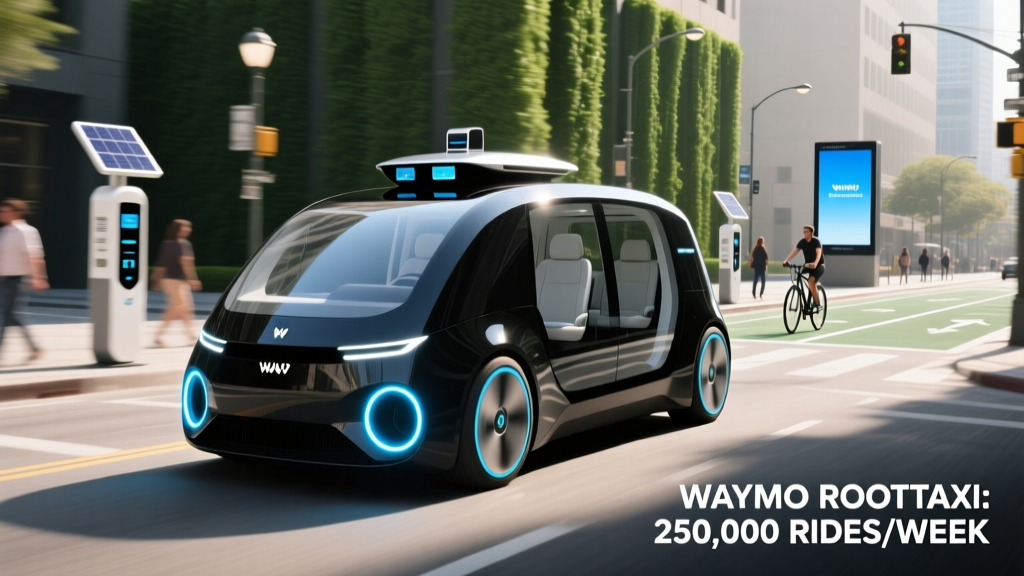
Waymo's paid robotaxi service crossed a milestone that separates it from every other autonomous vehicle operator in the United States: the company now logs over 250,000 paid rides per week across its commercial markets. That figure, disclosed in early 2026, represents a roughly 65% increase year-over-year and translates to more than 13 million annualized trips — all completed without a human driver behind the wheel.
For context, Uber processes approximately 28 million trips per day in the U.S. Waymo's volume is still a fraction of traditional rideshare, but it's the first time a Level 4 driverless service has achieved meaningful urban-scale throughput. Here's what that ride count tells us about where robotaxi service actually stands — and what it costs to hail one.
Where Can You Actually Ride in a Waymo Right Now?
Waymo One, the company's commercial ride-hailing service, is live in four metropolitan areas as of mid-2026. Each market has a defined geofence — a digitally mapped boundary within which the vehicles operate autonomously.
| City | Launch Year (Paid) | Approximate Geofence Coverage | Notable Zones |
|---|---|---|---|
| Phoenix, AZ | 2020 | ~315 sq mi | Tempe, Scottsdale, Chandler, Mesa, Sky Harbor Airport |
| San Francisco, CA | 2022 | ~47 sq mi (city-wide) | All SF neighborhoods, SFO airport service launched 2025 |
| Los Angeles, CA | 2024 | ~80 sq mi | Santa Monica, Hollywood, Downtown LA, LAX corridor |
| Austin, TX | 2025 | ~45 sq mi (expanding) | Downtown, South Austin, airport route in testing |
Phoenix remains Waymo's most mature market by ride volume and geographic coverage, but San Francisco generates the highest ride density per square mile due to urban trip frequency. Los Angeles expansion continues through 2026 with the geofence pushing further into the Westside and Mid-City corridors.
Where it's not available: Despite frequent announcements about future cities, Waymo One cannot be hailed outside these four metros. Trips that start or end outside the geofence are declined by the app. There is no waitlist trick to access service in Miami, Chicago, or any other city — if the app doesn't show availability in your area, it simply isn't live.
How to Use Waymo One and What It Costs vs. Uber
Hailing a Waymo works identically to Uber or Lyft in practice: open the Waymo One app, enter your destination, confirm the pickup spot, and a Jaguar I-PACE (the current fleet vehicle) arrives autonomously. You unlock via the app, and the car drives itself to your destination. No driver to rate, no tip screen.
| Trip Scenario | Waymo One (est.) | UberX (est.) | Notes |
|---|---|---|---|
| Short trip (~3 mi, city) | $8–$12 | $9–$14 | Roughly comparable; Waymo sometimes cheaper on short hops |
| Medium trip (~8 mi) | $16–$24 | $17–$26 | Similar base pricing; surge pricing affects Uber more |
| Airport run (~15 mi) | $28–$40 | $30–$50+ | Waymo pricing tends to be more stable without surge multipliers |
| Peak-hour surge scenario | Flat or mild increase | 1.5x–3x multiplier common | Waymo does not apply dynamic surge the way Uber/Lyft do |
Waymo's pricing model uses a base fare plus per-mile and per-minute rates, similar to traditional rideshare. The key difference: Waymo does not implement the aggressive surge multipliers that Uber and Lyft deploy during high-demand periods. This makes airport runs and evening trips more predictable in cost. However, during peak demand, wait times can extend to 15–20 minutes because fleet size is finite — there are roughly 1,000–1,500 vehicles across all markets combined.
Payment is handled in-app via credit card or Google Pay. Waymo occasionally offers promotional credits for new riders in newly expanded zones, but there is no loyalty or subscription program as of 2026.
Safety Record: What the Data Actually Shows
Waymo has accumulated over 40 million fully autonomous miles on public roads as of early 2026, with no driver behind the wheel. The safety question is the most scrutinized aspect of robotaxi deployment, so let's look at the concrete numbers rather than marketing claims.
- Total autonomous miles: ~40 million (driverless)
- Fatalities: 0
- Police-reported injury crashes: Significantly lower rate per million miles than human baseline, per NHTSA Standing General Order filings
- Contact events (any physical contact): Low single-digit incidents per million miles, most at very low speed (parking, low-speed intersection)
- Most common incident type: Low-speed side-swipe or rear-end by other (human-driven) vehicles, not Waymo-at-fault
Source: Waymo safety transparency reports, NHTSA crash data, and IIHS analysis.
The important caveat: robotaxi miles are not directly comparable to human driver miles. Waymo vehicles operate in dense urban environments at moderate speeds (typically under 45 mph), in fair weather, within thoroughly mapped geofences. They don't drive rural highways at 75 mph or navigate unplowed winter roads. The comparison group should be urban rideshare drivers in similar conditions, not all drivers everywhere.
That said, the data supports a clear finding: within their operational domain, Waymo vehicles are involved in fewer police-reported crashes per million miles than the human average for comparable urban driving. The NHTSA requires all Level 4 operators to file crash reports under a Standing General Order, making this one of the most transparently monitored vehicle fleets on American roads.
The Technology Stack: Lidar, Cameras, and HD Maps
Waymo's sixth-generation "Waymo Driver" hardware suite, fitted to the Jaguar I-PACE fleet, uses a sensor-fusion approach that contrasts sharply with camera-only systems (notably Tesla's vision-based FSD). Here's what's on the roof and around the body:
| Sensor Type | Count | Function |
|---|---|---|
| Lidar (custom-built) | 5 units | 360° 3D point-cloud mapping; detects objects, distances, and shapes regardless of lighting |
| Cameras (high-res) | 29 units | Traffic light state, signage reading, lane markings, pedestrian gesture recognition |
| External audio sensors | Multiple | Detects sirens, horns, emergency vehicle approach |
| IMU + GPS + HD maps | Integrated | Centimeter-level localization within pre-mapped environment |
Why lidar matters here: Lidar provides direct depth measurement — it doesn't need to infer distance from 2D images the way camera-only systems do. This gives Waymo reliable object detection in darkness, direct sunlight, and partial occlusion. The trade-off is hardware cost: each vehicle's sensor suite is estimated to add $20,000–$30,000 to the build cost, which is why Waymo's business model depends on high fleet utilization rather than consumer vehicle sales.
HD mapping and geofencing: Every inch of Waymo's service area is pre-mapped in high definition. The vehicle knows the exact position of every curb, lane marking, traffic signal, and crosswalk before it drives there. This is both the system's greatest strength and its greatest constraint — expanding to a new neighborhood requires completing a full HD map, which takes weeks to months of mapping drives and validation.
Current Limitations: What Waymo Cannot Do
The 250,000-rides-per-week figure can make robotaxi service sound ubiquitous. It isn't. The operational constraints are significant and worth understanding before you plan a trip around the assumption that a driverless car will take you anywhere.
- Geofence boundaries: Cannot drive outside mapped service area. A trip 1 mile beyond the geofence is impossible.
- Heavy weather: Service suspends during heavy rain (Phoenix monsoon events), dense fog, or any snowfall. Lidar performance degrades in precipitation, and the system is conservatively designed to pull over or decline rides when conditions exceed thresholds.
- Construction zones: Major unanticipated road construction can cause the vehicle to stop and request remote guidance. Frequent construction corridors may be temporarily excluded from the geofence.
- Highway driving: Limited. Waymo vehicles use freeways on specific routes (e.g., Phoenix airport runs) but cannot navigate arbitrary highway interchanges at full speed in all markets.
- No intercity trips: Phoenix to Tucson? Not possible. These are strictly intra-metro services.
- Wait times: During peak demand, expect 10–20 minute waits. Fleet size is not yet large enough to match Uber/Lyft availability.
- Accessibility: Wheelchair-accessible vehicles are available but in limited supply and must be requested in advance through the app.
- No food/item delivery (yet): Waymo has tested delivery partnerships but the primary service remains passenger rides only.
The weather limitation deserves emphasis for anyone considering robotaxi service as a daily commute option. In Phoenix, summer monsoon storms can suspend service for hours. In San Francisco, unusually heavy rain events trigger similar pauses. If you need guaranteed mobility in all conditions, robotaxi is not yet a sole transportation solution.
Regulatory Landscape: Who Approves Robotaxi Operations
Robotaxi deployment in the United States is regulated at the state level, not federally. Each market where Waymo operates required separate approvals:
- Arizona: The most permissive regulatory environment. The Arizona Governor's Office issued executive orders enabling driverless testing and commercial deployment with minimal oversight. No specific state permit required beyond standard business licensing and insurance.
- California: The California Public Utilities Commission (CPUC) issues permits for commercial robotaxi service. The California DMV separately issues testing and deployment permits. Waymo holds both. California requires detailed safety reporting, incident disclosure, and accessibility plans.
- Texas: Austin's deployment operates under a state autonomous vehicle framework passed in 2017, with local coordination through the city's transportation department. Requirements are moderate — less restrictive than California but more structured than Arizona.
At the federal level, NHTSA retains authority over vehicle safety standards but does not currently issue "robotaxi licenses." The agency's role is crash investigation, safety defect oversight, and the Standing General Order crash-reporting mandate. Congressional efforts to create a comprehensive federal AV framework have stalled repeatedly since 2017, leaving the patchwork state-by-state approach in place.
Insurance: Waymo carries commercial liability insurance covering all rides. In the event of a crash, the rider is not financially responsible — Waymo's insurance and self-insurance reserves handle claims. This is a meaningful advantage over personal-vehicle accidents where fault and coverage disputes can drag on.
What 250,000 Rides Per Week Signals for the Industry
The ride-volume number matters because it demonstrates something the autonomous vehicle industry has struggled to prove for a decade: sustained commercial demand for driverless service at prices that riders willingly pay. Waymo isn't offering free rides or heavy subsidies to inflate adoption — these are market-rate trips that people choose over Uber, Lyft, or driving themselves.
The constraints are equally clear. Four cities, geofenced zones, weather limitations, and finite fleet size mean this is still a niche service nationally. The 250,000 weekly rides represent roughly 0.5–1% of U.S. rideshare volume. Scaling to 1 million rides per week would require fleet expansion into the tens of thousands of vehicles and entry into at least 6–8 additional metro areas.
Waymo has announced intentions to expand to additional cities, but each new market requires mapping, regulatory approval, fleet deployment, and a ramp-up period measured in months. Expect 1–2 new city launches per year, not per quarter. The growth trajectory is real but incremental.
Frequently Asked Questions
Is Waymo truly self-driving, or is someone monitoring remotely?
Waymo vehicles drive themselves — there is no remote driver controlling the car in real time. However, Waymo employs "fleet response" specialists who can provide high-level guidance when a vehicle encounters an unfamiliar situation (e.g., an unexpected construction zone). The remote specialist does not steer or brake the vehicle; they confirm a path or authorize a maneuver that the vehicle then executes autonomously. Think of it as air-traffic control, not remote control.
Can I use Waymo if I'm visiting Phoenix or San Francisco?
Yes. Download the Waymo One app, create an account, and request a ride within the service geofence. No residency requirement, no waitlist for most areas. You'll need a valid payment method and to be 18 or older. Tourist and business-traveler use is a significant share of total rides, particularly for airport transfers.
How does Waymo handle a situation where the car gets confused?
The vehicle is programmed to stop safely — typically pulling to the side of the road or stopping in its lane with hazards on — and request remote fleet assistance. This happens infrequently (measured in incidents per tens of thousands of miles) but it does occur, particularly in areas with active construction or unusual temporary traffic controls. When it happens, expect a 2–5 minute delay while a fleet response specialist assesses the situation.
What vehicle does Waymo use?
The current fleet consists entirely of the Jaguar I-PACE, a battery-electric SUV with a 90 kWh battery pack and approximately 234 miles of EPA range. Waymo chose the I-PACE for its combination of interior space, electric powertrain, and sensor-integration flexibility. A next-generation vehicle based on the Zeekr M-Vision platform has been announced for future deployment but is not yet in commercial service as of 2026.
How does Waymo's safety record compare to Tesla FSD?
These are fundamentally different systems. Waymo is Level 4 (no driver needed, geofenced area). Tesla FSD (Supervised) is Level 2 (driver must remain fully attentive and is legally responsible). Comparing their safety records directly is misleading because Waymo operates without a driver who could intervene, while Tesla FSD has a licensed driver behind the wheel at all times. Tesla reports FSD miles and intervention data, but the presence of a supervising driver makes the operational context entirely different. NHTSA tracks crash data for both under separate reporting requirements.
Will Waymo come to my city soon?
Unless you live in or near Phoenix, San Francisco, Los Angeles, or Austin, the answer is probably not within the next 12 months. Waymo has signaled interest in markets like Miami, Atlanta, and Dallas, but each expansion requires extensive mapping, local regulatory coordination, and fleet deployment. Check the Waymo One app for actual service availability rather than relying on news announcements about future plans.