If you have opened the Waymo One app in Phoenix, San Francisco, or Los Angeles recently, you have likely noticed something: the prices fluctuate just like Uber or Lyft, but there is no human behind the wheel. As Alphabet's robotaxi subsidiary expands its commercial footprint through 2026, riders and curious onlookers alike are asking the same question — how much does a Waymo ride cost, and is it actually competitive with traditional rideshare?
This guide breaks down real Waymo One pricing, compares it head-to-head with Uber and Lyft, and examines the safety data, technology, and regulatory framework behind the world's most deployed Level 4 robotaxi fleet.
How Much Does a Waymo Ride Cost? Real Fare Examples
Waymo One uses dynamic pricing that factors in distance, time, demand, and time of day — similar to rideshare surge models. There is no separate "autonomous vehicle premium" baked into every ride. In practice, Waymo fares tend to land within a few dollars of comparable UberX or Lyft rides in the same market, sometimes slightly cheaper during off-peak hours and sometimes slightly higher during peak demand.
Based on aggregated rider reports and published fare data from early-to-mid 2026, here is what typical Waymo One rides cost across major service areas:
| Route Example | Distance | Waymo One | UberX | Lyft |
|---|---|---|---|---|
| SFO Airport to Downtown SF | ~14 mi | $32–$42 | $30–$48 | $28–$45 |
| Downtown Phoenix to Sky Harbor Airport | ~5 mi | $14–$19 | $13–$22 | $12–$20 |
| Santa Monica to LAX | ~8 mi | $22–$30 | $20–$35 | $19–$32 |
| Short trip within Downtown SF | ~2 mi | $8–$12 | $9–$14 | $8–$13 |
| Austin midtown to airport | ~10 mi | $20–$28 | $18–$30 | $17–$28 |
Key takeaways: Waymo One pricing is generally within 10–15% of UberX and Lyft for the same route. During high-demand periods, Waymo's pricing can be more stable because it does not factor in driver availability in the same way — but fleet availability can still limit supply. Waymo also periodically offers promotional discounts and loyalty credits to encourage adoption.
There is currently no tipping mechanism in the Waymo One app, which can save riders $3–$5 per trip compared to a tipped rideshare ride.
Where Can I Use Waymo One Right Now?
As of mid-2026, Waymo One operates fully driverless commercial service in the following metro areas. Service boundaries are geofenced — the app will only let you request a ride if both the pickup and drop-off fall within the approved operating zone.
| City | Service Status | Approximate Coverage Area | Notes |
|---|---|---|---|
| Phoenix, AZ (Metro) | Fully operational, open to public | ~300+ sq mi (Chandler, Tempe, Mesa, Scottsdale, Downtown Phoenix, Sky Harbor Airport) | Longest-running market; airport rides available |
| San Francisco, CA | Fully operational, open to public | ~50 sq mi core + expansion corridors | 24/7 service; dense urban environment |
| Los Angeles, CA | Operational, expanding | Santa Monica, Hollywood, Downtown LA, LAX corridor | Gradual geographic expansion ongoing |
| Austin, TX | Operational (launched 2025–2026) | Central Austin, select corridors | Expansion in progress |
Waymo has announced intentions to expand to additional cities, but any market not listed above should be considered announced or in testing — not yet available for public rides. Always check the Waymo One app for the latest service boundaries, as geofences expand incrementally.
Is Waymo Truly Self-Driving?
Yes — Waymo One is a Level 4 autonomous service under the SAE J3016 framework. This means the vehicle handles all driving tasks within its defined operational design domain (geofenced area, certain conditions) with no human driver present and no expectation of human intervention.
This is fundamentally different from consumer driver-assist systems like Tesla Autopilot, Ford BlueCruise, or GM Super Cruise, which are Level 2 — the driver must remain engaged and responsible at all times. Do not conflate the two.
Waymo vs. Uber and Lyft: How the Experience Compares
Beyond price, the rider experience differs in meaningful ways. Here is a side-by-side breakdown:
| Factor | Waymo One | UberX / Lyft |
|---|---|---|
| Driver | None (Level 4 autonomous) | Human driver |
| Wait time (typical) | 3–8 minutes | 2–10 minutes |
| Vehicle | Jaguar I-PACE (EV) or Zeekr RT custom robotaxi | Varies (personal vehicles) |
| Consistency | Highly consistent driving behavior | Varies by driver |
| Route flexibility | Geofence-limited; no off-map drop-offs | Anywhere the driver will go |
| Tipping | Not applicable | Expected ($2–$5+) |
| Conversational privacy | Full privacy (no driver) | Varies |
| Accessibility | Wheelchair-accessible vehicles in select markets | WAV options available in some cities |
The all-electric Jaguar I-PACE fleet (and the newer Zeekr custom robotaxi vehicles entering service) means every Waymo ride is a zero-tailpipe-emission trip. The I-PACE's 84 kWh battery pack provides ample range for urban robotaxi duty cycles, and vehicles return to depots for charging between shifts.
How Safe Are Waymo Robotaxis? The Real Data
Safety is the single most important question for any robotaxi service. Waymo has accumulated more driverless miles than any other commercial autonomous vehicle operator in the United States, and the data tells a specific story.
Waymo Safety Data (Through Early 2026)
- Total fully driverless miles driven: Over 10 million (cumulative since commercial launch)
- Fatalities: Zero reported fatalities in fully driverless Waymo One operations as of publication
- Contact rate vs. human benchmarks: Waymo's internal data, published in peer-reviewed studies, shows a roughly 85% reduction in injury-causing crash involvement compared to human baseline rates in comparable urban environments
- NHTSA Standing General Order: Waymo reports crash data to NHTSA under the agency's Standing General Order for automated driving systems. Minor contact incidents (e.g., low-speed scrapes with stationary objects) have been reported
- California DMV disengagement reports: Waymo's disengagement rate during testing has consistently ranked among the lowest (fewest human takeovers per 1,000 miles) of all permitted operators, though disengagement metrics alone are an incomplete safety measure
It is important to contextualize these numbers. Waymo operates primarily in geofenced, mapped urban areas with moderate speed limits (typically under 45 mph). The fleet avoids highways and extreme weather conditions by design. This controlled operational domain is a key reason the safety record is strong — it is not directly comparable to all-conditions human driving on rural highways or in blizzards.
For comparison, human drivers in the US experience approximately 1.35 fatalities per 100 million vehicle miles traveled (NHTSA). Waymo's driverless fleet has not reached 100 million miles, making a direct fatality-rate comparison statistically premature — but the absence of fatalities across 10+ million urban miles is a meaningful data point.
How Waymo's Technology Stack Works
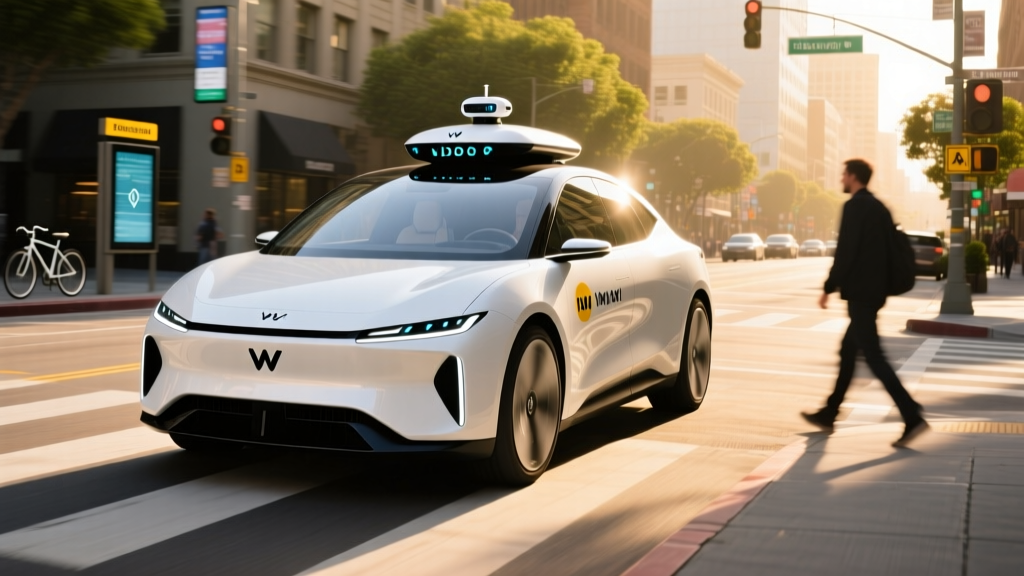
Waymo's vehicles — currently the Jaguar I-PACE equipped with the 6th-generation Waymo Driver, and the incoming Zeekr purpose-built robotaxi — use a sensor-fusion approach that is fundamentally different from camera-only systems (like Tesla's vision-based FSD).
Waymo Driver Sensor Suite
- LiDAR: Multiple roof- and body-mounted LiDAR units create a real-time 3D point cloud of the environment, detecting objects, pedestrians, and road geometry at ranges exceeding 200 meters regardless of lighting conditions
- Cameras: A suite of high-resolution cameras provides color and texture information — reading traffic signals, detecting brake lights, identifying signage, and classifying objects
- Radar: Millimeter-wave radar sensors track the velocity and distance of moving objects, performing reliably in rain and fog where LiDAR and cameras may degrade
- Audio detection: External microphones detect sirens from emergency vehicles, enabling the system to pull over or yield appropriately
- HD mapping: Waymo pre-maps every inch of its operating domain at centimeter-level precision. The vehicle localizes itself within this map in real time, providing a layer of redundancy beyond live sensor data
This multi-sensor redundancy is a defining characteristic of Level 4 systems. If one sensor modality is degraded (e.g., camera glare at sunset), LiDAR and radar continue to provide object detection. The system can also safely pull over and stop — what Waymo calls a "minimal risk condition" — if it encounters a scenario it cannot confidently handle.
This stands in contrast to camera-only approaches, which rely on neural networks to infer depth and 3D geometry from 2D images. Both approaches have trade-offs, but for unsupervised Level 4 operation in a commercial passenger service, the industry consensus currently favors sensor fusion with LiDAR.
The Regulatory Landscape: Who Approves Robotaxi Operations?
Robotaxi services in the United States operate under a patchwork of state and local regulations. There is no single federal "robotaxi license." Instead, approval authority falls primarily to state-level agencies:
- California: The California Public Utilities Commission (CPUC) issues permits for commercial passenger-carrying autonomous vehicle services. The California DMV separately regulates testing permits and requires annual disengagement reports. Waymo holds a CPUC permit for statewide commercial deployment, though it has phased its rollout city by city.
- Arizona: Arizona has taken a permissive regulatory approach since 2015, with executive orders enabling autonomous vehicle testing and commercial operation without a dedicated state permit process. Waymo's Phoenix operation benefits from this framework.
- Texas: Austin's robotaxi operations operate under state legislation (Texas Transportation Code Chapter 549) that permits autonomous vehicles on public roads, with local coordination for commercial passenger service.
- Federal (NHTSA): The National Highway Traffic Safety Administration does not currently "approve" autonomous driving systems for deployment but requires crash reporting under its Standing General Order and retains authority to investigate safety defects and issue recalls. NHTSA's ADS resources outline the federal posture.
The regulatory environment is evolving. Several states have considered or passed legislation addressing insurance requirements, data-sharing mandates, and local-government opt-out provisions for robotaxi services. Riders should expect the regulatory map to expand alongside service availability.
Current Limitations: What Waymo Cannot Do (Yet)
Level 4 autonomy is powerful but bounded. Waymo One has real, practical limitations that riders should understand before booking:
Known Limitations
- Geofencing: The vehicle will only operate within its pre-mapped service area. You cannot request a ride to a destination outside the geofence, even if it is just a few blocks beyond the boundary.
- Weather constraints: Heavy rain, fog, snow, or ice can trigger service slowdowns or suspensions. While the sensor suite handles light-to-moderate rain, the system is conservative by design and may pull over or refuse to route through severe conditions.
- No highway driving (most markets): Waymo's current commercial service primarily operates on surface streets and lower-speed corridors. Highway-capable operations are in testing but are not the norm for Waymo One rides.
- Construction zones: While the system handles many construction scenarios, major road closures or complex temporary lane shifts can cause rerouting delays or ride cancellations.
- Limited stop types: The vehicle will pull to the curb at your destination but cannot enter parking garages, drive-throughs, or private driveways. Drop-offs happen at the nearest safe curbside location.
- No en-route stop requests: Unlike Uber/Lyft, you generally cannot add a mid-trip stop (e.g., "stop at the pharmacy") once the ride has begun.
- Pet and cargo policies: Service animals are permitted, but general pets, oversized luggage, or open food containers may not be allowed. Check current Waymo One policies in the app.
- Edge-case delays: In rare scenarios — an unusual road obstruction, an emergency vehicle situation, or a sensor-confusing environment — the vehicle may pause and request remote guidance from a Waymo operations team member. This can add minutes to your trip.
These limitations are not failures — they are the defined operational design domain (ODD) within which Level 4 autonomy can safely function. The system is designed to recognize its own limits and act conservatively rather than guess.
How to Use Waymo One: Step-by-Step
- Download the Waymo One app (iOS or Android) and create an account.
- Verify your location is within a service area. The app map shows the active geofence.
- Enter your pickup and drop-off addresses. Both must be inside the service zone.
- Review the upfront fare — Waymo shows the estimated price before you confirm, just like Uber or Lyft.
- Confirm your ride. The app will show your vehicle's location, ETA, and license plate.
- Meet the vehicle at the curb. The car will arrive and wait. Tap "Start Ride" in the app or use the in-car screen to unlock the doors.
- Enjoy the ride. The in-car screen shows your route, ETA, and climate controls. A rider support line is available via the app or in-car button at all times.
Frequently Asked Questions
Is Waymo more expensive than Uber or Lyft?
Not consistently. Waymo One fares typically fall within 10–15% of comparable UberX or Lyft rides for the same route. During surge pricing on rideshare apps, Waymo can sometimes be cheaper. Conversely, during low-demand periods, a rideshare driver might be slightly less expensive. The absence of tipping with Waymo often makes the total out-of-pocket cost lower.
Can I use Waymo at airports?
Yes, in select markets. Waymo One offers airport rides at Phoenix Sky Harbor (PHX) and Los Angeles International (LAX). San Francisco International (SFO) service availability depends on current geofence boundaries and regulatory agreements — check the app for real-time availability.
What happens if the Waymo vehicle encounters a problem mid-ride?
The vehicle is designed to achieve a "minimal risk condition" — it will safely pull over to the curb and stop. A remote support team monitors the fleet 24/7 and can provide guidance to the vehicle or dispatch roadside assistance. You can also contact rider support at any time via the in-car screen or app.
Is Waymo a Tesla competitor?
Not directly. Waymo is a Level 4 robotaxi service — you ride in a fleet-owned vehicle with no driver. Tesla's Full Self-Driving (Supervised) is a Level 2 driver-assist system installed in consumer-owned vehicles, requiring the human driver to remain fully engaged. They operate in fundamentally different regulatory and technological categories. Tesla has announced plans for a robotaxi service, but as of 2026, it is not commercially operational in a driverless capacity.
How does Waymo make money if fares are similar to Uber?
Waymo is backed by Alphabet and currently operates as a growth investment. The long-term economic thesis is that removing the driver — who typically earns 50–70% of a rideshare fare — creates a path to profitability once fleet scale, vehicle cost (especially custom robotaxis like the Zeekr RT), and utilization rates reach sufficient levels. Waymo has not publicly disclosed profitability timelines.
Are Waymo vehicles electric?
Yes. The current primary fleet vehicle is the all-electric Jaguar I-PACE, equipped with a 90 kWh battery pack (approximately 84 kWh usable) and an EPA range of 234 miles. For urban robotaxi duty cycles with depot charging between shifts, this is more than sufficient. The incoming Zeekr purpose-built robotaxi is also fully electric.