What the Waymo Jaguar I-PACE Robotaxi Actually Is
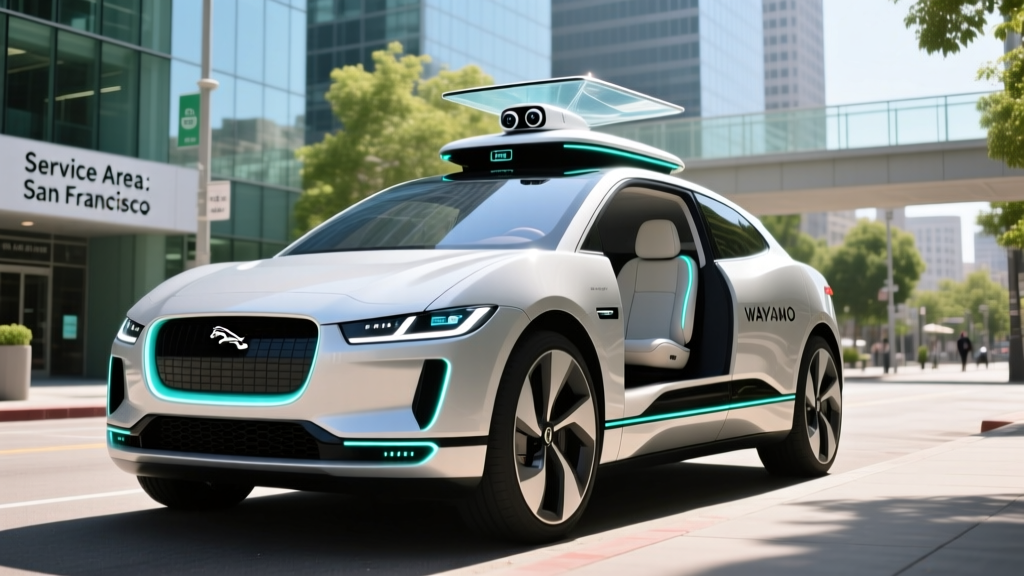
If you've hailed a driverless ride in Phoenix, San Francisco, or Los Angeles, chances are you climbed into a Waymo Jaguar I-PACE. This all-electric SUV is the backbone of Waymo One, Alphabet's commercial robotaxi service. But unlike the Tesla Model Y or Ford Mustang Mach-E you might cross-shop as a consumer EV, the I-PACE in Waymo's fleet isn't something you can buy — it's a purpose-modified autonomous vehicle (AV) packed with a sensor suite that costs more than the base car itself.
The Jaguar I-PACE was selected by Waymo (then Google's self-driving car project) in 2017 for its premium build quality, spacious cabin, and all-electric powertrain. The production I-PACE carries a 90 kWh battery pack (NMC chemistry), an EPA-rated range of 234 miles, and dual motors producing 394 horsepower with a 4.5-second 0-60 mph time. Waymo's fifth-generation autonomous driving system — called the Waymo Driver — adds a roof-mounted lidar array, side-facing lidars, forward and surround cameras, and radar units that collectively process millions of data points per second.
As of early 2026, Waymo operates the largest fully driverless commercial robotaxi fleet in the United States, with over 1,000 vehicles completing more than 150,000 paid rider-only trips per week across its active service areas. The Jaguar I-PACE remains the dominant platform, though Waymo has also begun integrating the Zeekr RT minivan for future fleet expansion.
SAE Automation Level: True Level 4, Not Driver-Assist
SAE Level 4 — High Automation (Geofenced Driverless)
The Waymo Jaguar I-PACE operates at SAE Level 4, meaning the vehicle handles all driving tasks within its defined operational design domain (ODD) with no human driver present. There is no steering wheel interaction, no pedal input, and no rider supervision required. This is fundamentally different from Level 2 systems like Tesla Autopilot, Ford BlueCruise, or GM Super Cruise, which require an attentive driver ready to take over at any moment.
Waymo's ODD is geofenced — the car operates only within pre-mapped urban zones under specific conditions. Outside those boundaries or in severe weather, the system will not operate.
| Level | Name | Driver Required? | Example |
|---|---|---|---|
| Level 2 | Partial Automation | Yes — always | Tesla Autopilot, BlueCruise |
| Level 3 | Conditional Automation | Yes — on standby | Mercedes DRIVE PILOT (limited) |
| Level 4 | High Automation | No — within ODD | Waymo, Zoox |
| Level 5 | Full Automation | No — anywhere | Does not exist commercially |
Where Can You Ride a Waymo Jaguar I-PACE Right Now?
Waymo One has expanded steadily, but it remains geofenced to specific metro areas. Here's the current operational footprint as of early 2026:
| City | Status | Service Area Notes |
|---|---|---|
| Phoenix, AZ | Fully operational | Largest coverage area — Chandler, Tempe, Mesa, Scottsdale, Phoenix Sky Harbor Airport |
| San Francisco, CA | Fully operational | City-wide coverage including downtown, Sunset, Richmond; highway trips to SFO approved |
| Los Angeles, CA | Fully operational | Santa Monica, Hollywood, Downtown LA, Beverly Hills; expanding to LAX corridor |
| Austin, TX | Operational (expanding) | Central Austin, South Congress, Domain area; limited highway routes |
| Mountain View / Silicon Valley, CA | Limited operational | Employee and invited-rider programs; gradual public expansion |
Phoenix was Waymo's first commercial market (launching Waymo One in December 2018), and it remains the most expansive service area. San Francisco followed with full public access in 2022, and Los Angeles scaled through 2023-2024. If you're outside these metros, you cannot currently book a ride — Waymo does not offer service in suburbs beyond its mapped ODD.
Pricing: Waymo vs. Uber and Lyft
Waymo One uses dynamic pricing similar to rideshare platforms, but without a human driver to pay, the economics differ. Based on rider reports and Waymo's published pricing structure in late 2025 and early 2026:
| Trip Type | Waymo One | UberX | Lyft Standard |
|---|---|---|---|
| Short urban (3-5 miles) | $8 – $14 | $10 – $18 | $9 – $17 |
| Medium trip (8-12 miles) | $16 – $28 | $18 – $35 | $17 – $32 |
| Airport run (15-20 miles) | $30 – $50 | $35 – $65 | $32 – $58 |
| Surge / peak hours | Moderate increase | 2x – 3x surge common | 2x – 3x surge common |
Waymo's pricing is generally competitive with or slightly below UberX and Lyft on standard trips, with a notable advantage during peak demand: because Waymo doesn't pay a driver, it has less incentive to surge pricing aggressively. Promo codes and first-rider discounts are frequently available through the Waymo One app.
To book, download the Waymo One app (iOS/Android), enter your pickup and drop-off within the service zone, and confirm. The car arrives, unlocks its doors automatically, and you can control climate and music from a rear-seat screen. No tipping is expected — there's no driver.
Safety Record: What the Data Actually Shows
Waymo Safety Data Snapshot (through 2025)
- 30+ million fully autonomous miles driven on public roads
- 10+ billion miles driven in simulation annually
- ~85% fewer injury-causing crash involvement rate compared to human drivers (per NHTSA-reported data and Waymo's published safety studies)
- Zero at-fault fatalities in driverless operations as of early 2026
Source: Waymo Safety Report, NHTSA AV Safety Data
Waymo publishes periodic safety analyses comparing its crash rates to human benchmarks. A key study found that Waymo vehicles were involved in 85% fewer injury-causing crashes and 57% fewer police-reported crashes per million miles compared to human drivers in the same operating environments. These figures are based on actual on-road data, not simulation.
That said, incidents do occur. Waymo vehicles have been involved in minor contact events — typically low-speed collisions with other road users who violated traffic rules (e.g., a truck backing up into the AV's path, or a pedestrian stepping into the roadway at speed). NHTSA's Standing General Order requires all AV operators to report crashes, and Waymo's filings are publicly accessible. The most common scenario involves the Waymo vehicle stopping correctly but being struck by an inattentive human driver.
A critical nuance: Waymo's ODD avoids the most challenging driving scenarios. The cars don't operate on unmapped rural roads, in heavy snow, or in construction zones they haven't pre-scanned. This geofencing is a safety feature, not a limitation — it keeps the system within conditions it can handle reliably.
Technology Stack: Lidar-First, Not Camera-Only
The Waymo Jaguar I-PACE uses a multi-modal sensor suite that differs fundamentally from Tesla's camera-only approach. Here's the hardware stack:
| Sensor Type | Quantity | Purpose |
|---|---|---|
| Custom LiDAR (roof-mounted) | 1 primary + multiple side units | 360° 3D point cloud; detects objects 500+ meters away, day or night |
| Cameras (visible spectrum) | ~29 (surround view) | Traffic light state, sign reading, lane markings, pedestrian gestures |
| Radar (forward + corner) | 6 units | Velocity measurement of moving objects; performs in rain/fog |
| Audio detection | External microphones | Detects emergency vehicle sirens for pre-emptive pull-over |
| IMU / GPS / HD maps | Integrated | Centimeter-level localization within pre-mapped environment |
The lidar-first philosophy gives Waymo a decisive advantage in depth perception and object detection independent of lighting conditions. At night, in tunnels, or in direct sun glare — conditions that challenge camera-only systems — lidar continues to generate reliable 3D spatial data. The tradeoff is cost: Waymo's custom lidar units reportedly cost tens of thousands of dollars each, though Waymo's in-house manufacturing has brought costs down significantly from early-generation Velodyne units.
The system runs on Waymo's custom compute platform and relies heavily on HD pre-mapping. Before a Waymo vehicle drives a new street, the route is mapped at centimeter resolution. During operation, the car continuously matches live sensor data against this map, enabling it to anticipate lane geometry, curb positions, and signal locations before they're visible. This is why Waymo can't simply drive anywhere — the map is a core safety layer.
Regulatory Landscape: Who Approves Robotaxi Operations?
Robotaxi deployment in the United States is governed by a patchwork of state and local regulations, not a single federal standard:
- California (CPUC + DMV): The California Public Utilities Commission issues permits for commercial passenger service. The DMV separately issues testing and deployment permits. Waymo holds both. San Francisco operations required approval from both agencies plus coordination with the SF Municipal Transportation Agency.
- Arizona: Arizona has taken a permissive approach since 2015, with minimal state-level AV regulation. Waymo's Phoenix operations launched under executive orders favoring AV testing and deployment.
- Texas: Austin's robotaxi operations fall under a state law (HB 3026, 2023) that preempts local bans on AVs but requires operators to carry insurance and report crashes.
- Federal (NHTSA): NHTSA does not currently "approve" AV deployments but requires crash reporting under its Standing General Order and retains recall authority. In 2025, NHTSA opened preliminary evaluations into several AV operators following reported incidents.
For riders, this means service availability is entirely determined by which jurisdictions have granted permission — and those permissions can be modified or revoked. San Francisco briefly paused Waymo expansion in 2023 following public concerns about vehicles blocking emergency responders, though operations resumed after mitigation agreements.
Current Limitations of the Waymo Jaguar I-PACE Fleet
What the Waymo Robotaxi Cannot Do (2026)
- Heavy rain / snow: Operations pause or reduce during severe precipitation. Phoenix rarely sees this; San Francisco and Austin occasionally do.
- Unmapped areas: The car cannot drive outside its geofenced ODD. Suburban or rural trips beyond the map boundary are not available.
- Complex construction zones: While Waymo handles many construction scenarios, novel or rapidly changing road work may cause the vehicle to stop and request remote guidance.
- Highway driving (limited): Waymo has begun highway-capable trips (e.g., SFO airport runs in SF), but most operations remain on surface streets. Interstate travel between cities is not available.
- Wheelchair / mobility device access: The Jaguar I-PACE is a standard SUV — it cannot accommodate wheelchair users without folding and stowing the chair. Waymo has acknowledged this gap and is addressing it with the Zeekr RT platform.
- Pets: Service animals are permitted; personal pets are at the rider's risk and must be in carriers.
- Multi-stop trips: Waymo One currently supports point-A to point-B only. Adding intermediate stops requires separate rides.
The EV-specific limitations of the Jaguar I-PACE platform also matter operationally. The 90 kWh battery provides an EPA-rated 234 miles, but in real-world stop-and-go robotaxi duty with constant sensor and compute draw, effective range is closer to 170-190 miles before the vehicle must return to a depot for charging. Waymo manages this through fleet scheduling — vehicles cycle in and out of service for charging, typically at dedicated depot Level 2 (19.2 kW) and DC fast-charging stations. The I-PACE supports up to 100 kW DC fast charging (10-80% in approximately 45 minutes), which is modest by 2026 standards but sufficient for fleet operations with planned downtime.
The Jaguar I-PACE as an EV: Specs Behind the Robotaxi
For EV enthusiasts wondering about the base vehicle beneath the lidar array, here's the production I-PACE specification that Waymo starts with:
| Specification | Value |
|---|---|
| Battery capacity | 90 kWh (NMC) |
| EPA range | 234 miles (real-world robotaxi duty: ~170-190 mi) |
| DC fast charge (peak) | 100 kW (10-80% in ~45 min) |
| Level 2 AC charge | 11 kW onboard charger |
| Powertrain | Dual motor AWD, 394 hp, 512 lb-ft |
| 0-60 mph | 4.5 seconds |
| Efficiency | 76 MPGe combined (fueleconomy.gov) |
| Curb weight | ~4,784 lbs (stock); significantly higher with AV hardware |
| Battery warranty | 8 years / 100,000 miles (Jaguar); Waymo manages fleet replacement internally |
The I-PACE's relatively slow DC charging speed (100 kW peak, tapering significantly above 60% SoC) is one reason Waymo is diversifying its fleet. The incoming Zeekr RT platform supports 200+ kW charging and offers a minivan form factor with wheelchair accessibility — addressing two of the I-PACE fleet's biggest operational constraints.
Frequently Asked Questions
Is the Waymo Jaguar I-PACE truly self-driving, or is there a remote driver?
There is no driver in the vehicle — no one in the front seat, no hidden controls. The car operates autonomously at SAE Level 4. However, Waymo employs remote fleet assistants who can provide guidance if the vehicle encounters an ambiguous situation (e.g., an unusual construction zone). These assistants do not "joystick" the car in real-time; they confirm a path or strategy that the vehicle then executes on its own.
How much does a Waymo ride cost compared to Uber or Lyft?
For typical urban trips (5-10 miles), Waymo One pricing is generally comparable to or 10-20% less than UberX or Lyft Standard, with a meaningful advantage during surge periods when human-driver platforms spike 2-3x. Airport trips and longer routes are similarly competitive. There is no tipping.
Can I buy a Waymo-equipped Jaguar I-PACE?
No. Waymo's autonomous driving hardware and software are proprietary and not available for consumer purchase. The vehicles in the fleet are owned and operated by Waymo. If you want a Jaguar I-PACE for personal use, you'd need to find one on the used market — Jaguar discontinued the I-PACE for the US market after the 2024 model year.
What happens if the Waymo vehicle gets into an accident?
Waymo carries commercial insurance for all rider trips. If a collision occurs, the vehicle is designed to pull over safely, contact emergency services if needed, and connect the rider to Waymo support via the in-car screen and app. Crash data is reported to NHTSA under the Standing General Order.
Does the Waymo Jaguar I-PACE handle rain and bad weather?
Light rain is handled without issue. Heavy rain, fog, or snow can degrade lidar and camera performance, and Waymo will reduce operations or pause service entirely during severe weather. In Phoenix, this is rarely a problem. In San Francisco and Austin, occasional weather-related service interruptions occur.
How does Waymo compare to Tesla's Full Self-Driving?
These are fundamentally different systems. Waymo is SAE Level 4 — fully driverless within its geofenced area, no human needed. Tesla FSD (Supervised) is SAE Level 2 — the driver must remain attentive and ready to take over at all times. Waymo uses lidar, radar, and cameras with HD pre-mapping; Tesla uses cameras only without pre-mapping. Waymo operates a commercial ride-hailing service; Tesla sells a driver-assist feature for personal vehicles.