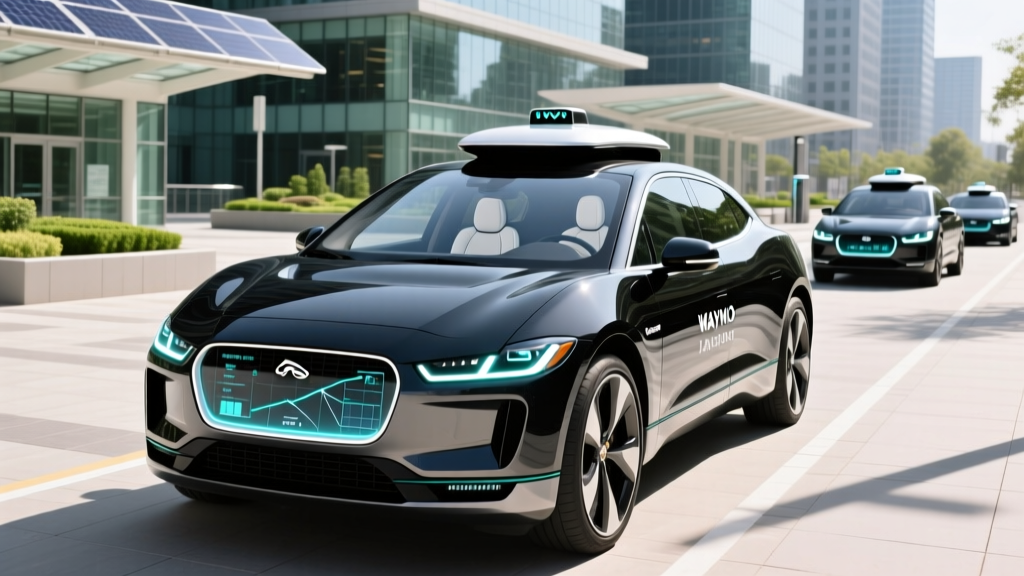
If you've hailed a driverless ride in Phoenix, San Francisco, or Los Angeles, chances are the vehicle that pulled up was a Waymo Jaguar I-PACE. Since 2018, Waymo — Alphabet's autonomous-driving subsidiary — has built its commercial robotaxi fleet almost exclusively on Jaguar's all-electric SUV, outfitting it with one of the most sophisticated sensor arrays ever deployed at scale. As of 2026, the Waymo Jaguar I-PACE remains the backbone of the largest paid driverless ride-hailing service in the United States, completing tens of thousands of trips per week across multiple metro areas.
This article breaks down exactly how the Waymo Jaguar I-PACE robotaxi works, where you can use it, what it costs, how safe it is, and where the technology still falls short. Whether you're an EV enthusiast curious about the platform or a prospective rider weighing robotaxi vs. traditional rideshare, here's the full picture with real data.
SAE Level 4: What "Self-Driving" Actually Means Here
Before examining the vehicle itself, it's essential to establish the automation level. The Waymo Jaguar I-PACE operates at SAE Level 4 — high automation within a defined operational design domain (ODD). This is fundamentally different from the Level 2 driver-assist systems found in consumer vehicles like Tesla's Autopilot or Ford's BlueCruise, where a human driver must remain engaged and ready to take over at all times.
| Level | Description | Example |
|---|---|---|
| Level 0 | No automation | Basic vehicle |
| Level 1 | Driver assistance (steering OR speed) | Adaptive cruise control |
| Level 2 | Partial automation (steering AND speed); driver must supervise | Tesla Autopilot, GM Super Cruise, Ford BlueCruise |
| Level 3 | Conditional automation; driver must be ready to resume | Mercedes DRIVE PILOT (limited markets/conditions) |
| Level 4 | High automation in a defined ODD; no driver needed | Waymo Jaguar I-PACE, Zoox |
| Level 5 | Full automation everywhere, all conditions | Does not exist commercially |
At Level 4, the Waymo Jaguar I-PACE handles all driving tasks — steering, acceleration, braking, lane changes, unprotected left turns, construction-zone navigation — without any human in the driver's seat. There is no steering wheel override, no "take over" prompt. If the system encounters a situation it cannot handle, it executes a minimal-risk maneuver: pulling over safely and contacting remote assistance. This is the critical distinction that separates robotaxis from consumer ADAS features.
The Waymo Jaguar I-PACE Platform: EV Specs and Sensor Stack
Waymo selected the Jaguar I-PACE for its robotaxi fleet because it offered a combination of attributes well-suited to autonomous urban driving: a flat battery skateboard for sensor mounting, sufficient electrical capacity to power compute hardware, and a premium cabin for rider comfort. Here's what the base vehicle delivers:
| Specification | Value |
|---|---|
| Battery (usable) | 84 kWh (NMC lithium-ion) |
| EPA Range (stock) | 234 miles |
| Drivetrain | Dual-motor AWD, 394 hp, 512 lb-ft |
| 0–60 mph | 4.5 seconds |
| DC Fast Charge (peak) | 100 kW (CCS1) |
| Effective Robotaxi Range | ~150–180 miles (sensor/compute load, urban driving) |
The stock I-PACE's 84 kWh NMC battery and 234-mile EPA range provide ample capacity for urban robotaxi shifts. In practice, Waymo vehicles operate on charging rotations — returning to dedicated depots for DC fast charging during off-peak hours. The sensor and compute payload draws additional power, reducing effective range to roughly 150–180 miles per charge in real-world urban service, which is more than sufficient for multi-shift city operations.
The 5th-Generation Waymo Driver Sensor Suite
What transforms a stock I-PACE into a robotaxi is Waymo's proprietary "Waymo Driver" hardware stack, now in its 5th generation. This multi-modal sensor array provides 360-degree perception:
- LiDAR: Multiple spinning and solid-state units providing high-resolution 3D point clouds up to 500+ meters. LiDAR is the core perception sensor, giving precise distance and shape data regardless of lighting.
- Cameras: 29+ cameras covering 360 degrees, including long-range forward-facing units for traffic-light and sign reading at distance, and short-range units for close-proximity detection.
- Radar: 6 radar units for velocity detection, functioning reliably in rain and fog where cameras and lidar degrade.
- Audio detection: External microphones that detect emergency-vehicle sirens and trigger appropriate yielding behavior.
- Compute: Custom-designed onboard computers processing sensor fusion, prediction, and planning in real time.
- HD Maps: Centimeter-accurate pre-mapped routes within the geofenced service area, providing lane-level context the vehicle cross-references with live sensor data.
This sensor-redundant approach contrasts sharply with Tesla's camera-only strategy for its consumer FSD system. Waymo's use of lidar, radar, and cameras together provides overlapping perception layers — if one modality degrades (e.g., camera glare from low sun), the others compensate. This redundancy is a key enabler of Level 4 operation without a human fallback driver.
Where Can You Ride a Waymo Jaguar I-PACE Right Now?
Waymo's commercial service, branded Waymo One, operates in specific geofenced zones within approved cities. The service area has expanded steadily, but it is not citywide in most markets. As of early 2026, here is the availability landscape:
| Metro Area | Status | Service Area Notes |
|---|---|---|
| Phoenix, AZ (East Valley) | Fully open | Largest operational area; covers Chandler, Tempe, Mesa, Scottsdale, Phoenix Sky Harbor Airport. ~225+ sq mi. |
| San Francisco, CA | Fully open | Most of SF proper; dense urban environment with complex intersections and hills. |
| Los Angeles, CA | Open (expanding) | Downtown LA, Hollywood, Santa Monica, Westside; LAX airport service added. |
| Austin, TX | Open (limited) | Initial service area covering central Austin; expansion ongoing. |
| Other cities | Announced/testing | Additional markets in various stages of mapping, testing, and regulatory approval. Not yet available for public rides. |
To use Waymo One, you download the Waymo app (iOS/Android), enter your pickup and drop-off within the service zone, and request a ride. The vehicle arrives driverless — there is no one in the front seat. You unlock the car via the app, buckle up, and the ride begins. In-app controls let you adjust climate, add stops, or pull over early. Payment is handled through the app, similar to Uber or Lyft.
How Much Does Waymo Cost vs. Uber and Lyft?
Pricing is one of the most common questions prospective riders ask. Waymo One uses dynamic pricing that factors in distance, time, and demand, similar to rideshare platforms. Based on rider reports and fare comparisons through 2025–2026, here's how typical fares stack up:
| Route Type | Waymo One | UberX | Lyft Standard |
|---|---|---|---|
| Short trip (3 mi, urban) | $9–$14 | $8–$13 | $8–$12 |
| Medium trip (8 mi, mixed) | $18–$28 | $16–$25 | $15–$24 |
| Airport run (15+ mi) | $35–$55 | $30–$50 | $28–$48 |
| Surge/peak demand | Moderate surge | Heavy surge common | Heavy surge common |
The bottom line: Waymo fares are generally comparable to or slightly above standard UberX and Lyft rides, but often below surge-priced rideshare during peak hours. A notable advantage is consistency — Waymo's pricing tends to surge less dramatically because fleet supply is algorithmically managed rather than dependent on gig-worker availability. Waymo also occasionally offers promotional credits for new users and subscription-style plans for frequent riders.
One cost factor worth noting: you cannot request a specific vehicle type (e.g., XL or luxury) with Waymo One as of 2026. Every ride is in a Jaguar I-PACE, which is a midsize luxury SUV — effectively giving you a "premium" vehicle class at near-standard rideshare pricing.
Safety Record: What the Data Shows
Safety is the most scrutinized aspect of robotaxi operations. Waymo has published safety data and been subject to regulatory reporting requirements in California (via the DMV and CPUC) and other states. Here's what the numbers indicate:
- Cumulative autonomous miles driven: 50+ million fully driverless miles (as of 2025 reporting)
- Contact rate: Waymo's published analysis (peer-reviewed, 2023–2024) found its vehicles were involved in 85% fewer injury-causing crashes per million miles compared to human benchmarks in comparable geographies
- Police-reported crash involvement: Significantly lower rate than human drivers per million miles, with most incidents involving other parties striking the Waymo vehicle
- California DMV disengagement reports: Waymo reports very low disengagement rates (instances where remote assistance is needed), though these metrics are self-reported and methodology varies across companies
Sources: Waymo Safety Reports, NHTSA Standing General Order crash reporting, California DMV autonomous vehicle program data.
It's important to contextualize these figures. Waymo vehicles operate primarily in urban environments at moderate speeds (typically under 45 mph), which reduces crash severity compared to highway driving. They also drive conservatively — yielding generously, maintaining larger following distances, and avoiding aggressive maneuvers. This makes direct comparison to all human driving somewhat imprecise, but the data consistently shows strong safety performance within the operational domain.
Incidents have occurred. Waymo vehicles have been involved in minor collisions, typically low-speed contacts where another driver or cyclist struck the robotaxi. In 2024, NHTSA opened an investigation into Waymo's crash reporting practices, as it has for other autonomous operators. No fatalities involving a Waymo-operated driverless vehicle have been reported as of early 2026. The most notable historical incident was the 2018 fatal Uber ATG crash in Tempe, Arizona — which involved Uber's test vehicle (not Waymo) and led to industry-wide safety practice reforms.
Regulatory Landscape: Who Approves Robotaxi Operations?
Robotaxi deployment in the U.S. is governed by a patchwork of state and local regulations — there is no single federal framework for commercial autonomous vehicle operations. Here's how the approval process works in key markets:
- California: The California DMV issues testing permits and deployment permits. The California Public Utilities Commission (CPUC) regulates commercial passenger service. Waymo holds a CPUC-issued permit for commercial driverless service in San Francisco and Los Angeles.
- Arizona: Among the most permissive states for AV operations. Arizona does not require a state-issued permit for testing or deployment, though operators must comply with general vehicle and insurance regulations. This regulatory openness is why Phoenix was Waymo's first commercial market.
- Texas: Austin allows AV testing and deployment under state law (HB 2021), with local coordination. Waymo began Austin operations under this framework.
- Federal (NHTSA): The National Highway Traffic Safety Administration sets vehicle safety standards (FMVSS) and has issued a Standing General Order requiring crash reporting for vehicles with SAE Level 2+ and above automation. NHTSA can investigate and issue recalls but does not currently "approve" AV operations for commercial service — that authority rests with states.
This state-by-state approach means expansion into new cities requires navigating different regulatory environments, mapping new geofenced areas, and building relationships with local first responders and transportation agencies. This is a primary reason expansion is gradual rather than rapid.
Current Limitations: Where the Waymo Jaguar I-PACE Cannot Go
Despite impressive capabilities, the Waymo Jaguar I-PACE robotaxi has well-defined limitations that are important for riders to understand:
- Geofencing: The vehicle will only operate within its pre-mapped, approved service area. You cannot request a ride to a destination outside the geofence — the app simply won't allow it. This means suburbs beyond the mapped zone are inaccessible.
- Weather constraints: Heavy rain, dense fog, and snow can degrade lidar and camera performance. In Phoenix, monsoon downpours may trigger service pauses. Waymo does not currently operate in cities with regular snow or ice.
- Highway driving: While Waymo vehicles can handle certain freeway segments within the geofence, the system is primarily optimized for urban and suburban surface streets. High-speed highway merging and complex multi-lane interchanges remain challenging edge cases.
- Construction zones: Major, unmapped construction reroutes can challenge the system. While Waymo has improved handling of temporary lane shifts and cones, significant deviations from the HD map may cause the vehicle to pull over and request remote assistance.
- Pickup/dropoff precision: The vehicle uses designated pull-over spots and may not stop at an exact address — it finds the nearest safe stopping point, which could be half a block away from your requested location.
- No rider flexibility: You cannot ask the vehicle to wait, make an unscheduled stop by flagging it down, or override its routing decisions. The experience is fully automated — for better or worse.
- Limited accessibility features: While Waymo has introduced features for wheelchair users and riders with disabilities in select markets, availability is not universal, and the Jaguar I-PACE's ride height can present challenges for some passengers.
These limitations are not unique to Waymo — they apply broadly to all current Level 4 robotaxi services. The technology excels within its defined operational domain but cannot yet handle the full spectrum of driving scenarios that a human driver navigates routinely.
The Jaguar I-PACE as a Robotaxi: Why This EV?
Waymo's partnership with Jaguar Land Rover began in 2016, and the I-PACE was selected as the fleet vehicle for several engineering reasons:
- Flat battery platform: The I-PACE's skateboard architecture provides a low, flat roof and underbody, making it easier to integrate lidar units and roof-mounted sensor pods without drastically altering the vehicle's center of gravity.
- Electrical capacity: The 84 kWh battery provides ample reserve power for the Waymo Driver's compute and sensor hardware, which draws several kilowatts continuously during operation.
- Drive-by-wire readiness: The I-PACE's electric powertrain, steering, and braking systems are natively compatible with electronic control interfaces, simplifying integration with Waymo's autonomous driving computer.
- Premium rider experience: As a luxury EV, the I-PACE offers a comfortable, quiet cabin — important for a service where the rider experience is a key differentiator from traditional rideshare.
That said, the I-PACE is aging. Originally launched for the 2019 model year, it was competitive at launch but now trails newer EVs in charging speed (its 100 kW peak is modest compared to 250+ kW platforms from Hyundai, Tesla, and others). Waymo has acknowledged it is evaluating next-generation vehicle platforms, and industry reports suggest future fleet vehicles may be custom-built or based on newer EV architectures with faster charging and more efficient powertrains. For now, though, the I-PACE remains the workhorse of the fleet.
Frequently Asked Questions
Is the Waymo Jaguar I-PACE truly self-driving, or is there a driver?
It is truly driverless. There is no human in the driver's seat, no remote teleoperator "driving" the car in real time. The vehicle operates at SAE Level 4, meaning it handles all driving tasks autonomously within its geofenced service area. Remote assistance is available for edge cases (e.g., an unmapped construction zone), but remote staff advise the vehicle's planning system — they do not steer or brake the car directly.
How much does a Waymo ride cost compared to Uber or Lyft?
Waymo One fares are generally comparable to standard UberX and Lyft rides, typically ranging from $9–$14 for short urban trips and $35–$55 for airport runs. Waymo often undercuts surge-priced rideshare during peak demand. You get a Jaguar I-PACE (a luxury SUV) for near-standard rideshare pricing.
Where can I use Waymo One right now?
As of 2026, Waymo One is available to the public in Phoenix (East Valley), San Francisco, Los Angeles, and Austin. Each city has a specific geofenced service area — you must be within that zone for both pickup and drop-off. Phoenix has the largest coverage area at 225+ square miles.
How safe are Waymo robotaxis?
Waymo's published safety data, based on 50+ million driverless miles, indicates significantly lower injury-crash rates compared to human benchmarks in comparable driving environments. No fatalities have been reported involving a Waymo driverless vehicle. The vehicles drive conservatively, with extensive sensor redundancy. However, they are not immune to incidents — most reported collisions involve other parties striking the Waymo vehicle.
Can I ride a Waymo in bad weather?
It depends on severity. Light rain is generally handled without issue. Heavy downpours, dense fog, or any snow/ice conditions may trigger service pauses or geofence restrictions. Waymo's current markets (Phoenix, LA, San Francisco, Austin) are chosen partly for their mild climates. Snow-capable robotaxi service does not yet exist commercially.
What happens if the Waymo vehicle encounters a problem mid-ride?
The vehicle is designed to execute a "minimal risk condition" — it will safely pull over, activate hazard lights, and contact Waymo's remote operations team. Riders can also reach support via the in-app help button or in-vehicle intercom at any time. The vehicle will not continue driving if it detects a system fault it cannot resolve.
Will Waymo expand to my city?
Waymo has announced plans to expand to additional U.S. markets, but expansion timelines depend on regulatory approval, HD mapping, local partnerships, and fleet logistics. New city launches are announced on Waymo's official site. Do not assume announced cities are live — always check the app for current availability.