Tesla FSD 14 Release Timeline: What We Know So Far
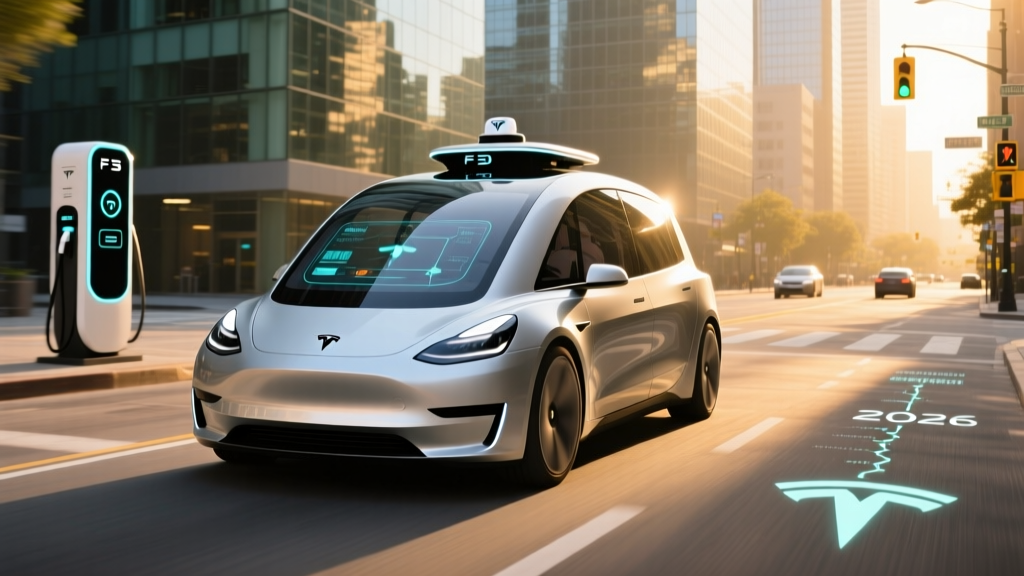
Tesla's Full Self-Driving (Supervised) software has evolved through rapid iteration since its beta launch in 2020, and owners tracking version numbers are now looking ahead: when will FSD 14 be released? As of early 2026, Tesla has not announced an official release date for FSD v14. The company's public roadmap, shared during Q4 2025 earnings and subsequent AI Day presentations, targets a mid-to-late 2026 rollout for the next major version branch — though Tesla's software timelines have historically been fluid.
To understand what FSD 14 might bring and whether it's worth waiting for, it's essential to examine what the current system actually does, what it costs, and how it stacks up against competing driver-assistance platforms in real-world use.
SAE Automation Level: Level 2 — Driver Supervision Required
Tesla's FSD (Supervised), like GM's Super Cruise, Ford's BlueCruise, and all other consumer-available driver-assist systems, operates at SAE Level 2. This means the system can simultaneously control steering and acceleration/braking under certain conditions, but the human driver must remain fully attentive, keep hands on or near the wheel, and be prepared to take over instantly. It is not self-driving. Only Level 4 services like Waymo's driverless robotaxis operate without a human driver in defined geographic zones.
What Does Tesla FSD (Supervised) Actually Do?
Tesla's FSD (Supervised) is an advanced driver-assistance feature layered on top of the base Autopilot system. Where standard Autopilot handles lane centering and adaptive cruise control on highways, FSD adds:
| Feature | Description | Environment |
|---|---|---|
| Auto Lane Change | Initiates and completes lane changes based on navigation route | Highway |
| Navigate on Autopilot | Follows navigation route, takes exits, handles interchanges | Highway |
| Traffic Light & Stop Sign Control | Detects and responds to traffic signals and stop signs | Surface streets |
| City Street Driving | Navigates intersections, turns, and urban roads | City/suburban |
| Autopark | Parallel and perpendicular parking with minimal input | Parking lots/streets |
| Summon / Smart Summon | Vehicle navigates parking lots to reach the driver | Parking lots |
Under the hood, Tesla's approach is vision-only — relying entirely on a suite of cameras (typically 8 cameras providing 360-degree coverage on current Model 3, Model Y, Model S, and Model X vehicles). Tesla removed ultrasonic sensors and radar from new production vehicles starting in 2022–2023, betting entirely on neural-network-driven perception from camera data. This is a distinct technical choice: competitors like GM Super Cruise and Ford BlueCruise supplement cameras with radar and, in some cases, LiDAR mapping.
FSD Version History: How We Got Here
Understanding the FSD 14 question requires context on Tesla's version progression:
- FSD v10 (2021–2022): First wide beta release; vision-only transition; frequent disengagements on city streets.
- FSD v11 (2022–2023): Unified highway and city stack; improved intersection handling.
- FSD v12 (2024): Major architectural shift — end-to-end neural network replacing much of the rules-based C++ code. Smoother, more human-like driving behavior. Significant reduction in intervention frequency per NHTSA data and third-party testing.
- FSD v13 (2025): Extended end-to-end architecture; improved unprotected left turns, construction zone navigation, and unpaved road handling. Tesla reported intervention rates dropping below 1 per ~500 miles in favorable conditions.
- FSD v14 (expected mid-to-late 2026): Tesla has referenced training on dramatically expanded video datasets from its global fleet. Expected improvements include better edge-case handling, adverse weather performance, and potentially expanded geographic operational design domains (ODDs).
Tesla CEO Elon Musk stated during a 2025 shareholder presentation that FSD v14 would represent "another order-of-magnitude improvement in miles between interventions," though the company has not published specific technical benchmarks for the upcoming release. Based on Tesla's cadence — major version branches arriving roughly every 12–18 months — a mid-2026 release window aligns with the historical pattern, but delays are common.
Which Tesla Models Include FSD, and What Does It Cost?
FSD (Supervised) is available across Tesla's entire 2026 consumer lineup, but it is not included in the base vehicle price. Here is the current pricing structure:
| Option | Cost | Notes |
|---|---|---|
| FSD Monthly Subscription | $99/month | Cancel anytime; no long-term commitment |
| FSD One-Time Purchase | $8,000 | Transfers with the vehicle, not the owner |
| Basic Autopilot | Included (standard) | Lane centering + adaptive cruise; no city streets |
| Enhanced Autopilot | $6,000 one-time | Highway features + Autopark + Summon; no city streets |
The subscription model has become the more popular choice among Tesla owners. At $99/month, it takes roughly 81 months (nearly 7 years) of subscription payments to equal the $8,000 one-time purchase price. For owners who plan to keep their vehicle for 3–4 years, the subscription is significantly cheaper — and it allows you to pause the service during months you don't need it (e.g., winter driving in regions where FSD performance degrades).
Model compatibility (2026 lineup):
- Model 3 (Highland / Juniper refresh): All trims support FSD; Hardware 4.0 cameras standard.
- Model Y (Juniper): All trims support FSD; Hardware 4.0 cameras standard.
- Model S / Model X: All trims support FSD; Hardware 4.0 cameras standard on 2023+ production.
- Cybertruck: FSD available; camera suite adapted for the vehicle's geometry.
- Older vehicles (Hardware 3.0, pre-2022): FSD v12+ requires Hardware 4.0. Tesla offered a paid hardware upgrade path ($1,000–$2,000 depending on the vehicle) for eligible HW3.0 cars. Contact Tesla service to confirm eligibility.
Real-World Limitations: Where FSD Falls Short
Tesla's FSD has improved dramatically since the v10 days, but it remains a supervised driver-assist system with meaningful limitations that every owner must understand before engaging it.
Critical Limitations of FSD (Supervised)
- Rain, fog, and snow: The vision-only camera system degrades in heavy precipitation, fog, and snow-covered roads. Lane markings obscured by snow or water render the system unreliable. Tesla's owner manual explicitly warns against use in these conditions.
- Construction zones: While v13 improved construction-zone handling, temporary lane shifts, barrel placements, and flaggers still cause frequent disengagements.
- Unprotected left turns: FSD handles many unprotected lefts competently, but complex multi-lane intersections with pedestrians, cyclists, and oncoming traffic remain edge cases requiring driver readiness.
- Rural and unmapped roads: Performance drops on roads with poor or absent lane markings, narrow lanes, and no clear shoulder definition.
- Sun glare and low-visibility conditions: Direct sun into forward cameras can temporarily blind the system, particularly at dawn and dusk.
- Phantom braking: Though significantly reduced in v12+, the system still occasionally brakes hard for perceived obstacles that don't exist — particularly overpasses and roadside signage.
- Driver monitoring: Tesla uses a cabin camera to monitor driver attention. Repeated warnings for inattention can result in temporary FSD suspension (typically 1 week for multiple infractions).
In practical terms, FSD in its current v13 form performs best on well-marked highways and suburban arterials in clear weather. On a 300-mile highway trip in dry conditions, many owners report zero or one intervention. In dense urban environments with construction, the system may require intervention every 5–15 miles. These figures are improving with each version, but they underscore why Level 2 supervision is non-negotiable.
How Tesla FSD Compares to Competing Systems
| Feature | Tesla FSD (Supervised) | GM Super Cruise | Ford BlueCruise | Mercedes Drive Pilot |
|---|---|---|---|---|
| SAE Level | Level 2 | Level 2 | Level 2 | Level 3 (limited ODD) |
| Highway Hands-Free | No (hands-on or wheel torque required) | Yes (on pre-mapped roads) | Yes (on pre-mapped roads) | Yes (under 40 mph, approved highways) |
| City Street Capability | Yes (supervised) | Limited (point-to-point on mapped roads) | No (highway only) | No (highway only, low speed) |
| Sensor Suite | Cameras only | Cameras + radar + LiDAR map | Cameras + radar | Cameras + radar + LiDAR + HD map |
| Cost | $99/mo or $8,000 | $2,100 for 3 years, then $25/mo | $2,100 for 3 years, then varies | $2,500/year (S-Class); $250/mo (EQS) |
| Driver Monitoring | Cabin camera | Infrared eye-tracking camera | Infrared eye-tracking camera | Camera + capacitive steering wheel |
| Real-World Coverage | Nationwide (any road) | ~750,000 miles of pre-mapped roads | ~130,000 miles of pre-mapped roads | Select approved highway segments (NV, CA) |
The key tradeoff: Tesla FSD offers the broadest geographic coverage — it will attempt to drive on any road in the country. Competitors like Super Cruise and BlueCruise offer more polished hands-free experiences but only on pre-mapped, divided highways. Mercedes' Drive Pilot is the only SAE Level 3 system available to US consumers, meaning the manufacturer accepts liability during operation — but it's restricted to low-speed highway congestion on approved road segments in Nevada and California, and costs $2,500/year.
What FSD 14 Might Bring: Informed Expectations
While Tesla has not published a detailed FSD v14 changelog, several indicators point to likely improvements based on the company's public statements and the trajectory of its AI training infrastructure:
- Expanded training data: Tesla's Dojo supercomputer and external GPU clusters have been training on fleet data at an unprecedented scale. FSD v12's end-to-end architecture was trained on roughly 1 million video clips; Tesla has indicated v14 will use an order of magnitude more data, which should improve edge-case handling.
- Better adverse-weather performance: Improved neural-network inference in rain, low-light, and partially snow-covered roads is a stated priority. However, the fundamental physics limitation of cameras in heavy fog or blizzard conditions cannot be fully solved by software alone.
- Smoother ride quality: Each version branch has reduced unnecessary braking, hesitation at intersections, and overly conservative merging. Expect v14 to continue this trend toward more naturalistic driving.
- Potential new features: Tesla has hinted at improved valet/Smart Summon reliability, better parking garage navigation, and possibly early point-to-point autonomous capability in geofenced areas — though any Level 3+ claims would require regulatory approval and would likely be limited in scope.
A realistic expectation: FSD v14 will likely push miles-between-intervention higher — perhaps into the 800–1,200 mile range on highways in favorable conditions — but it will remain a Level 2 supervised system. Tesla has not announced any regulatory submission for Level 3 classification of FSD as of this writing.
Frequently Asked Questions
Is Tesla FSD truly self-driving?
No. Tesla FSD (Supervised) is an SAE Level 2 driver-assistance system. The driver must remain attentive, monitor the road, and be prepared to take over at any moment. The "(Supervised)" label Tesla added in 2024 is a deliberate acknowledgment of this requirement. Only Level 4 robotaxi services like Waymo operate without a human driver — and only in geofenced areas with extensive mapping and sensor redundancy.
When will FSD 14 be released?
Tesla has not announced an official date. Based on the company's historical cadence of major version branches every 12–18 months and public statements from late 2025, a mid-to-late 2026 release is the most likely window. Tesla frequently adjusts timelines, so this should be treated as an estimate, not a guarantee.
Should I buy FSD now or wait for v14?
If you want the feature today, the $99/month subscription is the lowest-risk option — you can cancel at any time and will automatically receive v14 when it rolls out to your vehicle. The $8,000 one-time purchase only makes financial sense if you plan to keep the vehicle for 7+ years and value having FSD as a permanent feature. Note that FSD transfers with the vehicle at resale, not with the owner, which can add modest resale value.
Will FSD v14 work on my older Tesla?
FSD v12 and later require Hardware 4.0 (HW4) camera suite. If you have a 2023 or newer Model 3, Model Y, Model S, or Model X, you likely have HW4. Older vehicles with Hardware 3.0 may need a paid upgrade ($1,000–$2,000) to run the latest FSD versions. Contact Tesla service with your VIN to confirm.
How does FSD compare to Waymo's robotaxi service?
They are fundamentally different products. Waymo operates Level 4 driverless vehicles in geofenced urban zones (Phoenix, San Francisco, Los Angeles, Austin) with no human driver required. Tesla FSD is Level 2 and works nationwide but requires constant driver supervision. Waymo uses a far more expensive sensor suite (LiDAR, radar, cameras) and extensive HD mapping, limited to approved service areas. Tesla's vision-only approach sacrifices some reliability for universal geographic coverage.
Does FSD work in bad weather?
Tesla's owner manual advises against using FSD in heavy rain, snow, fog, or any condition that impairs camera visibility. In light rain on well-marked roads, the system generally performs adequately. In heavy precipitation or snow-covered roads, performance degrades significantly and the system may disengage. Always default to manual driving in adverse conditions.