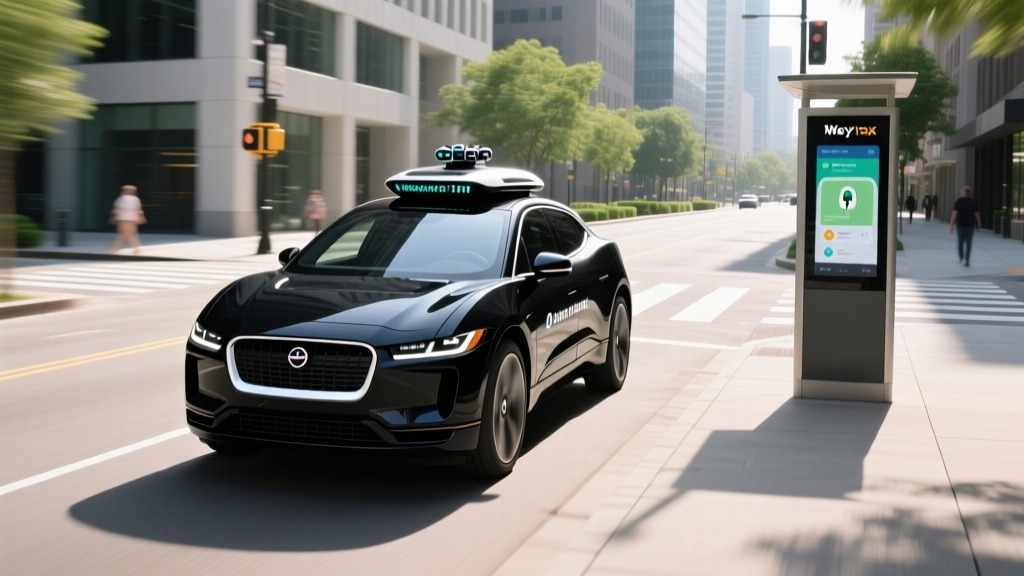
If you've seen a white Jaguar I-PACE navigating city streets with a distinctive roof-mounted sensor array, you've spotted one of the most advanced commercial robotaxis in operation. The Waymo I-PACE — officially the Jaguar I-PACE equipped with Waymo's 5th-generation Driver sensor suite — is the workhorse vehicle behind Waymo One, Alphabet's commercial ride-hailing service. Unlike the driver-assist systems in consumer EVs, these vehicles operate without anyone behind the wheel, making them a fundamentally different category of autonomous transportation.
This guide breaks down exactly where you can hail a Waymo I-PACE today, what the ride costs, how the technology works, and what the safety record actually shows — with real numbers, not marketing claims.
Is the Waymo I-PACE Truly Self-Driving? SAE Level 4 Explained
The short answer: yes, within its operational domain. The Waymo I-PACE operates at SAE Level 4 — high automation — meaning the vehicle handles all driving tasks without human intervention within a defined geographic area (geofence) and under specific conditions. There is no driver in the front seat, no steering wheel being monitored, and no expectation that a passenger will take over.
This is a critical distinction from consumer systems like Tesla's FSD (Supervised), GM's Super Cruise, or Ford's BlueCruise, which are all SAE Level 2 — partial automation that requires continuous driver supervision.
| Level | Name | Who Drives | Example |
|---|---|---|---|
| Level 0 | No Automation | Human | Any conventional car |
| Level 1 | Driver Assistance | Human (system assists) | Adaptive cruise control |
| Level 2 | Partial Automation | Human (must supervise) | Tesla Autopilot, FSD Supervised, BlueCruise |
| Level 3 | Conditional Automation | System (human on standby) | Mercedes Drive Pilot (limited markets) |
| Level 4 | High Automation | System (no human needed in domain) | Waymo I-PACE, Zoox |
| Level 5 | Full Automation | System (all conditions, everywhere) | Does not yet exist commercially |
The key constraint at Level 4 is the operational design domain (ODD) — the Waymo I-PACE can only operate within its mapped and approved geofence. If a route would take the vehicle outside that boundary, the system simply won't accept the ride request.
Where Can You Use the Waymo I-PACE Right Now?
As of 2026, Waymo One operates commercially in several major U.S. metro areas, with the I-PACE serving as the primary fleet vehicle. Service availability expands incrementally, and each city requires separate regulatory approval at both the state and local level.
| Metro Area | Status | Coverage Notes |
|---|---|---|
| Phoenix, AZ (East Valley) | Fully commercial — open to all | Chandler, Tempe, Mesa, Gilbert, parts of Scottsdale; largest continuous geofence (~250+ sq mi) |
| San Francisco, CA | Fully commercial — open to all | Most of SF proper; 24/7 service including nighttime |
| Los Angeles, CA | Commercial service active | Santa Monica, Hollywood, Downtown LA, select corridors |
| Austin, TX | Launched / expanding | Initial geofenced zone; phased expansion |
| Mountain View / Bay Area | Testing / limited access | Waymo's headquarters area; limited rider programs |
How to hail a ride: Download the Waymo One app (iOS/Android), enter your pickup and drop-off locations, and if both fall within the geofence, you'll receive a price estimate and ETA. The vehicle arrives autonomously — you unlock it via the app by tapping the roof sensor or using the in-app unlock button. There is no driver to greet you.
Pricing: Waymo I-PACE vs. Uber and Lyft
One of the most common questions is whether robotaxi rides are cheaper than traditional rideshare. The answer depends on the city, time of day, and trip length — but Waymo generally positions its pricing to be competitive with UberX and Lyft standard rides, not premium tiers.
| Service | Estimated Fare | Notes |
|---|---|---|
| Waymo One | $10–$18 | No surge pricing in the traditional sense; wait times vary by fleet density |
| UberX | $9–$20 | Subject to surge during peak hours |
| Lyft Standard | $9–$19 | Similar surge dynamics |
| Uber Comfort | $14–$25 | Premium vehicle category |
Waymo's pricing model typically includes a base fare, per-mile charge, and per-minute charge — similar to rideshare. However, Waymo does not implement the same aggressive surge multipliers that Uber and Lyft use during high-demand periods. In Phoenix and San Francisco, riders have reported that Waymo fares are often comparable to or slightly below UberX during normal hours, and noticeably cheaper during events or rush hour when rideshare surges hit 1.5x–2.5x.
Important cost note: You don't tip a Waymo — there's no driver. This alone can save $2–$5 per ride compared to a tipped rideshare trip.
The Waymo I-PACE Technology Stack: Lidar, Cameras, and Radar
The Jaguar I-PACE was chosen as Waymo's production vehicle because its all-electric platform provides the electrical architecture and packaging space needed for Waymo's 5th-generation sensor suite. Here's what's actually on the vehicle:
- Lidar: Multiple roof-mounted and body-integrated lidar units providing 360° high-resolution 3D point-cloud mapping. Waymo's custom lidar can detect objects at 300+ meters and generates millions of data points per second.
- Cameras: Dozen+ high-dynamic-range cameras positioned around the vehicle for traffic light detection, signage reading, lane marking identification, and object classification (pedestrian vs. cyclist vs. vehicle).
- Radar: Multiple radar units for velocity detection of surrounding objects and redundancy in low-visibility conditions where cameras and lidar can be impaired.
- External audio sensors: Microphones that detect sirens from emergency vehicles, enabling the I-PACE to pull over before a human passenger might even hear the siren.
- HD Maps: Pre-built centimeter-accurate maps of every street in the geofence, updated regularly. The vehicle localizes itself against these maps in real time.
- Compute: Custom Waymo compute platform in the trunk area processing sensor fusion, perception, prediction, and planning — reportedly consuming several kilowatts of power from the I-PACE's 90 kWh battery pack.
Unlike Tesla's camera-only approach to its FSD system, Waymo relies on sensor redundancy — lidar, camera, and radar each provide overlapping coverage so that if one modality is degraded (heavy rain obscuring cameras, for example), the others compensate. This multi-sensor philosophy is standard across nearly all Level 4 robotaxi operators, including Cruise (now restructured) and Zoox.
The I-PACE's 90 kWh lithium-ion battery (NMC chemistry) provides the energy reserve needed to power both propulsion and the compute/sensor stack. In practice, the sensor suite and compute platform reduce the vehicle's effective range compared to a stock I-PACE — Waymo vehicles typically return to charging depots more frequently than a consumer EV would need to.
Safety Record: What the Real Data Shows
Safety is the most scrutinized aspect of robotaxi operations, and Waymo publishes more transparency reports than most competitors. Here's what the data shows as of the latest available reports:
- Cumulative autonomous miles driven: 30+ million fully driverless miles across all Waymo One markets (as of late 2025 / early 2026 reporting).
- Contact rate: Waymo's published data shows a contact rate (any physical contact with another object, vehicle, or person) that is roughly 50–70% lower per million miles than human benchmarks in comparable urban environments, per their insurance-partner studies.
- NHTSA Standing General Order: Waymo, like all ADS operators, is required to report crashes involving their vehicles. Most reported incidents involve the Waymo vehicle being rear-ended or side-swiped by human-driven vehicles — not the robotaxi initiating contact.
- Notable incidents: In late 2023, a Cruise robotaxi (a competitor, not Waymo) dragged a pedestrian in San Francisco, leading to Cruise's permit suspension. Waymo was not involved, but the incident heightened regulatory scrutiny across the industry and underscored the importance of post-collision behavior programming.
- IIHS/NHTSA vehicle safety: The Jaguar I-PACE itself earned a 5-star Euro NCAP rating. U.S. NHTSA crash-test data for the I-PACE should be checked directly for the latest scores.
It's important to contextualize these numbers. Waymo operates in dense urban environments at relatively low speeds (typically under 45 mph within geofences), which differs from highway driving. The comparison benchmarks matter — Waymo's internal studies compare their crash rates to human drivers in the same cities and conditions, which is the most relevant comparison.
For deeper analysis, the NHTSA automated vehicle safety page maintains crash reporting data under the Standing General Order that applies to all Level 4 operators.
Current Limitations: What the Waymo I-PACE Cannot Do
Level 4 autonomy is impressive, but it is not Level 5. The Waymo I-PACE has well-defined limitations that riders should understand before booking:
- Geofencing: The vehicle will not drive outside its approved service area. If you try to book a ride that crosses the boundary, the app won't allow it.
- Heavy rain and fog: While the multi-sensor stack handles light rain well, extreme precipitation can degrade lidar and camera performance. Waymo may restrict service or route around affected areas during severe weather events.
- Construction zones: Rapidly changing road configurations (new barriers, shifted lanes, temporary signals) remain challenging. Waymo's HD maps are updated frequently, but sudden overnight construction can cause the vehicle to take conservative routes or pause.
- No highway driving (in most markets): Waymo's urban geofences generally exclude limited-access highways. Your ride will use surface streets, which can mean longer trip times for cross-city routes.
- Pickup/drop-off constraints: The vehicle can only stop at safe, legal locations. It won't pull into a private garage, a narrow alley, or a loading zone with active restrictions.
- No interstate travel: You cannot take a Waymo I-PACE from Phoenix to Tucson, even though both are in Arizona. Each metro area is a separate geofenced island.
- Accessibility: The I-PACE is a crossover SUV, which means step-in height is higher than a sedan. Waymo has been testing wheelchair-accessible vehicles (including the Zeekr RT minivan) but availability varies by market.
These limitations aren't unique to Waymo — they apply broadly to all current Level 4 services. The technology is excellent within its domain, but that domain is deliberately narrow by design.
Regulatory Landscape: Who Approves Robotaxi Operations?
Robotaxi operations in the U.S. are governed by a patchwork of state and local regulations. There is no single federal "robotaxi license." Instead, operators need approvals from multiple agencies:
- State level: Each state sets its own rules for autonomous vehicle testing and deployment. Arizona has been among the most permissive, requiring minimal permitting for driverless operations. California requires permits from both the California DMV (testing) and the California Public Utilities Commission (CPUC) for commercial passenger service.
- Federal level: NHTSA regulates vehicle safety standards but does not currently have a comprehensive framework for ADS (Automated Driving System) certification. The Standing General Order requires crash reporting from all ADS operators.
- Local/city level: Cities often negotiate directly with operators on issues like parking, curb access, congestion impact, and equity requirements. San Francisco's Board of Supervisors and the SFMTA have been vocal about managing robotaxi density and behavior in the city.
This regulatory fragmentation means that expansion to new cities is slow and politically complex. A company can have the technology ready but still wait months or years for the local permits needed to operate commercially.
The Jaguar I-PACE as an EV Platform: Quick Specs
For EV enthusiasts curious about the underlying vehicle, here are the key specs of the Jaguar I-PACE that Waymo uses as its robotaxi platform:
| Specification | Jaguar I-PACE (Stock Consumer) |
|---|---|
| Battery Capacity | 90 kWh (NMC lithium-ion) |
| EPA Range | ~246 miles (stock); reduced in Waymo config due to sensor/compute load |
| Motor Power | 394 hp / 512 lb-ft (dual motor AWD) |
| 0–60 mph | 4.5 seconds |
| DC Fast Charging | Up to 100 kW (CCS); 10–80% in ~40 min |
| Level 2 Charging | 11 kW onboard charger; ~9 hours for full charge |
| Efficiency | ~44 MPGe combined (stock consumer variant) |
Note that Waymo's fleet vehicles are maintained at dedicated depots and charged using a mix of Level 2 and DC fast charging infrastructure. The compute and sensor load draws additional power from the traction battery, so the effective range of a Waymo-configured I-PACE is lower than the consumer EPA figure. Fleet operations account for this with strategic charging schedules.
Frequently Asked Questions
Can I buy a Waymo I-PACE for personal use?
No. The Waymo-configured I-PACE is not available for consumer purchase. The sensor suite, compute platform, and software are proprietary to Waymo and are only deployed in their commercial fleet. If you want a Jaguar I-PACE for personal use, you'd be buying the standard consumer model with no autonomous capability.
How much does a Waymo ride cost compared to Uber?
For a typical 5-mile urban trip, Waymo One fares generally fall in the $10–$18 range, which is comparable to UberX ($9–$20) and Lyft Standard ($9–$19). The key advantage: Waymo doesn't surge-price as aggressively during peak demand, and there's no driver to tip. During high-demand events, Waymo can be significantly cheaper.
Has a Waymo I-PACE ever been in a serious crash?
Waymo vehicles have been involved in minor incidents — mostly being rear-ended or sideswiped by human drivers. Under NHTSA's Standing General Order, all ADS-related crashes are reported. Waymo's published data indicates their contact rate per million miles is substantially lower than the human benchmark in comparable urban settings. There has been no widely reported fatal crash involving a driverless Waymo vehicle as of early 2026.
What happens if the Waymo I-PACE encounters a situation it can't handle?
The vehicle is programmed to execute a "minimal risk condition" — essentially, it will safely pull over to the side of the road, activate hazard lights, and stop. Waymo also has remote assistance operators who can provide guidance to the vehicle (not remote driving, but high-level routing or decision support) when the system encounters an ambiguous scenario like an unusual construction zone.
Is Waymo expanding to more cities in 2026?
Waymo has announced plans to expand to additional U.S. markets, and Austin, TX has been one of the more recent additions. However, each new city requires regulatory approval, HD mapping, and fleet deployment — a process that takes months. Check the Waymo One app for the latest service area map. Any city not shown as "available" in the app is not yet operational, regardless of press announcements.
How does Waymo's technology compare to Tesla's FSD?
They are fundamentally different categories. Waymo is SAE Level 4 — no driver present, operating within a geofence, using lidar + cameras + radar. Tesla FSD (Supervised) is SAE Level 2 — a driver must remain attentive and is legally responsible for the vehicle at all times. Tesla uses a camera-only approach without lidar. Waymo's system is commercially proven for driverless rides; Tesla's FSD requires active human supervision and is not approved for driverless operation anywhere.