The Short Answer: No, You Cannot Sit in the Driver's Seat of a Waymo
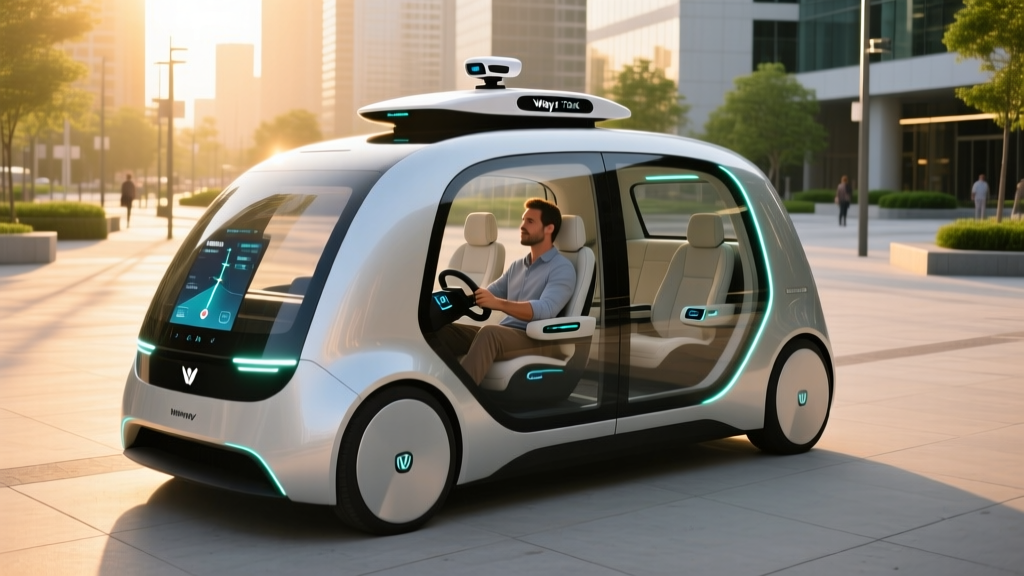
If you've ever watched a Waymo pull up to a curb with an empty driver's seat and wondered whether you could slide behind the wheel — the answer is a firm no. Waymo's consumer robotaxi service, branded Waymo One, operates as a fully driverless ride-hailing platform. There is no steering wheel available for passenger use in their current fleet, no pedals on the passenger side, and no scenario in which a rider takes control of the vehicle. You are a passenger, not a driver, and the car's SAE Level 4 autonomous system handles every aspect of the trip within its approved operational design domain.
This isn't a policy quirk — it's a fundamental design and regulatory distinction that separates robotaxis from the driver-assist systems you might find in a Tesla, Ford, or GM vehicle you can buy today. Understanding that difference is critical before you book your first ride or compare robotaxi services to conventional rideshare.
Waymo operates at SAE Level 4 — high automation within a defined operational design domain (specific geofenced areas, certain weather conditions). The system performs all driving tasks without human intervention in those conditions. This is fundamentally different from:
- Level 2 (Driver Assist): Tesla Autopilot, FSD Supervised, GM Super Cruise, Ford BlueCruise — the human driver must remain engaged and is legally responsible for the vehicle at all times.
- Level 3 (Conditional Automation): Mercedes DRIVE PILOT (limited to specific highway conditions in approved regions) — the system drives but can hand control back to the driver with notice.
- Level 5 (Full Automation): No production system exists at this level. Level 5 would mean any road, any condition, no human needed — a milestone no company has reached.
When you ride in a Waymo, you are in a Level 4 vehicle: no driver present, no driver needed, within its approved service area.
Where Can You Actually Use Waymo One Right Now?
Waymo has steadily expanded its commercial robotaxi footprint, but availability remains geographically constrained. Unlike Uber or Lyft, which operate virtually everywhere, Waymo One runs within tightly mapped geofences in select metro areas. As of early 2026, here is the operational landscape:
| City | Status | Service Area Notes |
|---|---|---|
| Phoenix, AZ | Fully operational | Largest service area (~225+ sq mi); covers Chandler, Tempe, Mesa, Scottsdale, Phoenix Sky Harbor Airport |
| San Francisco, CA | Fully operational | City-wide coverage; approved for 24/7 operation including highway segments |
| Los Angeles, CA | Operational (expanding) | Covers downtown LA, Hollywood, Santa Monica, Westside; gradual geographic expansion ongoing |
| Austin, TX | Operational (limited) | Initial service area covering downtown and South Austin; expansion in progress |
Waymo has announced intentions to expand to additional cities, but announced service is not live service. If you're outside these metros — or on the fringe of a geofence boundary — the app will simply not allow you to book a ride to or from that location. The geofence is precise: a street on one side of an intersection may be in-bounds while the next block is not.
How Waymo's Technology Stack Works: Lidar, Cameras, and Geofencing
The reason you can't sit in the driver's seat isn't just regulatory — it's because the vehicle is engineered from the ground up as a platform that doesn't need one. Waymo's current fleet primarily uses the Jaguar I-PACE (a battery-electric SUV with a 90 kWh battery pack and ~234 miles of EPA range) and has begun integrating the Zeekr RT, a purpose-built robotaxi vehicle designed in partnership with Geely's Zeekr brand.
- Lidar: Multiple roof-mounted and body-integrated lidar units provide 360° 3D point-cloud mapping up to ~500 meters. Lidar is the core differentiator vs. camera-only approaches (like Tesla's FSD) — it measures distance via laser pulses and works reliably in low light.
- Cameras: A network of high-resolution cameras handles object classification, traffic-light state detection, signage reading, and lane-marking identification.
- Radar: Millimeter-wave radar supplements lidar for velocity detection of moving objects, particularly in rain or fog where lidar reflectivity can increase.
- HD Maps + Geofencing: Waymo pre-maps every inch of its service area at centimeter-level precision. The car doesn't navigate unknown roads — it operates within a known, validated environment. This is the geofence constraint: the car simply won't operate outside its mapped domain.
- Onboard Compute: Custom-designed Waymo compute platforms process sensor fusion data in real time, making driving decisions (routing, lane changes, yielding, stopping) without any cloud dependency for safety-critical functions.
The lidar-versus-camera debate is one of the defining technical splits in autonomous driving. Tesla's FSD Supervised relies entirely on cameras and neural networks — a lower-hardware-cost approach but one that remains SAE Level 2, requiring driver supervision. Waymo's lidar-heavy stack is more expensive per vehicle (estimated $100,000+ in sensor and compute hardware per vehicle, though costs have declined significantly across each hardware generation) but enables the Level 4 driverless operation that makes the robotaxi model possible.
Pricing: How Does Waymo Compare to Uber and Lyft?
Waymo One pricing is structured similarly to conventional rideshare — you get an upfront price estimate before confirming your ride — but the economics differ in important ways. There's no human driver to pay, but the vehicle hardware, remote-assistance infrastructure, mapping, and fleet operations carry substantial cost.
| Factor | Waymo One | Uber / Lyft (standard) |
|---|---|---|
| Base fare (typical 5-mile trip) | $12–$18 | $10–$16 |
| Surge / dynamic pricing | Less frequent; fleet supply managed centrally | Common during peak demand |
| Tipping | Not applicable (no driver) | Expected ($2–$5+ typical) |
| Wait time charges | Typically 2–3 min grace period | Varies by market |
| Shared / pooled rides | Not available (private ride only) | Available in some markets (lower fare) |
| Airport rides | Available at Phoenix Sky Harbor; SFO approved | Universally available |
In practice, a typical Waymo ride costs roughly the same as an UberX or Lyft Standard ride in the same market — sometimes slightly more, sometimes less depending on demand and distance. The key economic advantage for the rider: no tipping expectation and generally more consistent pricing without aggressive surge multipliers. The key disadvantage: you can only use it within the geofence, and you can't request rides in the vast majority of US cities.
Safety Data: What the Numbers Actually Show
Safety is the most scrutinized — and most misunderstood — aspect of robotaxi operations. Waymo has published safety performance data and has been subject to regulatory incident reporting requirements, giving us concrete numbers rather than marketing claims.
- Cumulative autonomous miles driven: Over 50 million fully driverless miles as of late 2025, across all operational cities.
- Injury-causing crash rate: Waymo's published analysis (peer-reviewed and submitted to NHTSA) indicates its vehicles are involved in injury-causing crashes at a rate approximately 85% lower than the human benchmark in comparable urban environments.
- Police-reported crash rate: Approximately 57% lower than human drivers in similar operating conditions.
- Contact incidents: The vast majority of Waymo-involved incidents are low-speed contacts (often under 5 mph) where the vehicle was rear-ended or sideswiped by a human-driven vehicle — not at-fault collisions initiated by the autonomous system.
- Recalls and software updates: Like all autonomous operators, Waymo has issued voluntary safety recalls (filed with NHTSA) to address specific software behaviors — a regulatory transparency mechanism, not necessarily indicative of fleet-wide danger.
Sources: NHTSA Automated Vehicle Safety, Waymo Safety Reports.
Context matters enormously here. Robotaxis operate in dense urban environments at relatively low speeds (typically under 45 mph within city geofences), which reduces crash severity but increases the frequency of close-interaction scenarios. The comparison benchmark — human drivers in the same cities — includes distracted, impaired, and fatigued drivers, which sets a relatively low bar. Waymo's data suggests it clears that bar meaningfully, but the sample size, while growing, still represents a fraction of total urban vehicle-miles traveled.
For comparison, IIHS data shows that human drivers in the US experience roughly 5.5 police-reported crashes per million vehicle-miles. Waymo's reported rate falls below that benchmark, but direct statistical comparison requires careful normalization for road type, speed, weather, and time of day — all factors where Waymo's operating envelope is narrower than the average human driver's.
Current Limitations: Where Robotaxis Still Fall Short
Level 4 autonomy is impressive engineering, but "Level 4 within a geofence" carries real-world constraints that riders need to understand before booking:
- Geofence boundaries: You cannot travel outside the mapped service area. If your trip crosses the geofence line, the app won't let you book it. This means suburban and rural destinations are generally unavailable.
- Weather constraints: Heavy rain, dense fog, and flooding can trigger service slowdowns or temporary suspensions. Waymo's lidar handles light rain well, but severe weather degrades sensor performance and the system is designed to pull over safely rather than push through conditions it can't handle.
- Construction zones: Rapidly changing road configurations (new lane closures, detours not yet reflected in HD maps) can cause the vehicle to stop and request remote assistance, adding minutes to your trip.
- No highway driving (most markets): While Waymo has received approval for certain highway segments in San Francisco, most rides are surface-street only. You can't take a Waymo on a long interstate trip.
- Limited passenger accommodations: No car seats for infants/toddlers, limited cargo space (it's an I-PACE or Zeekr RT trunk), no pets unless in carriers, and no eating or drinking in the vehicle. You also can't make multiple stops on a single trip.
- Wait times: Fleet density varies by time and location. In Phoenix at 2 AM, you may wait 15+ minutes. During peak hours in SF, waits are typically 3–7 minutes.
- Remote assistance delays: When the vehicle encounters an edge case it can't resolve autonomously (an unusual construction setup, a police officer directing traffic with hand signals), it contacts a remote guidance operator. This can add 1–5 minutes while the vehicle waits for instructions.
These limitations are the practical reason why robotaxis complement rather than replace conventional rideshare and personal vehicle ownership. For a predictable urban trip within a well-mapped corridor, Waymo is seamless. For a trip to the suburbs in a rainstorm with a toddler and a stroller? You're calling an Uber or driving yourself.
Regulatory Landscape: Who Approves Robotaxi Operations?
Robotaxi deployment in the United States is governed by a patchwork of state and local regulations — there is no single federal license that allows a company to operate driverless vehicles nationwide.
- California: The California Public Utilities Commission (CPUC) issues permits for commercial robotaxi service. The California DMV separately issues testing and deployment permits. Both agencies have the authority to suspend operations — as seen when Cruise's permit was suspended in late 2023 following a safety incident in San Francisco.
- Arizona: Takes a more permissive regulatory approach. Waymo has operated commercially in the Phoenix metro since 2020 with relatively fewer state-imposed restrictions, which is partly why Phoenix became the first fully driverless market.
- Texas: Austin's entry required coordination with local authorities and the Texas Department of Licensing and Regulation. State law permits autonomous vehicle operation with appropriate insurance and registration.
- Federal (NHTSA): The National Highway Traffic Safety Administration does not currently "certify" autonomous systems the way it certifies vehicle crashworthiness. Instead, it exercises authority through Standing General Orders requiring incident reporting, recall authority for software defects, and investigation powers. A crash involving a Level 2+ or higher system triggers mandatory reporting within 24 hours.
The regulatory environment remains fluid. Each new city requires separate approvals, and political dynamics (public sentiment after an incident, local government priorities, lobbying from rideshare incumbents) can accelerate or stall expansion. This is why Waymo's city-by-city rollout, while frustrating for eager riders, reflects regulatory reality rather than purely technical readiness.
Is This Truly Self-Driving or Just Driver-Assist?
This is the question that generates the most confusion in the EV and autonomous vehicle space, and the answer has real safety implications.
Waymo One is genuinely self-driving within its operational domain. There is no human driver in the vehicle. There is no steering wheel accessible to passengers. The system handles all aspects of the dynamic driving task — steering, braking, accelerating, signaling, navigating intersections, yielding to pedestrians, responding to traffic signals — without human intervention. A remote assistance operator can provide high-level guidance (e.g., "proceed around the obstacle on the left") but does not remotely steer or brake the vehicle in real time.
This stands in stark contrast to consumer vehicles with advanced driver-assist systems:
| System | SAE Level | Driver Required? | Legally Responsible Party |
|---|---|---|---|
| Waymo One | Level 4 | No | Waymo (the operator) |
| Tesla FSD (Supervised) | Level 2 | Yes — always | The human driver |
| GM Super Cruise | Level 2 | Yes — always | The human driver |
| Ford BlueCruise | Level 2 | Yes — always | The human driver |
| Mercedes DRIVE PILOT | Level 3 | Conditionally (can disengage in approved zones) | Mercedes (when active) / Driver (when system requests handoff) |
If you buy a Tesla and engage FSD Supervised, you are still the driver. You must monitor the road, keep your hands available, and you bear full legal liability for any crash. Calling these systems "self-driving" is not just imprecise — it's dangerous, because it encourages the exact complacency that leads to crashes. Waymo, by contrast, has no driver to be complacent. The system either handles the trip or it doesn't operate.
How to Actually Book a Waymo Ride: Step by Step
- Download the Waymo One app (iOS or Android). It's separate from Google Maps, though Google Maps may surface Waymo as a transit option in supported cities.
- Create an account with a payment method (credit/debit card). No waitlist remains in fully operational cities — you can book immediately.
- Enter your pickup and drop-off locations. The app will confirm whether both are within the service area. If not, it will suggest the nearest valid location.
- Review the upfront price and estimated pickup time. Prices are locked at confirmation — no meter running.
- Meet the car. The app shows the vehicle's approach in real time. When it arrives, confirm the license plate and use the app to unlock the doors (or enter a PIN on the rear-door screen, depending on the vehicle generation).
- Buckle up and confirm you're ready. The rear-seat screen prompts all passengers to fasten seatbelts. The trip begins only after confirmation.
- Ride. The screen shows the route, current speed, and detected objects (cars, pedestrians, cyclists) in real time — a useful transparency feature. You can adjust music and climate from the rear screen.
- Arrive and exit. The car pulls to the curb, unlocks the doors, and the trip ends automatically. Your card is charged.
Frequently Asked Questions
Can I sit in the front passenger seat of a Waymo?
In the Jaguar I-PACE fleet, the front passenger seat is typically available for riders to sit in, though most passengers choose the rear seats. The driver's seat area is sectioned off and contains no accessible controls. In the Zeekr RT purpose-built vehicles, the interior layout is designed around rear-seat passengers with no traditional "front seat" experience.
What happens if the Waymo gets into an accident while I'm riding?
Waymo carries commercial liability insurance covering passengers. In the event of a collision, the vehicle is designed to pull over safely, contact emergency services if needed, and connect you with Waymo support via the in-car screen and app. You are not liable for the vehicle's operation — Waymo, as the operator, bears responsibility.
Can a Waymo drive me to a city outside its service area?
No. The geofence is absolute. If you need to travel from Phoenix to Tucson or from San Francisco to Sacramento, Waymo cannot make that trip. You'll need conventional transportation for inter-city travel.
How does Waymo handle a situation where a police officer is directing traffic?
This is a known edge case. Waymo's system can detect police presence and, in many cases, interpret hand signals. However, complex or unusual traffic-control scenarios may cause the vehicle to stop and request remote guidance. This is a safety-first design choice — the car would rather wait than misinterpret an instruction.
Is Waymo available 24 hours a day?
In Phoenix and San Francisco, yes — Waymo One operates 24/7. In newer markets like Austin, hours may initially be more limited as the service ramps up. Late-night availability also depends on fleet density; at 3 AM, wait times may be longer.
Can I use Waymo if I use a wheelchair?
Waymo has been developing wheelchair-accessible vehicle (WAV) options, but availability is limited. The standard I-PACE fleet is not wheelchair-accessible. Check the app for WAV availability in your market, as this is an area of ongoing expansion.
Will Waymo eventually let me sit in the driver's seat and drive manually?
No. Waymo's entire business model and vehicle design philosophy is built around removing the human driver, not offering a manual-driving option. If you want to drive yourself, Waymo is not the service for you — and the company has no announced plans to change this approach.
The bottom line for prospective robotaxi riders: Waymo One offers a genuinely driverless experience within well-defined urban boundaries, at prices competitive with conventional rideshare, with a safety record that — based on available data — compares favorably to human drivers in similar conditions. But it is not a replacement for personal vehicle ownership, it does not operate everywhere, and you will never sit in the driver's seat. The car drives itself, or it doesn't drive at all.