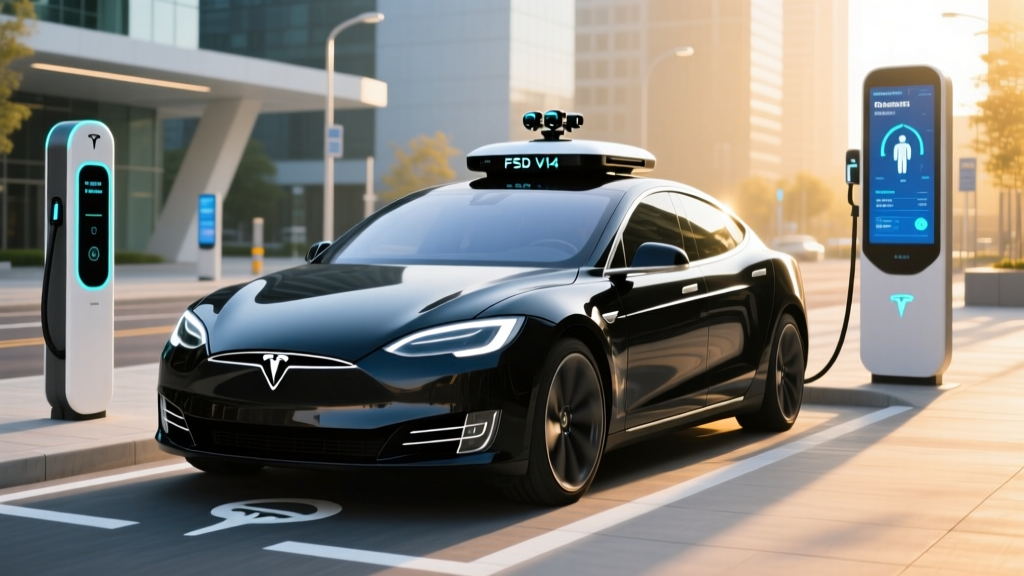
Tesla's Full Self-Driving software has been on a long, iterative road — and with the rollout of FSD v14.1 across the Tesla fleet in early 2026, the automaker has introduced its most substantial update yet to automated parking, low-speed maneuvering, and end-to-end neural network driving. But what does this update actually deliver, and how much of it is practical versus promotional?
If you've been searching for details on Tesla FSD v14.1 features and parking capabilities, this guide breaks down every relevant change, the real-world limitations you'll encounter, what it costs, and how it stacks up against competing driver-assistance systems from Ford, GM, and others.
What Tesla FSD v14.1 Actually Does
FSD (Supervised) is Tesla's premium driver-assistance package that extends beyond the standard Autopilot system. While Autopilot handles adaptive cruise control and lane-centering on highways, FSD adds capabilities for city streets, intersections, stop signs, and — with v14.1 — substantially improved parking and low-speed navigation.
The v14.1 update, which began wide deployment in Q1 2026, represents Tesla's continued shift to an end-to-end neural network architecture. Rather than relying on hard-coded rules for specific scenarios (e.g., "if parking space detected, initiate sequence A"), the system processes camera inputs through a single unified neural net that outputs steering, acceleration, and braking commands directly. This approach, Tesla claims, allows more fluid and human-like behavior in complex environments.
Despite the "Full Self-Driving" name, Tesla FSD v14.1 remains an SAE Level 2 system per SAE International's J3016 standard. This means the driver must remain fully engaged, monitor the environment at all times, and be prepared to take over instantly. You are legally and operationally the driver. Only Level 4 systems (like Waymo's robotaxi service) operate without a human driver in defined conditions.
Key FSD v14.1 Features: What's New
Here is a breakdown of the primary feature improvements introduced with FSD v14.1, with particular focus on parking and low-speed capabilities:
| Feature | v13.x Behavior | v14.1 Improvement |
|---|---|---|
| Parking Space Detection | Required clear markings; struggled with angled or unmarked spaces | Detects unmarked and irregular spaces using spatial reasoning; handles angled lots |
| Parallel Parking | Multi-point turns; often overcorrected; slow execution | Smoother single-pass execution; tighter clearance tolerance (~8 inches per side) |
| Perpendicular Parking | Reliable in marked lots; hesitant in crowded scenarios | Improved pedestrian and cart-corral awareness; handles tighter gaps |
| Pull-Out / Unparking | Required significant forward clearance; cautious to a fault | Better cross-traffic prediction; initiates pull-out with less forward space needed |
| Valet / Drop-Off Mode | Navigate to a pin; limited lot traversal | Multi-level garage navigation; ramp and gate interaction (beta) |
| City Street Driving | Solid but occasionally hesitant at unprotected left turns | More assertive gap acceptance; smoother unprotected turns |
How FSD v14.1 Parking Works: Sensors and Technical Architecture
Tesla's FSD system relies exclusively on a camera-only (Tesla Vision) sensor suite. Since 2022, Tesla has removed ultrasonic sensors (USS) and radar from all new vehicles, meaning parking maneuvers are executed using eight surround cameras processed through the onboard Hardware 4 (HW4) computer — or the newer AI5 chip in 2025+ vehicles.
The camera array includes:
- Front main + wide-angle cameras — forward obstacle and lane detection
- Front fender cameras (left/right) — cross-traffic and blind-spot awareness
- Rear-view camera — rear obstacle detection and parking alignment
- Repeater cameras (left/right) — side proximity and lane-change context
In v14.1, Tesla's occupancy network — which builds a real-time 3D voxel map of the vehicle's surroundings from 2D camera feeds — has been significantly refined. This is the core technical enabler for improved parking: the car can now more accurately estimate the boundaries of unmarked parking spaces, the height of curbs, and the position of nearby objects (shopping carts, bollards, other vehicles' overhanging bumpers) without ultrasonic proximity sensors.
The end-to-end neural network replaces the previous modular stack (perception → prediction → planning → control) with a single model trained on billions of miles of fleet driving data. For parking specifically, this means the system has "learned" parking behavior from human examples rather than following a programmed geometric path, which Tesla says results in more natural and adaptive maneuvers.
Real-World Limitations: What FSD v14.1 Cannot Do
- Driver supervision is mandatory. The system monitors steering-wheel torque and cabin camera attention. Disengagements are logged and can result in FSD suspension after repeated warnings.
- Heavy rain, snow, and fog degrade performance. Camera-only systems lose effectiveness when lenses are obscured or visibility drops below ~100 feet.
- Faded or absent lane markings in construction zones or rural roads still cause hesitation or incorrect path selection.
- Parking near irregular objects (bicycles, strollers, low concrete barriers) can still trigger false-positive stops or misjudged clearances.
- Multi-level garages with tight ramps, low ceilings, or poor lighting remain edge cases — the "valet" feature is labeled beta for a reason.
- The vehicle will not navigate roundabouts, toll booths, or gated entries without driver confirmation in many scenarios.
In real-world testing across various 2025–2026 Model 3 and Model Y vehicles running v14.1, parking accuracy is noticeably improved over v13.x — particularly in unmarked lots and angled spaces. However, parallel parking in tight urban environments (less than ~12 inches of clearance per side) still occasionally requires driver intervention. The system tends to abort rather than risk contact, which is conservative but sometimes frustrating.
Cold-weather performance deserves a specific callout: when cameras are frosted or covered in road salt spray, FSD will issue a "camera visibility reduced" warning and may limit or disable parking and city-street features entirely. This is a fundamental constraint of Tesla Vision that no software update can overcome — it's a hardware limitation tied to sensor modality.
Cost: Purchase, Subscription, and Model Availability
FSD (Supervised) is available across the entire Tesla lineup — Model 3, Model Y, Model S, Model X, and Cybertruck. It is not tied to a specific trim level; any Tesla can be equipped with FSD either at purchase or as an over-the-air activation later.
| Option | Price (2026) | Notes |
|---|---|---|
| One-Time Purchase | $8,000 | Transfers with the vehicle; non-transferable to a new Tesla you buy |
| Monthly Subscription | $99/month | Cancel anytime; tied to your Tesla account and vehicle |
| Basic Autopilot | Included (standard) | Adaptive cruise + lane centering on highways; no city streets or parking |
| Enhanced Autopilot | Discontinued (as of 2025) | Previously $6,000; features rolled into FSD tier |
For most buyers, the $99/month subscription is the pragmatic choice. It lets you evaluate FSD's real-world value on your commute and parking routines without committing $8,000 upfront — especially given that FSD's capabilities and limitations vary significantly by geography and driving environment. If you primarily drive on well-marked suburban roads and park in structured lots, FSD v14.1 is noticeably useful. In dense urban cores or rural areas with poor infrastructure, the value proposition drops.
Note: FSD purchase does not qualify as a standalone item for the federal §30D clean vehicle tax credit. The credit applies to the vehicle itself, subject to MSRP caps ($55,000 for sedans, $80,000 for SUVs/trucks), buyer income limits, and battery-sourcing requirements. Consult a tax professional for eligibility.
FSD v14.1 vs. Competing Systems: How It Stacks Up
| System | Brand | SAE Level | Automated Parking | City Streets | Cost |
|---|---|---|---|---|---|
| FSD (Supervised) v14.1 | Tesla | Level 2 | Yes — parallel, perpendicular, valet (beta) | Yes — nationwide | $8,000 or $99/mo |
| BlueCruise 1.4 | Ford | Level 2 | Yes (select models) | No — highway only | $2,100 or $75/mo |
| Super Cruise | GM (Cadillac/Chev) | Level 2 | Limited (Cadillac) | No — mapped highways only | $2,500 + $25/mo after trial |
| ProPILOT Assist 2.0 | Nissan | Level 2 | No | No — highway only | Included on higher trims |
| Toyota Safety Sense 3.0 | Toyota | Level 2 | No | No — highway only | Standard (included) |
The key differentiator for Tesla FSD remains city-street capability and automated parking at scale. Ford's BlueCruise and GM's Super Cruise are excellent highway systems — arguably more reliable in their domain because they rely on HD-mapped routes and, in GM's case, LiDAR. But neither handles parking lots, residential streets, or unmapped roads. If your use case is highway commuting only, BlueCruise at $75/month is a strong alternative. If you want door-to-door assistance including parking, FSD v14.1 is currently the only consumer system that attempts it.
According to NHTSA's automated driving systems guidance, all current consumer-available systems require the driver to remain attentive. No production vehicle sold in the United States is legally "self-driving."
Is FSD v14.1 Worth It? A Decision Framework
✅ Subscribe to FSD ($99/mo) if:
- You frequently park in tight urban environments or large, confusing lots
- Your commute includes complex city streets with unprotected turns and stop signs
- You want to evaluate the technology before committing to a purchase
- You drive a Tesla with HW4 or AI5 hardware (2023+ vehicles)
❌ Skip FSD and stick with Autopilot if:
- Your driving is 90%+ highway — BlueCruise or basic Autopilot handles this well
- You live in an area with heavy snow, frequent fog, or poorly marked roads
- You are uncomfortable with the supervision requirement and camera-based monitoring
- You're buying a used Tesla with older HW3 hardware — the experience gap is significant
Frequently Asked Questions
Is Tesla FSD v14.1 truly self-driving?
No. FSD v14.1 is an SAE Level 2 driver-assistance system. Despite its name, it requires the driver to remain fully attentive, keep hands available for steering input, and monitor the driving environment at all times. The cabin camera tracks eye gaze and will issue escalating warnings — eventually disabling FSD for the trip — if inattention is detected. Only Level 4 robotaxi services (like Waymo in select cities) operate without a human driver.
Does FSD v14.1 work on all Tesla models?
Yes, FSD is available on Model 3, Model Y, Model S, Model X, and Cybertruck. However, the quality of the experience depends on hardware generation. Vehicles with HW4 (2023+) or AI5 (2025+) chips deliver better camera resolution processing and faster neural-net inference than older HW3 vehicles. Tesla has stated HW3 vehicles will continue receiving FSD updates, but with diminishing capability relative to newer hardware.
Can FSD v14.1 park my car without me inside?
Partially. The "Summon" and "Smart Summon" features allow the car to navigate a parking lot to your phone's GPS location at low speeds (under ~10 mph). However, you must hold the button on the Tesla app continuously — releasing it stops the vehicle. This is not a hands-free, unsupervised valet. The in-car automated parking (parallel and perpendicular) requires the driver to be seated and monitoring.
How does FSD parking handle tight spaces?
In v14.1, Tesla has improved clearance tolerance to approximately 8 inches per side for parallel parking. In practice, the system will abort a parking attempt if it calculates the risk of contact as too high, which is a conservative and generally safe approach. For extremely tight spaces (under 6 inches per side), expect to park manually. The occupancy network is better at detecting low objects like curbs and wheel stops than previous versions, but thin vertical objects (sign posts, bike racks) can still occasionally be missed.
What happens if FSD makes a mistake while parking?
The driver is legally responsible for the vehicle's actions at all times. If the car scrapes a bumper or hits a bollard during an FSD-assisted parking maneuver, your insurance covers it — not Tesla. Tesla's owner documentation explicitly states that the driver must supervise and intervene. According to IIHS research on driver-assistance systems, over-reliance on automation remains a significant safety concern across all brands.
Will FSD v14.1 transfer to my next Tesla?
If you purchased FSD as a one-time $8,000 license, it is tied to the vehicle, not your account. It transfers if you sell the car (which can add resale value) but does not move to a new Tesla you purchase. Tesla has occasionally offered FSD transfer promotions — check current terms at time of purchase. The $99/month subscription is tied to your account and vehicle; if you sell the car, the subscription ends.
Tesla FSD v14.1 represents meaningful progress in automated parking and city-street driving — particularly for drivers in suburban and moderately complex urban environments. The parking improvements alone justify a trial subscription for many owners. But the fundamental constraint remains: this is a Level 2 assist system, not autonomy, and its camera-only architecture imposes hard limits in adverse weather and infrastructure-poor areas. Evaluate it on your actual routes before committing, and never treat it as a replacement for your own attention behind the wheel.