If you're a dog owner living in one of Waymo's operating cities, you've probably asked yourself: does Waymo allow dogs? The short answer is yes — but with important caveats depending on whether your dog is a pet or a service animal, and how well-behaved your four-legged companion is inside a driverless vehicle with no one to intervene if things go sideways.
This guide breaks down exactly what Waymo's pet and service animal policies entail, then zooms out to cover everything a first-time or curious rider needs to know about hailing a robotaxi in 2026 — from where the service operates to how much it costs, how safe the fleet really is, and what the technology under the hood actually looks like.
Does Waymo Allow Dogs? The Official Pet Policy
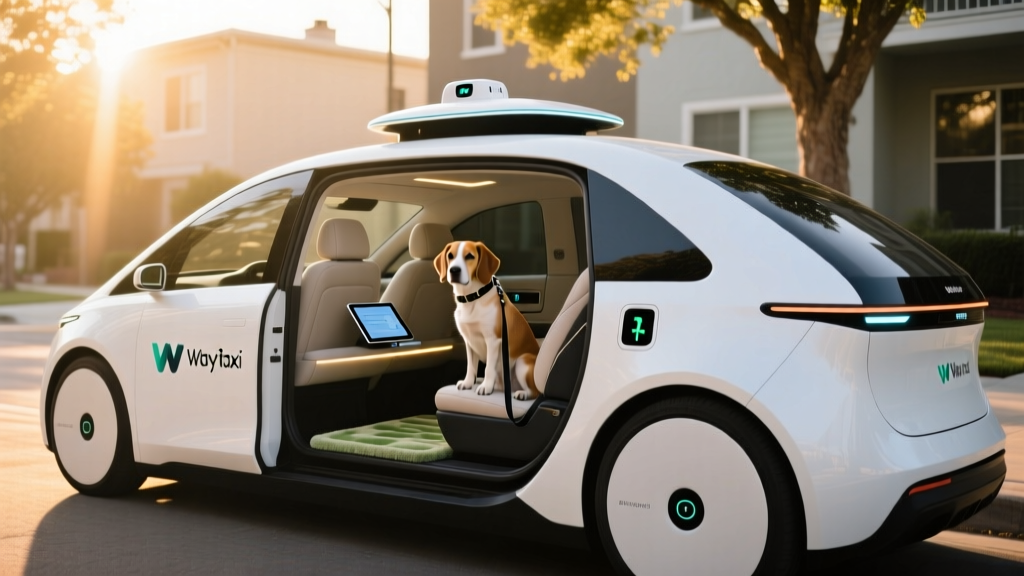
Waymo's rider policy permits service animals in all vehicles at all times, in compliance with the Americans with Disabilities Act (ADA). If your dog is a trained service animal performing a specific task related to a disability, no driver — human or AI — can refuse your ride.
For pet dogs, Waymo's policy is more nuanced. The company does not explicitly ban pet dogs from its Waymo One fleet, but riders are held fully responsible for any damage, soiling, or disruption their animal causes inside the vehicle. Because Waymo vehicles are unmanned (there is no driver to ask your dog to settle down), the practical reality is this:
- Small, crated, or well-trained dogs are generally fine — treat the interior like a shared rental space.
- Large, uncrated, or anxious dogs are risky. Without a human driver to mediate, a dog that scratches upholstery, has an accident, or becomes agitated could result in cleaning fees or a temporary account suspension.
- Cats and other pets fall under the same rider-responsibility framework. Keep them secured.
SAE Autonomy Levels: Where Waymo Sits vs. Tesla FSD and Others
A common mistake in EV and autonomous vehicle coverage is lumping Waymo's driverless taxis into the same category as Tesla's Full Self-Driving (Supervised) or GM's Super Cruise. They are fundamentally different systems operating at different SAE automation levels.
| SAE Level | Name | Driver Required? | Examples |
|---|---|---|---|
| Level 0 | No Automation | Full control | Legacy vehicles |
| Level 1 | Driver Assistance | Yes, full attention | Adaptive cruise, lane-keep |
| Level 2 | Partial Automation | Yes, hands on or eyes on | Tesla Autopilot/FSD (Supervised), BlueCruise, Super Cruise |
| Level 3 | Conditional Automation | Eyes off in limited conditions | Mercedes DRIVE PILOT (limited markets) |
| Level 4 | High Automation | No driver needed in geofence | Waymo One, Zoox, Baidu Apollo (China) |
| Level 5 | Full Automation | No driver, anywhere | Does not yet exist commercially |
Where Can I Use Waymo One Right Now?
As of early 2026, Waymo One — the company's commercial ride-hailing service — operates in a defined set of metropolitan areas. Availability has expanded steadily, but each new city requires regulatory approval and geofence mapping before riders can request trips.
| City / Region | Status | Service Area Notes |
|---|---|---|
| Phoenix, AZ (Metro) | Live — Full | Largest geofence; ~200+ sq mi covering Chandler, Tempe, Mesa, Scottsdale, Phoenix Sky Harbor Airport |
| San Francisco, CA | Live — Full | City-wide coverage including downtown, SOMA, Mission, Sunset, Presidio areas |
| Los Angeles, CA | Live — Expanding | Downtown LA, Hollywood, Santa Monica, Westside; airport routes rolling out |
| Austin, TX | Live — Limited | Central Austin geofence; gradual expansion underway |
| Atlanta, GA | Announced / Testing | Mapping and testing phase; commercial launch expected later in 2026 |
If you're outside these metros, Waymo One isn't available yet. The app will show you whether your pickup and drop-off fall within the active geofence before confirming a ride.
How Much Does Waymo Cost vs. Uber and Lyft?
Waymo One pricing is designed to be competitive with UberX and Lyft Standard — not cheaper, not dramatically more expensive. Fares are calculated based on distance, time, and demand, similar to traditional rideshare. Here's how they stack up on typical urban trips:
| Trip Type | Waymo One | UberX | Lyft Standard |
|---|---|---|---|
| Short (3 mi, ~10 min) | $9–$13 | $8–$14 | $8–$13 |
| Medium (8 mi, ~20 min) | $16–$24 | $15–$26 | $14–$24 |
| Airport (15 mi, ~30 min) | $28–$42 | $25–$45 | $24–$40 |
Key pricing notes:
- Waymo does not currently apply surge pricing as aggressively as Uber/Lyft during peak hours, though demand-based adjustments exist.
- There is no tipping — there's no driver to tip. This alone can save 15–20% versus a comparable Uber/Lyft ride where tipping is customary.
- Waymo One offers a subscription-like "Waymo One Pass" in some markets for frequent riders, providing discounted per-ride rates.
- Payment is handled entirely in-app via credit card, debit card, or linked payment method.
How Safe Are Waymo Robotaxis? The Real Data
Safety is the single biggest question prospective riders have about stepping into a vehicle with no driver. Waymo has published the most transparent safety data in the robotaxi industry, and it's worth examining the actual numbers rather than relying on anecdotal social media clips.
- Total fully autonomous miles driven: Over 30 million driverless miles across Phoenix, San Francisco, and Los Angeles combined.
- Fatalities: Zero fatalities attributed to Waymo autonomous operation as of early 2026.
- Injury-causing crashes: Waymo's published safety report claims a 85% reduction in injury-causing crash rates compared to human-driven benchmarks in the same geographies.
- Contact rate: Waymo reports contacting objects (e.g., low-speed bumps, cones) at a rate significantly lower than human drivers per million miles.
- Weekly ride volume: Over 300,000 paid rides per week across all operating cities as of late 2025.
For context, the National Highway Traffic Safety Administration (NHTSA) reports that human drivers are involved in roughly 1.35 fatal crashes per 100 million vehicle miles traveled nationally. Waymo's 30+ million driverless miles with zero fatalities is a strong data point — though the sample size is still far smaller than the billions of human-driven miles logged annually.
It's also worth noting that Waymo vehicles have been involved in minor incidents — primarily low-speed contacts with stationary objects, construction-zone confusion, and rare encounters with erratic human drivers. The NHTSA Standing General Order requires all ADS-equipped vehicles to report crashes, and Waymo's filings are publicly accessible.
Under the Hood: Waymo's Technology Stack
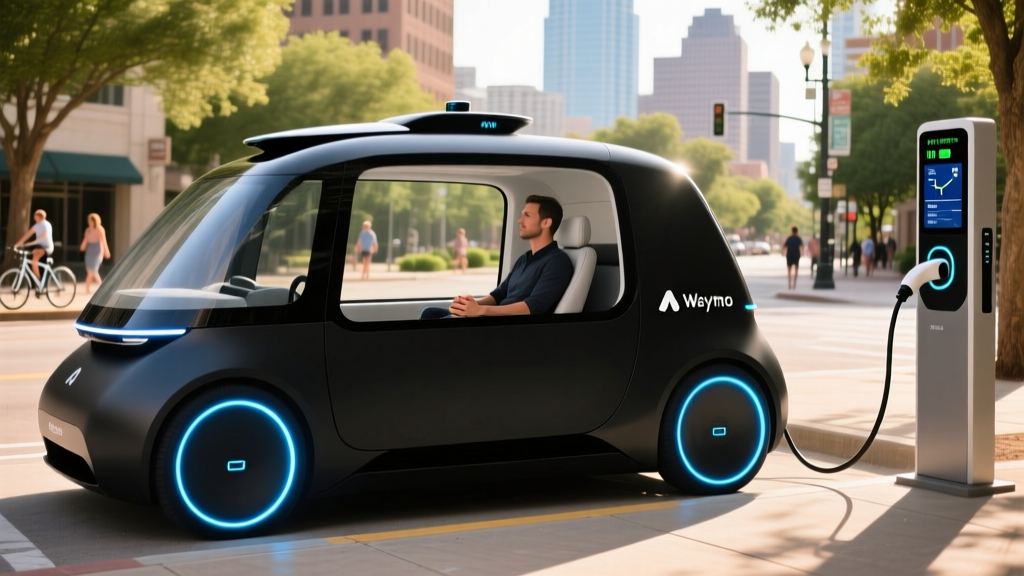
Waymo's 6th-generation "Waymo Driver" system, deployed on the Jaguar I-PACE electric SUV and the purpose-built Zeekr RT robotaxi, uses a sensor suite that differs significantly from camera-only approaches (like Tesla's).
Waymo 6th-Gen Sensor Stack
- LiDAR: Multiple custom-built 360° LiDAR units providing high-resolution point clouds up to 500+ meters. LiDAR works independently of lighting conditions — critical for nighttime and glare scenarios.
- Cameras: 29+ cameras covering 360° surround view with high dynamic range, used for object classification, traffic-light state detection, and signage reading.
- Radar: Imaging radar units for velocity detection of moving objects, performance in rain and fog where LiDAR and cameras degrade.
- Audio sensors: External microphones to detect sirens from emergency vehicles — the vehicle will pull over for ambulances and fire trucks.
- Compute: Custom Waymo-designed silicon for real-time sensor fusion and path planning, running on the vehicle (no cloud dependency for driving decisions).
Geofencing: Waymo operates only within pre-mapped, high-definition geofenced areas. Every road, lane marking, traffic signal, and speed zone is mapped in advance. If a destination falls outside the geofence, the ride simply cannot be requested.
This is a fundamentally different approach from Tesla's vision-only FSD, which relies on cameras and neural networks without LiDAR. Both approaches have trade-offs: Waymo's multi-sensor stack is more expensive per vehicle but provides redundancy; Tesla's camera-only system is cheaper to scale but has shown limitations in edge cases involving unusual lighting, obscured lane markings, and novel obstacles.
Regulatory Landscape: Who Approves Robotaxi Operations?
Robotaxi deployment in the United States is not governed by a single federal agency. Instead, it's a patchwork of state and local approvals:
- California (CPUC & DMV): The California Public Utilities Commission (CPUC) issues permits for commercial robotaxi service. The California DMV separately issues autonomous vehicle testing and deployment permits. Waymo holds both. After Cruise's December 2023 suspension in San Francisco, California regulators have applied heightened scrutiny to all ADS operators.
- Arizona: Arizona has among the most permissive regulatory environments for autonomous vehicles. The state's approach has been to allow companies to operate with minimal pre-approval, relying on existing traffic law enforcement. Waymo's Phoenix operations benefit from this framework.
- Texas: Austin requires local permits and coordination with city transportation departments. Texas state law permits autonomous vehicle operation with proper registration.
- Federal (NHTSA): NHTSA does not currently "approve" robotaxi services but mandates crash reporting via the Standing General Order and can issue recalls or investigations for safety defects. NHTSA has investigated specific Waymo incidents but has not issued fleet-wide actions as of early 2026.
Current Limitations: Where Robotaxis Still Fall Short
Waymo's Level 4 system is impressive within its operational domain, but that domain has hard boundaries. Here's what the technology cannot do today:
- Geofence boundaries: You cannot hail a Waymo to a destination outside the mapped service area. Rural areas, suburbs beyond the geofence, and interstate highway routes between cities are not available.
- Heavy weather degradation: Heavy rain, fog, and snow reduce LiDAR and camera effectiveness. Waymo may pause service or restrict the geofence during severe weather events. Phoenix's dry climate is one reason it was the launch city.
- Construction zones: Rapidly changing construction zones with shifted lanes, temporary signals, and flaggers remain a challenge. Waymo vehicles may take conservative routes or pause until the path is clear.
- No highway service (most markets): Most Waymo rides are on surface streets. Highway driving at 65+ mph within the geofence is available in some Phoenix corridors but is not the norm.
- Passenger capacity: Waymo's Jaguar I-PACE vehicles seat up to 3 rear passengers. There is no option for larger groups, wheelchair-accessible vehicles (limited availability), or cargo-heavy trips.
- Multi-stop rides: You cannot currently add intermediate stops to a Waymo One trip the way you can with Uber. It's point-A to point-B only.
- Edge cases: Unusual road configurations, unpaved roads, private property (parking garages, driveways), and areas with poor GPS/mapping coverage are excluded from service.
How to Use Waymo One: Step by Step
- Download the Waymo One app (iOS or Android) and create an account with your phone number and payment method.
- Enter your pickup and drop-off — the app will confirm whether both locations are within the active geofence.
- Confirm your ride — you'll see an estimated fare, ETA for the vehicle, and a description of the car (typically a white Jaguar I-PACE or Zeekr RT).
- Meet the vehicle — the car will pull to the curb. Verify the license plate and vehicle number match your app. Unlock the doors via the app when you're at the vehicle.
- Buckle up and start the ride — the rear seat has a screen showing your route. Press "Start Ride" on the screen once you're seated and belted.
- Arrive and exit — the vehicle will pull to your destination. Check for belongings (including your dog, if riding with one) and exit. Payment is automatic.
Frequently Asked Questions
Can I bring my dog in a Waymo if it's not a service animal?
Waymo does not explicitly ban pet dogs, but you are fully liable for any damage, mess, or disruption your pet causes. Because there's no driver to manage the situation, bringing an uncrated or anxious dog is risky. A small dog in a carrier is the safest approach. Expect a cleaning fee of $50–$200 if your dog soils or damages the interior.
Are service dogs always allowed in Waymo vehicles?
Yes. Under the ADA, trained service animals must be permitted. Waymo's policy explicitly complies with this requirement. You do not need to notify Waymo in advance that you'll be traveling with a service animal.
Is Waymo really self-driving, or is there a remote operator?
Waymo One vehicles are SAE Level 4 — fully autonomous within their geofence with no human driver in the vehicle. Waymo does employ remote fleet response agents who can be contacted by passengers via an in-app button for help (e.g., routing questions, emergencies), but these agents do not remotely steer or drive the vehicle in real-time. The AI handles all driving decisions.
What happens if the Waymo vehicle gets confused or stuck?
If the vehicle encounters a situation it cannot resolve (e.g., a completely blocked road, an unmapped detour), it will pull over safely and contact Waymo's fleet response team. The team can provide updated routing instructions to the vehicle's AI. In rare cases, a remote support specialist may guide the vehicle through a complex maneuver, but they do not directly control steering or braking.
How does Waymo compare to Cruise or Zoox?
Cruise (GM's robotaxi division) suspended operations in late 2023 after a serious incident in San Francisco and has been slowly returning to limited testing. Zoox (Amazon's subsidiary) operates a purpose-built, bidirectional vehicle currently in limited testing in Las Vegas and Foster City, CA, but does not yet offer broad commercial service. Waymo is currently the only robotaxi operating at meaningful commercial scale in the U.S.
Can I use Waymo to get to the airport?
Yes, in Phoenix (Sky Harbor) and selectively in Los Angeles. San Francisco airport routes have been in testing. Check the app — if your airport is within the geofence, the ride can be requested.
Whether you're bringing a well-behaved terrier in a carrier or simply curious about what it feels like to ride in a car with an empty driver's seat, Waymo One in 2026 is the most mature robotaxi service available to U.S. consumers. The technology works remarkably well within its domain — just understand that domain has clear boundaries, and your dog's behavior in a driverless car is entirely your responsibility.