The Real Cost of Hailing a Robotaxi vs. a Human Driver
If you live in Phoenix, San Francisco, or Los Angeles, you've likely seen Waymo's white Jaguar I-PACE SUVs navigating city streets without anyone behind the wheel. The natural question for any rideshare regular: is Waymo cheaper than Lyft? The answer depends on your route, time of day, and whether Lyft's surge pricing kicks in — but in many common scenarios, Waymo's fares are competitive with, and sometimes lower than, traditional rideshare.
This isn't a theoretical comparison. Waymo One, the company's commercial robotaxi service, has completed tens of millions of fully driverless paid trips across multiple U.S. metros. We've analyzed fare structures, service coverage, safety records, and the technology underpinning Level 4 autonomy to give you a clear picture of what robotaxi ownership actually costs — and where the service still falls short.
SAE Automation Levels: Why Waymo Is Fundamentally Different From Tesla FSD
Before comparing prices, it's essential to understand what you're riding in. Waymo operates at SAE Level 4 — high automation within a defined operational design domain (ODD). The vehicle handles all driving tasks without any human intervention within its geofenced service area. There is no steering wheel for a passenger to grab, no driver monitoring camera watching your eyes.
This is categorically different from consumer systems like Tesla's FSD (Supervised), GM's Super Cruise, or Ford's BlueCruise, which are all SAE Level 2 driver-assist features requiring continuous human supervision.
| Level | Name | Who Drives? | Examples |
|---|---|---|---|
| Level 0 | No Automation | Human does everything | Basic cruise control |
| Level 1 | Driver Assistance | Human, with one automated function | Adaptive cruise OR lane-keep |
| Level 2 | Partial Automation | Human supervises at all times | Tesla Autopilot/FSD, BlueCruise, Super Cruise |
| Level 3 | Conditional Automation | System drives in specific conditions; human must take over when requested | Mercedes DRIVE PILOT (limited markets) |
| Level 4 | High Automation | System drives fully within its ODD; no human needed | Waymo One, Zoox |
| Level 5 | Full Automation | System drives everywhere, all conditions | Does not exist commercially |
Where Can You Actually Use Waymo One Right Now?
Waymo's Level 4 autonomy operates within tightly defined geofences. The vehicle will not enter unmapped zones, and it will pull over safely if it encounters conditions outside its operational design domain. As of early 2026, Waymo One is commercially available in the following metros:
| Metro Area | Service Status | Coverage Notes |
|---|---|---|
| Phoenix, AZ (Metro) | Fully operational | Largest coverage area; includes Chandler, Tempe, Mesa, Scottsdale, parts of downtown Phoenix; airport service at PHX |
| San Francisco, CA | Fully operational | City-wide coverage including most neighborhoods; SFO airport service available |
| Los Angeles, CA | Fully operational | Downtown LA, Santa Monica, Hollywood, Westside; LAX service launched |
| Austin, TX | Operational (expanding) | Central Austin and select surrounding corridors; Uber integration available |
Waymo has announced plans to expand to additional cities, but announced expansion is not live service. If you're outside the geofence, the app simply won't let you book a ride. Coverage maps are available directly in the Waymo One app and shift periodically as mapping and regulatory approvals progress.
Is Waymo Cheaper Than Lyft? A Fare-by-Fare Breakdown
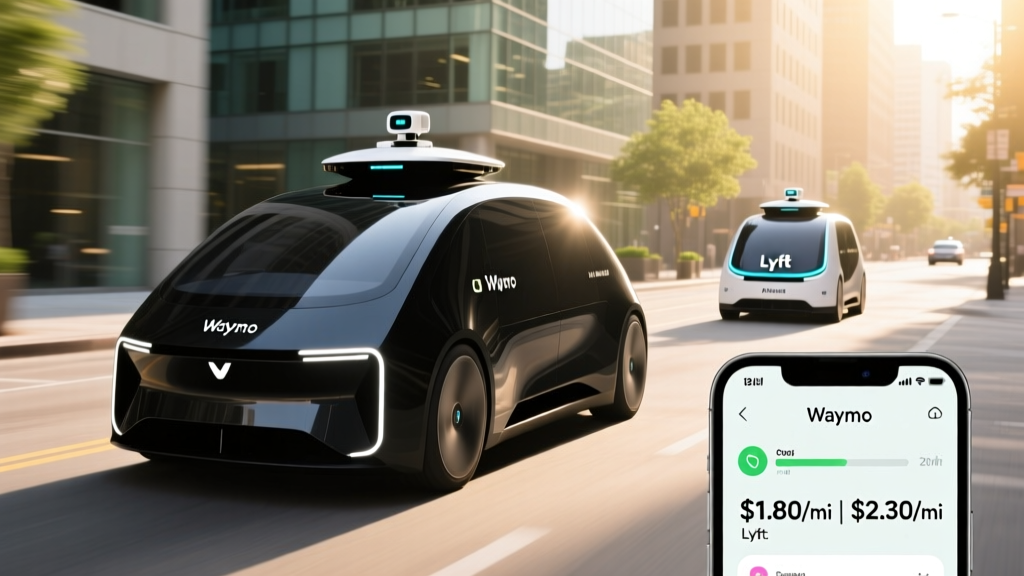
Both Waymo and Lyft use dynamic pricing models that factor in distance, time, and demand. However, their pricing structures differ in ways that matter for your wallet.
| Factor | Waymo One | Lyft (Standard) |
|---|---|---|
| Base fare structure | Distance + time-based; no separate "booking fee" line item in most markets | Base fare + per-mile + per-minute + service fee + booking fee |
| Surge / dynamic pricing | Rare; Waymo has historically avoided aggressive surge multipliers, though wait times increase during peak demand | Common; 1.5x–3x+ surge during peak hours, events, bad weather |
| Typical 5-mile urban trip (off-peak) | $12–$18 | $13–$22 |
| Typical 5-mile urban trip (peak/surge) | $14–$20 | $22–$40+ |
| Airport trip (e.g., SFO to downtown SF, ~14 mi) | $30–$42 | $35–$65 (highly surge-dependent) |
| Tips | Optional in-app; no driver to tip directly | Expected; 15–20% adds significantly to cost |
| Promotional pricing | Frequent first-rider credits and promo codes, especially in newer markets | Lyft Pink membership, occasional promos |
There's a catch, though: Waymo's fleet is finite. During high-demand periods, you may face longer wait times (10–20 minutes vs. Lyft's typical 3–7 minutes) because the company can't simply onboard more drivers. You're trading surge pricing for potential wait-time inconvenience.
Waymo's Safety Record: What the Data Actually Shows
Safety is the most scrutinized aspect of robotaxi operations, and it should be. Waymo publishes safety data and is subject to NHTSA oversight, state DMV reporting requirements, and incident disclosure mandates in California and Arizona.
- Fully driverless miles driven: Over 50 million autonomous miles across commercial operations
- Injury-causing collision rate: Waymo's published analysis (peer-reviewed methodology) showed an 85% reduction in injury-causing crash rates compared to human benchmarks in equivalent operating environments
- Contact rate: Waymo vehicles showed a 57% reduction in any-contact crash rate vs. human drivers in the same geographies
- Notable incidents: A small number of low-speed contact events have been reported (e.g., cone strikes, minor fender contact with improperly parked vehicles). No passenger fatalities have occurred in Waymo One commercial service
- Regulatory actions: In late 2023, the NHTSA opened an investigation into Waymo following several incidents involving contact with stationary objects; the company issued software updates in response
For context, human drivers in the U.S. experience approximately 1.35 fatalities per 100 million vehicle miles (IIHS). Waymo's operational miles are still far below the billions needed for statistical parity, but the available data points toward a favorable safety trajectory in geofenced urban environments. The company's safety transparency reports are among the most detailed in the industry.
How Waymo's Technology Stack Works
Waymo's sixth-generation "Waymo Driver" system uses a sensor-fusion approach that stands in stark contrast to camera-only systems like Tesla's. The vehicle perceives the world through redundant, overlapping sensor arrays:
- LiDAR: Multiple roof-mounted and body-integrated LiDAR units provide a real-time 360° 3D point cloud, accurate to centimeter resolution at ranges exceeding 200 meters. LiDAR works identically in darkness, fog (to a degree), and direct sunlight.
- Cameras: A suite of high-resolution cameras handles object classification, traffic-light state detection, signage reading, and lane-marking interpretation.
- Radar: Millimeter-wave radar units detect velocity and distance of moving objects, providing redundancy in heavy rain or conditions where LiDAR return degrades.
- Audio sensors: External microphones detect emergency-vehicle sirens, triggering preemptive pull-over behavior.
- HD Mapping: Waymo vehicles operate on centimeter-accurate pre-built maps of their service area. The vehicle localizes itself within this map in real time, cross-referencing sensor data against known infrastructure.
This multi-sensor redundancy is why Waymo can operate without a human in the loop. If one sensor modality is degraded (e.g., camera blinded by sun glare), LiDAR and radar maintain situational awareness. The trade-off is hardware cost: a fully equipped Waymo vehicle's sensor suite is estimated at $100,000+ per unit, though costs have decreased substantially with each hardware generation.
The Regulatory Landscape: Who Approves Robotaxis?
Robotaxi operations in the U.S. require approval at multiple government levels:
- State level: Each state sets its own autonomous-vehicle testing and deployment rules. Arizona has maintained the most permissive framework, which is why Phoenix was Waymo's first commercial market. California's DMV and CPUC issue separate permits for testing and commercial deployment, with specific reporting requirements for disengagements and collisions.
- Federal level: NHTSA regulates vehicle safety standards. Current FMVSS (Federal Motor Vehicle Safety Standards) assume a human driver — steering wheels, mirrors, pedals — and Waymo has received specific exemptions for its purpose-built vehicles (the Zeekr RT1, which lacks traditional driver controls). Congressional legislation for a comprehensive federal AV framework has stalled repeatedly.
- Local level: City governments and airport authorities negotiate access agreements. SFO and LAX airport robotaxi service required separate approval processes with local aviation authorities.
This patchwork regulatory environment is the primary reason robotaxi service is limited to a handful of metros. Each new city requires mapping, local-government negotiation, state permitting, and often new legislation.
Current Limitations: Where Waymo Cannot Go
Level 4 autonomy is powerful but bounded. Waymo's operational design domain has hard limits that riders should understand before relying on the service:
- Geofence boundaries: The vehicle will not travel outside its mapped service area. If your destination falls outside the geofence, the app won't let you book the ride.
- Heavy weather: While Waymo has improved rain and nighttime performance, extreme weather (heavy snow, dense fog, flash flooding) can trigger operational pauses. Phoenix's dry climate is one reason it was the first market.
- Construction zones: Major, unmapped road-construction changes can confuse the system. Waymo's fleet operations team monitors these in near-real-time and can update routing, but sudden lane closures may cause the vehicle to pull over and wait for remote-assistance guidance.
- No intercity or highway service: Waymo operates on surface streets within its metro areas. You cannot take a Waymo from San Francisco to Sacramento. Highway-speed autonomous operations remain an area of active development but are not part of the current commercial service.
- Accessibility limitations: Waymo's Jaguar I-PACE fleet requires passengers to enter and exit without driver assistance. The company has introduced WAV (wheelchair-accessible vehicle) options in select markets, but availability is limited.
- Wait times during peak demand: With a fixed fleet and no surge-pricing mechanism to throttle demand, wait times can extend to 15–25 minutes during busy periods, compared to 3–8 minutes for Lyft or Uber.
Frequently Asked Questions
Is Waymo cheaper than Lyft for airport rides?
Often, yes — particularly when Lyft applies surge pricing. A 14-mile trip from SFO to downtown San Francisco typically runs $30–$42 on Waymo versus $35–$65 on Lyft, depending on demand. Waymo's pricing is more predictable, making it easier to budget airport transfers.
Do I need a special app to ride in a Waymo?
Yes. Download the Waymo One app (iOS/Android), create an account, and request a ride within the service area. In Austin, you can also request Waymo rides directly through the Uber app. Payment is handled in-app, just like Lyft or Uber.
What happens if the Waymo vehicle encounters a problem during my ride?
Waymo vehicles are monitored by a fleet-operations team. If the vehicle encounters an ambiguous situation (e.g., an unusual construction zone), it will pull over safely and request remote guidance. An in-app support button and a physical help button inside the cabin connect you to a live agent. The vehicle will not proceed into uncertain situations.
Is Waymo truly self-driving, or is there a remote human controlling it?
Waymo is genuinely self-driving (SAE Level 4) within its operational domain. No remote human is steering the vehicle in real time. Remote-assistance operators provide high-level guidance (e.g., "proceed around the obstacle") rather than joystick-style driving. The vehicle's onboard AI handles all steering, braking, and acceleration decisions.
Can Waymo handle rain and nighttime driving?
Yes, within limits. Waymo's LiDAR-based perception system does not rely on visible light, so nighttime driving is not a significant challenge. Moderate rain is handled well. However, heavy downpours or severely reduced visibility conditions may cause the service to pause operations temporarily in affected zones.
How does Waymo's cost compare to owning a car?
That depends heavily on your driving patterns. If you drive fewer than 8,000 miles per year in an urban area with Waymo coverage, robotaxi fares plus occasional car-share rentals can undercut the total cost of ownership (insurance, depreciation, fuel/charging, maintenance, parking) of a personal vehicle. For higher-mileage drivers or those outside the geofence, personal EV ownership remains more economical.