What Tesla FSD Actually Does in 2026
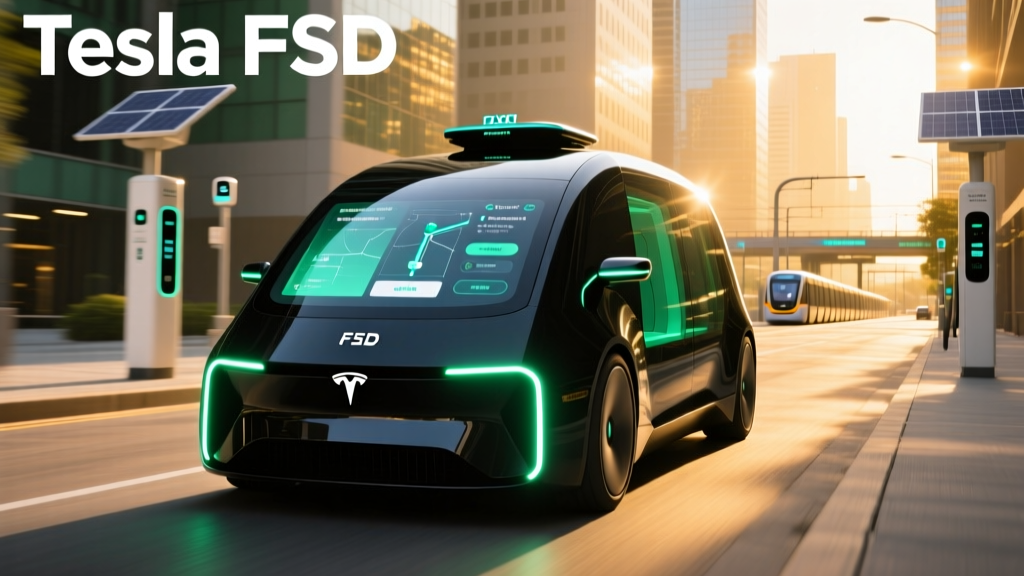
Full Self-Driving (Supervised) is Tesla's highest-tier driver-assistance package, layered on top of the standard Autopilot system included with every new Model 3, Model Y, Model S, and Model X. Despite the "Full Self-Driving" name, FSD remains an SAE Level 2 system — meaning the driver must continuously supervise, keep hands on or near the wheel, and be prepared to take over instantly.
Technically, FSD relies on Tesla's vision-only architecture (Tesla Vision), which uses eight external cameras feeding data into a neural-network-based perception stack running on the onboard Hardware 4 (AI4) computer. Tesla removed ultrasonic sensors and radar from its vehicles starting in 2022–2023, betting entirely on camera-based depth estimation and object detection. The system processes lane markings, traffic signals, pedestrian movement, and surrounding vehicles to execute steering, acceleration, and braking decisions.
Tesla FSD (Supervised) does not make the vehicle autonomous. The driver is legally and operationally responsible at all times. This places FSD in the same SAE category as Ford BlueCruise, GM Super Cruise, and Hyundai Highway Driving Assist — despite the marketing name. True driverless operation (Level 4) is currently only available in limited commercial robotaxi services like Waymo, not in any consumer vehicle you can purchase.
Tesla FSD Pricing: Purchase vs. Subscription Breakdown
As of early 2026, Tesla offers FSD through two purchase paths. The pricing structure has shifted multiple times since FSD's introduction, but the current model is as follows:
| Option | Cost | Notes |
|---|---|---|
| FSD One-Time Purchase | $8,000 | Permanently tied to the vehicle; transfers if you sell the car |
| FSD Monthly Subscription | $99/month | Cancel anytime; does not transfer to a new vehicle |
| Autopilot (Standard) | Included | Traffic-Aware Cruise Control + Autosteer; no FSD features |
| Enhanced Autopilot | Discontinued | Rolled into standard Autopilot or FSD tiers in recent model years |
The break-even math: At $99/month, the subscription reaches $8,000 in roughly 6 years and 9 months. If you plan to keep your Tesla longer than that, purchasing outright makes financial sense — and it adds resale value since FSD transfers with the vehicle. For shorter ownership cycles or buyers who want to test the feature before committing, the subscription is the lower-risk path.
Note: Tesla has occasionally offered FSD transfers to new vehicle purchases as a promotional incentive. These are time-limited and not guaranteed. Check Tesla's current offers at the time of purchase.
Which Tesla Models and Trims Include FSD?
FSD is not standard equipment on any Tesla. It is an add-on — either purchased or subscribed — available across the full current lineup:
| Model (2026 MY) | Base MSRP | FSD Available | Hardware Required |
|---|---|---|---|
| Model 3 (Standard Range / Long Range / Performance) | ~$38,990–$52,990 | Yes — add-on | HW4 (AI4) |
| Model Y (Long Range / Performance) | ~$44,990–$52,490 | Yes — add-on | HW4 (AI4) |
| Model S (Long Range / Plaid) | ~$74,990–$89,990 | Yes — add-on | HW4 (AI4) |
| Model X (Long Range / Plaid) | ~$79,990–$94,990 | Yes — add-on | HW4 (AI4) |
| Cybertruck (AWD / Cyberbeast) | ~$79,990–$99,990 | Yes — add-on | HW4 (AI4) |
All new Teslas ship with HW4 (AI4) as of mid-2023 onward. Older vehicles with HW3 received software updates but may have processing limitations compared to the newer hardware. Tesla has confirmed that FSD v12 and later versions are optimized for HW4's higher-resolution camera inputs and greater compute throughput.
Real-World FSD Capabilities: What It Handles Well
FSD (Supervised) in its current v13/v14 iterations uses an end-to-end neural network approach — meaning the system processes raw camera input and outputs driving decisions directly, rather than relying on hand-coded rules for each scenario. This has improved fluidity and human-like behavior in many situations:
- Highway driving: Lane changes, on-ramp merges, speed adjustment around slower traffic, and navigation-guided exits are generally smooth and confident.
- City street navigation: FSD can handle traffic lights (stopping on red, proceeding on green/arrow), stop signs (including multi-way), unprotected left turns, and roundabouts in many mapped areas.
- Speed limit adaptation: The system reads posted speed limit signs and adjusts accordingly, including temporary construction-zone limits in many cases.
- Pedestrian and cyclist awareness: Vision-based detection identifies vulnerable road users and initiates braking or avoidance — though this overlaps with standard Autopilot's emergency braking.
- Parking: FSD includes automated parking (parallel and perpendicular) and Summon, which moves the car short distances in parking lots via the Tesla app.
Real-World Limitations: Where FSD Still Falls Short
FSD (Supervised) does NOT handle all driving scenarios safely. The following situations require immediate driver takeover:
- Construction zones with temporary lane shifts, cones, or flaggers — FSD may follow old lane markings
- Heavy rain, fog, or snow — camera obstruction degrades perception; the system will issue a takeover request or disengage
- Faded or missing lane markings — rural roads and poorly maintained urban streets confuse the lane-keeping model
- Unprotected left turns across multi-lane traffic — the system can be overly cautious or misjudge gaps
- Complex intersections with multiple turn lanes, offset cross streets, or unusual signal phasing
- Emergency vehicles — FSD may not reliably yield to approaching ambulances or fire trucks
- Road debris or unusual obstacles — objects outside training distribution (fallen trees, large animals) may not trigger appropriate response
Cold-weather performance deserves specific attention. When cameras ice over or accumulate road salt spray, FSD will progressively disable features and alert the driver. Unlike lidar-equipped systems (used by Waymo robotaxis), Tesla's vision-only stack has no redundant sensing modality when cameras are compromised. In practice, this means FSD availability drops significantly in winter driving conditions in northern U.S. states.
Highway performance is generally strong, but phantom braking — where the system decelerates unexpectedly for non-existent obstacles — remains a documented concern. NHTSA has investigated multiple complaints related to Tesla's automatic emergency braking and Autopilot behavior. Drivers should maintain following distance awareness even when FSD is engaged.
Tesla FSD vs. Competing Level 2 Systems
| System | Brand | SAE Level | Hands-Free? | City Streets? | Cost |
|---|---|---|---|---|---|
| FSD (Supervised) | Tesla | Level 2 | No — torque monitoring | Yes (beta) | $8,000 or $99/mo |
| Super Cruise | GM (Cadillac/Chevy) | Level 2 | Yes — on mapped roads | No — highway only | $2,500 or included on select trims |
| BlueCruise | Ford | Level 2 | Yes — on mapped roads | No — highway only | $2,100 or $75/mo |
| Highway Driving Assist 2 | Hyundai/Kia/Genesis | Level 2 | No — hands-on | No — highway only | Included in select packages |
| Toyota Safety Sense 3.0 | Toyota/Lexus | Level 2 | No — hands-on | No — highway only | Standard (included) |
The key differentiator for Tesla FSD is city-street capability — it's the only consumer system that attempts full navigation on surface streets with traffic lights, stop signs, and turns. GM Super Cruise and Ford BlueCruise restrict hands-free operation to pre-mapped divided highways (over 750,000 miles mapped in North America for Super Cruise as of 2025). Those systems use a combination of cameras, radar, and lidar for redundancy, plus driver-facing cameras to monitor eye attention.
Tesla's approach trades sensor redundancy (no lidar, no radar) for broader geographic coverage — FSD will attempt to drive on virtually any road, not just mapped highways. The trade-off is that the driver must maintain higher vigilance because the system has fewer sensing fallbacks. According to IIHS research, drivers using Level 2 systems tend to over-trust the technology over time, increasing risk during edge-case scenarios.
Should You Buy Tesla FSD in 2026?
- You plan to keep your Tesla for 5+ years
- You commute in mixed highway/city traffic where FSD's city-street features add daily value
- You want the feature to transfer at resale (adds value to the vehicle)
- You're a tech-forward driver who actively supervises and enjoys the assistance
- You want to try FSD before committing $8,000
- You lease your Tesla or plan to sell within 3–4 years
- You only need FSD for specific trips (road trips, seasonal commuting)
- You primarily drive on highways — standard Traffic-Aware Cruise Control + Autosteer handles this well at no extra cost
- You expect a truly autonomous experience — FSD is not that, and won't be for the foreseeable future
- You're uncomfortable with the supervision burden or vision-only sensor approach
Frequently Asked Questions
Is Tesla FSD actually self-driving?
No. Tesla FSD (Supervised) is an SAE Level 2 driver-assistance system. The "Full Self-Driving" name is a branding choice, not a technical classification. The driver must remain attentive, keep hands on or near the steering wheel, and be prepared to take over at any moment. No consumer vehicle sold in the U.S. offers true self-driving (Level 4/5) capability. Only commercial robotaxi services like Waymo operate at Level 4, and only within geofenced service areas.
Can I transfer my FSD purchase to a new Tesla?
FSD purchased outright stays with the vehicle — it transfers to the next owner if you sell the car. It does not automatically transfer to a new Tesla you buy, though Tesla has occasionally run limited-time FSD transfer promotions. The subscription never transfers; it's tied to your account and the specific vehicle.
Does FSD work in bad weather?
FSD performance degrades in heavy rain, snow, and fog because the vision-only system depends on clear camera feeds. When cameras are obstructed by ice, dirt, or water, the system will alert the driver and progressively disable features. In sustained winter conditions common in northern states, expect FSD to be unavailable for portions of your drive.
What's the difference between Autopilot and FSD?
Standard Autopilot (included with every new Tesla) provides Traffic-Aware Cruise Control and Autosteer — essentially adaptive cruise plus lane-centering on highways. FSD adds Navigate on Autopilot (automatic highway exits and lane changes), Auto Lane Change, Autopark, Summon, Smart Summon, and city-street driving with traffic light and stop sign recognition. Think of Autopilot as highway assist; FSD as full-route assist with supervision.
Has NHTSA investigated Tesla FSD?
Yes. NHTSA has opened multiple investigations into Tesla's Autopilot and FSD systems, including inquiries into crashes involving emergency vehicles, phantom braking complaints, and the adequacy of Tesla's driver-monitoring approach (which uses steering-wheel torque sensing rather than a dedicated driver-facing camera). These investigations are ongoing as of early 2026. Check NHTSA's website for the latest status.
Will FSD eventually become fully autonomous?
Tesla has predicted full autonomy "next year" since approximately 2016. While FSD's neural-network approach has improved significantly — particularly with the v12 end-to-end architecture — achieving Level 4 autonomy requires solving edge cases that represent a tiny fraction of driving scenarios but carry outsized safety risk. Regulatory approval for unsupervised operation also remains an unresolved hurdle. Buyers should evaluate FSD based on what it does today, not speculative future capability.
Sources: Tesla official specifications (tesla.com), NHTSA investigation records, IIHS driver-assistance research, SAE International J3016 automation levels standard. Pricing and feature availability current as of early 2026; always verify with Tesla directly before purchasing.