Waymo in Austin, Texas: What Riders Need to Know
Austin has become one of the most important proving grounds for commercial robotaxi service in the United States. Waymo, the Alphabet subsidiary that spun out of Google's self-driving car project, has been expanding its Waymo One ride-hail service in the Texas capital since late 2024. As of early 2026, Austin ranks as Waymo's third-largest metro deployment behind Phoenix and the San Francisco Bay Area, covering significant portions of the urban core, airport corridors, and key suburban destinations.
This guide breaks down exactly where Waymo operates in Austin right now, how the service compares on price to Uber and Lyft, what the safety data actually shows, and the real-world limitations you should understand before summoning a driverless car to your doorstep.
SAE Automation Level: What "Self-Driving" Actually Means Here
Waymo One in Austin operates at SAE Level 4. This means the vehicle handles all driving tasks within a defined operational design domain (geofenced service area) without any human driver behind the wheel. There is no steering wheel, no pedals occupied by a safety operator, and no expectation that a passenger will intervene. This is fundamentally different from Level 2 driver-assist systems like Tesla Autopilot, Ford BlueCruise, or GM Super Cruise, which require an attentive human driver at all times.
| Level | Name | Who Drives | Example |
|---|---|---|---|
| Level 2 | Partial Automation | Human (always) | Tesla Autopilot, BlueCruise, Super Cruise |
| Level 3 | Conditional Automation | System in limited scenarios; human on standby | Mercedes Drive Pilot (restricted markets) |
| Level 4 | High Automation | System (geofenced, no human needed) | Waymo One, Zoox |
| Level 5 | Full Automation | System (anywhere, any condition) | Does not exist commercially |
The distinction matters because marketing language around "self-driving" gets applied loosely to Level 2 features. Waymo's Austin fleet is genuinely driverless within its service boundary — nobody is sitting in the front seat.
Where Can I Use Waymo in Austin Right Now?
As of early 2026, Waymo One's Austin geofence covers roughly 80+ square miles of the metro area. The service zone is not the entire city — it's a carefully mapped polygon that Waymo expands incrementally as it validates new roads and intersections.
| Area | Status | Notes |
|---|---|---|
| Downtown Austin | ✅ Live | Full coverage including the Capitol Complex, Rainey St, 2nd St District |
| South Austin (SoCo, Bouldin, Zilker) | ✅ Live | Includes Zilker Park area, Barton Springs Rd corridor |
| East Austin | ✅ Live | East 6th, Holly St, parts of Mueller development |
| North Austin (Domain, Arboretum) | ✅ Live | The Domain shopping/office district included |
| Austin-Bergstrom Int'l Airport (AUS) | ✅ Live | Dedicated pickup/dropoff zone; airport trips enabled |
| West Austin / Westlake / Rollingwood | ⚠️ Partial | Select corridors; hilly terrain and narrow roads slow expansion |
| Round Rock, Cedar Park, Pflugerville | ❌ Not yet | Outside current geofence; announced for future expansion |
| South Austin beyond Slaughter Ln | ❌ Not yet | Not in current service area |
To check whether a specific pickup or dropoff address falls inside the geofence, open the Waymo One app and enter your destination. The app will confirm availability in real time. If your address is outside the zone, the app will not let you book — there is no override.
The Waymo Tech Stack: Lidar, Cameras, and Geofencing
Waymo's current fleet in Austin consists primarily of the Jaguar I-PACE electric crossover equipped with the company's 6th-generation Waymo Driver hardware suite. The vehicle is fully electric (90 kWh battery pack, EPA range of approximately 234 miles in stock form, though Waymo's auxiliary compute load reduces effective range), and it carries a sensor array that differs fundamentally from the camera-only approach used by Tesla's FSD.
- Lidar: Multiple high-resolution lidar units providing 360° 3D point-cloud mapping up to 500+ meters. Lidar works independently of ambient light, giving the system reliable depth perception at night and in glare.
- Cameras: A suite of high-dynamic-range cameras covering 360° for object classification, traffic-light state detection, sign reading, and lane identification.
- Radar: Imaging radar for velocity detection of other vehicles and cyclists, especially useful in rain or fog where camera and lidar performance can degrade.
- External audio sensors: Microphones that detect emergency-vehicle sirens and trigger appropriate pull-over or yield behavior.
- HD maps + geofencing: Waymo pre-maps every road in its service area at centimeter-level resolution. The vehicle localizes against this map in real time. If the vehicle leaves the geofenced area or encounters an unmapped road, it will not operate.
This multi-sensor redundancy is a key differentiator from camera-only systems. The trade-off is cost: each Waymo-equipped Jaguar I-PACE carries an estimated $100,000+ in sensor and compute hardware, which is why the company has historically scaled more cautiously than software-first competitors. Waymo has not publicly confirmed a per-vehicle hardware cost for its 6th-gen system, but the company has stated that each successive generation has reduced cost significantly.
Pricing: Waymo vs. Uber and Lyft in Austin
Waymo One uses a pricing model similar to traditional rideshare: you get an upfront fare when you book, and there is no surge pricing in the Uber/Lyft sense. Fares are calculated based on distance, time, and a base fee. In Austin, Waymo's pricing has been broadly competitive with UberX and Lyft standard rides, though not always cheaper.
| Route | Distance | Waymo One | UberX | Lyft Standard |
|---|---|---|---|---|
| Downtown → AUS Airport | ~8 mi | $22–$28 | $19–$30 (surge dependent) | $18–$28 |
| The Domain → Downtown | ~12 mi | $26–$34 | $22–$35 | $21–$33 |
| Zilker Park → East Austin | ~5 mi | $14–$18 | $12–$20 | $11–$19 |
| Mueller → South Congress | ~7 mi | $18–$24 | $15–$25 | $14–$24 |
Key pricing notes:
- No surge pricing: Waymo does not currently apply surge multipliers during peak demand. If no vehicles are available, you wait or cannot book — but you won't see a 2.5x fare.
- No tips required: There's no driver to tip, which effectively saves 15–20% versus a comparable Uber/Lyft ride where tipping is customary.
- Promotional credits: Waymo frequently offers first-rider discounts and referral credits in newer markets like Austin, which can make initial rides significantly cheaper.
- Wait times: In Austin's core coverage area, typical wait times range from 3–8 minutes during midday hours, extending to 10–15 minutes during evening peak or special events (e.g., ACL Festival, F1 weekend).
Safety Data: What the Numbers Actually Show
- Total autonomous miles driven: Over 50 million fully driverless miles across all markets (Phoenix, SF, LA, Austin) as reported by Waymo.
- Injury-relevant crash rate: Waymo's published analysis (peer-reviewed and submitted to NHTSA) shows approximately 85% fewer injury-causing crashes per million miles compared to human drivers in comparable urban environments.
- Police-reported crash rate: Approximately 57% fewer police-reported crashes per million miles vs. human benchmarks.
- Contact rate: The vast majority of incidents involving Waymo vehicles are minor, low-speed contacts (often the Waymo vehicle being rear-ended at stops by human drivers).
Source: NHTSA Automated Vehicle Safety reporting and Waymo's published safety data.
Austin-specific incident data is less granular than Phoenix or San Francisco (where Waymo has operated longer), but the IIHS and NHTSA have not flagged any systemic safety issues unique to the Austin deployment. Texas requires autonomous vehicle operators to report crashes to the Texas Department of Transportation, and Waymo complies with these reporting obligations.
It's worth noting that "safer than human drivers" is a relative claim tied to urban, geofenced, mapped environments. Waymo does not operate on rural highways, in construction zones it hasn't mapped, or in severe weather — contexts where crash risk profiles differ substantially.
Regulatory Landscape: Who Approves Robotaxis in Texas?
Texas has one of the more permissive regulatory environments for autonomous vehicle deployment in the US. The key regulatory framework:
- State law (Texas Transportation Code § 545.401 et seq.): Texas permits fully driverless vehicles on public roads without requiring a safety operator, provided the vehicle is registered, insured, and complies with all traffic laws. No special state-level permit is required beyond standard vehicle registration and compliance with TxDOT autonomous vehicle reporting rules.
- City of Austin: Austin does not issue its own robotaxi operating permits. Waymo coordinates with the city on curb management, airport access at AUS, and data-sharing agreements, but there is no Austin-specific "robotaxi license" analogous to San Francisco's CPUC permitting process.
- Federal oversight: NHTSA retains authority over vehicle safety standards. Waymo's Jaguar I-PACE vehicles are FMVSS-compliant production vehicles modified with the Waymo Driver system. NHTSA's Standing General Order requires AV operators to report crashes involving Level 2+ and Level 4 systems.
- Airport access: Austin-Bergstrom International Airport has a ground transportation agreement with Waymo that allows designated pickup and dropoff at the terminal, similar to Uber/Lyft zones.
This relatively light-touch regulatory environment is one reason Waymo prioritized Austin for expansion — the company did not need to navigate the protracted California Public Utilities Commission (CPUC) permitting process that governed its San Francisco rollout.
Current Limitations: What Waymo Cannot Do in Austin
- Geofence boundary: If your destination falls outside the mapped service area, the app will not let you book. You cannot request a ride to Round Rock, Georgetown, or San Marcos.
- Heavy rain and flooding: Austin's sudden downpours can trigger service suspensions. Lidar and camera performance degrades in heavy precipitation, and Waymo will pause operations rather than risk reduced sensor fidelity. Flash-flood-prone areas may be excluded from routing.
- Construction zones: Major, unmapped road construction can confuse the system. Waymo updates its HD maps regularly, but rapidly changing construction zones (common on I-35 and MoPac corridor projects) may cause the vehicle to take conservative detours or decline a route.
- Multi-point stops: You cannot add intermediate stops to a Waymo ride. It's point A to point B only.
- Passenger capacity: Waymo's I-PACE seats up to 3 passengers in the rear. No front-seat passenger. Large groups or families needing car seats cannot use the service.
- Pets: Service animals are permitted. Pets are generally not allowed (check current Waymo policy before booking).
- Luggage: The I-PACE trunk can hold 1–2 standard suitcases, but there is no dedicated luggage service for airport runs with heavy baggage.
- No highway driving beyond mapped corridors: Waymo in Austin uses select highway segments (portions of I-35, MoPac, US-183) that it has validated, but it will not take arbitrary highway routes outside its operational design domain.
How to Book Your First Waymo Ride in Austin
- Download the Waymo One app (iOS or Android). The app is separate from Google Maps, though Google Maps may surface Waymo as a transport option in Austin.
- Create an account with your phone number, payment method (credit/debit card or Google Pay), and agree to the rider terms.
- Enter your pickup and dropoff addresses. The app confirms whether both fall within the Austin geofence.
- Confirm your fare (upfront, no surge) and request the ride.
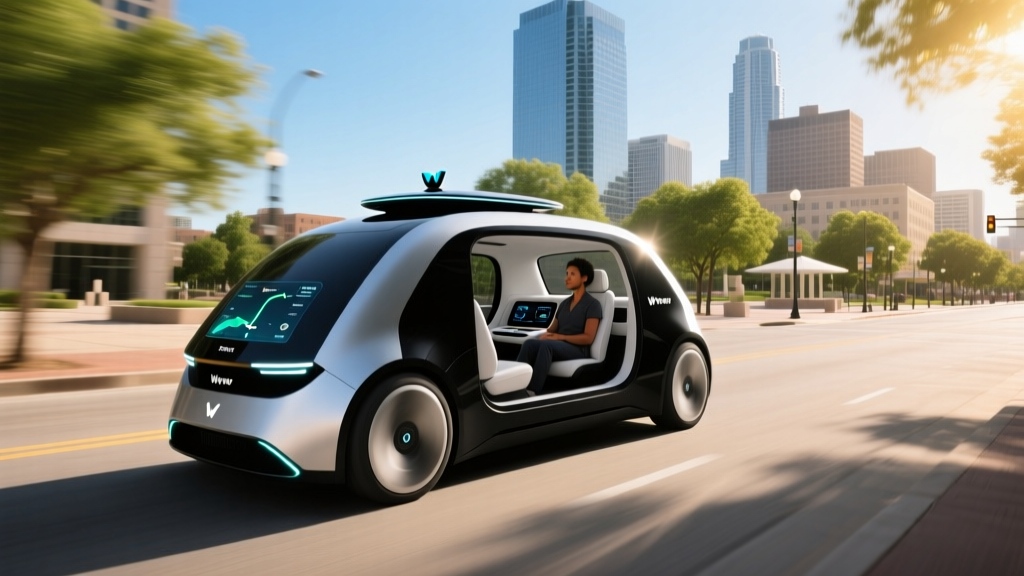
- Meet the vehicle. The app shows the car's location in real time and provides a license plate and vehicle description (white Jaguar I-PACE with Waymo branding and a roof-mounted lidar array). You unlock the car via the app — the rear doors unlock automatically when the vehicle arrives at your pickup point.
- Ride. Interior screens show the route and the vehicle's perception of surrounding traffic, cyclists, and pedestrians. A "Start Ride" button must be pressed by the passenger to begin the trip.
- Exit at your destination. The vehicle will pull to a safe stopping point. You exit, close the door, and the ride ends automatically.
Frequently Asked Questions
Is Waymo truly self-driving, or is there a remote human operator?
Waymo vehicles drive themselves with no human in the driver's seat. There is no remote driver controlling the car via teleoperation. However, Waymo does employ a remote assistance team that can provide high-level guidance (e.g., confirming it's safe to proceed around an unusual obstacle) — but the remote team does not steer, brake, or accelerate the vehicle. The onboard AI handles all real-time driving decisions.
How much does a Waymo ride cost compared to Uber in Austin?
Waymo fares in Austin are typically within $2–$5 of a comparable UberX or Lyft ride for the same route, and can be cheaper when Uber/Lyft surge pricing is active. Factor in the absence of tipping (saving ~15–20%) and Waymo often comes out slightly cheaper on a per-ride basis.
Is Waymo safe at night in Austin?
Yes. Waymo's lidar-based perception system is not dependent on visible light, so nighttime operation is within its design capability. The company operates 24/7 in its mature markets (Phoenix, San Francisco), and Austin service hours extend through late night. Crime-related safety concerns (e.g., carjacking) are effectively eliminated since there's no driver to confront and the vehicle cannot be redirected by a passenger.
Can I use Waymo to get to the Austin airport?
Yes. Austin-Bergstrom International Airport (AUS) is within the Waymo service area, and the airport has a designated Waymo pickup/dropoff zone. Fares from downtown to AUS typically run $22–$28.
What happens if the Waymo vehicle encounters an emergency?
The vehicle is programmed to pull over safely, activate hazard lights, and contact Waymo's roadside assistance team. Passengers can also use an in-vehicle support button or the app to request immediate assistance. Waymo maintains a 24/7 response team that can dispatch roadside support or contact emergency services.
Will Waymo expand to Round Rock, Cedar Park, or other Austin suburbs?
Waymo has announced plans to expand the Austin geofence over time, but specific suburb timelines have not been confirmed as of early 2026. Expansion depends on mapping, validation, and demand modeling for each new corridor. Check the Waymo One app periodically — the service area boundary updates incrementally.