What FSD Supervised Actually Does (And Doesn't Do)
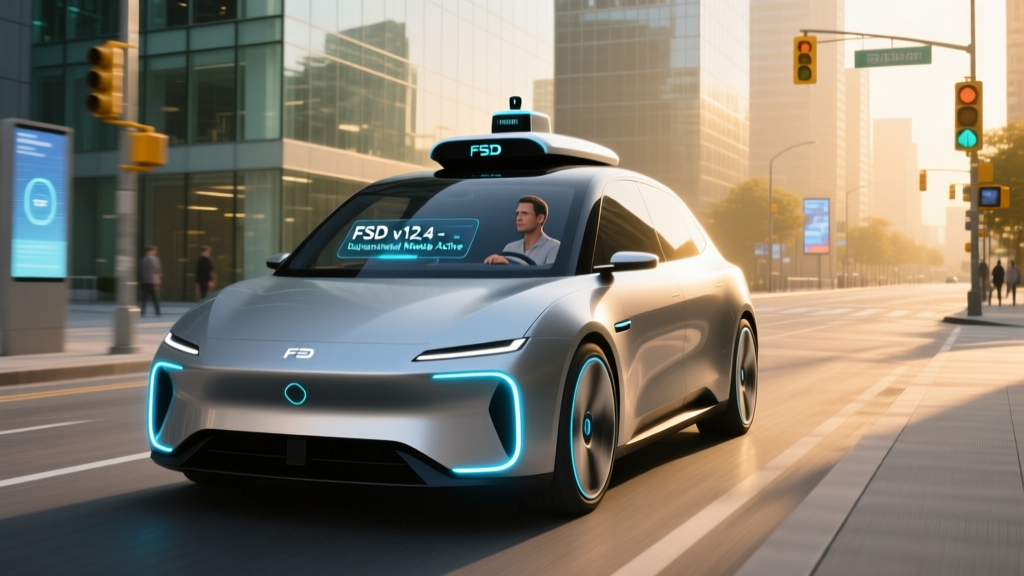
Tesla's Full Self-Driving (Supervised) is the most widely deployed consumer driver-assistance system on US roads — and the most misunderstood. Despite the "Full Self-Driving" name, FSD Supervised is a Level 2 SAE automation system that requires continuous driver attention, hands-on-wheel readiness, and active supervision at all times. It does not drive the car for you. You drive the car; it assists.
In practice, FSD Supervised handles highway lane-keeping, adaptive cruise control, automatic lane changes, on-ramp to off-ramp navigation, traffic light and stop sign recognition, and low-speed city street driving. The system uses Tesla's vision-only approach — no LiDAR, no radar on current hardware — relying on a suite of external cameras paired with Tesla's HW4 (or newer) onboard computer running neural-network-based perception models.
Hardware, Sensors, and How the System Works
Unlike competitors that fuse camera, radar, and sometimes LiDAR data, Tesla committed to a camera-only (Tesla Vision) architecture starting with HW3 vehicles and continuing through the current HW4 platform. Here's the technical breakdown:
| Component | Specification |
|---|---|
| Camera Count | 8 external cameras (front narrow, front wide, front main, left/right forward, left/right rear, backup) |
| Compute Platform | HW4 (AI5 expected late 2026/2027) — dual neural network processors |
| Radar | None (removed from production ~2022 onward) |
| LiDAR | None |
| Ultrasonic Sensors | Removed (Tesla Vision handles proximity) |
| Positioning | GPS + map data + visual odometry |
| Driver Monitoring | Cabin camera (steering wheel torque on older HW3 vehicles) |
The cabin-facing camera monitors eye gaze and head position. If the system detects inattention — eyes off-road, head turned away for extended periods — it escalates warnings: visual alert, audible chime, then gradual speed reduction and eventual disengagement with hazard lights. Three strikes within a drive can lock out FSD for the remainder of the trip.
Real-World Capabilities: Where FSD Supervised Excels
On well-marked divided highways with clear lane lines and moderate traffic, FSD Supervised performs near-flawlessly. Lane centering is precise, following distance is reasonable, and the system handles gentle curves at highway speeds without intervention. Automatic lane changes for navigation-based routing (the "Navigate on Autopilot" feature) are generally smooth, though the system occasionally hesitates at merge points in dense traffic.
City street driving — the most technically ambitious part of FSD — has improved substantially through 2025-2026 over-the-air updates. The system can navigate four-way stops, recognize traffic light states, execute unprotected left turns, and handle pedestrian crosswalks. In suburban environments with wide lanes and predictable traffic patterns, you may go several miles without intervention.
Tesla reports that FSD-equipped vehicles have accumulated billions of supervised miles. According to Tesla's own Impact Report, the system's miles-per-intervention metric has improved significantly year over year, though the company's methodology differs from NHTSA's crash-reporting framework and should be interpreted carefully.
Real-World Limitations: Where You Must Take Over
- Heavy rain, fog, or snow: Camera-only systems degrade sharply when lenses are obscured. The system will issue a "reduced capability" warning and may disengage.
- Faded or missing lane markings: Rural roads, construction zones, and freshly repaved highways without restriping confuse the lateral control model.
- Complex construction zones: Temporary barriers, shifted lanes, and flagger-directed traffic require immediate human takeover.
- Unprotected left turns across heavy traffic: The system sometimes hesitates or aborts; driver readiness is essential.
- Railroad crossings: FSD does not reliably stop at uncontrolled rail crossings — federal safety requirement for the driver.
- Emergency vehicles: While Tesla has improved emergency vehicle detection (flashing lights), the system may not yield or pull over reliably.
- Direct sunlight glare: Low-angle sun can wash out forward cameras, particularly at dawn and dusk.
Cold-weather performance deserves specific attention. Ice and road salt accumulation on camera housings can blind the system entirely. Unlike radar-based competitors (Ford BlueCruise, GM Super Cruise), which can partially penetrate precipitation, Tesla Vision has no fallback sensor. In winter conditions across the northern US, expect more frequent disengagements and a higher driver workload.
Cost Breakdown: Purchase vs. Subscription in 2026
Tesla offers FSD Supervised through two pricing models. The subscription option has made the system accessible without the upfront cost, while the one-time purchase remains available for buyers who plan long-term ownership.
| Option | Cost | Details |
|---|---|---|
| Monthly Subscription | $99/month | Cancel anytime; tied to your Tesla account, not the vehicle. Available on all HW4+ vehicles. |
| One-Time Purchase | $8,000 | Transfers with the vehicle to subsequent owners. Included in some promotional bundles. |
| Basic Autopilot | Included (free) | Traffic-Aware Cruise Control + Autosteer (lane centering). No auto lane changes, no city streets, no traffic light control. |
| Enhanced Autopilot (EAP) | $6,000 (one-time) | Adds Navigate on Autopilot, Auto Lane Change, Autopark, Summon. No city street driving. |
The math matters. At $99/month, you'd spend $5,940 over five years — still less than the $8,000 one-time purchase. However, FSD purchased outright adds residual value to the car at trade-in or private sale, whereas the subscription does not. For three-year ownership cycles, the subscription is cheaper. For five-plus years, the purchase breaks even and then pays off.
Note: FSD (Supervised) is not eligible for any federal tax credit or incentive. The IRS §30D clean vehicle credit applies only to the vehicle itself, subject to MSRP caps ($55,000 for sedans, $80,000 for SUVs/trucks), buyer income limits, and battery-sourcing requirements. Software subscriptions and one-time software purchases are excluded.
Which Tesla Models Include FSD Supervised?
FSD Supervised is available across Tesla's entire current lineup, but hardware compatibility is the limiting factor:
| Model | HW4 Availability | FSD Subscription Eligible | Starting MSRP (2026) |
|---|---|---|---|
| Model 3 (Highland refresh) | All 2024+ builds | Yes | ~$38,990 |
| Model Y (Juniper refresh) | All 2025+ builds | Yes | ~$44,990 |
| Model S | 2023+ builds | Yes | ~$74,990 |
| Model X | 2023+ builds | Yes | ~$79,990 |
| Cybertruck | All builds | Yes | ~$79,990 |
Vehicles built with HW3 (roughly 2019–2023 depending on model) can still run FSD Supervised but may face feature limitations or reduced performance compared to HW4. Tesla has offered HW3-to-HW4 upgrades in some cases, but availability and pricing vary. Check your vehicle's Software menu or contact Tesla service to confirm your hardware version.
FSD Supervised vs. Competing Systems: A Fair Comparison
FSD Supervised is the most ambitious consumer ADAS in scope — it attempts to handle any road, any condition, anywhere. Competitors take a narrower but often more polished approach:
| Feature | Tesla FSD Supervised | GM Super Cruise | Ford BlueCruise | Mercedes Drive Pilot |
|---|---|---|---|---|
| SAE Level | Level 2 | Level 2 | Level 2 | Level 3 (limited) |
| Hands-Off Highway | Yes (eyes monitored) | Yes (eyes monitored, mapped roads only) | Yes (eyes monitored, mapped roads only) | Yes (under 40 mph, mapped highways, specific conditions) |
| City Street Driving | Yes | No | No | No |
| Automatic Lane Changes | Yes | Yes | Yes | No |
| Sensor Suite | Camera only | Camera + LiDAR + radar + HD maps | Camera + radar | Camera + LiDAR + radar + HD maps |
| Geographic Scope | Any road (theoretically) | ~750,000+ mapped miles | ~130,000+ mapped miles | Select highway segments in NV and CA |
| Cost | $99/mo or $8,000 | ~$2,200 standard; $25/mo after trial | $2,100 one-time or ~$75/mo subscription | $2,500/year subscription (included in some trims) |
The tradeoff is clear. Super Cruise and BlueCruise are more reliable within their mapped corridors — HD maps and LiDAR give them a precision advantage on known highways. But they don't attempt city streets. FSD Supervised is the only system attempting generalized driving, which means it encounters more edge cases and requires more driver vigilance in complex scenarios.
Mercedes-Benz Drive Pilot is the only Level 3 system available in the US, but its scope is extremely narrow: under 40 mph, on specific mapped highway segments, in clear weather. When active, Mercedes assumes liability — a significant distinction from Level 2 systems where the driver always bears responsibility.
Frequently Asked Questions
Is FSD Supervised truly self-driving?
No. FSD Supervised is an SAE Level 2 driver-assistance system. The driver must remain alert, keep eyes on the road, and be ready to take over at any moment. Tesla's own documentation and the product name itself — "Supervised" — make this explicit. Only Level 4 services like Waymo One operate without a human driver, and those are geofenced robotaxis, not consumer vehicles.
Can I use FSD Supervised on any road?
Technically, yes — the system is designed to work on city streets, highways, and rural roads. Practically, performance varies dramatically. Well-marked divided highways yield the best results. Unmarked rural roads, construction zones, and adverse weather will degrade or disable the system.
Does FSD transfer if I sell my Tesla?
If you purchased FSD outright ($8,000), it stays with the vehicle and transfers to the next owner. The $99/month subscription is tied to your Tesla account and does not transfer — the new owner would need their own subscription. Tesla has occasionally offered promotional FSD transfers between vehicles for the same owner; check current policy before trading in.
How does the cabin camera driver monitoring work?
The interior camera tracks your eye gaze and head position. If you look away from the road for more than a few seconds, the system issues escalating alerts. On HW3 vehicles without robust cabin monitoring, Tesla relies on steering wheel torque detection — you must apply periodic light pressure to confirm engagement.
Will FSD ever become fully autonomous (Level 4 or 5)?
Tesla has predicted full autonomy for years, but as of 2026, FSD remains Level 2 with no announced timeline for regulatory approval at higher automation levels. The camera-only architecture faces skepticism from safety regulators and independent researchers who argue that sensor redundancy (LiDAR, radar) is necessary for higher-level automation. Buyers should evaluate FSD Supervised on what it does today — not on future promises.
Is FSD Supervised safer than driving manually?
Tesla publishes aggregate safety data suggesting FSD-equipped vehicles have fewer crashes per million miles than the US average. However, this data is self-reported, not independently verified, and subject to selection bias (FSD is used primarily on highways, which are already safer than urban streets). The NHTSA continues to investigate Tesla Autopilot and FSD-related incidents. The honest answer: FSD can reduce driver fatigue on long highway trips, but it does not eliminate risk, and over-reliance on the system is itself a safety hazard.