Who Actually Runs Vegas Self-Driving Cars in 2026?
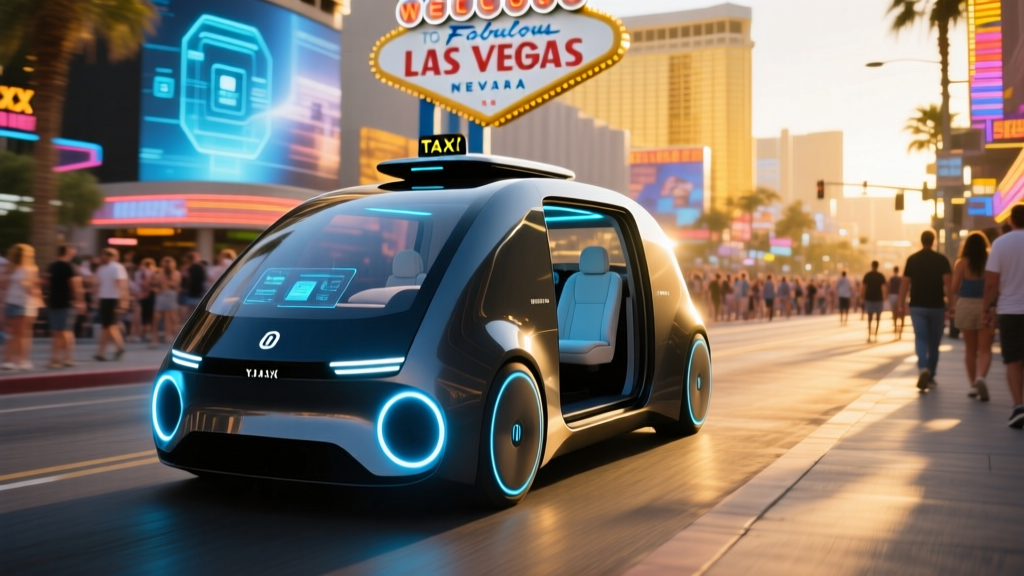
Las Vegas has become one of the densest proving grounds for driverless ride-hail in the United States. If you search for Vegas self-driving cars, you will find marketing videos, hotel shuttle demos, and a lot of confusion about what is actually available to the public. The reality in 2026 is narrower — and more interesting — than the hype.
Two operators dominate the conversation: Waymo (Alphabet/Google), running its fifth-generation and sixth-generation Jaguar I-PACE and custom Zeekr-based vehicles on a commercial, driverless basis; and Motional (the Hyundai/Aptiv joint venture), which operates Ioniq 5-based robotaxis primarily through the Uber and Lyft apps. A handful of smaller pilots — including Zoox's purpose-built carriage and hotel-campus shuttles from companies like Motional's earlier partners — exist in limited, geofenced pockets.
Before you summon one, it is worth understanding exactly what these vehicles can and cannot do, where the geofence ends, and what the safety record actually shows.
Is This Truly Self-Driving? SAE Automation Levels Explained
The single most important distinction in the autonomous-vehicle space is between SAE Level 2 driver-assist and SAE Level 4 driverless operation. Consumer vehicles like Tesla's FSD (Supervised), GM's Super Cruise, and Ford's BlueCruise are Level 2 systems: the human driver remains legally responsible, must monitor the road, and must be ready to take over at any moment. These are not robotaxis.
| Level | Name | Who Drives | Example |
|---|---|---|---|
| 0 | No Automation | Human only | Basic cruise control off |
| 1 | Driver Assistance | Human, one assist axis | Adaptive cruise OR lane-keep |
| 2 | Partial Automation | Human (hands-on/eyes-on or supervised) | Tesla Autopilot/FSD Supervised, Super Cruise, BlueCruise |
| 3 | Conditional Automation | System, human on fallback request | Mercedes DRIVE PILOT (limited markets/conditions) |
| 4 | High Automation | System within ODD (geofence) | Waymo One, Motional via Uber/Lyft, Zoox |
| 5 | Full Automation | System, everywhere, all conditions | Does not exist commercially |
Vegas robotaxis from Waymo and Motional are SAE Level 4: the system performs the entire dynamic driving task within a defined Operational Design Domain (ODD) — a geofenced service area, specific road types, and weather conditions. There is no driver behind the wheel, no steering wheel in some vehicles (Zoox), and no expectation that a passenger will intervene. If the vehicle encounters a scenario outside its ODD, it executes a minimal-risk maneuver (pull over, stop) rather than handing control to a rider.
- Operate outside their approved geofence (you cannot summon one to Red Rock Canyon or Lake Mead).
- Handle severe weather — heavy rain, dust storms, or dense fog will ground the fleet or trigger a safe-pull-over.
- Accept verbal instructions from passengers mid-ride; routing is app-driven only.
- Replace Level 2 driver-assist in a personal car you own — they are a service, not a product.
Where Can I Use Robotaxis in Vegas Right Now?
Service availability in Las Vegas is geofenced to specific corridors. As of early 2026, here is how the two major operators break down:
| Operator | Primary Geofence | How to Book | Hours |
|---|---|---|---|
| Waymo One | Las Vegas Strip corridor, Harry Reid International Airport (LAS), Downtown/Arts District, portions of Paradise and Winchester | Waymo One app (standalone) | 24/7 in core zones; reduced overnight in periphery |
| Motional (via Uber/Lyft) | Strip corridor (Mandalay Bay to Wynn/Encore), Convention Center loop, selected hotel-to-airport routes | Uber app (select "Autonomous" option) or Lyft | ~7 AM – 2 AM; weather-dependent |
| Zoox | Limited pilot zone — Summerlin and portions of the west Strip (announced/limited availability) | Zoox early-rider invitation list | Daytime pilot hours only |
A few practical notes from real rides: Waymo's geofence reliably covers every major Strip resort from Mandalay Bay through Resorts World, plus the airport's designated ride-app pickup level. Motional's Uber integration is the easiest entry point for visitors — you do not need a separate app — but matching to an autonomous vehicle is not guaranteed; the platform mixes human-driven and driverless cars in the same pool. Always check the vehicle description in the app before confirming.
How Much Does a Vegas Robotaxi Cost vs. Uber and Lyft?
Pricing is the most common question from first-time riders, and the answer is surprisingly mundane: robotaxis in Vegas are priced to compete directly with UberX and Lyft standard, not at a premium.
| Service | Typical Fare | Surge Behavior | Tipping |
|---|---|---|---|
| Waymo One | $11 – $16 | Mild demand pricing, caps apply | Optional in-app, not expected |
| Motional via Uber | $10 – $15 | Follows UberX surge in the market | Not applicable (no driver) |
| UberX (human driver) | $10 – $18 | Standard surge | Expected, 15–20% |
| Lyft Standard | $10 – $17 | Standard surge | Expected, 15–20% |
| Taxi (metered) | $18 – $25 + tip | N/A | Expected |
When you factor in the absent tip, a robotaxi ride often comes in $3–$6 cheaper than a comparable human-driven rideshare at equivalent demand. Waymo periodically runs promotional credits for first-time riders in new markets; check the app's promotions tab. Neither operator currently offers a subscription or membership pass in Las Vegas, though Waymo has tested flat-rate airport fares in Phoenix and may extend similar programs.
How Safe Are Vegas Robotaxis? The Real Data
Safety is where marketing claims and public perception diverge most sharply. Let's look at what the data actually shows.
- Over 30 million fully driverless miles logged across all U.S. markets combined.
- Per NHTSA Standing General Order crash reporting, Waymo's rate of police-reported collisions per million miles is significantly lower than the human-driver benchmark for comparable urban environments.
- The vast majority of reported incidents involve low-speed contact where another road user (typically a human driver) struck the robotaxi — rear-end collisions at stops are the most common category.
- Waymo publishes an annual Safety Case and Claims Avoidance report comparing its fleet's collision rates to human baselines, using actuarial methodology.
Motional's public data set is smaller, reflecting its more limited deployment scale. The company reports zero at-fault serious-injury collisions in its Las Vegas operations to date, though its total driverless miles are an order of magnitude below Waymo's. IIHS maintains a tracker of autonomous-vehicle incidents and regulatory actions that is worth consulting before your trip.
Context matters: robotaxis operate conservatively. They obey speed limits precisely, come to complete stops at stop signs (sometimes to the frustration of human drivers behind them), and yield aggressively at unprotected left turns. This driving style reduces severe crashes but increases the rate of minor rear-end contacts — exactly the pattern the data shows. On a per-mile basis, the available evidence indicates robotaxis are at least as safe as attentive human drivers in their approved geofences, and likely safer for the most consequential crash types (high-speed, T-bone, pedestrian).
Under the Hood: Lidar, Cameras, and the Tech Stack
Every commercially operating Vegas robotaxi uses a multi-sensor fusion stack. The "camera-only" approach championed by Tesla for its Level 2 FSD system is not used by any Level 4 operator in commercial passenger service.
Typical Level 4 Robotaxi Sensor Suite
| Sensor Type | Function | Typical Count per Vehicle |
|---|---|---|
| Lidar (roof-mounted + corner units) | 3D point-cloud mapping, object detection at range, redundancy in low light | 4 – 6 units |
| Cameras (wide + telephoto) | Traffic-light state, signage, lane markings, semantic understanding | 10 – 20 |
| Radar (long-range + corner) | Velocity measurement of moving objects, penetration through rain/dust | 4 – 6 |
| IMU + GNSS + HD maps | Localization to centimeter accuracy within the geofence | Integrated suite |
| Audio sensors | Siren detection (emergency vehicles) | Multiple microphones |
Waymo's sixth-generation "Driver" system, introduced on its newer vehicles, consolidates lidar into fewer, higher-resolution roof units while expanding camera coverage. The HD maps used by Level 4 operators are not the same as consumer navigation maps — they encode lane geometry, curb heights, traffic-signal phasing, and construction-zone patterns at centimeter resolution, and are updated continuously by the fleet itself. This map dependency is exactly why the geofence exists: the vehicle can only operate where the map is current and validated.
Compute happens on board. Each robotaxi carries multiple redundant compute trays (typically several hundred TOPS of inference capacity) to run perception, prediction, and planning models in real time. Connectivity to a remote operations center provides a human escalation path — not remote driving, but strategic guidance ("the construction zone ahead is approved to proceed" vs. "reroute").
Regulatory Landscape: Who Approves Vegas Robotaxis?
Nevada is one of the most permissive U.S. states for autonomous-vehicle testing and deployment, and Las Vegas benefits directly from that framework.
- Nevada DMV issues Autonomous Vehicle Testing and Deployment permits. Operators must submit safety cases, insurance documentation, and incident reports.
- NHTSA retains federal authority over vehicle safety standards (FMVSS). Robotaxis must either comply with all applicable FMVSS or operate under an NHTSA-granted exemption (as Zoox has for its steering-wheel-free carriage).
- Clark County and the City of Las Vegas manage local road-access permits, particularly for airport operations at Harry Reid International, where the Clark County Department of Aviation coordinates designated pickup zones.
- NHTSA's Standing General Order requires all Level 2+ and Level 4 operators to report crashes involving their systems within 24 hours — this is the primary public data source for incident tracking.
The practical implication for riders: every robotaxi you can summon in Vegas has passed a state permitting process, carries commercial insurance well above Nevada's minimums, and is subject to ongoing incident-reporting obligations. This is not an unregulated beta.
Current Limitations: Where Robotaxis Still Fall Short
Being honest about limitations is the difference between a good robotaxi experience and a frustrating one. Here is what the technology cannot yet handle reliably:
- Weather: Las Vegas monsoon-season rain (July–September) and dust-haboob events can ground the fleet. Lidar scatters in heavy precipitation, and camera visibility drops below safe thresholds. Expect service suspensions during these events, not degraded operation.
- Geofence edges: You cannot ride from the Strip to Henderson, Summerlin's outer reaches, or the Valley of Fire. The geofence is a hard boundary, not a soft one.
- Complex construction zones: While operators update HD maps frequently, sudden lane shifts or flagger-controlled zones may trigger a remote-operations escalation or a conservative pull-over. Rides through active Strip construction can take longer than a human driver would.
- Large events: Post-event egress from Allegiant Stadium or the Las Vegas Convention Center during peak hours can overwhelm pickup logistics. Waymo and Motional both implement event-mode pickup points that may require a longer walk than the app initially suggests.
- Multi-stop trips and errands: Robotaxis are point-A-to-point-B. You cannot ask the vehicle to wait while you run into a store, make multiple stops, or carry unaccompanied packages.
- Accessibility: Waymo's Jaguar I-PACE vehicles require the rider to enter a standard SUV cabin. Wheelchair-accessible vehicle (WAV) availability in Las Vegas remains limited compared to human-driven Uber WAV options. Motional's Ioniq 5 is similarly a standard passenger cabin.
- Child seats: Robotaxis do not provide child safety seats, and most operators restrict unaccompanied minors. Check operator policies before booking with young children.
Frequently Asked Questions
Can I hail a self-driving car directly on the Las Vegas Strip?
Yes, within the geofence. Both Waymo and Motional serve the major resort corridor from Mandalay Bay to Resorts World. Pickup points are sometimes designated by the resort (especially at larger properties like MGM Grand or Caesars Palace) — follow the in-app walking directions to the correct ride-app zone rather than assuming the main porte-cochère.
Is there a human in the car with me?
No. Waymo One and Motional's Uber/Lyft-integrated rides in Vegas are fully driverless — no safety driver, no front-seat attendant. The vehicle is monitored remotely by an operations center that can provide strategic guidance but does not "drive" the car in real time.
What happens if the robotaxi gets confused or stuck?
The vehicle will execute a minimal-risk maneuver: pull to the curb, activate hazards, and contact the remote operations center. You will see a message in the in-vehicle screen and can use the intercom button to speak with a support agent. The vehicle will not ask you to take the wheel — there is no steering wheel accessible to passengers in most configurations.
Do I need a special app to ride?
For Waymo, yes — download the Waymo One app (iOS/Android). For Motional, you can use your existing Uber or Lyft app; when an autonomous vehicle is available in your area, the app will show it as an option before you confirm. No separate account is required on the rideshare side.
Are Vegas self-driving cars available 24 hours a day?
Waymo One operates 24/7 in its core Strip and airport zones. Motional's service hours are more limited (typically early morning through late night). During severe weather events, all operators may suspend service temporarily.
How does robotaxi safety compare to a human Uber driver?
Based on NHTSA-reported data and operator safety publications, robotaxis show lower rates of at-fault collisions per million miles than the human-driver benchmark in comparable urban environments. The tradeoff: robotaxis drive more conservatively, which can mean longer trip times and a higher rate of minor rear-end contacts from impatient human drivers behind them.
Can a tourist from out of state use these services?
Yes. There is no residency requirement. You need a smartphone, a valid payment method, and the relevant app. First-time riders may be prompted to complete a brief in-app safety orientation before their first ride.
Bottom Line: Should You Ride a Vegas Robotaxi?
If you are visiting Las Vegas in 2026 and your trip stays within the Strip corridor, Downtown, or the airport, a robotaxi is a practical, price-competitive, and statistically safe alternative to a human-driven Uber or Lyft. The experience is genuinely novel the first time — watching a steering wheel turn itself through the chaos of Las Vegas Boulevard at 11 PM is not something you forget quickly — and mundane by the third ride, which is exactly the point. The technology is mature enough within its geofence to be boring, and boring is what you want from a ride at the end of a long night.
Just know the boundaries: you cannot take one to the Hoover Dam, you cannot ride through a monsoon, and you should budget an extra five minutes for the conservative driving style. Within those constraints, Vegas self-driving cars are not a demo or a pilot — they are a working, daily-ride transportation option.