Toyota's Autonomy Strategy: Two Parallel Tracks
When shoppers search for "Toyota self-driving cars," they're usually looking for one of two very different things: the hands-free highway assist available on a 2026 RAV4 at their local dealer, or the fully driverless robotaxi prototypes being tested in Japan and the U.S. by Toyota's autonomy division, Woven by Toyota. These sit on opposite ends of the SAE automation scale, and conflating them is the single biggest source of confusion in this space.
This guide separates what Toyota offers right now in consumer vehicles from what's happening in its Level 4 robotaxi program, with exact feature availability, real-world limitations, and safety data so you can set realistic expectations.
- Level 2 (Driver Assist): The system controls steering and speed, but the driver must remain engaged, eyes on the road, hands ready. This is Toyota Safety Sense, Teammate, and Lexus Teammate Advanced Drive. You are still driving.
- Level 3 (Conditional Automation): The car handles all driving in specific conditions; the driver can disengage but must take over when prompted. Not currently offered on any U.S.-market Toyota.
- Level 4 (High Automation): No driver needed within a defined geofence. This is the robotaxi category — Waymo, Zoox, and Toyota/Woven's research fleet. Not available for consumer purchase.
What You Can Buy Today: Toyota Teammate Advanced Drive
For the 2026 model year, the highest level of driver-assist Toyota sells to consumers is Teammate Advanced Drive, available on select Lexus models (LS, LC, and the new LX). In the Toyota lineup, the most advanced system is Toyota Safety Sense 3.0 (TSS 3.0), which bundles adaptive cruise control, lane-centering, and automatic emergency braking — a solid Level 2 suite, but it is not self-driving.
| Feature | TSS 3.0 (Toyota) | Teammate Advanced Drive (Lexus) |
|---|---|---|
| SAE Level | Level 2 | Level 2 (hands-free in limited conditions) |
| Hands-Free Highway | No (hands-on required) | Yes, low-speed congestion (<~40 mph) |
| Lane Change Assist | No | Yes (driver confirmed) |
| Availability | Most 2026 Toyota models (standard or optional) | 2026 Lexus LS, LC, LX (higher trims) |
| Driver Monitoring | Basic (steering wheel torque) | Infrared camera (eye/face tracking) |
| Subscription Cost | Included with vehicle | Included (trial period varies) |
Teammate Advanced Drive's hands-free capability is limited to congested highway driving at lower speeds — similar in concept to Ford's BlueCruise or GM's Super Cruise but with a narrower operational envelope. The moment traffic clears and speeds rise above ~40 mph, the system requires hands on the wheel. This is a meaningful safety constraint, not a software bug: Toyota has been more conservative than competitors in defining the conditions under which it permits hands-off operation.
Toyota's Level 4 Robotaxi Program: Woven by Toyota
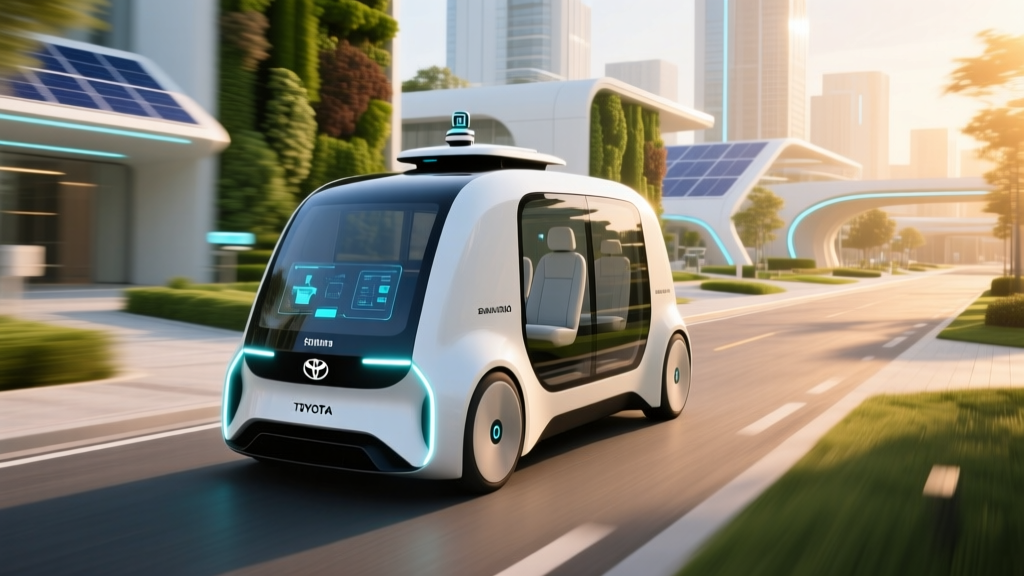
Toyota's actual push toward driverless vehicles runs through Woven by Toyota (formerly Woven Planet), the autonomy and software subsidiary established in 2021. Woven operates the Toyota Woven City — a purpose-built "living laboratory" near Mt. Fuji, Japan — and runs autonomous vehicle testing in both Japan and the United States.
Technology Stack
Woven's Level 4 platform uses a multi-sensor fusion approach, distinct from Tesla's camera-only FSD strategy:
- LiDAR: Multiple solid-state and spinning units for 360° depth mapping (range ~200m)
- Cameras: High-resolution surround-view for object classification, traffic signal recognition
- Radar: Millimeter-wave for adverse-weather redundancy (rain, fog, low-light)
- HD Mapping: Centimeter-precision geofenced maps, continuously updated
- Compute: Custom Toyota-developed "Arene" OS with redundant compute modules
This sensor-heavy approach is closer to Waymo's architecture than to Tesla's vision-only bet. The trade-off: higher per-vehicle hardware cost but more redundancy for edge-case detection, which matters for Level 4 operations where no human driver is present to intervene.
Where Can You Use a Toyota Robotaxi Right Now?
The honest answer: you cannot hail a driverless Toyota robotaxi anywhere in the United States as of 2026. Toyota/Woven's Level 4 fleet remains in testing and pilot phases, not in commercial passenger service.
| Location | Status | Public Access |
|---|---|---|
| Woven City, Susono, Japan | Active testing (geofenced campus) | Residents and invited participants only |
| Tokyo, Japan (public roads) | Limited pilot program | Closed testing; not open to public |
| United States (multiple sites) | R&D and mapping operations | No public ride service available |
For comparison, Waymo operates commercial driverless ride-hail in Phoenix, San Francisco, Los Angeles, and Austin as of 2026. Toyota/Woven is not in this category. The company has not announced a firm timeline for U.S. commercial robotaxi deployment, and Toyota executives have consistently emphasized a cautious, phased approach rather than aggressive expansion targets.
Safety Record: What the Data Shows
Because Toyota/Woven's Level 4 fleet is not in commercial service, there is no public-facing disengagement rate or passenger-incident database comparable to what California's DMV requires of Waymo and Cruise. What we can assess:
Toyota has not published a standalone Level 4 disengagement report for U.S. operations. The company reports testing miles through Japan's regulatory framework (MLIT) rather than through the California DMV's public disengagement reporting system. Specific intervention-per-mile figures are not publicly disclosed as of 2026.
For Toyota's consumer Level 2 systems (TSS 3.0), the Insurance Institute for Highway Safety (IIHS) has tested multiple Toyota models, with TSS-equipped vehicles consistently earning top scores in crash avoidance. However, IIHS evaluates collision-avoidance capability, not autonomous-driving safety — these are different metrics.
For consumer driver-assist specifically, NHTSA requires manufacturers to report crashes involving Level 2 and above systems through its Standing General Order. Toyota's incident data is aggregated within this database but not broken out by feature in a way that isolates Teammate-specific events from other TSS functions.
Current Limitations of Toyota's Autonomous Systems
Whether you're evaluating the Teammate system in a 2026 Lexus or tracking the Woven robotaxi program, these constraints define what the technology cannot do today:
- Weather: Heavy rain, snow, and fog degrade camera and radar performance; system may disengage and require full manual control with minimal warning
- Construction zones: Lane reconfigurations and temporary barriers are not reliably detected; system may follow old lane markings
- Unmapped roads: Advanced features like hands-free congestion assist require well-maintained lane markings and HD map coverage
- Urban complexity: Pedestrian-dense areas, unprotected left turns, and roundabouts require constant driver engagement
- Driver monitoring: Infrared cameras will issue escalating warnings and disengage if the driver looks away, closes eyes, or removes attention
- Geofencing: All current testing is restricted to pre-mapped zones; the vehicle will not operate outside these boundaries
- Weather ceiling: Heavy precipitation and low-visibility conditions trigger operational pauses — the fleet is pulled from service, not deployed into degraded conditions
- No commercial availability: No member of the public can currently book or hail a Woven-operated vehicle
- Edge cases: Unusual road configurations, emergency-vehicle interaction, and unmapped detours require remote-assist or human safety-driver fallback during testing
Pricing: Robotaxi vs. Rideshare (When Available)
Since Toyota/Woven does not yet offer a commercial robotaxi service, there is no Toyota robotaxi pricing to compare against Uber or Lyft. For reference, here's how existing Level 4 robotaxi pricing stacks up in markets where it's live:
| Service | Avg. Cost (5-mile trip) | Surge Pricing | Availability |
|---|---|---|---|
| Waymo One | ~$12–$18 | Yes (demand-based) | Phoenix, SF, LA, Austin |
| UberX | ~$14–$22 | Yes (surge) | Nationwide |
| Lyft | ~$13–$20 | Yes (prime time) | Nationwide |
| Toyota/Woven Robotaxi | N/A — not in service | N/A | Not available to public |
When and if Toyota launches a commercial robotaxi service, industry analysts expect pricing to be competitive with Waymo — roughly on par with UberX but without the variability of human-driver availability. The economic thesis of robotaxis is that removing the driver (typically 60–70% of rideshare cost) allows lower per-mile pricing at scale. That thesis has not yet been proven at fleet-wide profitability for any operator.
The Regulatory Landscape
Autonomous vehicle regulation in the U.S. is a patchwork. At the federal level, NHTSA sets safety standards but does not currently certify Level 4 systems for commercial deployment — that authority largely falls to individual states.
Key state-level dynamics affecting Toyota's potential U.S. robotaxi launch:
- California: The DMV issues testing permits; the California Public Utilities Commission (CPUC) approves commercial ride-hail deployment. Cruise's 2023 suspension in San Francisco demonstrated that regulators can and will revoke permits after safety incidents.
- Arizona: The most permissive regulatory environment; Waymo's Phoenix operations launched here partly because of lighter regulatory friction.
- Japan: Toyota's home market operates under MLIT (Ministry of Land, Infrastructure, Transport and Tourism) oversight. Japan passed Level 4 legislation in 2023, creating a legal framework that Toyota/Woven is actively testing within.
Toyota has signaled that its first commercial robotaxi operations are more likely to debut in Japan than in the U.S., given the regulatory clarity and the controlled environment of Woven City. Any U.S. launch would require state-by-state approval — a process that adds years, not months, to deployment timelines.
Toyota vs. Competitors: Where Does Toyota Stand?
Toyota's autonomy strategy differs fundamentally from Tesla's. Where Tesla pushes camera-only FSD (Supervised) — still Level 2 despite the "Full Self-Driving" branding — to millions of consumer vehicles and collects fleet data, Toyota separates its consumer Level 2 business from its Level 4 R&D and invests in sensor redundancy (LiDAR, radar, HD maps) rather than betting on vision alone.
Neither approach has yet produced a widely available Level 4 consumer vehicle. The realistic framing:
- If you want driver-assist today in a Toyota or Lexus, Teammate Advanced Drive and TSS 3.0 are competitive Level 2 systems — but you are still the driver.
- If you want a driverless ride today, Waymo is the only option at scale in the U.S., and it is not a Toyota vehicle.
- If you want a Toyota robotaxi, no commercial service exists anywhere in the world as of 2026. The program is active but pre-commercial.
Frequently Asked Questions
Is Toyota's driver-assist system actually self-driving?
No. Toyota Safety Sense 3.0 and Lexus Teammate Advanced Drive are SAE Level 2 driver-assist systems. The driver must remain engaged, monitor the road, and be prepared to take control at any moment. These are not autonomous vehicles — they are advanced cruise-control and lane-keeping systems with collision-avoidance features.
Can I buy a self-driving Toyota in 2026?
No Toyota vehicle sold to consumers in 2026 is self-driving (Level 4 or 5). The most advanced consumer system, Teammate Advanced Drive on select Lexus models, offers hands-free operation only in low-speed highway congestion and still requires driver monitoring. True self-driving Toyotas exist only in Toyota/Woven's testing fleet.
Where are Toyota robotaxis available?
They are not available to the public. Woven by Toyota conducts Level 4 testing at Woven City in Susono, Japan, and on limited public roads in Tokyo. No commercial ride-hail or passenger service is offered anywhere in the world as of 2026.
How does Toyota's approach compare to Tesla FSD?
Toyota uses a multi-sensor approach (LiDAR, radar, cameras, HD maps) and keeps Level 4 development separate from consumer vehicles. Tesla uses cameras only and deploys FSD (Supervised) as a Level 2 system to consumer vehicles at scale. Both remain Level 2 for consumer use; neither has achieved Level 4 commercial deployment. Toyota's approach is more conservative, with greater hardware redundancy but slower consumer-facing autonomy rollout.
When will Toyota launch a commercial robotaxi?
Toyota has not announced a firm date for commercial robotaxi service. Industry analysts expect Japan to be the first market, potentially in the late 2020s, but Toyota executives have consistently avoided committing to specific timelines. U.S. deployment would require state-by-state regulatory approval and would follow Japan, if it happens at all.
Is Toyota investing in self-driving technology?
Yes, significantly. Toyota invested over $1 billion in establishing Woven by Toyota and continues to fund the Woven City test environment, autonomous fleet operations, and the Arene software platform. However, Toyota's investment philosophy prioritizes safety validation over speed-to-market, which is why its consumer-facing autonomy features are more conservative than some competitors.