If you live in or near Palo Alto, California, you have likely seen Tesla vehicles navigating local streets and wondered whether the company's promised robotaxi service has actually arrived in Elon Musk's backyard. The short answer in early 2026: Tesla's robotaxi ambitions remain in a tightly controlled pilot phase, and the consumer-facing, app-summoned, fully driverless ride-hailing service that Tesla has teased since 2019 is not yet a publicly available service in Palo Alto or anywhere else.
What does exist is a limited supervised pilot program, a growing body of real-world FSD (Full Self-Driving) data from privately owned Teslas, and a regulatory landscape in California that draws a hard line between driver-assist technology and true driverless robotaxi operations. Here is exactly where things stand, what the data shows, and how Tesla's approach compares to the Level 4 robotaxi services that are actually picking up paying passengers today.
Is Tesla's Robotaxi Truly Self-Driving or Still Driver-Assist?
This is the most critical distinction for any buyer or rider to understand, because Tesla's own marketing has frequently blurred it. As of 2026, Tesla's Full Self-Driving (Supervised) software — the most advanced autonomy feature available to Tesla owners — is classified as SAE Level 2 driver-assist. That means the human driver must remain fully engaged, eyes on the road, hands available to take over at any moment.
| Level | Classification | Who Drives? | Example |
|---|---|---|---|
| Level 0 | No automation | Human | Basic cruise control |
| Level 1 | Driver assistance | Human | Adaptive cruise OR lane-keep |
| Level 2 | Partial automation | Human (supervising) | Tesla FSD (Supervised), GM Super Cruise, Ford BlueCruise |
| Level 3 | Conditional automation | System (human on standby) | Mercedes Drive Pilot (limited conditions) |
| Level 4 | High automation | System (no human needed in zone) | Waymo One, Zoox — true robotaxi |
| Level 5 | Full automation | System (everywhere) | Does not exist commercially |
By contrast, Waymo One operates at SAE Level 4 within its geofenced service areas — no human driver, no steering wheel intervention required, no passenger supervision needed. That is the gap Tesla must close to offer a true robotaxi service, and as of 2026, that gap remains significant.
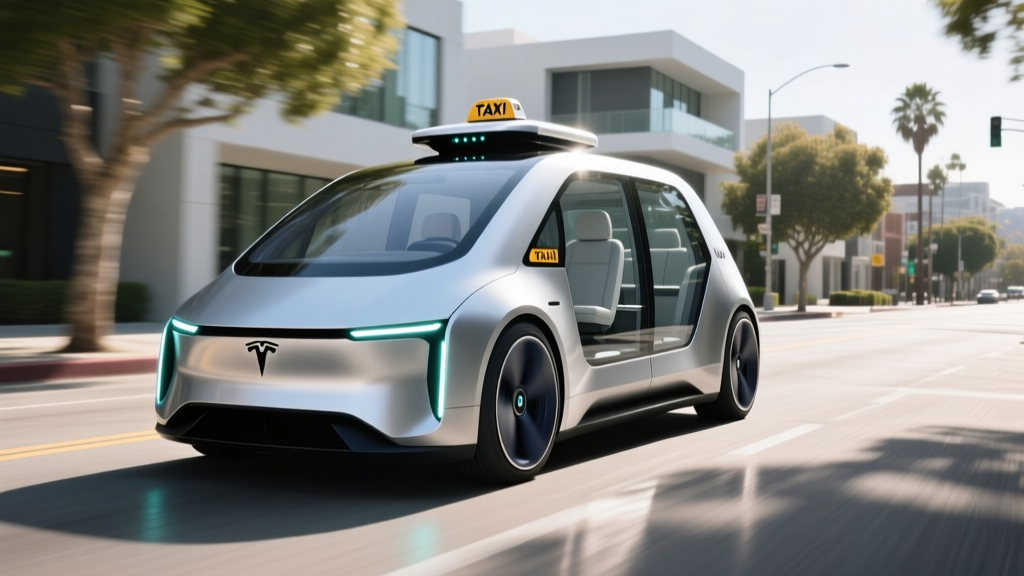
Tesla unveiled its dedicated "Cybercab" robotaxi concept in late 2024 — a two-seat vehicle with no steering wheel or pedals — but production and regulatory approval for driverless commercial deployment have not materialized as of this writing. Tesla's pilot programs in select cities use supervised vehicles with safety operators or restricted test parameters.
Where Can You Use a Tesla Robotaxi Right Now?
The honest answer: you cannot hail a driverless Tesla robotaxi anywhere in the United States as a paying passenger in 2026. What exists instead is a patchwork of supervised pilot programs and internal testing.
| City/Region | Tesla Status | Public Access? | Notes |
|---|---|---|---|
| Palo Alto, CA | Internal FSD testing; employee pilot | No | Tesla HQ proximity; heavy FSD data collection zone |
| Austin, TX | Supervised pilot (safety driver) | Limited/Invite | Gigafactory Texas; limited employee/early-access riders |
| San Francisco, CA | Testing with permits | No | CA DMV testing permit; safety driver required |
| Phoenix, AZ | No active program | No | Waymo dominates this market |
| Los Angeles, CA | FSD data collection | No | High FSD adoption; no robotaxi service |
For Palo Alto specifically, Tesla vehicles equipped with FSD (Supervised) are a common sight on University Avenue, El Camino Real, and around the Stanford campus. However, these are privately owned vehicles driven by engaged human drivers — not robotaxis available for hire. Tesla's proximity to its engineering headquarters makes the area a natural data-collection zone, but that does not translate to a public ride-hailing service.
If you want to ride in a genuine driverless robotaxi in the Bay Area today, Waymo One operates across San Francisco and has expanded into parts of the Peninsula and South Bay, though Palo Alto coverage remains limited and subject to geofence boundaries. Check Waymo's official service area map for current coverage.
Tesla's Technology Stack: Camera-Only vs. Lidar-Based Approaches
Tesla's autonomy strategy diverges sharply from every other major robotaxi developer, and understanding this split is essential to evaluating the company's robotaxi timeline.
Tesla: Vision-Only (Camera + Neural Networks)
- Sensors: 8 cameras (surround-view), no lidar, no radar (removed in 2021+ models)
- Compute: Custom HW4 (AI4) chip, ~300+ TOPS processing
- Approach: End-to-end neural network trained on billions of miles of fleet driving data; camera inputs mapped directly to driving decisions
- Mapping: No HD pre-mapped routes; relies on real-time perception
- Geofencing: FSD (Supervised) operates on any road — no geographic restriction
Waymo / Zoox / Cruise: Multi-Sensor Fusion (Lidar + Camera + Radar)
- Sensors: Roof-mounted lidar arrays, multiple cameras, radar units, ultrasonic sensors
- Compute: Custom high-performance computing platforms
- Approach: HD-mapped environments with sensor fusion; redundant perception layers
- Mapping: Centimeter-precision HD maps of every operational road
- Geofencing: Restricted to pre-mapped, approved zones only
Tesla's vision-only approach has significant cost advantages — no $10,000+ lidar array per vehicle — and scalability (any road a camera can see is theoretically drivable). But it also carries inherent limitations: camera performance degrades in heavy rain, fog, direct sun glare, and low-light conditions where lidar's active illumination provides reliable depth data regardless of ambient light.
This technology choice is the single biggest factor in why Tesla's FSD remains Level 2 (supervised) while lidar-equipped Waymo vehicles operate at Level 4 (driverless) within their geofenced zones. Regulatory bodies like the National Highway Traffic Safety Administration (NHTSA) and California's DMV require demonstrated redundancy and reliability before approving fully driverless commercial service.
Safety Data: What the Numbers Actually Show
Safety is the make-or-break question for any robotaxi service. Here is what the available data tells us about Tesla's FSD system and how it compares to established Level 4 operators.
- Cumulative FSD miles driven: Over 3 billion miles (as reported by Tesla, Q4 2025)
- Tesla-reported crash rate: ~1 crash per 4.5 million FSD miles (Tesla's self-reported quarterly safety data)
- U.S. average crash rate: ~1 crash per 670,000 miles (NHTSA national average, all vehicles)
- Important caveat: Tesla's data is self-reported, not independently verified by NHTSA or IIHS. FSD miles are predominantly driven on highways and in favorable conditions by engaged drivers who can intervene.
For comparison, Waymo has published peer-reviewed safety data covering over 25 million fully driverless miles across Phoenix, San Francisco, and Los Angeles. Their research, published in collaboration with insurance and safety analysts, shows a 76% reduction in police-reported crash rates compared to human baseline drivers in the same geographies, and an 83% reduction in injury-causing crashes. Waymo's disengagement (intervention) rates are tracked by the California DMV's annual autonomous vehicle disengagement reports, which are mandatory for all permitted operators.
Tesla does not participate in the California DMV's disengagement reporting framework in the same way, because FSD (Supervised) is classified as a Level 2 driver-assist system, not a Level 4 autonomous vehicle testing program. This means there is no standardized, independently verified intervention-rate data for Tesla's system comparable to what Waymo, Zoox, and other Level 4 operators are required to publish.
A critical context point: FSD (Supervised) miles are driven with an alert human ready to take over. Level 4 robotaxi miles are driven with no human backup at all. Comparing the safety records directly without this context is misleading. A Level 2 system with a vigilant human supervisor and a Level 4 system operating entirely alone face fundamentally different safety thresholds.
Pricing: How Would a Tesla Robotaxi Compare to Uber and Lyft?
Since Tesla's robotaxi is not yet a publicly bookable service, there is no live consumer pricing to report. However, Tesla has outlined an aspirational pricing model, and we can benchmark it against current rideshare and competing robotaxi costs.
| Service | Cost per Mile (Est.) | Typical 5-Mile Ride | Availability | Driver? |
|---|---|---|---|---|
| Tesla Robotaxi (announced target) | ~$0.20/mi | ~$5-8 (projected) | Not available | None (planned) |
| Waymo One (SF/Phoenix) | ~$1.50-2.50/mi | $12-18 | Live in select cities | None (Level 4) |
| UberX (Bay Area) | ~$2.00-3.50/mi | $15-25 | Ubiquitous | Human driver |
| Lyft Standard (Bay Area) | ~$1.80-3.00/mi | $14-22 | Ubiquitous | Human driver |
Tesla's projected ~$0.20/mile target is based on the premise that a fleet-owned Cybercab has no driver cost, low maintenance (electric powertrain), and high utilization (operating 16-20 hours/day). If achieved, it would undercut every existing mobility option. However, this projection does not fully account for insurance costs at scale, vehicle depreciation, remote fleet monitoring, cleaning and maintenance between rides, regulatory compliance fees, and the substantial R&D amortization required to bring the system to market.
For context, Waymo — which has been operating commercially since 2020 — prices its rides competitively with Uber/Lyft but has not yet demonstrated profitability. The economics of robotaxi operations at scale remain unproven industry-wide.
Regulatory Landscape: Who Approves Robotaxi Operations?
Even if Tesla's technology reached Level 4 capability tomorrow, the company would still need to navigate a multi-layered regulatory approval process before offering rides to the public in Palo Alto or anywhere in California.
- California DMV: Issues Autonomous Vehicle Testing Permits and Deployment Permits. Companies must submit safety data, disengagement reports, and operational plans. Tesla holds a testing permit but has not received a commercial deployment permit for driverless operations.
- California Public Utilities Commission (CPUC): Regulates commercial passenger transport, including robotaxi fares, insurance requirements, and accessibility mandates. Waymo received CPUC approval for its San Francisco expansion; Tesla has not applied.
- NHTSA (Federal): Sets vehicle safety standards (FMVSS). Tesla's Cybercab concept — with no steering wheel or pedals — would require exemptions from current FMVSS requirements that mandate manual driving controls. The NHTSA exemption process is lengthy and requires extensive safety justification.
- Local municipalities: Cities like Palo Alto, San Francisco, and Austin can impose additional operational restrictions, including geofence boundaries, hours of operation, and fleet-size caps.
The regulatory pathway is well-established — Waymo and Zoox have navigated it — but it requires years of documented safety data, public comment periods, and incremental expansion approvals. Tesla's more aggressive public timelines have historically outpaced both technological readiness and regulatory approval.
Current Limitations of Tesla's Autonomy System
What Tesla FSD (Supervised) Cannot Do in 2026
- Operate without a driver: A licensed, attentive human must be in the driver's seat at all times. This is not optional — it is a legal and technical requirement.
- Handle all weather conditions: Heavy rain, fog, snow, and direct sun glare degrade camera-only perception. Tesla's owner manual explicitly warns drivers to disengage FSD in adverse conditions.
- Navigate unmapped construction zones reliably: Temporary lane shifts, cones, and flaggers present edge cases that require frequent human takeovers.
- Handle complex unprotected left turns consistently: Urban intersections with mixed traffic, pedestrians, and cyclists remain high-intervention scenarios.
- Operate on roads without clear lane markings: Rural roads, worn markings, and non-standard road geometries increase system uncertainty.
- Function as a ride-hailing service: Tesla's terms of service for FSD explicitly prohibit using the system for commercial passenger transport.
These limitations are not unique to Tesla — they affect the entire autonomous driving industry. But Level 4 operators like Waymo address them through geofencing (avoiding unmapped or high-complexity zones), multi-sensor redundancy (lidar works in fog where cameras struggle), and remote assistance protocols. Tesla's camera-only, no-geofence approach means it must solve these edge cases universally before achieving true driverless capability, which is a fundamentally harder engineering problem.
The Palo Alto Reality: What You Can Actually Do Today
If you are a Palo Alto resident interested in Tesla's autonomous technology, here are your realistic options in 2026:
- Purchase a Tesla with FSD (Supervised): Available on Model 3, Model Y, Model S, and Model X. FSD capability costs $8,000 as a one-time purchase or $99/month as a subscription (pricing subject to change). You will get the most advanced Level 2 driver-assist system Tesla offers, but you must remain the driver.
- Ride in a Waymo One robotaxi: Available in San Francisco and expanding. Download the Waymo app, set your pickup within the service zone, and experience a genuine Level 4 driverless ride. Pricing is comparable to Uber.
- Monitor Tesla's pilot programs: Tesla may expand its supervised pilot to include select Palo Alto residents or employees. There is no public signup; access is controlled by Tesla internally.
Frequently Asked Questions
Can I hail a Tesla robotaxi in Palo Alto today?
No. As of 2026, Tesla does not operate a public robotaxi ride-hailing service in Palo Alto or any other city. Tesla's FSD-equipped vehicles on local roads are privately owned and driven by engaged human drivers using Level 2 driver-assist technology.
When will Tesla's robotaxi be available to the public?
Tesla has projected commercial robotaxi launches multiple times since 2019, and those timelines have consistently slipped. The Cybercab concept was unveiled in 2024, but production, regulatory approval, and commercial deployment remain pending. No confirmed public launch date exists. Industry analysts project the earliest plausible large-scale deployment at 2027-2028, contingent on regulatory approval.
Is Tesla FSD safe enough to be a robotaxi?
Tesla's self-reported data suggests FSD (Supervised) has a lower crash rate than the national average, but this data is not independently verified, and the system operates with a human supervisor ready to intervene. Level 4 robotaxi safety requires operating without any human backup — a substantially higher bar that Tesla has not yet demonstrated to regulators.
How does Tesla's camera-only approach compare to Waymo's lidar?
Cameras are cheaper and scalable but struggle in poor lighting, heavy rain, and fog. Lidar provides reliable 3D depth perception in all lighting conditions but adds significant cost per vehicle. Waymo's multi-sensor approach (lidar + camera + radar) provides the redundancy that regulators currently require for driverless operations. Tesla's vision-only approach has not yet received regulatory approval for driverless commercial use.
What robotaxi can I actually ride in the Bay Area right now?
Waymo One is the primary Level 4 robotaxi service available in the Bay Area, operating across San Francisco and expanding into surrounding areas. Download the Waymo One app to check current service availability and request a ride. Zoox (owned by Amazon) also conducts limited testing but does not yet offer public rides.