Elon Musk's unveiling of the Tesla Cybercab concept reignited one of the most polarizing debates in the auto industry: can a camera-only, lidar-free vehicle truly operate as a driverless robotaxi at scale? The Tesla robotaxi launch bet hinges on whether Tesla's neural-network-driven Full Self-Driving (FSD) software can bridge the gap from supervised driver-assist to unsupervised, geofence-free Level 4 autonomy — a feat no production vehicle has achieved without lidar redundancy.
As of early 2026, Tesla has not yet launched a commercial robotaxi service. The Cybercab remains an announced vehicle with a targeted production timeline, while competitors like Waymo and Zoox are actively operating paid, driverless rides in multiple U.S. cities. This article breaks down exactly where the Tesla robotaxi effort stands, the technology powering it, the regulatory barriers it faces, and what the data tells us about the viability of a vision-only autonomy stack.
What Tesla Is Actually Promising: The Cybercab at a Glance
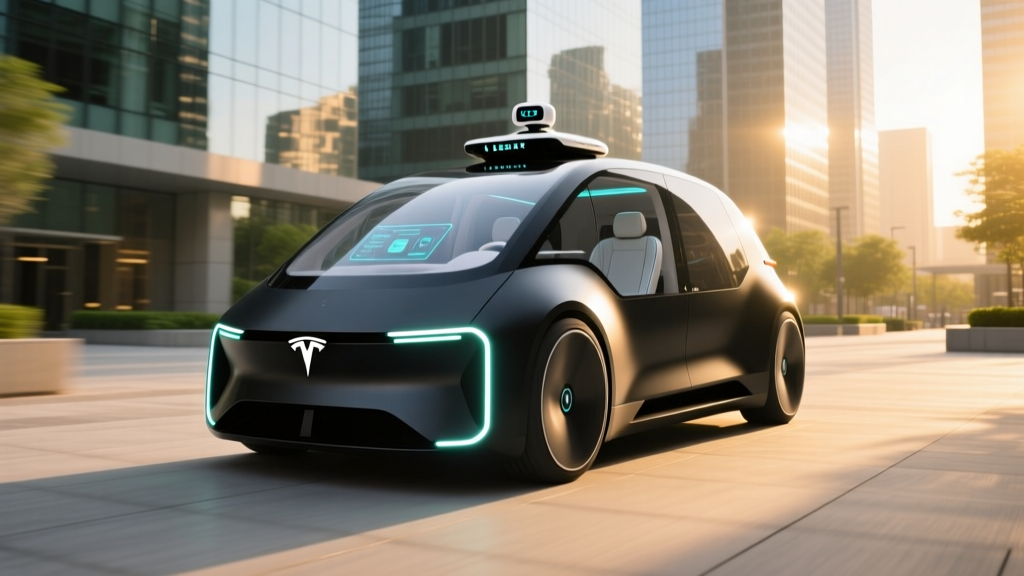
The Cybercab is Tesla's purpose-built robotaxi concept — a two-seat vehicle with no steering wheel, no pedals, and an inductive (wireless) charging system. Tesla announced it at the October 2024 "We, Robot" event and has since provided preliminary specifications. It is critical to note that the Cybercab is an announced vehicle; it is not currently available for purchase or ride-hailing.
| Attribute | Tesla Cybercab (Announced/Preliminary) |
|---|---|
| Vehicle Type | 2-seat robotaxi (no steering wheel/pedals) |
| Estimated Range | ~200-250 miles (EPA est. TBD) |
| Battery (estimated) | ~50-60 kWh usable, LFP chemistry expected |
| Charging | Wireless inductive (primary); no charge port confirmed |
| Sensor Suite | Camera-only (Tesla Vision); no lidar, no radar |
| Autonomy Target | SAE Level 4 (unsupervised, driverless) |
| Target Production | 2026-2027 (per Tesla statements) |
| Estimated Price (if sold) | <$30,000 MSRP (Tesla claim, unverified) |
| Target Operating Cost | ~$0.20/mile (Tesla claim) |
All specifications above are preliminary and based on Tesla's public statements. Independent EPA testing, crash ratings from NHTSA, and third-party validation are not yet available.
SAE Automation Levels: Where Tesla Stands vs. True Robotaxis
The single most important distinction in the autonomy conversation is the gap between SAE Level 2 (driver-assist) and SAE Level 4 (driverless in defined conditions). Tesla's current production vehicles — including those running FSD (Supervised) — operate at SAE Level 2. The driver must remain attentive and is legally responsible for the vehicle at all times.
| SAE Level | Name | Driver Required? | Current Example |
|---|---|---|---|
| Level 2 | Partial Automation | Yes — hands on/near wheel, eyes on road | Tesla Autopilot, FSD (Supervised), GM Super Cruise, Ford BlueCruise |
| Level 3 | Conditional Automation | No in specific conditions (driver must take over on request) | Mercedes Drive Pilot (limited markets, <40 mph) |
| Level 4 | High Automation | No — within geofenced ODD (operational design domain) | Waymo One, Zoox (operational cities) |
| Level 5 | Full Automation | No — all conditions, all roads | None in commercial operation |
Waymo, by contrast, operates at Level 4 within geofenced service areas using a multi-sensor stack (lidar, radar, cameras). The Tesla robotaxi launch bet is essentially a wager that neural networks trained on billions of miles of real-world camera data can match or exceed the reliability of lidar-equipped systems — without the hardware redundancy that regulators and safety researchers consider essential.
Where Can You Actually Ride a Robotaxi Right Now?
As of early 2026, Tesla does not operate a robotaxi service. If you want to ride in a driverless vehicle today (no human behind the wheel), here is where commercial services are live:
| Service | Operator | SAE Level | Live Cities (2026) | Availability |
|---|---|---|---|---|
| Waymo One | Waymo (Alphabet) | Level 4 | Phoenix, San Francisco, Los Angeles, Austin | 24/7, paid public service |
| Zoox | Zoox (Amazon) | Level 4 | Limited service in Las Vegas, Foster City (CA) | Invite-only / limited public |
| Cruise | Cruise (GM) | Level 4 | Suspended — gradual relaunch in Phoenix, Dallas with safety drivers | Paused/supervised relaunch |
| Tesla Cybercab | Tesla | Level 4 (target) | None — not yet in service | Announced, no live operations |
Waymo is the clear leader in commercial robotaxi deployment, with millions of paid driverless trips completed. The service is accessible via the Waymo app, functions similarly to Uber/Lyft in its user experience, and operates around the clock in approved geofenced zones.
Robotaxi Pricing: What a Ride Actually Costs vs. Uber and Lyft
One of Tesla's core promises is that the Cybercab will deliver rides at approximately $0.20 per mile — dramatically undercutting both human-driven rideshare and even Waymo's current pricing. Here's how current robotaxi fares compare to traditional rideshare:
| Service | Avg. Cost/Mile | Avg. Cost for 5-Mile Trip | Surge Pricing? |
|---|---|---|---|
| Waymo One (Phoenix/SF) | $1.00–$1.50/mi | $8–$15 | Rare; limited surge |
| Uber/Lyft (national avg.) | $1.50–$2.50/mi | $12–$20 | Yes — frequent during peak |
| Tesla Cybercab (projected) | ~$0.20/mi (Tesla claim) | ~$2–$5 (if achieved) | Unknown |
Tesla's $0.20/mile claim assumes a fully autonomous, fleet-operated model with minimal overhead — no driver wages, low maintenance (EV powertrain), and high utilization rates. Industry analysts remain skeptical of this figure. Waymo's current pricing, while competitive with Uber/Lyft in some markets, still reflects the high capital cost of lidar-equipped vehicles (estimated $150,000+ per Waymo 6th-gen vehicle) and remote operations staffing.
For Tesla to hit $0.20/mile, the Cybercab would need to achieve near-continuous utilization (18+ hours/day), minimal remote intervention, and extremely low per-vehicle hardware costs. The camera-only approach gives Tesla a structural cost advantage — cameras are vastly cheaper than lidar — but only if the software reliability eliminates the need for expensive remote safety operators.
How Safe Are Robotaxis? The Real Data
Safety is the most contentious dimension of the Tesla robotaxi launch bet. Tesla has pointed to FSD's supervised safety record as evidence that its vision system is approaching human-level reliability. But supervised FSD data and unsupervised robotaxi safety are fundamentally different benchmarks.
- Waymo: Over 50 million driverless miles completed (as of late 2025). Waymo's published data shows a fatality rate significantly below the U.S. human-driver average of 1.35 per 100 million vehicle miles. Minor contact incidents occur but are overwhelmingly low-speed and non-injury.
- Cruise: Suspended California operations in October 2023 after a pedestrian was dragged ~20 feet by a Cruise vehicle following a collision with a human-driven car. The incident exposed failures in post-collision behavior and transparency with regulators. Cruise has since relaunched with safety drivers in select cities.
- Tesla FSD (Supervised): Tesla reports one crash per ~4-5 million FSD miles, compared to the U.S. average of one crash per ~670,000 miles. However, FSD miles are driven with an attentive driver supervising, making direct comparison to unsupervised robotaxi operations misleading. NHTSA has opened multiple investigations into Tesla Autopilot/FSD incidents, particularly involving stationary emergency vehicles.
The critical question for the Cybercab: can a camera-only system reliably handle edge cases — a child stepping into the road at dusk, a white truck against a bright sky (the well-documented 2016 fatal Autopilot incident), construction zone lane shifts, or adverse weather — without the depth-perception redundancy that lidar provides?
Waymo's lidar stack generates a real-time 3D point cloud independent of ambient lighting, giving it a hardware-level safety margin in low-visibility scenarios. Tesla's vision-only approach relies on neural network inference from 2D camera images, which has improved dramatically but remains fundamentally probabilistic rather than deterministic in its depth estimation.
Technology Stack: Camera-Only vs. Lidar + Camera + Radar
Tesla Vision (Camera-Only):
- 8 cameras (Cybercab expected): front narrow, front wide, front main, left/right repeaters, rear, cabin
- No lidar, no radar (Tesla removed radar from all vehicles starting 2021, ultrasonic sensors removed 2022)
- Relies on end-to-end neural networks trained on fleet data from millions of Tesla vehicles
- Advantage: dramatically lower hardware cost (~$2,000 sensor suite vs. $50,000+ for lidar stacks)
- Limitation: depth perception is inferred, not measured; performance degrades in heavy rain, fog, direct sun glare, and darkness without street lighting
Waymo Multi-Sensor Stack (6th Generation):
- Multiple lidars (360° coverage, 500m+ range)
- Cameras (high-resolution, multiple focal lengths)
- Radar units (all-weather object detection)
- External audio sensors (detect sirens, horns)
- Advantage: hardware redundancy; lidar provides precise 3D mapping independent of lighting
- Limitation: high per-vehicle cost; roof-mounted sensor array increases vehicle profile
The Tesla robotaxi launch bet is, at its core, a bet that software can compensate for the absence of lidar. Tesla's argument: with billions of miles of real-world driving data, its neural networks will encounter and learn to handle every edge case. The counterargument: rare but critical edge cases (the "long tail" of driving scenarios) may require the physical redundancy of lidar to resolve safely, particularly in scenarios where camera data is ambiguous or corrupted.
Regulatory Landscape: Who Approves Robotaxi Operations?
Deploying a driverless vehicle commercially in the United States requires navigating a patchwork of federal and state regulations:
- Federal (NHTSA): Sets vehicle safety standards (FMVSS). The Cybercab's lack of a steering wheel and pedals requires a waiver or new rulemaking, as current FMVSS assume a human driver. NHTSA has not yet issued specific standards for driverless vehicles without manual controls.
- State DMVs and PUCs: California's DMV issues testing permits; the California Public Utilities Commission (CPUC) issues commercial deployment permits. Waymo holds both. Tesla would need equivalent approvals.
- City/Local: Municipal governments can restrict or condition robotaxi operations (speed limits, service zones, hours of operation). San Francisco imposed restrictions on Cruise operations prior to the 2023 suspension.
- NTSB: Investigates incidents but does not issue operating permits. NTSB has previously recommended Tesla implement more robust driver-monitoring for Autopilot.
Tesla's stated goal of operating without geofences — essentially anywhere Tesla vehicles can drive — would require regulatory approval in every jurisdiction, a process that currently takes years per state. Waymo's geofenced approach, while less ambitious, has proven more tractable with regulators because the operational domain is bounded and predictable.
Current Limitations and No-Go Scenarios
- Weather: Camera-only systems degrade in heavy rain, snow, fog, and ice. Lidar also struggles in heavy precipitation but maintains depth perception in low-visibility conditions where cameras fail. Tesla has not demonstrated reliable unsupervised operation in winter weather.
- Construction zones: Dynamic lane shifts, temporary signage, and flaggers remain challenging for all autonomy systems. Waymo handles these within its geofence through HD mapping and remote assistance; Tesla would need to handle them universally.
- Unmapped or poorly marked roads: Rural roads without lane markings, faded striping, or non-standard intersections stress vision-only systems.
- Edge cases: Unusual objects on roadways (debris, animals, overturned vehicles), non-standard road users (horse-drawn carriages, oversized loads), and adversarial scenarios (deliberately confusing lane markings).
- Regulatory approval timeline: Even if the Cybercab achieves technical readiness, obtaining commercial deployment permits across multiple states will take years of testing, documentation, and public hearings.
- FMVSS compliance: A vehicle without a steering wheel or pedals does not meet current federal motor vehicle safety standards without a waiver — and the waiver process is untested at scale.
These limitations are not unique to Tesla. Waymo, Zoox, and Cruise all operate within constrained geofences partly because of these edge cases. The difference is that Waymo acknowledges and works within these constraints; Tesla's stated ambition is to operate without geofences, which multiplies the regulatory and technical challenge.
The Bottom Line: Evaluating the Tesla Robotaxi Launch Bet
The Tesla robotaxi launch bet rests on three interdependent claims: (1) camera-only autonomy can achieve Level 4 reliability, (2) Tesla can obtain regulatory approval for a vehicle without manual controls, and (3) the service can operate at $0.20/mile. Each claim is individually plausible but unproven at the scale Tesla envisions.
For buyers and industry observers, the pragmatic framework is:
Watch the data, not the timeline. Tesla has a history of announcing aggressive production dates that slip by months or years. The meaningful milestones are:
- NHTSA FMVSS waiver or rulemaking for steering-wheel-free vehicles
- State-level commercial deployment permits (start with Texas, where Tesla HQ is located)
- Published disengagement and incident data from any Tesla driverless pilot program
- Third-party safety validation from IIHS or equivalent testing bodies
Until these milestones are met, the Cybercab remains an ambitious concept — not an available service. If you need a robotaxi today, Waymo One is operational in four U.S. cities with a demonstrated safety record.
Frequently Asked Questions
Is Tesla's FSD actually self-driving?
No. Tesla FSD (Supervised) is an SAE Level 2 driver-assistance system. The driver must remain attentive, keep hands on or near the steering wheel, and is legally responsible for all vehicle operations. It is not autonomous, and calling it "self-driving" is misleading and potentially dangerous.
Where can I ride a Tesla robotaxi right now?
You cannot. As of early 2026, Tesla has not launched any robotaxi or driverless ride-hailing service. The Cybercab is an announced vehicle with no confirmed production or service date. Waymo One is the most widely available commercial robotaxi service, operating in Phoenix, San Francisco, Los Angeles, and Austin.
How much will a Tesla Cybercab ride cost?
Tesla has claimed an operating cost of approximately $0.20 per mile, which would make rides dramatically cheaper than Uber/Lyft or even Waymo. However, this figure is unverified and depends on achieving near-continuous vehicle utilization, minimal remote intervention, and regulatory approval for fully driverless operation. No independent analysis has validated this cost projection.
Why doesn't Tesla use lidar like Waymo?
Elon Musk has argued that lidar is unnecessary and that a sufficiently advanced vision system — trained on massive real-world driving data — can replicate human-level perception using cameras alone. This approach dramatically reduces hardware costs but removes the depth-perception redundancy that lidar provides. The industry consensus outside Tesla is that lidar is a critical safety layer for unsupervised driving.
How safe are robotaxis compared to human drivers?
Waymo's published data indicates a lower crash rate than the U.S. human-driver average (approximately 1.35 fatalities per 100 million miles). However, robotaxis operate in geofenced, relatively well-mapped urban environments, often at lower speeds. Direct comparison is complicated by different operational conditions. Cruise's 2023 incident in San Francisco demonstrated that robotaxi safety failures, while rare, can have serious consequences and erode public trust.
When will the Tesla Cybercab actually launch?
Tesla has targeted 2026-2027 for Cybercab production. However, Tesla's historical timeline accuracy is mixed — the Cybertruck, Roadster 2.0, and earlier FSD milestones all experienced significant delays. A commercial robotaxi service requires not just vehicle production but regulatory approval at federal and state levels, which adds years of lead time regardless of hardware readiness.