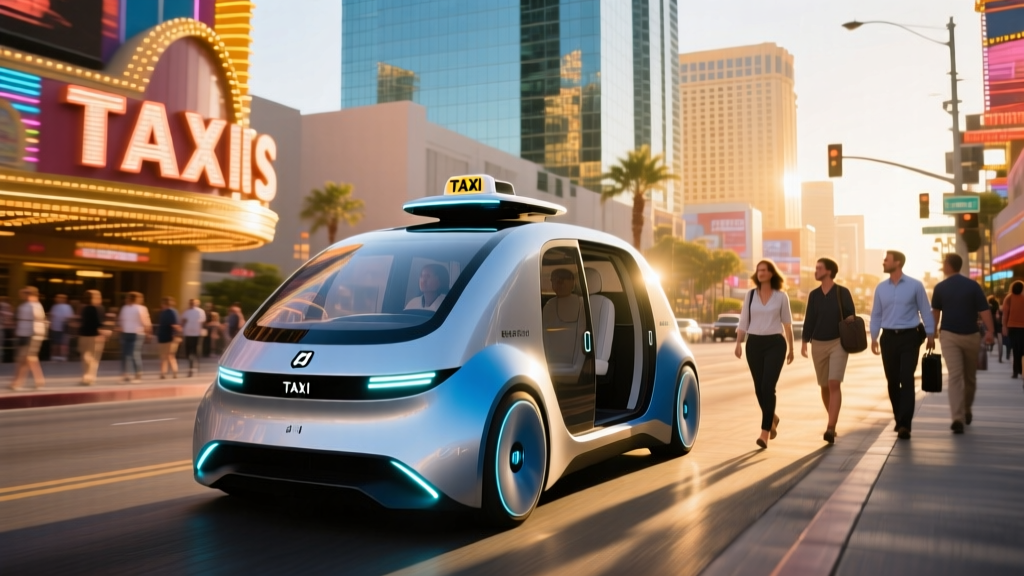
Las Vegas has quietly become one of the most important proving grounds for autonomous vehicles in the United States. Between the dense urban grid of downtown, the high-speed corridors of the Strip, and the predictable weather that favors sensor reliability, the city offers robotaxi operators a near-ideal testing environment. If you've searched for driverless cars Vegas and wondered whether you can actually hail one today — and what the experience is really like — this guide breaks down exactly what's available, what it costs, and where the technology still falls short.
Is This Truly Self-Driving or Just Driver-Assist?
The distinction between consumer driver-assist systems and actual robotaxi services is the single most misunderstood topic in autonomous vehicles. Let's make it unambiguous.
SAE Automation Levels: What They Actually Mean
| SAE Level | Classification | Who Drives | Examples |
|---|---|---|---|
| Level 0 | No Automation | Human | Basic cruise control |
| Level 1 | Driver Assistance | Human (system assists steering OR speed) | Adaptive cruise, lane-keeping |
| Level 2 | Partial Automation | Human (must supervise at all times) | Tesla Autopilot, FSD Supervised, GM Super Cruise, Ford BlueCruise |
| Level 3 | Conditional Automation | System (in narrow conditions; human on standby) | Mercedes Drive Pilot (limited markets) |
| Level 4 | High Automation | System (no human driver needed in geofenced area) | Waymo One, Zoox, Motional |
| Level 5 | Full Automation | System (everywhere, all conditions) | Does not exist commercially |
Bottom line: When you hail a Waymo in Las Vegas, there is no one in the driver's seat. That's Level 4. When you engage Tesla FSD on the I-15, you are still the driver — legally and functionally. That's Level 2. Never conflate the two.
Where Can I Use Driverless Cars in Vegas Right Now?
Las Vegas currently hosts two major robotaxi operators with commercial services, though their coverage areas differ significantly. Here's the current operational map as of early 2026:
| Operator | Service Name | Vegas Coverage Area | Hours | How to Access |
|---|---|---|---|---|
| Waymo (Alphabet) | Waymo One | Expanded geofence covering the Strip corridor, downtown, and portions of the suburbs (~80+ sq mi) | 24/7 | Waymo One app (iOS/Android) |
| Motional (Hyundai/Aptiv JV) | Motional (via Uber/Lyft) | Select routes: Strip, downtown, Convention Center corridor (~30 sq mi) | Limited hours (typically 10 AM–11 PM) | Request via Uber or Lyft app (may be matched to autonomous vehicle) |
Important caveat: Waymo's geofence in Las Vegas expanded significantly through 2025, but it does not cover every suburban neighborhood or the far edges of the metro area. If your pickup or drop-off falls outside the operational zone, the app will tell you before you confirm the ride. Motional's availability through Uber and Lyft is not guaranteed — you request a ride normally, and the platform may match you with an autonomous Ioniq 5 if one is available and your route fits the geofence.
Zoox (Amazon's autonomous vehicle subsidiary) has been testing in Las Vegas since 2022, but as of 2026, it has not yet launched a broad public ride-hail service comparable to Waymo One. Zoox's purpose-built vehicle (the boxy, bidirectional prototype) has been spotted on public roads, but commercial availability remains limited to controlled pilot programs.
How Much Does a Robotaxi Cost vs. Uber or Lyft?
Pricing is where robotaxis need to compete head-on with human-driven rideshare — and in Las Vegas, the economics are closer than you might expect.
| Service | Base Fare | Per-Mile Rate | Per-Minute Rate | Typical Strip-to-Downtown (~4 mi) |
|---|---|---|---|---|
| Waymo One | ~$2.50 | ~$1.30/mi | ~$0.35/min | $9–$14 |
| UberX | ~$2.80 | ~$1.40/mi | ~$0.38/min | $10–$16 |
| Lyft Standard | ~$2.60 | ~$1.35/mi | ~$0.36/min | $9–$15 |
| Motional (via Uber/Lyft) | Same as platform rate | Same as platform rate | Same as platform rate | $10–$16 |
Waymo has used promotional pricing and loyalty discounts to undercut UberX on many routes, particularly during off-peak hours. Surge pricing dynamics differ: Waymo does not surge in the traditional sense (no human driver supply to constrain), but it does implement higher rates during peak demand to manage fleet utilization. In practice, a 4-mile trip from the Bellagio to the Fremont Street Experience typically runs $9–$14 on Waymo One — comparable to or slightly cheaper than UberX during non-surge periods.
Neither Waymo nor Motional currently accepts cash. Payment is handled through the app, linked to a credit/debit card or digital wallet. Tipping is available in the Waymo app but is entirely optional — there's no driver to tip.
How Safe Are Robotaxis? Real Data, Not Hype
This is the question every potential rider asks, and it deserves a data-driven answer rather than marketing reassurance.
Waymo Safety Record: Key Data Points
- Total autonomous miles driven (all markets): Over 50 million fully driverless miles as of late 2025, per Waymo's published safety reports.
- Injury-causing crash rate: Waymo's driverless vehicles experienced approximately 85% fewer injury-causing crashes compared to human benchmarks in the same operating environments, according to a study published by the California Highway Patrol SWITRS data analyzed by independent researchers.
- Contact rate: Waymo reports that its vehicles make contact with objects (including minor scrapes and low-speed incidents) at a rate significantly below human drivers, though exact per-million-mile figures vary by market complexity.
- NHTSA reporting: All Level 4 operators are required to report crashes to the NHTSA Standing General Order database. These reports are publicly accessible and include incident context.
Waymo's safety record in Las Vegas specifically has been strong, with no widely reported serious injuries involving its driverless fleet in the city through early 2026. The most common incidents involve low-speed contact during complex maneuvers — parking lot navigation, construction-zone detours, and interactions with erratic human drivers.
Motional's Las Vegas fleet has logged millions of autonomous miles, primarily through its Uber/Lyft partnership. Publicly reported incidents have been minor. The company emphasizes its safety driver presence during earlier testing phases and its transition to fully driverless operations only after meeting internal safety benchmarks.
Context matters: Robotaxis operate in geofenced, well-mapped urban areas with favorable weather. They don't yet handle rural highways, unmapped roads, or severe weather. The safety comparison is valid within their operational design domain — not across all driving scenarios.
How the Technology Actually Works: Sensor Stacks and Geofencing
Understanding what's on the roof of a Waymo or Motional vehicle helps explain both the capabilities and the limitations.
Waymo 6th-Generation Driver System
- LiDAR: Multiple solid-state and spinning LiDAR units providing 360° point-cloud mapping out to 500+ meters. LiDAR is the core sensor for precise object detection and distance measurement, independent of lighting conditions.
- Cameras: High-resolution camera array (8+ cameras) for traffic-light state detection, signage recognition, lane-marking identification, and object classification.
- Radar: Imaging radar units for velocity detection of moving objects and performance in rain or fog where LiDAR and cameras degrade.
- Audio sensors: External microphones that detect emergency vehicle sirens, triggering pre-programmed pull-over protocols.
- HD Maps: Centimeter-accurate pre-mapped routes. The vehicle doesn't "figure out" the road in real time — it follows a known map and uses sensors to detect changes and dynamic obstacles.
Motional (Hyundai Ioniq 5 Platform)
- LiDAR: Roof-mounted LiDAR array (multiple units) providing overlapping 360° coverage.
- Cameras: Surround-view camera system for object classification and traffic-signal detection.
- Radar: Corner-mounted radar units for blind-spot detection and velocity tracking.
- HD Maps: Similar geofence-dependent mapping approach to Waymo.
Camera-Only vs. Multi-Sensor: Why It Matters
Tesla's consumer FSD system uses a camera-only approach (no LiDAR, no radar). Robotaxi operators like Waymo and Motional use LiDAR as a primary sensor. The difference is redundancy: LiDAR provides precise depth data that cameras must estimate computationally. In edge cases — a partially obscured stop sign, a pedestrian stepping out from behind a truck at night — LiDAR's direct distance measurement provides a critical safety margin. This is why no current Level 4 robotaxi operates without LiDAR.
Current Limitations: What Robotaxis Still Can't Do
Despite impressive progress, robotaxi services in Las Vegas — and everywhere else — have well-defined boundaries. These aren't minor edge cases; they're fundamental constraints of the current technology generation.
- Geofence boundaries: If your trip starts or ends outside the mapped operational zone, the service is unavailable. No exceptions. Waymo's Las Vegas geofence covers the core tourist and downtown corridors but does not extend to Henderson, Summerlin's outer edges, or the far northwest.
- Weather limitations: Las Vegas's dry climate is an advantage, but heavy monsoon rain or rare flooding can cause service suspension. LiDAR performance degrades in heavy precipitation, and standing water creates mapping ambiguity. In markets like San Francisco, fog is a known limitation; in Vegas, dust storms (haboobs) can trigger similar pullbacks.
- Construction zones: Major road construction can confuse HD map references. Operators typically geofence around known construction, but unexpected lane closures or detours may cause the vehicle to pull over and request remote assistance (a human teleoperator reviews the situation and guides the vehicle).
- Pickup/drop-off precision: Robotaxis pull to a safe, legal stop — but they won't navigate into a hotel's porte-cochère, a parking garage, or a private driveway in most cases. Expect to walk a short distance to/from the vehicle on a public street.
- No highway merging at high speed: Most robotaxi geofences in Las Vegas include surface streets and lower-speed boulevards. High-speed freeway driving (I-15 at 70+ mph) is generally not part of the operational domain for current services, though Waymo has been expanding freeway-capable routes in select markets.
- Passenger capacity: Waymo's Jaguar I-PACE fleet seats up to 3 passengers (front passenger seat is blocked off). Motional's Ioniq 5 similarly limits rear-seat occupancy. Large groups will need multiple vehicles or a traditional rideshare.
- No pet transport or unaccompanied minors: Current policies require a sober adult (18+) in the vehicle. Pets are generally not permitted unless in a carrier, and policies vary by operator.
Who Regulates Driverless Cars in Las Vegas?
Autonomous vehicle operations in Nevada sit under a layered regulatory framework:
Federal level: The National Highway Traffic Safety Administration (NHTSA) sets vehicle safety standards and requires crash reporting through the Standing General Order. NHTSA does not "approve" robotaxi services for operation — that authority falls to states.
State level: Nevada was one of the first states to pass autonomous vehicle legislation (NRS 482A, enacted in 2011 and updated since). The Nevada Department of Motor Vehicles (DMV) issues autonomous vehicle testing and deployment permits. Operators must demonstrate insurance coverage (minimum $5 million for driverless deployment), submit safety self-assessments, and comply with state reporting requirements.
Local level: The City of Las Vegas and Clark County coordinate on road-access permissions, particularly for the Strip corridor (which is largely unincorporated Clark County, not the City of Las Vegas). Local law enforcement has protocols for interacting with driverless vehicles during traffic stops or incidents — including remote contact with the operator's command center.
Key distinction from California: Unlike California's DMV, which publishes detailed disengagement reports and suspension orders (as seen with Cruise's 2023 suspension in San Francisco), Nevada's regulatory process is less publicly transparent. Riders and residents have less visibility into operator performance metrics, though NHTSA's federal crash-reporting mandate provides a baseline of accountability.
How to Actually Hail a Driverless Car in Vegas: Step by Step
If you're visiting Las Vegas and want to try a robotaxi, here's the practical process:
- Download the app. For Waymo One, install the Waymo app from the App Store or Google Play. For Motional, use your existing Uber or Lyft app — no separate download needed, but autonomous vehicle matching is not guaranteed.
- Create an account. You'll need a valid payment method and to agree to the rider terms. Some services require a brief introductory video or safety acknowledgment.
- Enter your destination. The app will confirm whether both your pickup and drop-off are within the operational geofence. If either is outside, you'll be notified and offered a traditional ride instead.
- Wait for the vehicle. Waymo's average wait time in the Las Vegas core is 5–10 minutes during normal hours. The app shows the approaching vehicle on a map with its license plate and a unique identifier (like a roof-color code or number) so you can spot it.
- Unlock and ride. When the vehicle arrives, you'll tap "Start Ride" in the app or scan a code on the window to unlock the doors. The vehicle will not move until all passengers are buckled — seatbelt sensors must confirm occupancy.
- In-ride experience. A screen in the back seat shows the vehicle's perception of the world — pedestrians, other cars, traffic signals, and the planned route. You can adjust the climate control and select music. A "Pull Over" button is available at any time if you need to end the ride early.
- Arrival and payment. The vehicle pulls to a legal stop at your destination. Payment processes automatically through the app. You can rate the ride and leave feedback.
Frequently Asked Questions
Can I ride in a completely empty car with no driver at all?
Yes. Waymo One's service in Las Vegas is fully driverless — there is no one in the driver's seat, no steering wheel being operated by a human, and no remote "driver" controlling the vehicle in real time. A remote support team monitors the fleet and can intervene by issuing high-level commands (like "pull over"), but they do not steer or brake the vehicle directly. This is Level 4 autonomy within the geofenced area.
What happens if the robotaxi gets confused or stuck?
The vehicle will pull over safely and contact a remote assistance center. A human teleoperator reviews the situation through the vehicle's cameras and sensors, then issues guidance — for example, confirming it's safe to proceed around a double-parked delivery truck. The vehicle still executes all driving actions itself; the teleoperator provides situational judgment, not real-time steering.
Are driverless cars in Vegas available 24/7?
Waymo One operates around the clock in Las Vegas, including late-night hours when human rideshare supply thins out. Motional's service through Uber/Lyft typically operates during limited hours (roughly 10 AM to 11 PM), and availability is not guaranteed for every ride request.
How do robotaxis handle the Las Vegas Strip's chaotic traffic?
The Strip is one of the most complex urban driving environments in the country — jaywalking pedestrians, frequent U-turns, double-parked vehicles, and dense congestion. Waymo's HD maps of the Strip are extremely detailed, and the company has accumulated millions of miles specifically on these corridors. That said, expect the vehicle to drive conservatively: it will yield more aggressively than a human driver and may take slightly longer to reach your destination, particularly during peak evening hours.
Is a robotaxi cheaper than a taxi from the airport?
As of early 2026, Waymo's Las Vegas geofence does not reliably cover Harry Reid International Airport (LAS) for all routes. If airport service is available for your destination, pricing is typically comparable to or slightly below a traditional taxi ($20–$30 to the mid-Strip). However, airport availability changes as Waymo expands its geofence — check the app for real-time confirmation.
What vehicle models are used for driverless rides in Vegas?
Waymo uses the Jaguar I-PACE, a fully electric SUV with a 90 kWh battery pack (EPA range approximately 234 miles when new, though fleet vehicles are charged frequently and rarely deplete below 40% State of Charge). Motional uses the Hyundai Ioniq 5, built on the E-GMP platform with a 77.4 kWh battery (EPA range approximately 303 miles in consumer trim). Zoox's purpose-built vehicle, if it enters commercial service, is a bidirectional electric pod with no steering wheel — designed from the ground up for autonomous operation.