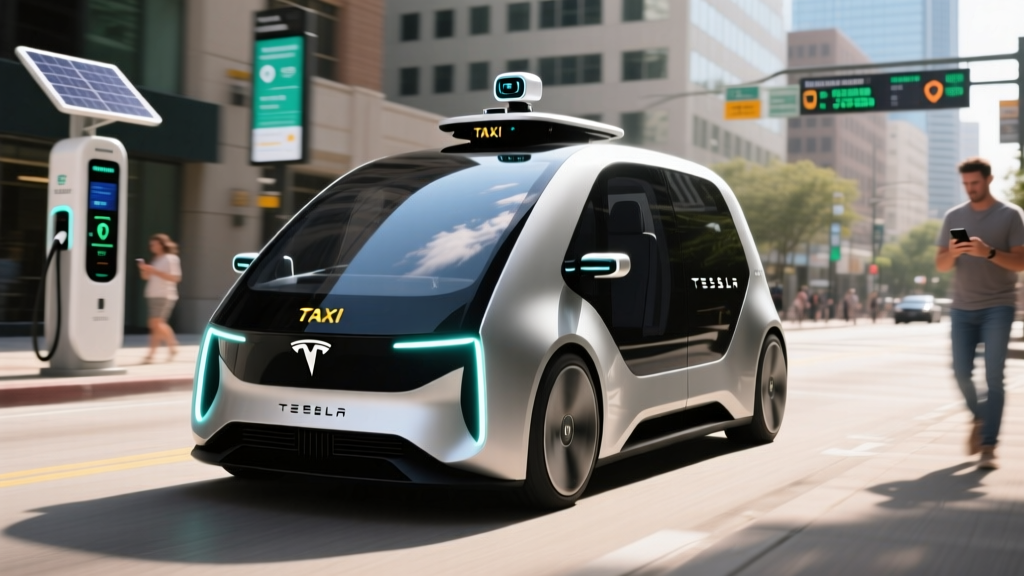
If you have been following Elon Musk's promises about a Tesla robotaxi fleet, you likely have one pressing question: Can you actually hail a driverless Tesla in Houston right now? The short answer requires separating marketing timelines from regulatory and technical reality. As of early 2026, Tesla does not operate a commercial, driverless robotaxi service in Houston — or anywhere else in the United States. What Tesla does offer is Full Self-Driving (Supervised), a Level 2 driver-assistance system that requires an attentive human driver at all times.
This guide cuts through the hype to explain exactly where Tesla's autonomous ambitions stand in Houston, how FSD (Supervised) actually works, what it would take for a true driverless robotaxi to launch in Texas, and how Tesla's camera-only approach stacks up against Level 4 competitors like Waymo that are already carrying fare-paying passengers in other cities.
SAE Autonomy Levels: Why the Tesla Robotaxi Distinction Matters
The single most important thing to understand about any "self-driving" claim is the SAE International automation level. This is not academic pedantry — it determines who is legally responsible when something goes wrong, and whether you can safely look at your phone.
| Level | Name | Who Drives? | Example | Available to Public? |
|---|---|---|---|---|
| Level 0 | No Automation | Human | Basic cruise control | Yes |
| Level 1 | Driver Assistance | Human (system assists steering OR speed) | Tesla Autopilot (basic), Toyota Safety Sense | Yes |
| Level 2 | Partial Automation | Human (system assists steering AND speed simultaneously) | Tesla FSD (Supervised), GM Super Cruise, Ford BlueCruise | Yes |
| Level 3 | Conditional Automation | System (human must take over when requested) | Mercedes Drive Pilot (limited conditions) | Limited markets |
| Level 4 | High Automation | System (no human needed within geofence) | Waymo One, Zoox | Select cities |
| Level 5 | Full Automation | System (everywhere, all conditions) | None exist | No |
Tesla Robotaxi Houston: Where Does the Service Stand?
Tesla unveiled its purpose-built "Cybercab" robotaxi concept in October 2024, a two-seat vehicle with no steering wheel or pedals designed exclusively for autonomous ride-hailing. Musk stated production would begin in 2026, with a target price under $30,000 and an operating cost of roughly $0.20 per mile. However, unveiling a concept vehicle is not the same as launching a commercial service.
For Houston specifically, here is the current landscape:
| Service | Autonomy Level | Houston Status | Texas Status |
|---|---|---|---|
| Tesla Robotaxi (Cybercab) | Level 4 (targeted) | Not available — concept/announced only | Not available anywhere in TX |
| Tesla FSD (Supervised) | Level 2 | Available (owner must drive) | Available statewide (owner must drive) |
| Waymo One | Level 4 | Not available | Austin (limited testing/preview) |
| Cruise | Level 4 | Not available | Suspended operations nationally since late 2023 |
Houston is not currently in any robotaxi operator's confirmed expansion roadmap for near-term commercial service. Waymo has focused its 2025-2026 expansion on Phoenix, San Francisco, Los Angeles, and initial forays into Austin. Tesla has not published a city-by-city robotaxi rollout plan, and the Cybercab has not entered production.
What Houston Tesla Owners Can Actually Use Today
If you own a Tesla in Houston equipped with FSD (Supervised) — either purchased outright for $8,000 or subscribed at $99/month — you can use the system on Houston roads today. FSD (Supervised) handles highway lane changes, navigation-based exits, city street turns, and stop-sign/light recognition. But you must keep your hands near the wheel and eyes on the road. The system monitors driver attention via the cabin camera and will issue warnings and eventually disengage if it detects inattention.
This is a driver-assistance feature for personal vehicle ownership, not a ride-hailing service.
Tesla's Camera-Only Tech Stack vs. Lidar-Equipped Robotaxis
Tesla's approach to autonomy is philosophically and technically distinct from every other major robotaxi player. Understanding this difference is essential for evaluating when — or whether — a Tesla robotaxi could operate safely in Houston's complex driving environment.
Tesla FSD (Supervised) — Camera-Only Vision Stack
- Sensors: 8 cameras (front-facing narrow/main/wide, side repeaters, rear-view) — no lidar, no radar (removed in 2022+ models)
- Processing: HW4 (AI4) computer with dual SoCs, ~300+ TOPS inference capability
- Software approach: End-to-end neural network trained on billions of miles of fleet video data; vision-only perception
- Mapping: Does not rely on HD maps; uses real-time perception
- Geofencing: None — FSD (Supervised) can be activated on virtually any road
Waymo Level 4 — Multi-Sensor Redundancy Stack
- Sensors: Custom lidar array (360° coverage), radar units, cameras, external audio sensors
- Processing: Custom compute platform with redundant systems
- Software approach: Perception + prediction + planning pipeline with HD map localization
- Mapping: Centimeter-accurate HD maps of every operational road
- Geofencing: Strictly limited to pre-mapped operational design domains (ODDs)
The tradeoff is fundamental. Tesla's camera-only approach is cheaper per vehicle and scales to any road without pre-mapping, but it lacks the depth-perception redundancy that lidar provides — particularly in Houston's common scenarios: heavy rain on I-10, sun glare at dusk on Westheimer, or construction-zone lane shifts on the Katy Freeway. Waymo's lidar-equipped vehicles carry sensor redundancy that allows true driverless operation, but only within carefully mapped zones, and at a vehicle cost estimated at $150,000+ per unit.
Tesla's bet is that neural networks trained on massive real-world data will eventually match lidar's reliability without the hardware cost. As of 2026, that bet has not been validated to the standard required for unsupervised Level 4 operation by any regulatory body.
Safety Data: What the Numbers Actually Show
Any discussion of robotaxi safety must separate driver-assist safety (Level 2, human supervised) from driverless safety (Level 4, no human in the loop). These are fundamentally different propositions.
Tesla FSD (Supervised) Safety Data
Tesla publishes quarterly safety reports. In its most recent reports, Tesla claims approximately 1 crash per 4-5 million miles driven with Autopilot/FSD engaged, versus the U.S. average of roughly 1 crash per 670,000 miles (NHTSA national average). However, these figures carry important caveats:
- Tesla's data is self-reported and not independently audited
- Most Autopilot/FSD miles are highway driving — statistically the safest environment
- The comparison to national averages mixes supervised highway miles with unsupervised urban/rural driving
- NHTSA has opened multiple investigations into Tesla Autopilot/FSD crashes, particularly involving stationary emergency vehicles
Waymo Level 4 Safety Data
Waymo has published peer-reviewed safety data covering over 7 million driverless miles across Phoenix, San Francisco, and Los Angeles. Their data, analyzed in partnership with insurance and safety researchers, shows reductions in injury-causing crash rates compared to human benchmarks in comparable geofenced areas. Waymo's IIHS-cited research provides the most transparent third-party-validated robotaxi safety record currently available.
For a hypothetical Tesla robotaxi operating without a driver in Houston, there is no safety data — because no such service exists. The NHTSA Standing General Order requires all automated driving systems to report crashes, and Tesla's FSD crash reports continue to reflect Level 2 supervised scenarios, not driverless operation.
Pricing: How Would a Tesla Robotaxi Compare to Uber and Lyft?
Since no Tesla robotaxi service exists, we cannot provide real fare data. However, we can compare what Tesla has projected against current Houston rideshare economics and Waymo's actual pricing in operational cities.
| Service | Base Fare (est.) | Per-Mile Rate | Per-Minute Rate | Typical 10-Mile Trip |
|---|---|---|---|---|
| UberX (Houston) | $2.50 | $1.15 | $0.22 | $18-$25 |
| Lyft Standard (Houston) | $2.25 | $1.10 | $0.20 | $17-$23 |
| Waymo One (Phoenix/SF) | $3.00 | $1.25 | $0.25 | $19-$28 |
| Tesla Robotaxi (projected by Musk) | N/A | ~$0.20/mi operating cost | N/A | $5-$10 (claimed target) |
Musk has repeatedly claimed Tesla's robotaxi could offer rides at $0.20 per mile — dramatically undercutting both human-driven rideshare and current robotaxis. This figure represents Tesla's estimated operating cost per mile (electricity, maintenance, depreciation), not necessarily the consumer fare, which would need to include platform fees, insurance, fleet management, and profit margin. Even with aggressive assumptions, analysts have questioned whether sub-$10 fares for a 10-mile trip are achievable in the early years of operation, given the overhead of maintaining a driverless fleet, remote-assistance operators, and regulatory compliance.
For context, Waymo's fares in Phoenix and San Francisco are generally comparable to Uber/Lyft — slightly higher in some markets, with occasional promotional pricing bringing them slightly lower. The "robotaxi cost advantage" over human drivers has not yet materialized at the consumer level for any operator.
Texas Regulatory Landscape for Autonomous Vehicles
Texas is actually one of the more permissive states for autonomous vehicle testing and deployment, which is relevant for any future Tesla robotaxi Houston launch.
- State law (Texas Transportation Code § 545.001 et seq.): Texas allows autonomous vehicles to operate on public roads without a human driver, provided the vehicle is capable of complying with all traffic laws and is properly registered and insured.
- No state-level permit required for testing: Unlike California (which requires DMV permits and publishes disengagement data), Texas does not require a specific state permit for AV testing, though local coordination is typical.
- Local authority: Houston and other Texas cities can impose operational requirements related to curb use, pick-up/drop-off zones, and traffic management.
- Federal oversight: NHTSA retains authority over vehicle safety standards. Currently, no Federal Motor Vehicle Safety Standard (FMVSS) explicitly addresses Level 4/5 vehicles without steering wheels — Tesla's Cybercab concept would require regulatory accommodation or a new rulemaking.
The practical implication: Texas law would not block a Tesla robotaxi launch in Houston the way it might be blocked in more restrictive states. But the vehicle itself — a production Cybercab with no steering controls — would need to clear federal safety certification hurdles before it could legally carry passengers on public roads.
Current Limitations: What Would Hold Back a Houston Robotaxi
Houston presents a particularly challenging environment for any driverless vehicle. Even if Tesla achieved Level 4 certification tomorrow, several real-world factors would constrain operations:
Houston-Specific Robotaxi Limitations
- Flooding and standing water: Houston's flash-flood-prone streets (Buffalo Bayou tributaries, low-lying underpasses) can create water depths that camera-only systems cannot reliably assess for drivability. Lidar also struggles in heavy rain.
- Construction zones: Houston's perpetual highway construction (I-10, I-45 North Houston Highway Improvement Project, Beltway 8) creates rapidly changing lane configurations that challenge both HD-mapped and perception-only systems.
- Sun glare: East-west arterial roads at dawn/dusk (Westheimer, Memorial Drive) create camera-blinding conditions. Without lidar redundancy, vision-only systems face elevated risk.
- Unprotected left turns: Houston's wide, high-speed intersections with permissive left turns require complex multi-agent prediction that remains an industry-wide edge case.
- Hurricane evacuation routes: Contraflow operations and emergency routing scenarios are not currently handled by any commercial robotaxi system.
- Geofencing requirements: Any initial Level 4 service would almost certainly be geofenced to well-mapped, lower-complexity areas — likely excluding much of Houston's sprawling 600+ square miles.
These are not hypothetical concerns. Cruise's suspension of operations in late 2023 followed incidents in San Francisco that involved construction zones, emergency vehicles, and complex urban scenarios — all of which Houston has in abundance. Any robotaxi operator entering Houston would need to demonstrate robust handling of these conditions before regulators and the public would accept driverless operation.
Frequently Asked Questions
Where can I use a Tesla robotaxi service right now?
You cannot. As of 2026, Tesla does not operate any commercial driverless robotaxi service in any city. The Cybercab remains an announced concept vehicle not yet in production. Tesla FSD (Supervised) is available as a Level 2 driver-assist feature for Tesla owners who remain responsible for driving.
How much would a Tesla robotaxi cost vs. Uber or Lyft?
Since no service exists, there are no real fares. Musk has projected operating costs around $0.20 per mile, which could theoretically enable $5-$10 fares for short trips. Current robotaxi operators like Waymo charge fares comparable to Uber/Lyft ($17-$28 for a typical 10-mile urban trip). Whether Tesla can achieve dramatically lower consumer pricing remains unproven.
How safe are robotaxis — is there real data?
Waymo has published peer-reviewed data from 7+ million driverless miles showing reduced injury-crash rates compared to human benchmarks in their operational areas. Tesla's FSD safety data covers supervised (Level 2) driving and is self-reported. There is no safety data for a Tesla robotaxi because the service does not exist. NHTSA continues to investigate Tesla Autopilot/FSD incidents.
What are the current limitations of Tesla FSD (Supervised)?
FSD (Supervised) requires continuous driver attention. It can struggle with construction zones, heavy rain, sun glare, complex unprotected intersections, and unmapped road changes. It is not geofenced but is also not capable of unsupervised operation. The driver is legally liable for all driving decisions.
Is Tesla FSD truly self-driving or is it driver-assist?
It is driver-assist — specifically, SAE Level 2 partial automation. Tesla's own product name includes "(Supervised)" to reflect this. The driver must remain engaged, monitor the road, and be prepared to take over immediately. Calling Level 2 "self-driving" is factually incorrect and potentially dangerous. Only Level 4 systems like Waymo's are designed to operate without a human driver, and those are geofenced to specific approved areas.
Could Houston be an early Tesla robotaxi city when it launches?
Texas's permissive AV regulatory environment makes Houston a plausible candidate for eventual robotaxi deployment. However, Houston's flooding, construction zones, and sprawling geography make it a technically challenging market. Initial robotaxi services — from Tesla or any competitor — are more likely to launch in geographically contained, well-mapped areas before expanding to a city as complex as Houston.